Introduction
Procurement software is a category of business applications that help organizations source, purchase, and manage goods and services in a structured, automated way. In plain English, procurement tools replace manual processes like email orders, spreadsheets, and disconnected approvals with digitized workflows that reduce cost, risk, and cycle time. Modern procurement systems also connect purchasing with supplier management, spend analytics, contract compliance, and financial systems.
Why it matters now: With increasingly complex supply chains, unpredictable markets, and pressure to cut costs, procurement teams are under more scrutiny than ever. Organizations are shifting from reactive purchasing to strategic, data‑driven procurement — where technology helps enforce policies, manage suppliers, and drive savings.
Real‑world use cases include:
- A manufacturing company automating purchase orders and approval workflows across plants
- A large healthcare provider consolidating suppliers and ensuring contract compliance
- A university deploying a procurement portal for departments with budget controls
- A retail chain optimizing inventory replenishment and supplier lead times
- A government agency tracking spend and enforcing procurement policies
What buyers should evaluate:
- Ease of requisition and purchase order creation
- Approval workflows and policy enforcement
- Supplier management and performance tracking
- Contract management support
- Spend visibility and analytics
- Integration with ERP/financial systems
- Automation and AI guidance
- Security and compliance posture
- Scalability and configurability
- Mobile or browser accessibility
Best for: Procurement teams, supply chain leaders, finance organizations, enterprises and SMBs with frequent purchasing needs
Not ideal for: Very small businesses with minimal procurement volume or straightforward purchasing needs that can be handled manually
Key Trends in Procurement Software
- AI and automation for guided buying and anomaly detection in spend
- Supplier risk scoring and real‑time monitoring
- Cloud‑native deployments replacing legacy, on‑prem solutions
- Self‑service catalogs and guided shopping experiences
- Advanced spend analytics and visualization
- Integration with ERP, SRM, and e‑invoicing platforms
- Focus on compliance, audit trails, and controls
- Mobile procurement capabilities
- Demand forecasting tied to purchasing decisions
How We Selected These Tools (Methodology)
- Evaluated market adoption and mindshare in the procurement category
- Assessed feature completeness across sourcing, purchasing, contracts, and analytics
- Reviewed reliability and performance signals from enterprise and SMB deployments
- Considered security posture signals such as access controls and audit capabilities
- Analyzed integrations and ecosystem, especially with financial and ERP systems
- Balanced customer fit across segments from SMB to large enterprises
- Weighed support, documentation strength, and community presence
- Confirmed extensibility: APIs, configurability, and customization potential
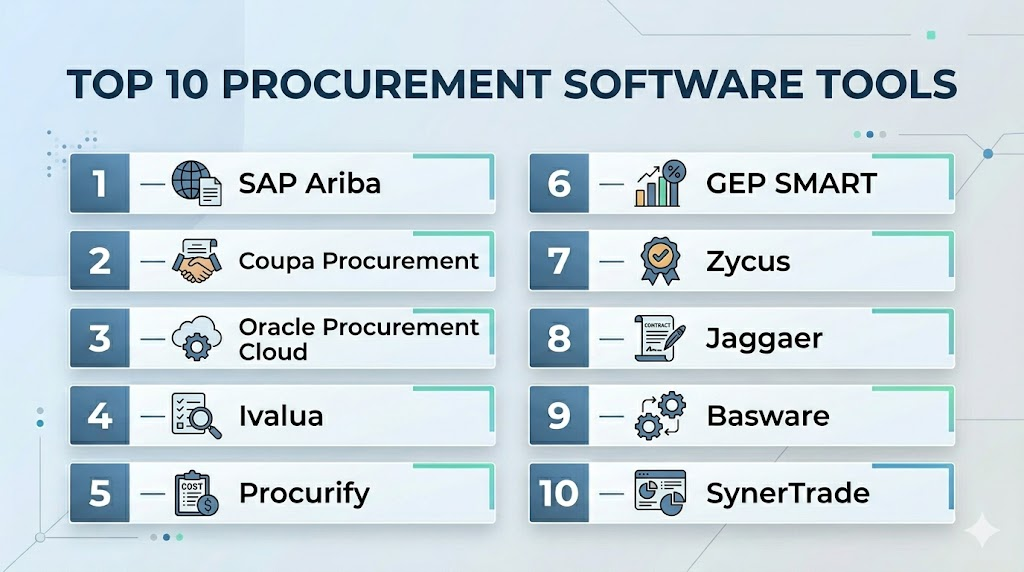
Top 10 Procurement Software Tools
#1 — SAP Ariba
Short description: SAP Ariba is a cloud‑based procurement suite that supports strategic sourcing, supplier management, procurement execution, and spend visibility. It is designed for large enterprises and global operations seeking deep integration and broad supplier networks.
Key Features
- Guided buying and requisition workflows
- Supplier discovery and onboarding
- Contract authoring and compliance checks
- Purchase order automation
- Spend analytics and dashboards
- Integration with financial and ERP systems
- Supplier performance management
Pros
- Comprehensive enterprise procurement feature set
- Strong supplier network and marketplace ecosystem
Cons
- Implementation complexity can be high
- Requires significant configuration for optimal use
Platforms / Deployment
- Web, Cloud
Security & Compliance
- SSO/SAML, encryption, RBAC
- Not publicly stated
Integrations & Ecosystem
SAP Ariba connects with ERP systems, financial platforms, and supplier portals.
- ERP connectors for financial and inventory systems
- Supplier network and collaboration tools
- APIs for custom integrations
Support & Community
- Enterprise support tiers
- Training resources and documentation
- Large user community and partner ecosystem
#2 — Coupa Procurement
Short description: Coupa is a cloud procurement platform that emphasizes usability, spend visibility, and rapid time to value. It is aimed at mid‑market and large organizations seeking an intuitive user experience backed by deep analytics.
Key Features
- Guided buying and self‑service catalogs
- Approval workflows and policy enforcement
- Supplier management
- Contract tracking
- Spend analytics and reporting
- Invoice and expense integration
Pros
- User‑friendly interface
- Strong spend analytics
Cons
- Mid‑market focus may limit advanced sourcing for global enterprises
- Premium features can increase cost
Platforms / Deployment
- Web, Cloud
Security & Compliance
- SSO/SAML, MFA, encryption
- Not publicly stated
Integrations & Ecosystem
Coupa supports integration with ERPs, financial systems, and supplier networks.
- ERP/finance connectors
- APIs for extensibility
- E‑invoicing and expense systems
Support & Community
- Tiered support plans
- Knowledge base and community forums
#3 — Oracle Procurement Cloud
Short description: Oracle Procurement Cloud is part of Oracle’s enterprise suite, offering strategic sourcing, purchasing, supplier management, and procurement analytics with tight ERP integration.
Key Features
- Supplier qualification and lifecycle
- Sourcing and bidding tools
- Purchase order creation and approvals
- Spend classification and analytics
- Contract repository and compliance
- Mobile procurement support
Pros
- Tight integration with Oracle ERP
- Scalable across global enterprises
Cons
- Complexity and licencing cost can be challenging
- Requires skilled administration
Platforms / Deployment
- Web, Cloud
Security & Compliance
- SSO/SAML, encryption
- Not publicly stated
Integrations & Ecosystem
Oracle Procurement Cloud integrates deeply with ERP and financial modules and supports third‑party connections.
- ERP and finance systems
- Supplier networks
- APIs for custom workflows
Support & Community
- Enterprise support options
- Extensive documentation and user groups
#4 — Ivalua
Short description: Ivalua is a procurement suite known for flexibility and configurability, covering sourcing, procurement execution, supplier management, and contracts in a unified platform.
Key Features
- Configurable workflows
- Supplier information management
- Blanket orders and PO automation
- Contract lifecycle management
- Spend classification and analytics
- Supplier portal
Pros
- Highly configurable for unique workflows
- Good fit for complex procurement environments
Cons
- Implementation and setup can be resource‑intensive
- UI can feel complex for new users
Platforms / Deployment
- Web, Cloud
Security & Compliance
- SSO/SAML, encryption
- Not publicly stated
Integrations & Ecosystem
Ivalua supports connections to ERPs and external data sources.
- ERP and finance systems
- APIs and integration framework
- Supplier portal
Support & Community
- Documentation and training
- Professional services options
#5 — Procurify
Short description: Procurify is a procurement solution focused on mid‑market companies and distributed teams, offering purchasing, approvals, spend tracking, and integrations with accounting systems.
Key Features
- Requisition and approval workflows
- Budget tracking and alerts
- Supplier and catalog management
- Purchase order generation
- Spend dashboards
- Mobile app for on‑the‑go approvals
Pros
- Mobile‑friendly and easy to use
- Strong budget controls and alerts
Cons
- Less suited for very large enterprises
- Advanced sourcing features are limited
Platforms / Deployment
- Web, iOS, Android
- Cloud
Security & Compliance
- SSL encryption
- Not publicly stated
Integrations & Ecosystem
Procurify integrates with accounting and ERP systems.
- Accounting platforms
- ERP connectors
- APIs for custom use
Support & Community
- Email and chat support
- Tutorials and documentation
#6 — GEP SMART
Short description: GEP SMART is a procurement suite with sourcing, contract management, savings tracking, and procurement execution, aimed at global enterprises.
Key Features
- Strategic sourcing tools
- Contract repository
- Supplier performance
- Spend analysis
- Purchase order automation
- Savings tracking
Pros
- Comprehensive enterprise feature set
- Strong analytics and sourcing support
Cons
- Implementation can be lengthy
- Heavy feature set may overwhelm smaller teams
Platforms / Deployment
- Web, Cloud
Security & Compliance
- SSO/SAML, encryption
- Not publicly stated
Integrations & Ecosystem
GEP SMART connects with ERP and sourcing tools.
- ERP systems
- Sourcing and analytics modules
- APIs for customization
Support & Community
- Enterprise support tiers
- Documentation and user training
#7 — Zycus
Short description: Zycus offers procurement and source‑to‑pay capabilities with a focus on AI‑driven analytics, supplier risk, and contract compliance.
Key Features
- AI spend analysis
- Supplier risk and performance
- Contract management
- Purchase management
- Sourcing and negotiation
- Analytics dashboards
Pros
- AI capabilities for spend insights
- Comprehensive source‑to‑pay coverage
Cons
- Complexity may require training
- Pricing may be high for SMBs
Platforms / Deployment
- Web, Cloud
Security & Compliance
- SSL, role‑based access
- Not publicly stated
Integrations & Ecosystem
Zycus integrates with ERP and finance systems.
- ERP connectors
- APIs for extensibility
Support & Community
- Professional support
- Training resources
#8 — Jaggaer
Short description: Jaggaer delivers procurement and supply chain software with sourcing, purchasing, and supplier management for diverse industries including education and life sciences.
Key Features
- Supplier information management
- Sourcing and eRFX
- Contract management
- PO automation
- Spend visibility
- Supplier performance
Pros
- Industry‑specific solutions
- Strong supplier and sourcing support
Cons
- Implementation and customization may require professional services
- Some advanced features are modular
Platforms / Deployment
- Web, Cloud
Security & Compliance
- SSL encryption
- Not publicly stated
Integrations & Ecosystem
Jaggaer supports ERP and financial integrations.
- ERP connectors
- Analytics and reporting modules
Support & Community
- Tiered support
- Professional services
#9 — Basware
Short description: Basware offers procurement and e‑invoicing with a focus on purchase‑to‑pay automation and financial process control.
Key Features
- Requisition and PO automation
- Invoice matching and approval
- Spend analytics
- Supplier catalog
- Contract repository
- ERP integration
Pros
- Strong P2P focus
- Good financial control and compliance
Cons
- Less deep sourcing capability
- SMB suitability is limited
Platforms / Deployment
- Web, Cloud
Security & Compliance
- SSL, encryption
- Not publicly stated
Integrations & Ecosystem
Basware integrates with ERPs and finance systems.
- ERP connectors
- Financial modules
- Analytics
Support & Community
- Support tiers
- Documentation
#10 — SynerTrade
Short description: SynerTrade provides procurement tools for sourcing, supplier management, and spend analytics across SMB and enterprise customers.
Key Features
- Sourcing and auctions
- Supplier management
- Purchase requisitions and POs
- Spend analysis
- Contract management
- Dashboards
Pros
- Balanced feature set for mid‑market
- Flexible deployment
Cons
- Some modules require separate licensing
- Advanced analytics require configuration
Platforms / Deployment
- Web, Cloud
Security & Compliance
- SSL encryption
- Not publicly stated
Integrations & Ecosystem
SynerTrade connects with ERP and financial systems.
- ERP connectors
- API access
Support & Community
- Support plans
- Online documentation
Comparison Table (Top 10)
| Tool Name | Best For | Platform(s) Supported | Deployment | Standout Feature | Public Rating |
|---|---|---|---|---|---|
| SAP Ariba | Large Enterprise | Web | Cloud | Supplier network ecosystem | N/A |
| Coupa Procurement | Mid‑market to Enterprise | Web | Cloud | User experience & analytics | N/A |
| Oracle Procurement Cloud | Enterprise | Web | Cloud | ERP integration | N/A |
| Ivalua | Complex Workflows | Web | Cloud | Configuration flexibility | N/A |
| Procurify | SMB, Budget‑focused | Web, iOS, Android | Cloud | Mobile procurement | N/A |
| GEP SMART | Global Enterprise | Web | Cloud | Sourcing & spend | N/A |
| Zycus | Source‑to‑Pay | Web | Cloud | AI spend insights | N/A |
| Jaggaer | Industry‑specific | Web | Cloud | Supplier & sourcing depth | N/A |
| Basware | P2P Automation | Web | Cloud | Invoice & PO pairing | N/A |
| SynerTrade | Mid‑market | Web | Cloud | Balanced module set | N/A |
Evaluation & Scoring of Procurement Software
| Tool Name | Core (25%) | Ease (15%) | Integrations (15%) | Security (10%) | Performance (10%) | Support (10%) | Value (15%) | Weighted Total (0–10) |
|---|---|---|---|---|---|---|---|---|
| SAP Ariba | 9 | 6 | 9 | 8 | 8 | 8 | 7 | 8.2 |
| Coupa Procurement | 8 | 8 | 8 | 8 | 8 | 8 | 8 | 8.0 |
| Oracle Procurement Cloud | 9 | 6 | 9 | 8 | 8 | 8 | 7 | 8.1 |
| Ivalua | 8 | 7 | 8 | 8 | 8 | 7 | 7 | 7.8 |
| Procurify | 7 | 9 | 7 | 7 | 7 | 7 | 8 | 7.6 |
| GEP SMART | 9 | 6 | 8 | 8 | 8 | 8 | 7 | 8.0 |
| Zycus | 8 | 7 | 8 | 8 | 8 | 7 | 7 | 7.8 |
| Jaggaer | 8 | 7 | 8 | 8 | 8 | 7 | 7 | 7.8 |
| Basware | 7 | 7 | 7 | 8 | 7 | 7 | 7 | 7.4 |
| SynerTrade | 7 | 8 | 7 | 7 | 7 | 7 | 7 | 7.4 |
Interpretation: Scores are comparative across tools. Higher total suggests stronger overall fit across features, integrations, security, and value. Enterprise tools score high in core and integrations; mid‑market tools balance ease and value.
Which Procurement Software Tool Is Right for You?
Solo / Freelancer
Procurement tools are generally overkill for individuals or freelancers; basic spreadsheet tracking with invoice and vendor lists may suffice.
SMB
Procurify and SynerTrade offer strong usability and value. Coupa can be affordable and intuitive for mid‑market needs.
Mid‑Market
Coupa and Ivalua provide robust features with flexibility. Procurify appeals to companies that prioritize speed of deployment.
Enterprise
SAP Ariba, Oracle Procurement Cloud, GEP SMART, and Zycus deliver deep capabilities for global procurement, compliance, and spend management.
Budget vs Premium
Budget: Procurify, Basware, SynerTrade
Premium: SAP Ariba, Oracle, GEP SMART
Feature Depth vs Ease of Use
Enterprise suites offer breadth but require training; mid‑market tools strike a balance for faster adoption.
Integrations & Scalability
Ensure ERP and financial system connections. Cloud procurement scales better across locations and units.
Security & Compliance Needs
Enterprises should require SSO, encryption, role‑based access, and audit trails; SMBs can balance access control with usability.
Frequently Asked Questions (FAQs)
1. What pricing models do procurement platforms use?
Many procurement tools use subscription pricing based on users, modules, and spend tiers. On‑premises licences are less common today.
2. How long does implementation take?
SMB solutions can be operational in weeks; enterprise suites may require months of setup, configuration, and integration.
3. Do procurement tools integrate with ERP systems?
Yes, modern platforms offer APIs and prebuilt connectors to financial and ERP systems to maintain unified financial data.
4. Can procurement software help with contract management?
Yes, many include contract lifecycle features for storage, compliance tracking, and renewals.
5. What is guided buying?
Guided buying provides users with catalogues and recommendations that enforce policy compliance and smart purchasing.
6. How does spend analytics work?
Spend data is aggregated and visualized in dashboards to show trends, savings opportunities, and supplier spend concentration.
7. What common mistakes happen when adopting procurement software?
Common pitfalls include poor change management, lack of executive sponsorship, and not aligning workflows before implementation.
8. Is mobile procurement important?
Increasingly, yes. Mobile access allows approvers and buyers to complete workflows from anywhere.
9. Can procurement software enforce policy compliance?
Yes, with approval workflows, spend limits, and requisition controls, policy enforcement is built into many tools.
10. Are there risks with cloud procurement systems?
Cloud systems are generally secure, but organizations should review encryption, access controls, and compliance certifications.
Conclusion
Procurement software is transforming how organizations source, purchase, and manage spend. From SMB procurement workflows to global enterprise sourcing and compliance, modern platforms provide automation, transparency, and cost control. The “best” solution depends on business size, complexity, integration requirements, and budget. Buyers should shortlist several tools, conduct pilots with real workflows, and validate integration and security needs before full deployment. With the right platform, procurement becomes a strategic advantage rather than a transactional function

Find Trusted Cardiac Hospitals
Compare heart hospitals by city and services — all in one place.
Explore Hospitals
Approval rules, budgets, and purchasing policies can change as the business grows, and a small configuration mistake can delay important purchases. Teams should test new rules with sample requests before applying them to everyone. This can help avoid blocked approvals and keep the purchasing process running smoothly.