Introduction
AI Agent Platforms are advanced software systems that enable businesses and developers to create, deploy, and manage autonomous AI agents capable of handling tasks, workflows, and decision-making processes. These platforms combine machine learning, natural language understanding, and automation capabilities to empower organizations to scale intelligent operations, reduce manual effort, and enhance productivity. They are increasingly relevant for companies looking to leverage AI-driven solutions for customer engagement, operations optimization, data insights, and more.
Real-world use cases include automating customer support with AI chatbots, handling routine IT and HR tasks, generating intelligent insights from enterprise data, orchestrating multi-step business workflows, and enabling personal AI assistants for knowledge workers. Buyers evaluating AI Agent Platforms should consider several criteria such as automation capabilities, integration options, ease of use, scalability, security and compliance, deployment flexibility, cost efficiency, monitoring and analytics, multi-agent orchestration, and AI intelligence features.
Best for: Teams and organizations with recurring or complex workflows, enterprises implementing intelligent automation, developers building AI applications, and companies seeking to reduce operational overhead while improving decision-making.
Not ideal for: Small teams with minimal automation needs, organizations without technical capacity to manage AI agents, or cases where simple workflow automation tools suffice.
Key Trends in AI Agent Platforms
- Increased adoption of multi-agent orchestration for complex workflows.
- Integration of generative AI to enhance agent decision-making.
- Enhanced compliance and security features to meet enterprise requirements.
- Low-code/no-code interfaces for faster agent creation and deployment.
- Cloud-native deployment and hybrid support for flexible infrastructure.
- Real-time analytics and monitoring of agent performance.
- Expansion into industry-specific AI agents for retail, finance, and healthcare.
- Pay-per-use and subscription-based pricing models gaining traction.
- Cross-platform interoperability with enterprise SaaS and productivity tools.
- Continuous learning and self-optimization of AI agents using reinforcement learning.
How We Selected These Tools (Methodology)
- Assessed market adoption and user mindshare in AI automation.
- Evaluated feature completeness including workflow automation, AI intelligence, and analytics.
- Verified reliability and performance signals via reported uptime and scalability.
- Checked security posture including SSO, encryption, and regulatory compliance.
- Reviewed integrations and ecosystem connectivity with enterprise software.
- Examined customer fit across different organizational sizes and industries.
- Considered community and developer support resources.
- Compared ease of use and deployment flexibility.
- Analyzed cost structure and overall value proposition.
- Prioritized tools with innovative AI capabilities or unique differentiators.
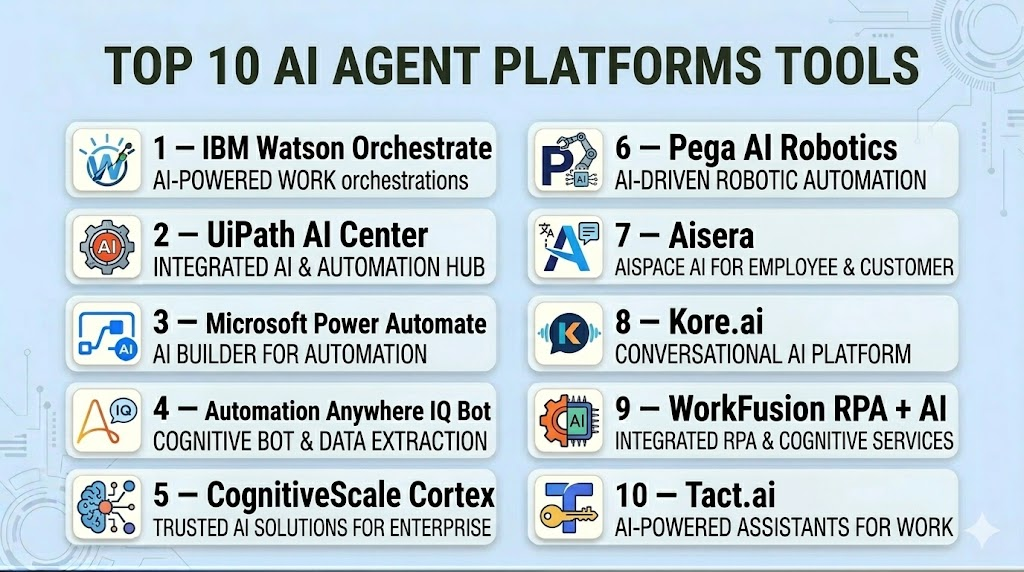
Top 10 AI Agent Platforms Tools
#1 — IBM Watson Orchestrate
Short description: IBM Watson Orchestrate enables businesses to automate complex workflows using AI-driven agents, focusing on productivity and operational efficiency. It is designed for enterprises seeking to optimize human and digital task coordination.
Key Features
- AI-powered task automation
- Integration with enterprise SaaS tools
- Natural language processing capabilities
- Multi-agent orchestration
- Real-time monitoring and analytics
- Role-based access and security
- Low-code interface for workflow design
Pros
- Reduces manual workload across departments
- Enterprise-grade security and compliance
- Supports hybrid deployment models
Cons
- Steeper learning curve for advanced features
- Can be costly for smaller teams
Platforms / Deployment
- Web / Windows / macOS / Linux
- Cloud / Hybrid
Security & Compliance
- SOC 2, ISO 27001, GDPR
- SSO/SAML, MFA, RBAC
Integrations & Ecosystem
Supports a wide range of enterprise applications and APIs
- Salesforce
- ServiceNow
- Microsoft Teams
- Slack
Support & Community
- Strong documentation, onboarding guides, enterprise support tiers
- Active developer and partner community
#2 — UiPath AI Center
Short description: UiPath AI Center combines RPA with AI agent capabilities to deliver intelligent automation. It is tailored for enterprises looking to integrate AI insights with robotic process automation.
Key Features
- AI model deployment and management
- Automated workflow orchestration
- Pre-trained AI models for document processing
- Real-time analytics dashboard
- API and connector library
Pros
- Integrates AI with existing RPA workflows
- Facilitates rapid deployment of AI solutions
Cons
- Requires knowledge of UiPath Studio for advanced setups
- Enterprise pricing may be high
Platforms / Deployment
- Windows / Web
- Cloud / On-premise / Hybrid
Security & Compliance
- SOC 2, ISO 27001, GDPR
- SSO/SAML, encryption, audit logs
Integrations & Ecosystem
Supports multiple enterprise apps and AI frameworks
- Microsoft Office 365
- SAP
- Python / TensorFlow
Support & Community
- Extensive tutorials, professional services, community forums
#3 — Microsoft Power Automate with AI Builder
Short description: Combines low-code automation with AI agent capabilities to streamline workflows and business processes, suitable for SMBs and large enterprises alike.
Key Features
- Low-code workflow creation
- Prebuilt AI models
- Integration with Microsoft ecosystem
- Real-time process monitoring
- Multi-agent coordination
Pros
- Easy to adopt for Microsoft users
- Scalable across organization
Cons
- Limited outside Microsoft ecosystem
- Advanced AI customization requires extra expertise
Platforms / Deployment
- Web / Windows / iOS / Android
- Cloud
Security & Compliance
- ISO 27001, SOC 2, GDPR
- SSO, MFA
Integrations & Ecosystem
- Office 365
- Dynamics 365
- Azure Cognitive Services
Support & Community
- Microsoft support tiers, active community, extensive documentation
#4 — Automation Anywhere IQ Bot
Short description: AI agents focused on document-centric workflows, enabling businesses to process unstructured data efficiently with automation.
Key Features
- AI-powered document understanding
- Integration with RPA bots
- Real-time monitoring and reporting
- Machine learning model management
Pros
- Excellent for processing unstructured data
- Streamlines manual document workflows
Cons
- Less suited for multi-agent orchestration
- Requires RPA knowledge
Platforms / Deployment
- Windows / Web
- Cloud / On-premise
Security & Compliance
- SOC 2, ISO 27001
- SSO, audit logs
Integrations & Ecosystem
- SAP
- Salesforce
- Custom APIs
Support & Community
- Vendor support, knowledge base, active forum
#5 — CognitiveScale Cortex
Short description: AI agent platform for building enterprise-grade autonomous agents with contextual intelligence across customer and operational workflows.
Key Features
- Contextual AI agents
- Multi-domain automation
- Pre-built connectors for enterprise systems
- Monitoring and analytics
Pros
- Scalable across enterprise environments
- Supports complex AI-driven decisions
Cons
- Requires advanced AI expertise
- Higher implementation cost
Platforms / Deployment
- Web / Linux
- Cloud / Hybrid
Security & Compliance
- ISO 27001, GDPR
- RBAC, encryption
Integrations & Ecosystem
- CRM, ERP systems
- APIs for custom apps
Support & Community
- Enterprise support, onboarding, documentation
#6 — Pega AI Robotics
Short description: Provides intelligent automation through AI agents embedded within Pega’s low-code application platform, focusing on business process optimization.
Key Features
- AI-enhanced workflows
- Low-code development
- Analytics and reporting
- Integration with enterprise systems
Pros
- Simplifies automation deployment
- Enterprise-grade process insights
Cons
- Limited AI customization options
- Primarily tied to Pega ecosystem
Platforms / Deployment
- Web / Windows
- Cloud / On-premise
Security & Compliance
- SOC 2, GDPR
- Encryption, SSO
Integrations & Ecosystem
- ERP and CRM connectors
- APIs for extensions
Support & Community
- Vendor support, online documentation, user community
#7 — Aisera
Short description: AI service platform offering autonomous agents for IT, HR, and customer support, combining AI and RPA capabilities for task automation.
Key Features
- AI-driven self-service agents
- Multi-channel support
- Knowledge management integration
- Analytics and monitoring
Pros
- Reduces support tickets
- Cross-functional automation
Cons
- Customization complexity
- Enterprise pricing
Platforms / Deployment
- Web / iOS / Android
- Cloud
Security & Compliance
- SOC 2, ISO 27001
- MFA, encryption
Integrations & Ecosystem
- ServiceNow, Salesforce, Slack
- APIs for custom integrations
Support & Community
- Documentation, professional services, online community
#8 — Kore.ai
Short description: Provides conversational AI agents and automation for enterprises, emphasizing omnichannel customer experiences.
Key Features
- Omnichannel chatbots
- NLP and intent recognition
- Workflow automation
- Analytics dashboard
Pros
- Great for customer engagement
- Supports multiple communication channels
Cons
- Primarily focused on chatbots
- May require AI training expertise
Platforms / Deployment
- Web / iOS / Android
- Cloud / Hybrid
Security & Compliance
- GDPR, SOC 2
- SSO, RBAC
Integrations & Ecosystem
- CRM, helpdesk, messaging apps
- APIs and SDKs
Support & Community
- Vendor support, tutorials, active community
#9 — WorkFusion RPA + AI
Short description: Combines RPA with AI agents for automating business operations, especially in finance and banking sectors.
Key Features
- Intelligent automation
- Document processing AI
- Workflow orchestration
- Analytics
Pros
- Strong for finance and banking
- Combines AI and RPA effectively
Cons
- Steeper learning curve
- Enterprise-focused pricing
Platforms / Deployment
- Web / Windows
- Cloud / On-premise
Security & Compliance
- SOC 2, ISO 27001
- MFA, audit logs
Integrations & Ecosystem
- ERP systems, APIs
- CRM connectors
Support & Community
- Professional services, knowledge base, forums
#10 — Tact.ai
Short description: AI agents focused on sales and customer engagement, providing intelligent workflows and insights for revenue teams.
Key Features
- AI-driven sales workflows
- CRM integration
- Predictive analytics
- Multi-channel engagement
Pros
- Enhances sales productivity
- Integrates seamlessly with CRMs
Cons
- Limited to sales and customer-facing roles
- May require CRM expertise
Platforms / Deployment
- Web / iOS / Android
- Cloud
Security & Compliance
- SOC 2, GDPR
- Encryption, SSO
Integrations & Ecosystem
- Salesforce, HubSpot, Microsoft Dynamics
- APIs for custom workflows
Support & Community
- Vendor support, online documentation, webinars
Comparison Table (Top 10)
| Tool Name | Best For | Platform(s) Supported | Deployment | Standout Feature | Public Rating |
|---|---|---|---|---|---|
| IBM Watson Orchestrate | Enterprise workflow automation | Web, Windows, macOS, Linux | Cloud/Hybrid | Multi-agent orchestration | N/A |
| UiPath AI Center | AI + RPA | Windows, Web | Cloud/On-premise/Hybrid | AI model management | N/A |
| Microsoft Power Automate | SMB & enterprise | Web, Windows, iOS, Android | Cloud | Low-code workflow automation | N/A |
| Automation Anywhere IQ Bot | Document workflows | Windows, Web | Cloud/On-premise | Unstructured data processing | N/A |
| CognitiveScale Cortex | Enterprise AI | Web, Linux | Cloud/Hybrid | Contextual AI agents | N/A |
| Pega AI Robotics | Business process automation | Web, Windows | Cloud/On-premise | AI-enhanced workflows | N/A |
| Aisera | IT/HR automation | Web, iOS, Android | Cloud | Self-service agents | N/A |
| Kore.ai | Customer engagement | Web, iOS, Android | Cloud/Hybrid | Omnichannel AI agents | N/A |
| WorkFusion RPA + AI | Finance & operations | Web, Windows | Cloud/On-premise | Intelligent automation | N/A |
| Tact.ai | Sales & CRM | Web, iOS, Android | Cloud | AI-driven sales workflows | N/A |
Evaluation & Scoring of AI Agent Platforms
| Tool Name | Core (25%) | Ease (15%) | Integrations (15%) | Security (10%) | Performance (10%) | Support (10%) | Value (15%) | Weighted Total (0–10) |
|---|---|---|---|---|---|---|---|---|
| IBM Watson Orchestrate | 9 | 7 | 9 | 9 | 8 | 8 | 7 | 8.4 |
| UiPath AI Center | 8 | 7 | 8 | 8 | 8 | 7 | 7 | 7.8 |
| Microsoft Power Automate | 7 | 9 | 8 | 8 | 7 | 8 | 8 | 8.0 |
| Automation Anywhere IQ Bot | 8 | 7 | 7 | 8 | 8 | 7 | 7 | 7.7 |
| CognitiveScale Cortex | 9 | 6 | 8 | 8 | 9 | 7 | 7 | 7.9 |
| Pega AI Robotics | 8 | 7 | 7 | 8 | 7 | 7 | 7 | 7.4 |
| Aisera | 7 | 8 | 7 | 8 | 7 | 7 | 7 | 7.4 |
| Kore.ai | 7 | 7 | 7 | 8 | 7 | 7 | 7 | 7.2 |
| WorkFusion RPA + AI | 8 | 6 | 7 | 8 | 8 | 7 | 7 | 7.6 |
| Tact.ai | 7 | 7 | 7 | 7 | 7 | 7 | 7 | 7.0 |
The scores highlight comparative strengths in features, ease of use, integration capabilities, security, and overall value. Higher scores indicate stronger alignment with enterprise needs and flexibility across use cases.
Which AI Agent Platforms Tool Is Right for You?
Solo / Freelancer
Look for platforms with low-code interfaces, cloud deployment, and affordability. Microsoft Power Automate or Aisera are practical options for small teams.
SMB
Platforms that balance ease of use and feature depth, like UiPath AI Center or Tact.ai, help small to mid-sized businesses automate workflows and customer engagement.
Mid-Market
Require scalable and flexible solutions; IBM Watson Orchestrate and CognitiveScale Cortex provide robust multi-agent orchestration and AI capabilities.
Enterprise
Focus on advanced security, integration with legacy systems, and high scalability. IBM Watson Orchestrate, CognitiveScale Cortex, and Pega AI Robotics fit these requirements.
Budget vs Premium
Choose budget-friendly solutions for simpler automation needs; premium platforms provide full-scale AI capabilities, multi-agent orchestration, and compliance features.
Feature Depth vs Ease of Use
Balance between comprehensive AI agent features and platform usability is key. Low-code tools are easier to adopt, while enterprise-grade platforms offer deeper functionality.
Integrations & Scalability
Select platforms with strong API support and prebuilt connectors for rapid deployment across enterprise systems.
Security & Compliance Needs
For regulated industries, prioritize SOC 2, ISO 27001, GDPR, and MFA support. Enterprise-grade platforms often provide robust audit and role-based access controls.
Frequently Asked Questions (FAQs)
1. What pricing models are common for AI Agent Platforms?
Pricing typically includes subscription-based, pay-per-use, or enterprise licensing, varying by platform capabilities and deployment options.
2. How easy is it to onboard new users?
Most platforms offer low-code/no-code interfaces, documentation, and onboarding guides; complexity increases with enterprise-grade features.
3. Can these platforms handle multi-agent orchestration?
Yes, enterprise platforms like IBM Watson Orchestrate and CognitiveScale Cortex support coordination among multiple AI agents.
4. Are these platforms secure for sensitive data?
Leading platforms offer SOC 2, ISO 27001, GDPR compliance, encryption, SSO, and RBAC; verify specifics with each vendor.
5. How do AI agents integrate with existing systems?
Platforms provide APIs, connectors, and SDKs to integrate with CRM, ERP, and productivity software.
6. Can I switch platforms easily?
Migration is feasible but may require data mapping, workflow reconfiguration, and re-training AI agents.
7. Do these platforms support industry-specific workflows?
Many offer prebuilt templates or customizable agents for finance, HR, IT, and customer service workflows.
8. How scalable are AI Agent Platforms?
Cloud-native and hybrid solutions allow scaling from small teams to enterprise-wide deployment.
9. What are common mistakes when implementing AI agents?
Underestimating change management, insufficient integration planning, and overlooking monitoring and analytics needs.
10. Are these platforms suitable for non-technical users?
Low-code and no-code platforms like Power Automate and Aisera provide accessibility, though advanced AI customization may require technical expertise.
Conclusion
AI Agent Platforms are revolutionizing business automation by enabling intelligent, autonomous workflows across functions like customer service, operations, IT, and sales. Selecting the right platform requires careful assessment of feature depth, ease of use, integration capabilities, scalability, and compliance requirements. Smaller teams may prioritize simplicity and affordability, while enterprises need robust, multi-agent orchestration and security. Running pilot projects, validating integrations, and aligning platforms with organizational goals ensures the deployment of AI agents that deliver tangible productivity gains and operational efficiency.

Find Trusted Cardiac Hospitals
Compare heart hospitals by city and services — all in one place.
Explore Hospitals
Some tasks can be handled automatically, but important actions may still need human approval. Teams should define which decisions an agent can make on its own and when it must ask a person. This can reduce mistakes while still getting the benefits of automation.