Introduction
Contract Lifecycle Management CLM tools help businesses create, review, approve, negotiate, sign, store, track, and analyze contracts from start to finish. Instead of managing agreements through email threads, shared folders, manual reminders, and disconnected spreadsheets, CLM platforms centralize contract workflows and improve visibility across legal, sales, procurement, finance, HR, and operations teams. CLM matters because contracts control revenue, vendor obligations, renewals, risk exposure, pricing terms, service commitments, compliance duties, and business relationships. Modern companies need faster contract turnaround, better clause control, stronger approval governance, searchable repositories, renewal alerts, and AI-assisted contract review.
Real World Use Cases
- Creating sales contracts, vendor agreements, NDAs, MSAs, and order forms
- Managing legal review, redlining, approvals, and negotiation workflows
- Tracking renewals, expirations, obligations, and contract milestones
- Storing signed contracts in a searchable central repository
- Analyzing clauses, risks, deviations, and contract performance
Evaluation Criteria for Buyers
- Contract creation and template management
- Clause library and fallback language control
- Review, approval, and negotiation workflows
- E-signature and document execution support
- Contract repository and search capability
- AI-assisted review and obligation extraction
- Renewal, milestone, and obligation tracking
- CRM, ERP, procurement, and finance integrations
- Security, permissions, and audit logs
- Scalability for multiple teams, entities, and regions
Best for: CLM tools are best for legal teams, sales operations, procurement teams, finance leaders, contract managers, revenue operations teams, HR teams, compliance teams, and enterprises that manage high contract volume or complex approval workflows.
Not ideal for: Very small businesses with only a few simple agreements per year may not need a full CLM platform. A document template library, e-signature tool, shared folder, or basic contract tracker may be enough until contract volume, risk, or approval complexity increases.
Key Trends in Contract Lifecycle Management CLM for Modern Businesses
- AI-assisted contract review is becoming standard: CLM platforms increasingly use AI to summarize agreements, identify clauses, flag risks, suggest fallback language, and extract obligations.
- Contract data is becoming business intelligence: Companies want to analyze renewal dates, pricing terms, liabilities, service commitments, payment obligations, and legal risk across the contract portfolio.
- Legal teams are focusing on self-service contracting: Sales, HR, procurement, and business teams increasingly use approved templates and guided intake workflows to generate routine contracts without waiting for legal every time.
- Approval automation is replacing email-based review: Modern CLM tools route contracts to legal, finance, procurement, security, and leadership based on value, risk, region, customer type, or clause deviations.
- Post-signature management is now a core requirement: Buyers want more than contract creation. They need renewal alerts, obligation tracking, repository search, reporting, and compliance monitoring after signature.
- CRM and procurement integrations are critical: Sales contracts should connect with CRM and CPQ data, while vendor contracts should connect with procurement, supplier management, and ERP workflows.
- Clause governance is becoming more important: Legal teams need approved clauses, fallback language, playbooks, and deviation tracking to manage risk consistently.
- Security reviews are stricter: CLM tools store sensitive legal, financial, customer, vendor, and employee data, so access controls, encryption, SSO, audit logs, and data governance are major buying factors.
- Global contract operations are becoming more complex: Multi-entity, multi-language, multi-currency, and region-specific compliance workflows are increasingly important for growing companies.
- CLM is moving from legal-only to enterprise-wide: Sales, procurement, HR, finance, customer success, and operations teams now rely on contract data for everyday business decisions.
How We Selected These Tools
The tools below were selected using practical evaluation logic for contract workflow automation, legal operations, enterprise scalability, usability, integrations, and post-signature management.
- Market adoption and recognition: Preference was given to CLM platforms commonly recognized by legal, procurement, sales, finance, and contract operations teams.
- Feature completeness: Tools were evaluated for contract creation, negotiation, approvals, e-signature, repository, search, reporting, and obligation tracking.
- AI and automation capability: Platforms with AI-assisted review, clause detection, contract analytics, workflow routing, and automated alerts were prioritized.
- Legal team usability: Contract managers and legal reviewers need efficient redlining, clause control, audit history, and collaboration tools.
- Business team adoption: Strong CLM tools must support self-service intake, simple request forms, guided templates, and clear approval status.
- Integration ecosystem: CRM, CPQ, ERP, procurement, e-signature, document storage, finance, and identity integrations were considered.
- Repository and analytics depth: Centralized storage, metadata extraction, search, renewal tracking, and contract insights were evaluated.
- Security posture signals: Role-based access, SSO, audit logs, permissions, encryption, and data governance were considered where confidently known.
- Scalability: The list includes platforms for SMBs, mid-market teams, enterprises, legal departments, procurement-heavy organizations, and sales-driven businesses.
- No invented ratings: Public ratings are not guessed. Where rating confidence is not strong, “N/A” is used.
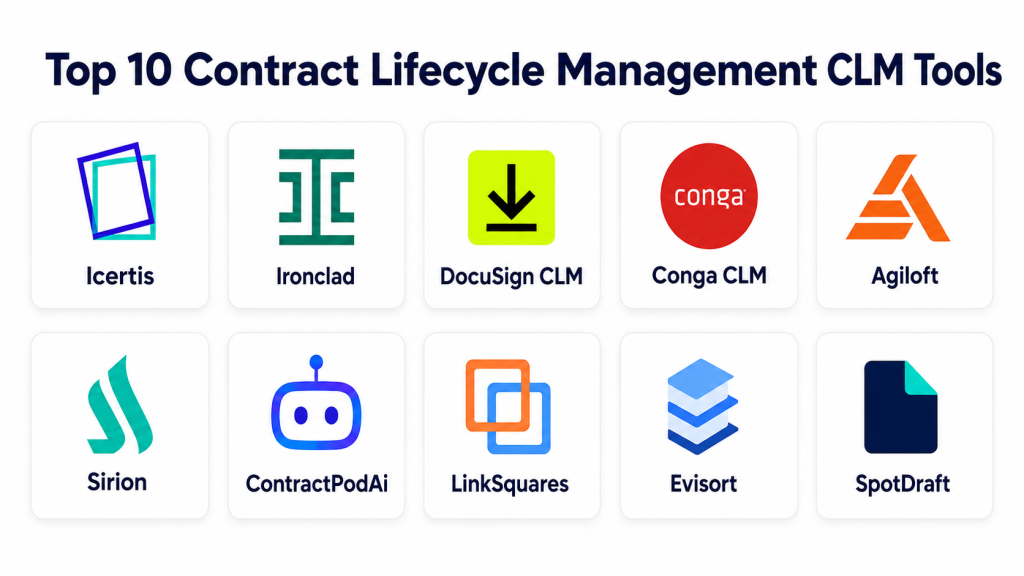
Top 10 Contract Lifecycle Management CLM Tools
1- Icertis
Short description: Icertis is an enterprise CLM platform designed for complex contract operations across legal, procurement, sales, finance, and compliance teams. It is best for large organizations that need deep contract intelligence, governance, and enterprise-scale workflow automation.
Key Features
- Enterprise contract creation and lifecycle workflows
- Centralized contract repository
- Clause and template management
- AI-assisted contract intelligence capabilities
- Obligation, renewal, and compliance tracking
- Approval and negotiation workflows
- ERP, CRM, procurement, and business system integrations
Pros
- Strong fit for large enterprises with complex contract portfolios
- Useful for managing risk, obligations, and contract intelligence at scale
- Supports cross-functional legal, procurement, and sales workflows
Cons
- May be too complex for smaller teams
- Implementation requires planning, data migration, and workflow design
- Full value depends on strong contract metadata and process governance
Platforms / Deployment
Web
Cloud
Security & Compliance
Icertis provides enterprise-grade contract governance, access controls, and administrative capabilities. Specific details such as SSO, MFA, RBAC, audit logs, SOC 2, ISO 27001, GDPR, and other compliance documentation should be verified directly during vendor review.
Integrations & Ecosystem
Icertis is designed to connect contract data with enterprise business systems so legal and business teams can manage agreements as operational assets.
- CRM integrations
- ERP integrations
- Procurement system integrations
- E-signature workflows
- Finance and supplier management connections
- Reporting and analytics exports
Support & Community
Icertis provides enterprise onboarding, implementation support, documentation, customer success resources, and partner services. Support depth depends on contract size, region, and deployment complexity.
2- Ironclad
Short description: Ironclad is a CLM platform focused on digital contracting, workflow automation, contract collaboration, repository management, and business-friendly legal operations. It is best for legal teams that want to streamline contract intake, review, approval, and execution.
Key Features
- Contract workflow automation
- Guided contract intake and request forms
- Template and clause management
- Contract collaboration and redlining
- Searchable contract repository
- AI-assisted contract insights depending on configuration
- E-signature and business system integrations
Pros
- Strong user experience for legal and business teams
- Useful for self-service contract workflows
- Helps reduce email-based legal review bottlenecks
Cons
- Complex enterprise requirements may need careful configuration
- Contract data migration requires planning
- Full adoption depends on business teams using intake workflows consistently
Platforms / Deployment
Web
Cloud
Security & Compliance
Ironclad provides business-grade permissions, workflow controls, and contract governance capabilities. Specific certifications, SSO, MFA, audit logs, RBAC, and compliance documentation should be verified directly.
Integrations & Ecosystem
Ironclad supports contract workflows that connect with sales, procurement, legal operations, document tools, and e-signature systems.
- CRM integrations
- E-signature integrations
- Document storage workflows
- Slack or collaboration workflows
- Procurement workflow connections
- Reporting and repository exports
Support & Community
Ironclad provides onboarding resources, documentation, customer success support, implementation guidance, and legal operations best practice materials. Support depth varies by package and customer needs.
3- DocuSign CLM
Short description: DocuSign CLM helps organizations automate contract generation, routing, approval, collaboration, and storage while connecting with e-signature workflows. It is best for teams that want CLM capabilities closely tied to digital signature and agreement execution.
Key Features
- Contract generation and document assembly
- Approval and routing workflows
- Clause and template management
- Contract collaboration and redlining
- Repository and document storage support
- E-signature integration
- CRM and business workflow connections
Pros
- Strong fit for organizations already using DocuSign workflows
- Useful for connecting contract creation with signature execution
- Supports structured approvals and agreement process automation
Cons
- Advanced CLM workflows may require configuration
- Repository and analytics depth should be validated for complex needs
- Best value depends on agreement workflow maturity
Platforms / Deployment
Web / iOS / Android
Cloud
Security & Compliance
DocuSign CLM provides contract workflow controls and agreement administration capabilities. Specific certifications, SSO, MFA, audit logs, RBAC, and compliance documentation should be verified directly.
Integrations & Ecosystem
DocuSign CLM connects contract workflow automation with e-signature, CRM, document, and business process systems.
- E-signature workflows
- CRM integrations
- Document storage integrations
- Approval workflow connections
- Salesforce-related workflows
- Reporting and data exports
Support & Community
DocuSign provides documentation, onboarding resources, customer support, implementation partners, and agreement workflow guidance. Support depth depends on package and contract requirements.
4- Conga CLM
Short description: Conga CLM is a contract lifecycle management platform focused on document generation, contract negotiation, approvals, compliance, and commercial operations. It is best for organizations that need CLM connected with revenue, sales, and quote-to-contract workflows.
Key Features
- Contract creation and lifecycle workflows
- Clause and template management
- Contract negotiation and redlining
- Approval routing and audit history
- Document generation support
- Contract repository and reporting
- CRM and revenue system integrations
Pros
- Strong fit for quote-to-contract and revenue workflows
- Useful for teams needing document automation plus CLM
- Supports contract governance across sales and legal teams
Cons
- Configuration can require implementation planning
- Best value depends on integration with sales and revenue systems
- Smaller teams may find the platform more advanced than needed
Platforms / Deployment
Web
Cloud
Security & Compliance
Conga CLM provides business workflow controls, permissions, and contract administration features. Specific certifications, SSO, MFA, RBAC, audit logs, and compliance documentation should be verified directly.
Integrations & Ecosystem
Conga CLM connects contract workflows with sales, revenue, CPQ, CRM, and document generation systems.
- CRM integrations
- CPQ workflow connections
- E-signature integrations
- Document generation workflows
- Revenue operations data flows
- Reporting exports
Support & Community
Conga provides documentation, implementation support, customer success resources, training, and partner services. Support depth varies by deployment size and contract complexity.
5- Agiloft
Short description: Agiloft is a configurable CLM platform for contract creation, approvals, repository management, obligation tracking, and workflow automation. It is best for teams that need flexible process configuration across legal, procurement, and enterprise contract workflows.
Key Features
- Configurable contract workflows
- Contract request and intake management
- Clause and template libraries
- Approval routing and audit trails
- Contract repository and search
- Obligation and renewal tracking
- Integration and automation capabilities
Pros
- Highly configurable for different contract processes
- Useful for legal, procurement, and enterprise operations
- Strong fit for teams needing workflow flexibility
Cons
- Flexibility requires thoughtful configuration
- Implementation planning is important for complex use cases
- User experience depends on how well workflows are designed
Platforms / Deployment
Web
Cloud / Self-hosted options may vary
Security & Compliance
Agiloft provides administrative controls, permissions, and workflow governance capabilities. Specific certifications, SSO, MFA, RBAC, audit logs, and compliance details should be verified directly.
Integrations & Ecosystem
Agiloft supports CLM workflows connected with business systems, contract repositories, procurement operations, and e-signature tools.
- CRM integrations
- ERP and procurement workflows
- E-signature integrations
- Document management connections
- API and workflow automation
- Reporting exports
Support & Community
Agiloft provides documentation, implementation support, customer assistance, training resources, and configuration guidance. Support depth depends on deployment model and agreement.
6- Sirion
Short description: Sirion is a CLM and contract performance management platform focused on contract authoring, negotiation, obligation management, supplier and customer contracts, and post-signature performance tracking. It is best for enterprises managing complex commercial relationships.
Key Features
- Contract authoring and negotiation workflows
- Contract repository and metadata management
- Obligation and milestone tracking
- AI-assisted contract analytics depending on configuration
- Supplier and customer contract management
- Performance and compliance tracking
- Enterprise integrations
Pros
- Strong post-signature contract management focus
- Useful for complex supplier and customer agreements
- Supports obligation tracking and contract performance visibility
Cons
- May be more advanced than needed for simple contract workflows
- Implementation requires contract data and process planning
- Best suited for organizations with mature contract operations
Platforms / Deployment
Web
Cloud
Security & Compliance
Sirion provides enterprise contract governance, permissions, and workflow controls. Specific certifications, SSO, MFA, RBAC, audit logs, and compliance documentation should be verified directly.
Integrations & Ecosystem
Sirion connects contract lifecycle workflows with procurement, supplier management, finance, legal, and enterprise systems.
- ERP integrations
- Procurement workflows
- Supplier management connections
- CRM-related workflows
- E-signature integrations
- Reporting and analytics exports
Support & Community
Sirion provides implementation support, documentation, customer success resources, and enterprise service support. Support depth varies by contract complexity and deployment scope.
7- ContractPodAi
Short description: ContractPodAi is a legal and contract management platform that supports CLM, legal intake, contract automation, AI-assisted legal workflows, and document management. It is best for legal departments that want CLM connected with broader legal operations.
Key Features
- Contract creation and automation
- Legal intake and workflow management
- AI-assisted contract analysis depending on configuration
- Repository and search capabilities
- Clause and template management
- Approval and collaboration workflows
- E-signature and business integrations
Pros
- Strong fit for legal teams managing broader legal operations
- Useful for contract automation and legal workflow visibility
- Supports AI-assisted legal and contract workflows
Cons
- May require legal operations planning for best use
- Advanced workflows should be validated during pilot
- Smaller teams may not need the broader legal platform depth
Platforms / Deployment
Web
Cloud
Security & Compliance
ContractPodAi provides legal workflow controls, permissions, and administrative capabilities. Specific certifications, SSO, MFA, RBAC, audit logs, and compliance documentation should be verified directly.
Integrations & Ecosystem
ContractPodAi supports contract and legal workflows that connect with document systems, e-signature tools, legal operations, and business applications.
- E-signature workflows
- Document management integrations
- CRM and business system connections
- Legal intake workflows
- Reporting and analytics exports
- Collaboration tool connections
Support & Community
ContractPodAi provides onboarding, documentation, customer support, legal operations guidance, and implementation resources. Support depth varies by product package and deployment needs.
8- LinkSquares
Short description: LinkSquares is a CLM platform focused on contract repository, AI-powered contract analysis, contract lifecycle workflows, and legal team visibility. It is best for legal teams that need stronger contract search, reporting, and post-signature insights.
Key Features
- Contract repository and search
- AI-assisted contract analysis depending on configuration
- Metadata extraction and reporting
- Contract drafting and workflow support
- Renewal and obligation tracking
- Legal team dashboards
- Integrations with business systems
Pros
- Strong repository and contract analytics focus
- Useful for legal teams needing visibility into existing contracts
- Helps manage renewals, key terms, and contract reporting
Cons
- Contract workflow depth should be validated for complex approval processes
- Data quality depends on contract ingestion and metadata accuracy
- May require process design for pre-signature workflows
Platforms / Deployment
Web
Cloud
Security & Compliance
LinkSquares provides contract repository controls, user permissions, and legal workflow administration. Specific certifications, SSO, MFA, RBAC, audit logs, and compliance documentation should be verified directly.
Integrations & Ecosystem
LinkSquares connects legal contract data with business workflows, document repositories, and operational reporting.
- CRM integrations
- E-signature workflows
- Document storage connections
- Legal operations workflows
- Reporting exports
- Search and analytics workflows
Support & Community
LinkSquares provides onboarding support, documentation, customer success resources, and legal operations guidance. Support depth varies by customer size and agreement.
9- Evisort
Short description: Evisort is a contract intelligence and CLM platform focused on AI-assisted contract analysis, repository management, workflow automation, and contract data extraction. It is best for companies that want to turn contract documents into searchable, reportable business data.
Key Features
- AI-assisted contract analysis
- Contract repository and search
- Metadata and clause extraction
- Workflow automation
- Contract review and approval support
- Obligation and renewal tracking
- Reporting and analytics dashboards
Pros
- Strong contract intelligence and analytics focus
- Useful for extracting insights from existing agreements
- Supports legal, finance, procurement, and business visibility
Cons
- Workflow fit should be validated for complex CLM processes
- AI results require review and governance
- Implementation requires clean contract ingestion and validation
Platforms / Deployment
Web
Cloud
Security & Compliance
Evisort provides contract data controls, permissions, and business-grade administration features. Specific certifications, SSO, MFA, RBAC, audit logs, and compliance details should be verified directly.
Integrations & Ecosystem
Evisort supports contract intelligence workflows connected with legal, procurement, finance, and business systems.
- Document repository workflows
- CRM and business system connections
- E-signature integrations
- Procurement-related workflows
- Analytics and reporting exports
- Workflow automation tools
Support & Community
Evisort provides onboarding, documentation, customer support, implementation services, and contract intelligence guidance. Support depth varies by deployment scope.
10- SpotDraft
Short description: SpotDraft is a CLM platform designed for contract creation, legal workflows, approvals, repository management, and business team collaboration. It is best for growing companies and legal teams that need practical contract automation with modern usability.
Key Features
- Contract request and intake workflows
- Template and clause management
- Contract review and approval routing
- E-signature workflow support
- Contract repository and search
- Renewal and obligation tracking
- CRM and business integrations
Pros
- Modern user experience for legal and business teams
- Useful for growing companies moving beyond manual contract tracking
- Supports practical contract automation and repository workflows
Cons
- Enterprise complexity should be validated during evaluation
- AI and advanced analytics depth may vary by package
- Requires contract process standardization for best results
Platforms / Deployment
Web
Cloud
Security & Compliance
SpotDraft provides access controls, workflow permissions, and contract administration features. Specific certifications, SSO, MFA, RBAC, audit logs, and compliance documentation should be verified directly.
Integrations & Ecosystem
SpotDraft connects contract workflows with sales, legal, finance, document, and e-signature systems.
- CRM integrations
- E-signature workflows
- Document storage connections
- Approval workflow integrations
- Contract reporting exports
- Business collaboration workflows
Support & Community
SpotDraft provides onboarding resources, customer support, implementation guidance, documentation, and legal workflow assistance. Support depth varies by plan and customer needs.
Comparison Table
| Tool Name | Best For | Platform Supported | Deployment | Standout Feature | Public Rating |
|---|---|---|---|---|---|
| Icertis | Enterprise contract intelligence | Web | Cloud | Enterprise CLM and contract intelligence at scale | N/A |
| Ironclad | Legal workflow automation | Web | Cloud | Business-friendly contract intake and workflows | N/A |
| DocuSign CLM | Agreement workflows and e-signature alignment | Web, iOS, Android | Cloud | Contract automation tied to e-signature workflows | N/A |
| Conga CLM | Quote-to-contract and revenue workflows | Web | Cloud | CLM connected with document and revenue operations | N/A |
| Agiloft | Flexible enterprise contract workflows | Web | Cloud / Self-hosted varies | Highly configurable CLM workflows | N/A |
| Sirion | Complex contract performance management | Web | Cloud | Post-signature obligation and performance tracking | N/A |
| ContractPodAi | Legal operations and contract workflows | Web | Cloud | CLM connected with broader legal workflow automation | N/A |
| LinkSquares | Contract repository and analytics | Web | Cloud | AI-assisted contract search and insights | N/A |
| Evisort | Contract intelligence and data extraction | Web | Cloud | AI-powered contract metadata and clause analysis | N/A |
| SpotDraft | Growing legal teams and modern CLM workflows | Web | Cloud | Practical contract automation and legal collaboration | N/A |
Evaluation & Scoring of Contract Lifecycle Management CLM
The scoring below is comparative and designed to help buyers evaluate contract lifecycle depth, ease of use, integrations, security, performance, support, and price-to-value. It is not a universal ranking for every organization.
| Tool Name | Core 25% | Ease 15% | Integrations 15% | Security 10% | Performance 10% | Support 10% | Value 15% | Weighted Total |
|---|---|---|---|---|---|---|---|---|
| Icertis | 9.5 | 7.7 | 9.1 | 9.0 | 8.9 | 8.6 | 7.6 | 8.64 |
| Ironclad | 9.0 | 8.7 | 8.7 | 8.7 | 8.7 | 8.5 | 8.0 | 8.65 |
| DocuSign CLM | 8.7 | 8.2 | 8.8 | 8.7 | 8.7 | 8.4 | 8.0 | 8.50 |
| Conga CLM | 8.8 | 8.0 | 8.8 | 8.6 | 8.6 | 8.3 | 7.9 | 8.43 |
| Agiloft | 8.9 | 8.0 | 8.6 | 8.5 | 8.5 | 8.3 | 8.2 | 8.48 |
| Sirion | 9.0 | 7.8 | 8.5 | 8.7 | 8.6 | 8.4 | 7.8 | 8.42 |
| ContractPodAi | 8.6 | 8.1 | 8.3 | 8.5 | 8.4 | 8.2 | 8.0 | 8.31 |
| LinkSquares | 8.4 | 8.5 | 8.2 | 8.4 | 8.5 | 8.2 | 8.2 | 8.35 |
| Evisort | 8.5 | 8.2 | 8.2 | 8.4 | 8.4 | 8.1 | 8.1 | 8.30 |
| SpotDraft | 8.2 | 8.7 | 8.0 | 8.2 | 8.3 | 8.1 | 8.5 | 8.30 |
Which Contract Lifecycle Management CLM Tool Is Right for You?
Solo / Freelancer
Solo professionals usually do not need a full CLM system unless they manage many client contracts, vendor agreements, or recurring renewals. A document template, e-signature tool, and simple contract tracker may be enough.
If a solo consultant or small legal advisor needs searchable contract storage, a lightweight repository or modern contract workflow tool may be more practical than enterprise CLM.
SMB
SMBs need simple contract creation, approvals, e-signature, searchable storage, renewal alerts, and easy collaboration. SpotDraft, LinkSquares, Ironclad, DocuSign CLM, or Agiloft may be relevant depending on contract volume and workflow needs.
SMBs should prioritize ease of use, template control, repository quality, e-signature support, and pricing clarity.
Mid-Market
Mid-market companies often need self-service contracting, legal intake, approval routing, clause libraries, CRM integration, procurement workflows, renewal alerts, and contract analytics. Ironclad, Agiloft, Conga CLM, DocuSign CLM, LinkSquares, Evisort, and SpotDraft may be strong candidates.
Mid-market buyers should test sales contracts, vendor contracts, legal review workflows, contract metadata, approval rules, and repository search before selecting a platform.
Enterprise
Enterprises need contract governance, multi-entity support, regional workflows, clause playbooks, obligation tracking, ERP and CRM integrations, AI-assisted analysis, advanced permissions, and audit trails. Icertis, Sirion, Agiloft, Conga CLM, DocuSign CLM, Ironclad, and ContractPodAi are strong options.
Enterprise buyers should involve legal, procurement, sales, finance, IT, security, compliance, and business leaders before rollout.
Budget vs Premium
Budget-focused teams should start with the specific contract problem they need to solve first, such as renewal tracking, contract repository, approval routing, or template automation. SpotDraft, LinkSquares, and selected DocuSign CLM or Agiloft configurations may be practical depending on size and workflow.
Premium buyers should evaluate Icertis, Sirion, Conga CLM, Agiloft, Ironclad, ContractPodAi, or DocuSign CLM when they need complex lifecycle automation, enterprise integrations, analytics, and governance.
Feature Depth vs Ease of Use
Ironclad and SpotDraft often appeal to teams that want modern workflows and business-friendly legal intake. LinkSquares and Evisort are strong for contract analytics and repository intelligence. Icertis, Sirion, Conga CLM, Agiloft, ContractPodAi, and DocuSign CLM offer deeper enterprise capabilities but may require more implementation planning.
The right choice depends on whether your biggest need is pre-signature workflow, post-signature repository intelligence, procurement contracts, sales contracts, or enterprise contract governance.
Integrations & Scalability
CLM tools should connect with CRM, CPQ, ERP, procurement, e-signature, document storage, finance, supplier management, identity, and reporting systems. Buyers should test field mapping, approval triggers, document generation, metadata sync, and signed contract storage.
Scalability depends on contract volume, business units, entities, regions, languages, approval layers, contract types, and user roles.
Security & Compliance Needs
CLM platforms store sensitive commercial terms, customer agreements, vendor contracts, employment documents, pricing, liability terms, and legal negotiation history. Buyers should review SSO, MFA, role-based access, encryption, audit logs, permission controls, data retention, and vendor security documentation.
Regulated industries should also validate approval history, access logs, clause governance, repository controls, obligation tracking, and export capabilities.
Frequently Asked Questions
1. What is Contract Lifecycle Management CLM software?
CLM software helps businesses manage contracts from request and drafting through review, approval, negotiation, signature, storage, renewal, and obligation tracking.
2. Who needs a CLM platform?
Legal teams, procurement teams, sales teams, finance teams, HR teams, and operations teams can benefit. CLM is especially useful when contract volume, approval complexity, or renewal risk becomes hard to manage manually.
3. What is the difference between CLM and e-signature software?
E-signature software helps execute documents digitally. CLM is broader and manages the full contract lifecycle, including drafting, review, approvals, negotiation, repository, renewals, and obligations.
4. Can CLM tools help reduce legal review time?
Yes, CLM tools can reduce review time through approved templates, clause libraries, automated approvals, self-service intake, fallback language, and standardized workflows.
5. Do CLM platforms use AI?
Many modern CLM platforms include AI-assisted features such as clause extraction, contract summaries, risk flags, metadata extraction, search, and obligation identification. Buyers should validate accuracy and review controls.
6. How much does CLM software cost?
Pricing varies by vendor, user count, contract volume, modules, integrations, AI features, support level, and enterprise requirements. Buyers should request pricing based on real workflow needs.
7. What are common mistakes when choosing CLM software?
Common mistakes include buying before standardizing templates, ignoring business-team adoption, underestimating data migration, skipping integration testing, and failing to define contract ownership.
8. Is CLM software secure?
Business-grade CLM tools usually provide access controls and secure document management. Buyers should verify SSO, MFA, encryption, role-based access, audit logs, and vendor security documentation.
9. How long does CLM implementation take?
Implementation depends on contract volume, templates, workflows, integrations, metadata needs, and migration complexity. Smaller rollouts can be faster, while enterprise deployments often require phased planning.
10. Can CLM tools integrate with CRM and ERP systems?
Yes, many CLM tools integrate with CRM, ERP, procurement, CPQ, e-signature, and finance systems. Buyers should test data mapping, approval triggers, contract generation, and signed document storage.
Conclusion
Contract Lifecycle Management tools help businesses reduce contract delays, improve legal control, manage risk, track obligations, and make contract data easier to use across teams. The best CLM platform depends on contract volume, business size, legal workflow complexity, integration needs, security requirements, and whether the biggest pain point is pre-signature workflow, post-signature analysis, procurement contracts, or sales agreements. Icertis and Sirion are strong for enterprise-scale contract intelligence and performance management, while Ironclad, SpotDraft, and LinkSquares are strong for modern legal operations and repository visibility. DocuSign CLM and Conga CLM are useful when agreement workflows connect closely with signatures, revenue, and document generation. Agiloft, ContractPodAi, and Evisort support configurable workflows, legal automation, and contract intelligence. The right next step is to shortlist two or three CLM tools, run a pilot with real contracts and workflows, validate integrations and security controls, and confirm that legal, sales, procurement, and finance teams can use the platform consistently before scaling it across the organization.

Find Trusted Cardiac Hospitals
Compare heart hospitals by city and services — all in one place.
Explore Hospitals
Contract Lifecycle Management (CLM) software is most valuable when it helps organizations manage contracts from creation and negotiation through approval, execution, monitoring, renewal, and expiration within a centralized platform. By providing contract drafting, templates, workflow automation, approval management, e-signature integration, clause and obligation tracking, renewal alerts, compliance monitoring, document storage, reporting, analytics, and integration with legal and business systems, these platforms enable organizations to reduce manual work, improve contract visibility, minimize compliance risks, accelerate contract cycles, and better manage contractual obligations.