Introduction
Vendor Management Systems VMS help businesses manage external workers, staffing suppliers, service providers, contingent labor, contractor onboarding, approvals, timesheets, invoices, compliance documents, and workforce spend in one structured platform. Instead of managing vendors through emails, spreadsheets, manual approvals, and disconnected HR or procurement systems, a VMS centralizes vendor relationships and gives procurement, HR, finance, and operations teams better control. VMS platforms matter because organizations increasingly rely on contractors, agencies, freelancers, consultants, managed service providers, and temporary workers. Without a centralized system, companies can lose visibility into spend, compliance risk, worker status, supplier performance, and contract obligations.
Real World Use Cases
- Managing contingent workforce programs and staffing suppliers
- Tracking contractor onboarding, compliance, assignments, and offboarding
- Approving job requisitions, work orders, timesheets, and invoices
- Monitoring supplier performance, rates, fill times, and workforce spend
- Connecting procurement, HR, finance, payroll, and identity workflows
Evaluation Criteria for Buyers
- Contingent workforce management depth
- Supplier onboarding and vendor performance tracking
- Requisition, assignment, and approval workflows
- Timesheet, invoicing, and spend management support
- Compliance document and worker classification controls
- Integration with HRIS, ERP, procurement, payroll, and identity systems
- Reporting, analytics, and workforce visibility
- Multi-region, multi-currency, and multi-entity support
- Security, permissions, and audit trails
- Ease of use for hiring managers, suppliers, and program teams
Best for: Vendor Management Systems are best for procurement teams, HR leaders, contingent workforce managers, finance teams, managed service providers, staffing-heavy enterprises, healthcare organizations, manufacturing companies, technology firms, financial services companies, and global businesses managing large external workforces.
Not ideal for: Very small businesses with only a few vendors or occasional contractors may not need a dedicated VMS. A procurement tool, HR system, spreadsheet, or simple contractor management workflow may be enough until vendor volume, workforce risk, compliance needs, or spend visibility becomes more complex.
Key Trends in Vendor Management Systems VMS for Modern Businesses
- Contingent workforce visibility is becoming a board-level concern: Companies need a clear view of contractors, temporary workers, freelancers, consultants, suppliers, locations, cost centers, and contract terms.
- AI-assisted workforce matching is gaining attention: Modern platforms are beginning to support smarter job matching, supplier recommendations, rate benchmarking, and workforce planning insights.
- Compliance automation is a major buying driver: Worker classification, background checks, onboarding documents, certifications, location rules, tax requirements, and access removal all need stronger controls.
- Direct sourcing is becoming part of VMS strategy: Companies want to build private talent pools and reduce dependency on staffing agencies for repeat contractor needs.
- Supplier performance analytics are improving: Businesses increasingly track fill rates, response times, quality of candidates, tenure, cost, compliance, and manager satisfaction by supplier.
- Procurement and HR workflows are converging: VMS platforms now sit between procurement, HR, finance, payroll, identity access, and workforce planning systems.
- Global workforce programs are more complex: Multi-country contractor rules, local compliance requirements, currencies, language needs, and region-specific approvals are becoming more important.
- External workforce spend control is a priority: Finance teams want better forecasting, budget controls, rate card compliance, invoice validation, and spend analytics.
- Security and identity integrations are becoming essential: Contractor access must be connected with onboarding and offboarding so system access does not remain active after assignments end.
- Managed service provider collaboration is maturing: Many enterprises use VMS platforms alongside MSPs, requiring dashboards, supplier workflows, service-level metrics, and program governance.
How We Selected These Tools
The tools below were selected using practical evaluation logic for contingent workforce management, supplier governance, procurement alignment, compliance controls, workforce visibility, and enterprise scalability.
- Market adoption and recognition: Preference was given to platforms widely recognized by procurement, HR, contingent workforce, MSP, staffing, and enterprise workforce teams.
- VMS feature completeness: Tools were evaluated for requisition management, supplier management, contractor onboarding, assignment tracking, timesheets, invoicing, compliance, and reporting.
- Contingent workforce depth: Strong VMS platforms should support temporary labor, contractors, consulting services, statement of work projects, and supplier-driven staffing workflows.
- Supplier ecosystem support: Platforms with supplier portals, vendor scorecards, candidate submissions, rate controls, and performance analytics were prioritized.
- Compliance workflow strength: Worker classification, document collection, background checks, certifications, audit history, and assignment controls were considered important.
- Integration ecosystem: HRIS, ERP, procurement, payroll, identity, finance, timekeeping, and reporting integrations were evaluated.
- Scalability: The list includes tools for mid-market companies, global enterprises, healthcare staffing, enterprise contractor programs, and MSP-supported workforce models.
- User experience: VMS tools must work for hiring managers, suppliers, program managers, procurement teams, HR teams, and finance users.
- Security posture signals: Role-based access, audit trails, approval history, data governance, and admin controls were considered where confidently known.
- No invented ratings: Public ratings are not guessed. Where rating confidence is not strong, “N/A” is used.
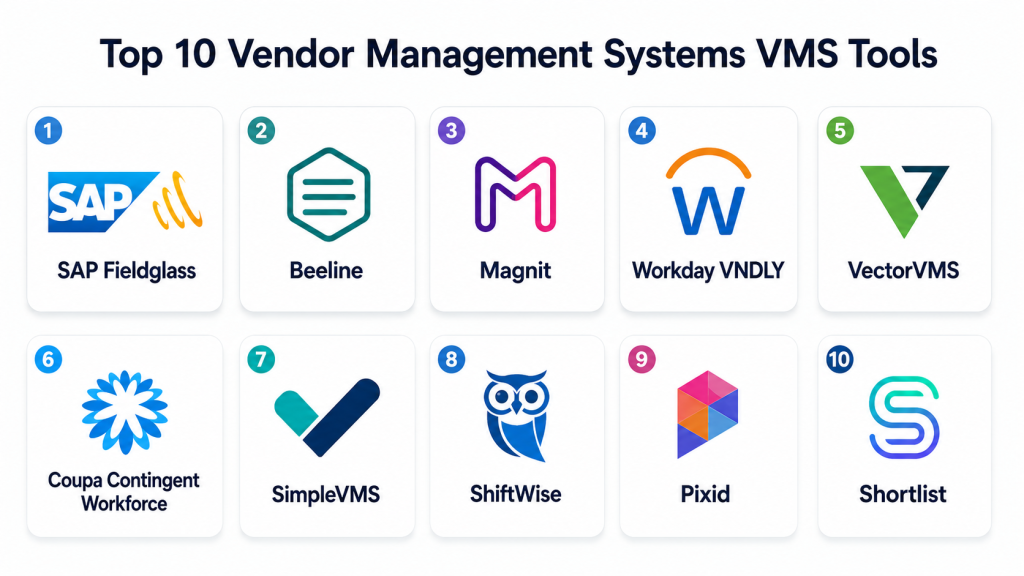
Top 10 Vendor Management Systems VMS Tools
1- SAP Fieldglass
Short description: SAP Fieldglass is an enterprise VMS for managing external workers, services procurement, suppliers, work orders, time tracking, compliance, and spend visibility. It is best for large organizations with complex global contingent workforce and services procurement programs.
Key Features
- Contingent workforce management
- Services procurement and statement of work support
- Supplier and vendor workflows
- Work order and assignment tracking
- Timesheet and invoice management
- Compliance and onboarding controls
- Spend analytics and enterprise reporting
Pros
- Strong fit for large global workforce programs
- Useful for companies already using SAP procurement or ERP systems
- Supports both contingent labor and services procurement workflows
Cons
- May be too complex for small businesses
- Implementation requires planning and stakeholder alignment
- Best value depends on mature workforce and procurement processes
Platforms / Deployment
Web
Cloud
Security & Compliance
SAP Fieldglass provides enterprise administration, permissions, workflow controls, and audit-oriented processes. Specific certifications, SSO, MFA, RBAC, audit logs, and compliance documentation should be verified directly during vendor review.
Integrations & Ecosystem
SAP Fieldglass works well for organizations that need external workforce data connected with ERP, procurement, finance, HR, and supplier systems.
- SAP ecosystem integrations
- ERP and finance workflows
- Procurement system connections
- HRIS integrations
- Supplier portal workflows
- Reporting and analytics exports
Support & Community
SAP provides documentation, implementation partners, enterprise support, training resources, and customer success services. Support depth depends on contract, region, and deployment complexity.
2- Beeline
Short description: Beeline is a VMS platform for managing contingent labor, services procurement, supplier networks, compliance, and workforce analytics. It is best for enterprise and mid-market companies that need strong visibility into external workforce programs.
Key Features
- Contingent workforce program management
- Supplier and staffing vendor workflows
- Requisition and assignment management
- Services procurement support
- Compliance tracking and onboarding workflows
- Timesheet and invoice management
- Workforce analytics and reporting
Pros
- Strong fit for complex external workforce programs
- Useful for companies working with multiple suppliers and MSPs
- Provides visibility into spend, suppliers, and workforce activity
Cons
- May require implementation support for advanced workflows
- Smaller teams may not need full VMS depth
- Process quality depends on clean program governance
Platforms / Deployment
Web
Cloud
Security & Compliance
Beeline provides business-grade administration, permissions, and workforce governance capabilities. Specific certifications, SSO, MFA, RBAC, audit logs, and compliance details should be verified directly.
Integrations & Ecosystem
Beeline connects contingent workforce workflows with enterprise systems, supplier networks, finance data, and workforce reporting.
- HRIS integrations
- ERP and finance workflows
- Procurement system connections
- Supplier portal workflows
- MSP collaboration workflows
- Reporting exports
Support & Community
Beeline provides implementation support, customer assistance, documentation, program guidance, and workforce management resources. Support depth varies by agreement and program size.
3- Magnit
Short description: Magnit provides a workforce management and VMS platform for contingent labor, services procurement, direct sourcing, workforce intelligence, and external workforce program management. It is best for organizations that want VMS technology combined with workforce strategy and analytics.
Key Features
- Contingent workforce management
- Services procurement support
- Direct sourcing workflows
- Supplier management and performance tracking
- Workforce analytics and intelligence
- Timesheet and invoicing workflows
- Compliance and program governance controls
Pros
- Strong external workforce and talent intelligence focus
- Useful for companies combining VMS with direct sourcing strategy
- Supports large workforce programs and supplier ecosystems
Cons
- May be more advanced than needed for simple vendor tracking
- Program design and data quality are important for value
- Implementation scope can vary by workforce model
Platforms / Deployment
Web
Cloud
Security & Compliance
Magnit provides workforce program controls, access management, and governance workflows. Specific certifications, SSO, MFA, RBAC, audit logs, and compliance documentation should be verified directly.
Integrations & Ecosystem
Magnit supports external workforce programs that require links between HR, procurement, finance, supplier systems, and talent pools.
- HRIS integrations
- Procurement and ERP workflows
- Supplier and staffing workflows
- Direct sourcing talent pools
- Finance and invoicing workflows
- Workforce analytics exports
Support & Community
Magnit provides customer support, program services, implementation guidance, documentation, and workforce strategy resources. Support depth depends on contract and program requirements.
4- Workday VNDLY
Short description: Workday VNDLY is a VMS for contingent workforce management, supplier collaboration, contractor lifecycle workflows, and external labor visibility. It is best for organizations using Workday or companies that want workforce data connected with HR and finance systems.
Key Features
- Contingent worker management
- Supplier collaboration workflows
- Requisition and work order tracking
- Contractor onboarding and offboarding support
- Timesheet and invoice workflows
- Workforce reporting and analytics
- Integration with broader workforce systems
Pros
- Strong fit for Workday-centered organizations
- Useful for connecting contingent workforce data with HR and finance
- Modern VMS experience for managers and suppliers
Cons
- Best value may depend on Workday ecosystem fit
- Enterprise workflow configuration requires planning
- Advanced regional needs should be validated during evaluation
Platforms / Deployment
Web
Cloud
Security & Compliance
Workday VNDLY supports workforce administration, permissions, and external worker governance workflows. Specific certifications, SSO, MFA, RBAC, audit logs, and compliance documentation should be verified directly.
Integrations & Ecosystem
Workday VNDLY connects vendor and contingent workforce processes with Workday and other business systems.
- Workday ecosystem integrations
- HRIS workflows
- Finance and procurement connections
- Supplier collaboration workflows
- Timesheet and invoice exports
- Workforce analytics
Support & Community
Workday provides implementation support, documentation, customer success services, partner assistance, and enterprise support options. Support depth varies by contract and deployment scope.
5- VectorVMS
Short description: VectorVMS is a vendor management system for contingent workforce programs, supplier management, work orders, timesheets, invoicing, and workforce reporting. It is suitable for mid-market and enterprise organizations managing staffing suppliers and temporary labor programs.
Key Features
- Contingent labor management
- Supplier and vendor workflows
- Requisition and work order management
- Candidate submission tracking
- Timesheet and invoicing workflows
- Compliance document tracking
- Reporting and program analytics
Pros
- Practical VMS option for staffing-heavy organizations
- Useful for supplier collaboration and workforce visibility
- Supports core contingent workforce workflows
Cons
- Enterprise integration depth should be validated
- Advanced analytics needs may require review
- Setup depends on supplier and program structure
Platforms / Deployment
Web
Cloud
Security & Compliance
VectorVMS provides user permissions, workflow controls, and program administration features. Specific certifications, SSO, MFA, RBAC, audit logs, and compliance documentation should be verified directly.
Integrations & Ecosystem
VectorVMS supports workforce program workflows that connect suppliers, hiring managers, and program administrators.
- Supplier portal workflows
- HR and procurement data workflows
- Timesheet and invoice workflows
- Reporting exports
- Compliance document workflows
- MSP program workflows
Support & Community
VectorVMS provides onboarding resources, documentation, implementation assistance, and customer support. Support depth may vary by contract and program complexity.
6- Coupa Contingent Workforce
Short description: Coupa Contingent Workforce supports external workforce and services spend management as part of the broader Coupa spend management ecosystem. It is best for procurement-led organizations that want contingent labor visibility connected with spend governance.
Key Features
- Contingent workforce spend management
- Supplier and vendor workflows
- Services procurement alignment
- Requisition and approval workflows
- Invoice and spend visibility
- Procurement policy control
- Analytics and reporting support
Pros
- Strong fit for procurement and spend management teams
- Useful for companies already using Coupa
- Helps connect workforce spend with broader supplier spend
Cons
- Best value depends on Coupa ecosystem alignment
- May not fit companies needing only a standalone VMS
- Workforce-specific depth should be validated by use case
Platforms / Deployment
Web
Cloud
Security & Compliance
Coupa provides enterprise spend management controls, permissions, and audit-oriented workflows. Specific certifications, SSO, MFA, RBAC, audit logs, and compliance documentation should be verified directly.
Integrations & Ecosystem
Coupa Contingent Workforce connects contingent labor workflows with procurement, spend management, supplier, and finance processes.
- Coupa ecosystem workflows
- ERP and finance integrations
- Procurement system connections
- Supplier management workflows
- Invoice and spend analytics
- Approval routing
Support & Community
Coupa provides documentation, implementation partners, customer support, training, and spend management resources. Support depth depends on product package and deployment scope.
7- SimpleVMS
Short description: SimpleVMS is a vendor management platform focused on contingent labor, staffing supplier workflows, timekeeping, invoicing, and program visibility. It is suitable for companies that want practical VMS functionality without unnecessary enterprise complexity.
Key Features
- Vendor and supplier management
- Contingent labor requisitions
- Candidate submission workflows
- Timekeeping and approval workflows
- Invoice management
- Compliance document support
- Program reporting
Pros
- Straightforward VMS option for contingent labor programs
- Useful for organizations needing supplier and staffing visibility
- Can be easier to adopt than highly complex enterprise systems
Cons
- May not support all global enterprise requirements
- Advanced integrations should be validated
- Feature depth depends on program needs and configuration
Platforms / Deployment
Web
Cloud
Security & Compliance
SimpleVMS provides user permissions, vendor access controls, and workflow administration features. Specific certifications, SSO, MFA, audit logs, RBAC, and compliance documentation should be verified directly.
Integrations & Ecosystem
SimpleVMS supports staffing program workflows that connect hiring managers, suppliers, program teams, and finance processes.
- Supplier portal workflows
- Timekeeping workflows
- Invoice exports
- Compliance document tracking
- Reporting exports
- Workforce program administration
Support & Community
SimpleVMS provides onboarding assistance, support resources, documentation, and customer service. Support depth varies by customer agreement.
8- ShiftWise
Short description: ShiftWise is a VMS used heavily in healthcare and staffing environments to manage contingent labor, clinical staffing suppliers, assignments, credentials, scheduling, time tracking, and invoicing. It is best for healthcare organizations managing temporary or agency-based workforce needs.
Key Features
- Healthcare staffing vendor management
- Requisition and assignment workflows
- Credential and compliance tracking
- Timekeeping and invoicing workflows
- Supplier performance visibility
- Workforce scheduling support
- Reporting and analytics
Pros
- Strong fit for healthcare staffing programs
- Useful for managing credentials and contingent clinical labor
- Supports staffing supplier workflows and workforce visibility
Cons
- Best suited to healthcare and staffing-focused use cases
- May not fit general enterprise procurement programs as broadly
- Integration requirements should be reviewed carefully
Platforms / Deployment
Web
Cloud
Security & Compliance
ShiftWise provides staffing program controls, user permissions, and compliance-related workflows. Specific certifications, SSO, MFA, RBAC, audit logs, and compliance documentation should be verified directly.
Integrations & Ecosystem
ShiftWise connects healthcare staffing operations with supplier workflows, credential management, timekeeping, and invoicing.
- Healthcare staffing workflows
- Supplier portal connections
- Credential tracking workflows
- Time and invoice workflows
- Reporting exports
- Workforce scheduling connections
Support & Community
ShiftWise provides customer support, documentation, implementation resources, and program assistance for staffing and healthcare workforce workflows. Support depth varies by agreement.
9- Pixid
Short description: Pixid is a VMS and workforce management platform used for temporary staffing, supplier management, workforce compliance, and contingent labor processes. It is relevant for organizations and staffing ecosystems that need digital workforce administration and supplier collaboration.
Key Features
- Temporary workforce management
- Supplier collaboration workflows
- Worker onboarding and compliance support
- Assignment and contract tracking
- Time and attendance workflows
- Invoice and payment process support
- Reporting and analytics
Pros
- Useful for temporary staffing and supplier collaboration
- Supports workforce administration and compliance workflows
- Relevant for staffing-heavy and regional workforce programs
Cons
- Market fit may vary by region
- Enterprise integration needs should be validated
- Buyers should confirm country-specific capabilities
Platforms / Deployment
Web
Cloud
Security & Compliance
Pixid provides workforce administration controls and supplier workflow permissions. Specific certifications, SSO, MFA, audit logs, RBAC, and compliance details should be verified directly.
Integrations & Ecosystem
Pixid supports temporary workforce workflows that connect staffing suppliers, hiring organizations, and program administrators.
- Supplier collaboration workflows
- Temporary staffing processes
- Time and attendance workflows
- Compliance document management
- Invoice workflows
- Reporting exports
Support & Community
Pixid provides customer support, documentation, onboarding resources, and workforce program assistance. Support depth may vary by region and agreement.
10- Shortlist
Short description: Shortlist is a vendor management and supplier collaboration platform focused on onboarding, tracking, and managing external vendors, freelancers, and service providers. It is best for teams that need structured vendor visibility and collaboration rather than only traditional staffing VMS workflows.
Key Features
- Vendor onboarding and profiles
- Supplier collaboration workflows
- Compliance document collection
- Project and engagement tracking
- Vendor performance visibility
- Centralized vendor records
- Reporting and workflow support
Pros
- Useful for managing vendors, freelancers, and service providers
- Good fit for teams needing vendor visibility and onboarding control
- Practical option for service-provider and external partner workflows
Cons
- May not match deep enterprise contingent workforce VMS requirements
- Timesheet and staffing workflows should be validated
- Best fit depends on vendor program type
Platforms / Deployment
Web
Cloud
Security & Compliance
Shortlist provides vendor access controls, workflow administration, and vendor record management features. Specific certifications, SSO, MFA, RBAC, audit logs, and compliance documentation should be verified directly.
Integrations & Ecosystem
Shortlist supports vendor collaboration and external partner management workflows.
- Vendor onboarding workflows
- Document collection workflows
- Project tracking
- Reporting exports
- Supplier collaboration
- Procurement-adjacent workflows
Support & Community
Shortlist provides documentation, onboarding support, customer assistance, and vendor management guidance. Support depth may vary by plan and business requirements.
Comparison Table
| Tool Name | Best For | Platform Supported | Deployment | Standout Feature | Public Rating |
|---|---|---|---|---|---|
| SAP Fieldglass | Enterprise contingent workforce and services procurement | Web | Cloud | External workforce and services procurement at scale | N/A |
| Beeline | Large workforce programs and MSP-supported models | Web | Cloud | Contingent labor visibility and supplier management | N/A |
| Magnit | Workforce intelligence and direct sourcing | Web | Cloud | VMS plus workforce analytics and direct sourcing | N/A |
| Workday VNDLY | Workday-centered workforce programs | Web | Cloud | Contingent workforce workflows connected with HR data | N/A |
| VectorVMS | Staffing-heavy mid-market and enterprise teams | Web | Cloud | Core VMS workflows for suppliers and assignments | N/A |
| Coupa Contingent Workforce | Procurement-led spend management teams | Web | Cloud | Contingent workforce spend governance | N/A |
| SimpleVMS | Practical contingent labor program management | Web | Cloud | Straightforward supplier and staffing workflows | N/A |
| ShiftWise | Healthcare staffing and clinical workforce programs | Web | Cloud | Healthcare credential and staffing workflows | N/A |
| Pixid | Temporary staffing and supplier collaboration | Web | Cloud | Digital temporary workforce administration | N/A |
| Shortlist | Vendor onboarding and service provider management | Web | Cloud | Vendor profiles and external partner collaboration | N/A |
Evaluation & Scoring of Vendor Management Systems VMS
The scoring below is comparative and designed to help buyers evaluate VMS depth, ease of use, integrations, security, performance, support, and price-to-value. It is not a universal ranking for every organization.
| Tool Name | Core 25% | Ease 15% | Integrations 15% | Security 10% | Performance 10% | Support 10% | Value 15% | Weighted Total |
|---|---|---|---|---|---|---|---|---|
| SAP Fieldglass | 9.5 | 7.6 | 9.2 | 9.0 | 8.9 | 8.5 | 7.5 | 8.61 |
| Beeline | 9.2 | 8.0 | 8.8 | 8.7 | 8.7 | 8.5 | 7.8 | 8.55 |
| Magnit | 9.0 | 8.0 | 8.6 | 8.6 | 8.6 | 8.5 | 7.9 | 8.47 |
| Workday VNDLY | 8.8 | 8.3 | 8.8 | 8.7 | 8.6 | 8.4 | 8.0 | 8.52 |
| VectorVMS | 8.3 | 8.2 | 8.0 | 8.2 | 8.3 | 8.1 | 8.2 | 8.20 |
| Coupa Contingent Workforce | 8.5 | 8.0 | 8.8 | 8.7 | 8.5 | 8.3 | 7.8 | 8.38 |
| SimpleVMS | 7.9 | 8.6 | 7.6 | 8.0 | 8.1 | 8.0 | 8.5 | 8.12 |
| ShiftWise | 8.2 | 8.1 | 7.8 | 8.2 | 8.2 | 8.1 | 8.0 | 8.10 |
| Pixid | 8.0 | 8.2 | 7.8 | 8.1 | 8.1 | 8.0 | 8.1 | 8.05 |
| Shortlist | 7.6 | 8.5 | 7.5 | 8.0 | 8.0 | 7.9 | 8.4 | 7.98 |
Which Vendor Management System VMS Tool Is Right for You?
Solo / Freelancer
Solo professionals rarely need a full VMS unless they coordinate multiple subcontractors, freelancers, or service vendors. A project management tool, contract tracker, or simple vendor database may be enough.
If a solo consultant manages several external partners, a lightweight vendor onboarding and collaboration tool may be more practical than an enterprise VMS.
SMB
SMBs need simple vendor records, supplier onboarding, contractor tracking, time approvals, invoice visibility, and basic compliance documentation. SimpleVMS, Shortlist, VectorVMS, and selected Workday VNDLY or Beeline configurations may be relevant depending on workforce size.
SMBs should prioritize ease of use, pricing clarity, supplier adoption, reporting, and whether the system reduces manual vendor coordination.
Mid-Market
Mid-market companies often need structured requisition workflows, staffing supplier management, rate controls, compliance tracking, worker onboarding, timesheets, invoices, and procurement reporting. Beeline, Workday VNDLY, VectorVMS, Magnit, Coupa Contingent Workforce, and SimpleVMS may be strong candidates.
Mid-market buyers should validate supplier portals, approval workflows, integrations, compliance records, and reporting dashboards during the pilot.
Enterprise
Enterprises need scalable contingent workforce management, supplier governance, services procurement, MSP collaboration, multi-region compliance, advanced analytics, ERP integration, and security controls. SAP Fieldglass, Beeline, Magnit, Workday VNDLY, Coupa Contingent Workforce, and VectorVMS are strong options.
Enterprise buyers should involve procurement, HR, finance, IT, legal, compliance, security, hiring managers, suppliers, and MSP stakeholders before selecting a platform.
Budget vs Premium
Budget-focused teams should start with the specific workflow they need to solve, such as supplier onboarding, contractor tracking, time approval, or invoice visibility. SimpleVMS, Shortlist, Pixid, and VectorVMS may be practical depending on use case.
Premium buyers should evaluate SAP Fieldglass, Beeline, Magnit, Workday VNDLY, and Coupa Contingent Workforce when they need large-scale external workforce governance, services procurement, enterprise analytics, and integrations.
Feature Depth vs Ease of Use
SAP Fieldglass, Beeline, Magnit, Workday VNDLY, and Coupa Contingent Workforce offer deeper enterprise capabilities but may require more implementation planning. SimpleVMS, VectorVMS, Pixid, ShiftWise, and Shortlist may be easier to evaluate for focused workflows.
The right choice depends on whether your biggest need is contingent labor, services procurement, healthcare staffing, direct sourcing, supplier governance, or vendor onboarding.
Integrations & Scalability
VMS platforms should connect with HRIS, ERP, procurement, finance, payroll, identity, timekeeping, supplier systems, and reporting tools. Buyers should test worker data sync, invoice approvals, cost center mapping, supplier access, and compliance document workflows.
Scalability depends on supplier count, worker volume, countries, job categories, approval layers, assignment types, invoice volume, and compliance requirements.
Security & Compliance Needs
VMS platforms store sensitive worker, supplier, rate, contract, financial, and compliance data. Buyers should review SSO, MFA, role-based access, encryption, audit logs, supplier permissions, data retention, and vendor security documentation.
Companies with strict compliance needs should also validate onboarding controls, background check workflows, certification tracking, worker classification records, access removal, and reporting exports.
Frequently Asked Questions
1. What is a Vendor Management System VMS?
A Vendor Management System VMS is software that helps companies manage external workers, staffing suppliers, vendor relationships, contractor assignments, timesheets, invoices, compliance documents, and workforce spend.
2. Who needs a VMS platform?
Companies that use many contractors, temporary workers, staffing agencies, freelancers, consultants, or service providers can benefit from a VMS. It is especially useful for procurement, HR, finance, and contingent workforce teams.
3. What is the difference between VMS and procurement software?
Procurement software manages purchasing, sourcing, suppliers, contracts, and spend. VMS platforms focus more specifically on contingent labor, staffing suppliers, external workforce workflows, timesheets, assignments, and workforce compliance.
4. Can a VMS help manage staffing agencies?
Yes, VMS platforms commonly support staffing agency workflows such as requisitions, candidate submissions, rate controls, assignments, compliance documents, timesheets, and invoice approval.
5. How much does a VMS cost?
Pricing varies by vendor, worker volume, modules, regions, supplier count, integrations, support level, and program complexity. Buyers should request pricing based on real workforce and supplier usage.
6. Can a VMS support global contractors?
Many enterprise VMS platforms support multi-region workforce programs, but capabilities vary by country. Buyers should validate local compliance, currency, language, tax, worker classification, and regional supplier workflows.
7. What are common mistakes when choosing a VMS?
Common mistakes include ignoring supplier adoption, underestimating data migration, failing to define approval workflows, skipping integration testing, and choosing a platform without clear program governance.
8. Is VMS software secure?
Business-grade VMS platforms usually provide security and access controls. Buyers should verify SSO, MFA, encryption, role-based access, audit logs, supplier permissions, and vendor security documentation.
9. How long does VMS implementation take?
Implementation depends on worker volume, supplier count, integrations, compliance workflows, approval rules, and data migration needs. Enterprise rollouts often require phased planning and stakeholder alignment.
10. Can a VMS integrate with HRIS and ERP systems?
Yes, many VMS platforms integrate with HRIS, ERP, procurement, finance, payroll, identity, and reporting systems. Buyers should test data mapping, approvals, invoices, worker records, and access workflows.
Conclusion
Vendor Management Systems help organizations manage external workers, staffing suppliers, vendor workflows, compliance records, timesheets, invoices, and workforce spend with better visibility and control. The best VMS depends on company size, supplier volume, contingent workforce complexity, procurement model, compliance requirements, integrations, and global workforce needs. SAP Fieldglass, Beeline, Magnit, Workday VNDLY, and Coupa Contingent Workforce are strong options for larger workforce programs and enterprise governance. VectorVMS, SimpleVMS, ShiftWise, Pixid, and Shortlist can fit more focused staffing, healthcare, temporary workforce, or vendor collaboration needs. The right next step is to shortlist two or three platforms, run a pilot with real supplier and contractor workflows, validate integrations and security controls, and confirm that hiring managers, suppliers, HR, procurement, and finance teams can use the system consistently before scaling it across the organization.

Find Trusted Cardiac Hospitals
Compare heart hospitals by city and services — all in one place.
Explore Hospitals
Vendor management systems (VMS) are most valuable when they help organizations centralize and streamline the management of vendors, suppliers, contractors, and external workforce relationships. By providing vendor onboarding, profile management, contract tracking, compliance monitoring, performance evaluation, document management, invoice and payment workflows, supplier communication, reporting, analytics, and integration with procurement and HR systems, these platforms enable organizations to improve vendor visibility, reduce administrative work, strengthen compliance, monitor supplier performance, and manage external partnerships more efficiently.