Introduction
Digital Identity Wallets allow individuals and organizations to securely store, manage, verify, and share digital identity credentials using mobile apps, cloud platforms, decentralized identity frameworks, or enterprise authentication systems. These wallets support digital IDs, verifiable credentials, biometric authentication, employee access credentials, government-issued identities, healthcare records, educational certificates, and financial onboarding workflows. Digital identity infrastructure is becoming increasingly important because governments, banks, fintech firms, healthcare organizations, and enterprises are moving toward passwordless authentication, decentralized identity standards, and privacy-focused credential sharing. Traditional identity verification methods often create friction, security risks, and fragmented user experiences. Modern digital identity wallets now combine biometric security, decentralized identity standards, cryptographic verification, AI-assisted fraud prevention, and privacy-preserving authentication workflows to improve trust and operational efficiency.
Real-World Use Cases Include:
- Secure employee and customer authentication
- Government-issued digital identity verification
- Passwordless login and MFA workflows
- Sharing verified educational and healthcare credentials
- Supporting decentralized identity ecosystems
Evaluation Criteria for Buyers:
- Identity verification capabilities
- Decentralized identity support
- Security and encryption controls
- Biometric authentication support
- Verifiable credential interoperability
- API and integration flexibility
- User experience and onboarding simplicity
- Compliance and privacy features
- Scalability for enterprise deployments
- Cross-platform compatibility
Best for: governments, banks, fintech companies, enterprises, healthcare organizations, universities, telecom providers, and digital service providers requiring secure identity verification and credential management workflows.
Not ideal for: organizations that only require basic password-based authentication without advanced identity verification or decentralized credential management capabilities.
Key Trends in Digital Identity Wallets
- Decentralized identity frameworks are becoming increasingly important across public and private sectors.
- Passwordless authentication is replacing traditional username-password workflows.
- Verifiable credentials and digital certificates are expanding rapidly in education and healthcare.
- Biometric authentication integration is improving security and user experience.
- AI-assisted fraud prevention is helping reduce synthetic identity attacks.
- Government-backed digital identity programs are accelerating wallet adoption globally.
- Cross-border digital identity interoperability is becoming a major focus area.
- Mobile-first digital identity ecosystems are replacing physical credential workflows.
- Privacy-preserving identity sharing is gaining regulatory attention.
- Cloud-native identity infrastructure is improving scalability and deployment flexibility.
How We Selected These Tools
The tools below were selected using a practical digital identity and authentication evaluation framework:
- Market adoption across identity ecosystems
- Breadth of credential management capabilities
- Security and encryption maturity
- Decentralized identity support
- Integration ecosystem strength
- Scalability for enterprise and public-sector deployments
- User experience and onboarding workflows
- Vendor reputation within identity and authentication markets
- Deployment flexibility across cloud and enterprise models
- Long-term relevance for evolving digital identity standards
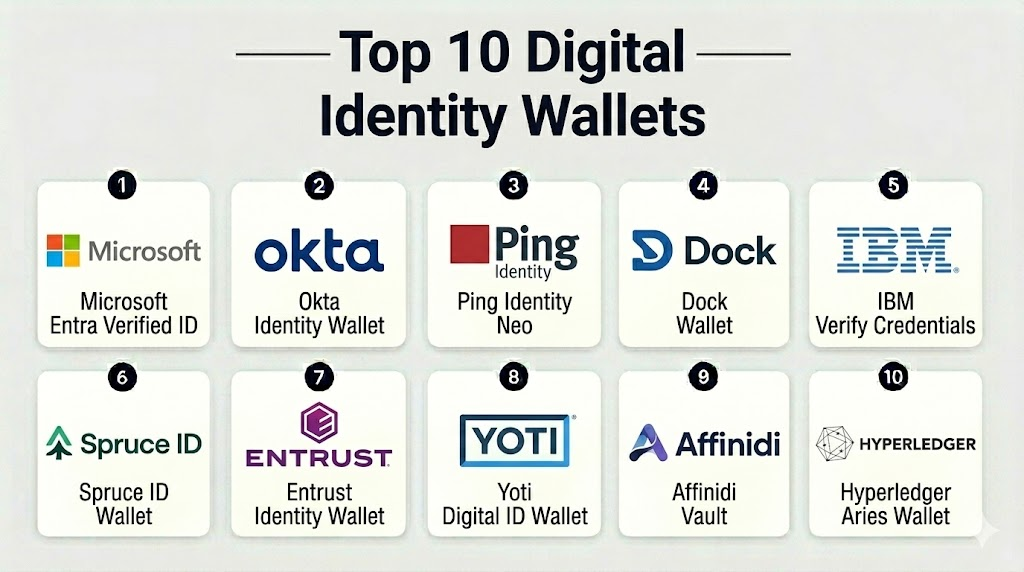
Top 10 Digital Identity Wallets
1- Microsoft Entra Verified ID
Short description: Microsoft Entra Verified ID provides decentralized identity verification and verifiable credential management for enterprises and digital identity ecosystems.
Key Features
- Decentralized identity support
- Verifiable credential issuance
- Passwordless authentication
- Enterprise identity integration
- Biometric authentication support
- Identity verification workflows
- API integration support
Pros
- Strong enterprise integration ecosystem
- Good decentralized identity support
- Broad Microsoft infrastructure compatibility
Cons
- Enterprise-focused deployment complexity
- Advanced workflows require planning
- Smaller organizations may not need full feature depth
Platforms / Deployment
Cloud
Security & Compliance
Enterprise-grade controls available.
Integrations & Ecosystem
Microsoft integrates Verified ID with identity management, authentication, and enterprise productivity ecosystems.
- Microsoft Entra
- Azure infrastructure
- Enterprise authentication
- Identity verification systems
- API workflows
Support & Community
Strong enterprise onboarding and global support ecosystem.
2- Okta Identity Wallet
Short description: Okta provides identity wallet and authentication capabilities focused on secure enterprise access and passwordless authentication workflows.
Key Features
- Passwordless authentication
- Identity verification workflows
- MFA support
- Enterprise SSO integration
- Biometric authentication
- API-based identity workflows
- Access management tools
Pros
- Strong enterprise authentication ecosystem
- Good usability and onboarding workflows
- Broad integration support
Cons
- Primarily enterprise-focused
- Advanced customization may require expertise
- Public pricing details limited
Platforms / Deployment
Cloud
Security & Compliance
Enterprise-grade controls available.
Integrations & Ecosystem
Okta integrates identity wallet workflows with enterprise authentication and access management systems.
- Enterprise applications
- Cloud infrastructure
- SSO platforms
- MFA systems
- API integrations
Support & Community
Strong enterprise identity and authentication support ecosystem.
3- Ping Identity Neo
Short description: Ping Identity Neo provides decentralized identity and digital wallet workflows for enterprises and regulated organizations.
Key Features
- Decentralized identity support
- Digital credential management
- Passwordless authentication
- Identity federation
- MFA support
- Enterprise access management
- API-driven identity workflows
Pros
- Strong identity federation support
- Enterprise-grade scalability
- Good authentication flexibility
Cons
- Enterprise implementation complexity
- Requires identity management expertise
- Public pricing transparency limited
Platforms / Deployment
Cloud / Hybrid
Security & Compliance
Enterprise-grade controls available.
Integrations & Ecosystem
Ping Identity integrates digital wallet workflows with enterprise IAM and authentication infrastructure.
- Enterprise IAM systems
- Cloud infrastructure
- MFA platforms
- Identity federation
- API integrations
Support & Community
Strong enterprise IAM implementation support.
4- Dock Wallet
Short description: Dock Wallet provides decentralized identity and verifiable credential management for individuals, enterprises, and Web3 ecosystems.
Key Features
- Verifiable credential support
- Decentralized identity workflows
- Mobile identity wallet
- Blockchain credential verification
- Privacy-focused credential sharing
- Digital certificate storage
- Identity portability support
Pros
- Strong decentralized identity focus
- Good Web3 compatibility
- Flexible credential management
Cons
- Smaller enterprise ecosystem
- Blockchain adoption varies by organization
- Public enterprise deployment details limited
Platforms / Deployment
Mobile / Cloud
Security & Compliance
Security controls available.
Integrations & Ecosystem
Dock integrates decentralized identity workflows with blockchain and verifiable credential ecosystems.
- Blockchain platforms
- Credential issuers
- Identity verification systems
- API integrations
- Web3 ecosystems
Support & Community
Growing decentralized identity community support.
5- IBM Verify Credentials
Short description: IBM Verify Credentials provides digital identity verification and decentralized credential management for enterprises and public-sector deployments.
Key Features
- Digital credential verification
- Decentralized identity support
- Enterprise authentication workflows
- Identity federation
- API integrations
- Passwordless authentication
- Credential lifecycle management
Pros
- Strong enterprise security capabilities
- Broad public-sector deployment support
- Good scalability for large organizations
Cons
- Enterprise implementation complexity
- Advanced deployments require planning
- Public pricing details limited
Platforms / Deployment
Cloud / Hybrid
Security & Compliance
Enterprise-grade controls available.
Integrations & Ecosystem
IBM integrates digital identity workflows with enterprise security and authentication infrastructure.
- Enterprise IAM systems
- Authentication platforms
- API environments
- Security monitoring
- Identity verification tools
Support & Community
Strong enterprise and public-sector onboarding support.
6- Spruce ID Wallet
Short description: Spruce ID Wallet provides decentralized identity and verifiable credential workflows focused on privacy-preserving authentication.
Key Features
- Decentralized identity support
- Privacy-preserving verification
- Verifiable credentials
- Blockchain identity workflows
- Mobile credential storage
- Authentication APIs
- Digital certificate management
Pros
- Strong privacy-focused architecture
- Good decentralized identity support
- Flexible credential portability
Cons
- Smaller enterprise footprint
- Limited traditional IAM ecosystem presence
- Public pricing details limited
Platforms / Deployment
Mobile / Cloud
Security & Compliance
Security controls available.
Integrations & Ecosystem
Spruce integrates decentralized identity workflows with blockchain and verifiable credential ecosystems.
- Blockchain networks
- Identity providers
- API workflows
- Credential issuers
- Authentication systems
Support & Community
Strong Web3 and decentralized identity community support.
7- Entrust Identity Wallet
Short description: Entrust Identity Wallet provides enterprise digital identity verification and secure credential management for regulated industries.
Key Features
- Secure credential management
- Identity verification workflows
- MFA support
- Enterprise authentication
- Biometric verification
- PKI integration
- Digital certificate workflows
Pros
- Strong enterprise security focus
- Broad regulated-industry support
- Good authentication integration capabilities
Cons
- Enterprise deployment complexity
- Premium enterprise pricing
- Smaller developer ecosystem
Platforms / Deployment
Cloud / Hybrid
Security & Compliance
Enterprise-grade controls available.
Integrations & Ecosystem
Entrust integrates digital identity workflows with enterprise security and certificate infrastructure.
- PKI systems
- Enterprise IAM
- MFA platforms
- Authentication tools
- API environments
Support & Community
Strong enterprise identity and security implementation support.
8- Yoti Digital ID Wallet
Short description: Yoti provides digital identity verification and mobile identity wallet workflows for consumers, enterprises, and public-sector organizations.
Key Features
- Mobile identity verification
- Biometric authentication
- Digital age verification
- Credential sharing workflows
- Privacy-focused authentication
- Identity verification APIs
- Digital document verification
Pros
- Strong mobile identity usability
- Good consumer onboarding workflows
- Useful privacy-focused verification support
Cons
- Smaller enterprise IAM footprint
- Limited advanced enterprise customization
- Public pricing details limited
Platforms / Deployment
Mobile / Cloud
Security & Compliance
Security controls available.
Integrations & Ecosystem
Yoti integrates digital identity workflows with onboarding and mobile authentication ecosystems.
- Mobile onboarding systems
- Identity verification APIs
- Authentication workflows
- Digital document verification
- Consumer platforms
Support & Community
Strong onboarding and mobile verification support.
9- Affinidi Vault
Short description: Affinidi Vault provides decentralized identity and digital credential management workflows for developers and enterprises.
Key Features
- Decentralized identity support
- Verifiable credentials
- Privacy-preserving authentication
- Developer APIs
- Credential management
- Identity portability
- Digital verification workflows
Pros
- Strong developer-focused APIs
- Flexible decentralized identity support
- Good credential portability
Cons
- Smaller enterprise ecosystem
- Web3 adoption maturity varies
- Public pricing details limited
Platforms / Deployment
Cloud / Mobile
Security & Compliance
Security controls available.
Integrations & Ecosystem
Affinidi integrates decentralized identity workflows with developer ecosystems and digital credential environments.
- Identity APIs
- Blockchain systems
- Authentication platforms
- Credential issuers
- Mobile ecosystems
Support & Community
Growing decentralized identity developer ecosystem.
10- Hyperledger Aries Wallet
Short description: Hyperledger Aries Wallet provides open-source decentralized identity and credential exchange frameworks for enterprise and government ecosystems.
Key Features
- Open-source identity framework
- Decentralized identity support
- Verifiable credentials
- Credential exchange workflows
- Identity interoperability
- API integrations
- Privacy-preserving authentication
Pros
- Strong open-source ecosystem
- Flexible interoperability support
- Good decentralized identity architecture
Cons
- Requires technical expertise
- Enterprise deployment complexity
- Commercial support varies
Platforms / Deployment
Cloud / Self-hosted / Hybrid
Security & Compliance
Varies / N/A
Integrations & Ecosystem
Hyperledger Aries integrates decentralized identity workflows across enterprise and public-sector ecosystems.
- Blockchain frameworks
- Identity providers
- Credential systems
- API integrations
- Enterprise identity workflows
Support & Community
Strong open-source and decentralized identity community support.
Comparison Table
| Tool Name | Best For | Platform Supported | Deployment | Standout Feature | Public Rating |
|---|---|---|---|---|---|
| Microsoft Entra Verified ID | Enterprise decentralized identity | Web / Cloud | Cloud | Verifiable credentials | N/A |
| Okta Identity Wallet | Enterprise authentication | Web / Cloud | Cloud | Passwordless authentication | N/A |
| Ping Identity Neo | Enterprise identity federation | Web / Cloud | Cloud / Hybrid | Identity federation support | N/A |
| Dock Wallet | Web3 identity workflows | Mobile / Cloud | Cloud | Blockchain credential verification | N/A |
| IBM Verify Credentials | Enterprise credential management | Web / Cloud | Cloud / Hybrid | Public-sector identity workflows | N/A |
| Spruce ID Wallet | Privacy-focused decentralized identity | Mobile / Cloud | Cloud | Privacy-preserving verification | N/A |
| Entrust Identity Wallet | Enterprise credential security | Web / Cloud | Cloud / Hybrid | PKI integration | N/A |
| Yoti Digital ID Wallet | Consumer identity verification | Mobile / Cloud | Cloud | Mobile biometric verification | N/A |
| Affinidi Vault | Developer decentralized identity | Mobile / Cloud | Cloud | Developer-focused APIs | N/A |
| Hyperledger Aries Wallet | Open-source identity ecosystems | Web / Cloud | Hybrid | Open interoperability architecture | N/A |
Evaluation & Scoring of Digital Identity Wallets
| Tool Name | Core 25% | Ease 15% | Integrations 15% | Security 10% | Performance 10% | Support 10% | Value 15% | Weighted Total |
|---|---|---|---|---|---|---|---|---|
| Microsoft Entra Verified ID | 9 | 8 | 9 | 9 | 8 | 9 | 7 | 8.45 |
| Okta Identity Wallet | 8 | 9 | 9 | 9 | 8 | 8 | 7 | 8.25 |
| Ping Identity Neo | 9 | 7 | 8 | 9 | 8 | 8 | 7 | 8.00 |
| Dock Wallet | 7 | 8 | 7 | 7 | 7 | 7 | 8 | 7.30 |
| IBM Verify Credentials | 9 | 7 | 8 | 9 | 8 | 8 | 7 | 8.00 |
| Spruce ID Wallet | 7 | 8 | 7 | 7 | 7 | 7 | 8 | 7.30 |
| Entrust Identity Wallet | 8 | 7 | 8 | 9 | 8 | 8 | 7 | 7.95 |
| Yoti Digital ID Wallet | 7 | 9 | 7 | 7 | 7 | 7 | 8 | 7.45 |
| Affinidi Vault | 7 | 8 | 8 | 7 | 7 | 7 | 8 | 7.45 |
| Hyperledger Aries Wallet | 8 | 6 | 8 | 7 | 8 | 7 | 8 | 7.45 |
Which Digital Identity Wallet Is Right for You?
Solo / Freelancer
Independent professionals and small organizations may benefit from lightweight mobile identity wallets that support secure credential storage and passwordless authentication without requiring enterprise IAM complexity.
SMB
Fintech startups, marketplaces, and digital businesses should prioritize usability, onboarding speed, mobile compatibility, and API flexibility. Yoti, Affinidi Vault, and Dock Wallet are often practical options.
Mid-Market
Mid-sized enterprises typically require stronger authentication controls, credential management workflows, and integration flexibility. Ping Identity Neo, Entrust Identity Wallet, and IBM Verify Credentials can provide balanced functionality.
Enterprise
Large enterprises, banks, governments, and multinational organizations should evaluate Microsoft Entra Verified ID, Okta Identity Wallet, IBM Verify Credentials, and Ping Identity Neo for scalability and enterprise identity governance capabilities.
Budget vs Premium
Premium identity wallet platforms provide broader enterprise integrations, stronger authentication controls, advanced governance, and scalability features. Smaller organizations should focus first on practical identity workflows and user adoption requirements.
Feature Depth vs Ease of Use
Enterprise-grade identity platforms deliver advanced governance and federation capabilities but often require experienced IAM teams. Cloud-native and mobile-first identity wallets generally simplify deployment and onboarding experiences.
Integrations & Scalability
Integration quality is critical because digital identity wallets commonly connect with authentication systems, onboarding workflows, cloud infrastructure, enterprise IAM systems, APIs, and verification providers.
Security & Compliance Needs
Strong encryption, biometric verification, audit logging, role-based access controls, credential portability, and privacy-preserving identity workflows are essential because identity wallets manage highly sensitive personal and enterprise credential data.
Frequently Asked Questions FAQs
1. What are Digital Identity Wallets?
Digital Identity Wallets allow individuals and organizations to securely store, manage, and share digital identity credentials electronically. These wallets can support employee IDs, government credentials, educational certificates, and authentication workflows. Modern platforms also integrate decentralized identity standards and biometric verification. They are becoming important across enterprise and public-sector digital transformation projects.
2. Who typically uses digital identity wallets?
Governments, banks, fintech companies, healthcare organizations, universities, telecom providers, and enterprises commonly use digital identity wallets. Employees, customers, students, and citizens may all interact with these systems depending on the use case. Identity management teams, compliance teams, and authentication administrators often manage deployments. Adoption is growing across regulated industries.
3. Why are digital identity wallets important today?
Traditional passwords and fragmented identity systems create security risks and poor user experiences. Digital identity wallets improve authentication security, simplify onboarding, support privacy-preserving verification, and reduce identity fraud risks. Governments and enterprises are also moving toward decentralized identity ecosystems and passwordless authentication workflows. Adoption continues expanding globally.
4. What types of credentials can digital identity wallets store?
Most digital identity wallets can store government IDs, employee credentials, educational certificates, healthcare records, authentication tokens, and verifiable credentials. Some advanced wallets also support decentralized identity frameworks and blockchain-based certificates. Enterprise-grade platforms may combine authentication, credential management, and access governance workflows together. Supported credential types vary by vendor.
5. Are decentralized identity standards important?
Yes, decentralized identity standards are becoming increasingly important because they improve identity portability, privacy, and user control. Traditional centralized identity systems often create security and interoperability limitations. Decentralized identity frameworks can support verifiable credentials and trusted identity sharing without relying entirely on centralized databases. However, enterprise adoption maturity still varies.
6. Can digital identity wallets support passwordless authentication?
Yes, many modern digital identity wallets support passwordless authentication using biometrics, MFA, device-based authentication, and cryptographic verification workflows. Passwordless authentication improves user experience and reduces phishing and credential theft risks. Buyers should verify exact authentication workflows before deployment. Enterprise requirements may vary significantly.
7. What integrations matter most for digital identity wallets?
Important integrations include enterprise IAM systems, onboarding platforms, cloud infrastructure, MFA tools, API environments, authentication systems, HR platforms, and verification providers. API flexibility is especially important for digital onboarding ecosystems. Poor integrations can create fragmented identity workflows and operational inefficiencies. Integration planning should be prioritized early.
8. Are cloud-based identity wallets secure?
Most enterprise identity wallet vendors provide encryption, biometric authentication, audit logging, and compliance-focused security workflows. However, organizations should independently review vendor security documentation and operational practices carefully. Security expectations vary depending on industry regulations and identity sensitivity. Highly regulated organizations should involve IAM and security teams during procurement.
9. What mistakes should organizations avoid during implementation?
Common mistakes include underestimating integration complexity, ignoring user adoption challenges, focusing only on authentication instead of governance workflows, and failing to involve security teams early. Some organizations also overlook interoperability and credential portability requirements. Poor planning can create fragmented identity ecosystems and operational inefficiencies. Pilot deployments are highly recommended.
10. How long does digital identity wallet implementation usually take?
Implementation timelines vary depending on authentication complexity, credential workflows, integration requirements, and organizational scale. Smaller cloud-native deployments may move relatively quickly, while enterprise or government rollouts can take several months. Identity governance, onboarding flows, and interoperability testing often require significant planning. Organizations should use phased rollout strategies whenever possible.
Conclusion
Digital Identity Wallets are rapidly becoming foundational infrastructure for modern authentication, identity verification, and credential management ecosystems. As enterprises, governments, healthcare providers, fintech organizations, and digital platforms continue moving toward passwordless authentication and decentralized identity standards, organizations need scalable systems capable of delivering secure credential management, privacy-preserving verification, and operational flexibility. The best platform depends on deployment scale, regulatory requirements, interoperability needs, user experience priorities, and integration complexity. Enterprise organizations may prioritize Microsoft Entra Verified ID, Okta Identity Wallet, IBM Verify Credentials, and Ping Identity Neo for governance and scalability, while decentralized identity ecosystems may prefer Dock Wallet, Spruce ID Wallet, Affinidi Vault, or Hyperledger Aries Wallet for interoperability and privacy-focused identity workflows. Before selecting a digital identity wallet platform, organizations should shortlist a few vendors, validate integrations carefully, test authentication workflows, review privacy and governance controls, and run pilot deployments using realistic identity and onboarding scenarios.

Find Trusted Cardiac Hospitals
Compare heart hospitals by city and services — all in one place.
Explore Hospitals
Digital identity wallets are most valuable when they allow individuals and organizations to securely store, manage, and share verified digital identities and credentials while maintaining privacy and user control. By supporting verifiable credentials, decentralized identity (DID) standards, biometric authentication, selective data sharing, encryption, multi-factor authentication, and seamless integration with government, financial, healthcare, and enterprise systems, these platforms enhance digital trust, simplify identity verification, reduce fraud, and enable secure access to online services.