Introduction
Enterprise Service Bus (ESB) Platforms are middleware solutions designed to connect disparate applications and systems across an organization. They provide a centralized architecture for data routing, transformation, and communication between software applications, enabling seamless integration and reducing point-to-point connections.
ESB platforms are critical for organizations managing multiple enterprise applications, legacy systems, and cloud-based solutions. They allow for flexible, scalable, and maintainable integrations while maintaining high availability and reliability.
Real-world use cases include:
- Integrating CRM, ERP, and HR systems for consistent data flow
- Orchestrating order-to-fulfillment processes across supply chain systems
- Event-driven communication between microservices and legacy applications
- Centralized logging and monitoring of enterprise workflows
- Ensuring secure and standardized communication between internal and external systems
Key evaluation criteria for buyers:
- Connectivity to cloud, on-premises, and legacy systems
- Message routing, transformation, and orchestration
- Security and compliance (encryption, authentication, RBAC)
- Monitoring, logging, and error handling
- API and microservices integration
- Low-code or visual workflow support
- Scalability and performance under load
- Deployment flexibility (cloud, hybrid, on-premises)
- Analytics and reporting capabilities
- Pricing and support options
Best for: Enterprises, IT architects, developers, and system integrators managing complex application ecosystems.
Not ideal for: Small organizations with minimal integration needs or teams that rely solely on cloud-native SaaS applications with native connectors.
Key Trends in Enterprise Service Bus (ESB) Platforms
- Cloud-native ESB deployments with hybrid and multi-cloud support
- AI-assisted workflow optimization and anomaly detection
- Event-driven architectures with real-time data streaming
- Low-code integration and visual workflow orchestration
- Enhanced security with SSO, MFA, encryption, and RBAC
- Integration with APIs, microservices, and serverless functions
- Centralized monitoring, logging, and analytics
- Pre-built connectors and templates for SaaS and legacy systems
- Subscription-based and consumption-based pricing models
- Scalable architectures to handle high-volume enterprise data
How We Selected These Tools (Methodology)
- Evaluated market adoption and enterprise mindshare
- Assessed feature completeness, including message routing, orchestration, and transformation
- Reviewed performance and reliability in production environments
- Examined security posture, compliance certifications, and access control
- Analyzed integrations and ecosystem support for SaaS, APIs, and legacy systems
- Considered suitability for different organization sizes and complexity
- Evaluated user experience, workflow building, and low-code capabilities
- Reviewed support options, documentation, and community engagement
- Considered deployment flexibility and hybrid cloud support
- Assessed pricing models, total cost of ownership, and scalability
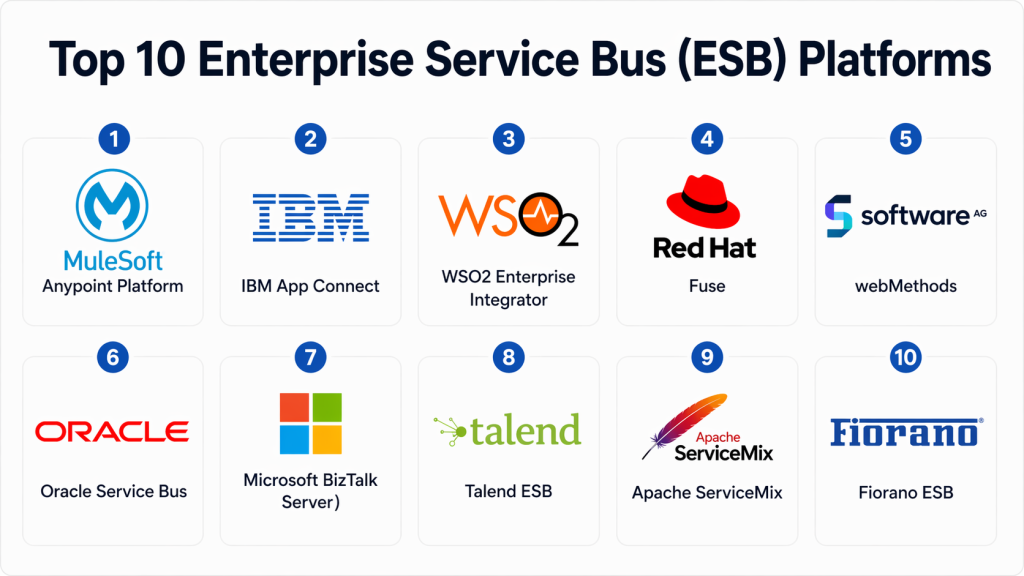
Top 10 Enterprise Service Bus (ESB) Platforms
#1 — MuleSoft Anypoint Platform
Short description: MuleSoft Anypoint Platform provides enterprise-grade ESB capabilities with API management, real-time data integration, and workflow orchestration.
Key Features
- Full lifecycle API management
- Pre-built connectors for cloud and on-prem systems
- Data transformation and mapping
- Workflow orchestration
- Real-time monitoring and analytics
- Hybrid and multi-cloud support
Pros
- Enterprise-grade scalability and reliability
- Extensive connector library
Cons
- Steep learning curve
- Higher pricing than SMB-focused solutions
Platforms / Deployment
- Web / Windows / macOS / Linux / Cloud / Hybrid
Security & Compliance
- SSO/SAML, MFA, encryption, RBAC
- SOC 2, ISO 27001, GDPR
Integrations & Ecosystem
- Salesforce, SAP, Oracle, AWS, Azure
- REST, SOAP, GraphQL APIs
- CI/CD and DevOps tools
Support & Community
- Enterprise support, documentation, developer community
#2 — IBM App Connect
Short description: IBM App Connect offers a robust ESB solution for integrating applications and data across enterprise systems with low-code capabilities.
Key Features
- Pre-built connectors for SaaS and legacy systems
- Visual integration and workflow builder
- Event-driven data integration
- API management
- Monitoring and logging dashboards
- Cloud and hybrid deployment
Pros
- Strong enterprise reliability
- Low-code interface for rapid deployment
Cons
- Complexity for small teams
- Premium features require higher-tier plans
Platforms / Deployment
- Web / Cloud / Hybrid
Security & Compliance
- SSL, OAuth, RBAC
- SOC 2, ISO 27001, GDPR
Integrations & Ecosystem
- ERP, CRM, cloud apps
- REST and SOAP APIs
- Workflow automation tools
Support & Community
- Documentation, tutorials, enterprise support
#3 — WSO2 Enterprise Integrator
Short description: WSO2 Enterprise Integrator provides open-source ESB functionality with API management, data integration, and service orchestration.
Key Features
- Open-source ESB and API management
- Message routing and transformation
- Event-driven architecture support
- Workflow orchestration
- Monitoring and analytics
- Cloud and on-premises deployment
Pros
- Open-source flexibility
- Strong developer community
Cons
- Requires technical expertise for deployment
- Enterprise support optional
Platforms / Deployment
- Web / Cloud / Self-hosted
Security & Compliance
- SSL, OAuth, RBAC
- Not publicly stated
Integrations & Ecosystem
- REST/SOAP APIs
- Cloud and on-prem apps
- CI/CD pipelines
Support & Community
- Community support, documentation
#4 — Red Hat Fuse
Short description: Red Hat Fuse is an open-source ESB platform with flexible integration and container-native deployment for enterprises.
Key Features
- Cloud-native microservices integration
- API management and orchestration
- Message routing and transformation
- Pre-built connectors
- Monitoring and logging
- Container support with Kubernetes
Pros
- Open-source and flexible
- Container-native architecture
Cons
- Requires Red Hat ecosystem knowledge
- Support subscription needed for enterprise features
Platforms / Deployment
- Web / Cloud / Hybrid / Linux
Security & Compliance
- SSL, OAuth, RBAC
- Not publicly stated
Integrations & Ecosystem
- REST/SOAP APIs
- Cloud apps and on-premises systems
- CI/CD pipelines
Support & Community
- Documentation, enterprise support, community forums
#5 — Software AG webMethods
Short description: webMethods provides enterprise ESB, API management, and integration services with robust monitoring and orchestration capabilities.
Key Features
- Pre-built connectors for enterprise systems
- Workflow automation and orchestration
- API management
- Event-driven integration
- Monitoring dashboards
- Cloud, on-prem, and hybrid deployment
Pros
- Enterprise reliability and scalability
- Strong analytics and monitoring
Cons
- Complex for small teams
- Licensing can be expensive
Platforms / Deployment
- Web / Cloud / Hybrid
Security & Compliance
- SSL, OAuth, RBAC
- SOC 2, GDPR
Integrations & Ecosystem
- ERP, CRM, cloud apps
- REST and SOAP APIs
- DevOps tools
Support & Community
- Enterprise support, documentation
#6 — Oracle Service Bus
Short description: Oracle Service Bus enables enterprise integration with ESB capabilities, API management, and message transformation for complex IT landscapes.
Key Features
- Message routing and transformation
- API orchestration
- Event-driven integration
- Pre-built connectors
- Monitoring and logging
- Cloud, on-premises, and hybrid deployment
Pros
- Enterprise-grade performance
- Strong monitoring and analytics
Cons
- High licensing costs
- Learning curve for advanced features
Platforms / Deployment
- Web / Cloud / Hybrid
Security & Compliance
- SSL, OAuth, RBAC
- SOC 2, ISO 27001, GDPR
Integrations & Ecosystem
- ERP, CRM, databases
- REST and SOAP APIs
- DevOps pipelines
Support & Community
- Enterprise support, documentation
#7 — Microsoft BizTalk Server
Short description: BizTalk Server is an ESB platform for integrating applications, automating workflows, and providing real-time data flow in enterprise environments.
Key Features
- Message routing and transformation
- Workflow orchestration
- Adapter library for enterprise systems
- Monitoring and analytics
- API integration
- On-premises and hybrid deployment
Pros
- Mature enterprise platform
- Extensive connector library
Cons
- Primarily on-premises
- Licensing complexity
Platforms / Deployment
- Windows / On-premises / Hybrid
Security & Compliance
- SSL, OAuth, RBAC
- Not publicly stated
Integrations & Ecosystem
- SAP, Oracle, Microsoft 365
- REST and SOAP APIs
- CI/CD support
Support & Community
- Enterprise support, documentation
#8 — Talend ESB
Short description: Talend ESB is an open-source integration platform providing data and application integration, transformation, and orchestration.
Key Features
- Message routing and transformation
- Workflow orchestration
- API management
- Event-driven integration
- Cloud and on-premises deployment
- Pre-built connectors
Pros
- Open-source flexibility
- Strong data transformation features
Cons
- Requires technical expertise
- Enterprise support optional
Platforms / Deployment
- Web / Cloud / Self-hosted
Security & Compliance
- SSL, OAuth
- Not publicly stated
Integrations & Ecosystem
- SaaS, on-prem apps
- REST/SOAP APIs
- CI/CD pipelines
Support & Community
- Community support, documentation
#9 — Apache ServiceMix
Short description: Apache ServiceMix is an open-source ESB supporting integration patterns, routing, and orchestration in enterprise and cloud environments.
Key Features
- Open-source ESB and message broker
- Routing and transformation
- API orchestration
- Event-driven integration
- Cloud and on-prem deployment
- Component-based architecture
Pros
- Open-source and flexible
- Lightweight and modular
Cons
- Requires deep technical knowledge
- Enterprise support limited
Platforms / Deployment
- Web / Linux / Cloud / Self-hosted
Security & Compliance
- SSL, OAuth
- Not publicly stated
Integrations & Ecosystem
- REST/SOAP APIs
- Cloud and on-prem apps
- CI/CD pipelines
Support & Community
- Community-driven, documentation
#10 — Fiorano ESB
Short description: Fiorano ESB provides enterprise-grade integration, orchestration, and API management with real-time monitoring.
Key Features
- Message routing and transformation
- Workflow orchestration
- API management
- Event-driven integration
- Monitoring dashboards
- Cloud, hybrid, and on-premises deployment
Pros
- Real-time event-driven architecture
- Enterprise-grade reliability
Cons
- Requires expertise to configure
- Licensing cost
Platforms / Deployment
- Web / Cloud / Hybrid
Security & Compliance
- SSL, OAuth, RBAC
- SOC 2, GDPR
Integrations & Ecosystem
- ERP, CRM, databases
- REST and SOAP APIs
- DevOps pipelines
Support & Community
- Documentation, enterprise support
Comparison Table (Top 10)
| Tool Name | Best For | Platform(s) Supported | Deployment | Standout Feature | Public Rating |
|---|---|---|---|---|---|
| MuleSoft Anypoint | Enterprise integrations | Web / Windows / macOS / Linux | Cloud / Hybrid | Full lifecycle API & integration | N/A |
| IBM App Connect | Enterprise & SMB | Web / Cloud | Cloud / Hybrid | Low-code integration builder | N/A |
| WSO2 Enterprise Integrator | Open-source developers | Web / Cloud / Self-hosted | Cloud / Self-hosted | Open-source ESB with API mgmt | N/A |
| Red Hat Fuse | Container-native integration | Web / Cloud / Linux | Cloud / Hybrid | Microservices & container support | N/A |
| Software AG webMethods | Enterprise automation | Web / Cloud / Hybrid | Cloud / Hybrid | Robust workflow orchestration | N/A |
| Oracle Service Bus | Enterprise ESB | Web / Cloud / Hybrid | Cloud / Hybrid | Message routing & transformation | N/A |
| Microsoft BizTalk | On-prem & hybrid | Windows | On-prem / Hybrid | Mature enterprise ESB | N/A |
| Talend ESB | Open-source integration | Web / Cloud / Self-hosted | Cloud / Self-hosted | Data & app integration | N/A |
| Apache ServiceMix | Developers, open-source | Web / Linux / Cloud | Self-hosted / Cloud | Modular lightweight ESB | N/A |
| Fiorano ESB | Enterprise real-time | Web / Cloud / Hybrid | Cloud / Hybrid | Event-driven integration | N/A |
Evaluation & Scoring of Enterprise Service Bus (ESB) Platforms
| Tool Name | Core (25%) | Ease (15%) | Integrations (15%) | Security (10%) | Performance (10%) | Support (10%) | Value (15%) | Weighted Total (0–10) |
|---|---|---|---|---|---|---|---|---|
| MuleSoft Anypoint | 9 | 7 | 9 | 8 | 9 | 8 | 7 | 8.45 |
| IBM App Connect | 8 | 8 | 8 | 7 | 8 | 7 | 8 | 7.95 |
| WSO2 Enterprise Integrator | 8 | 7 | 8 | 7 | 8 | 7 | 7 | 7.75 |
| Red Hat Fuse | 8 | 7 | 8 | 7 | 8 | 7 | 7 | 7.75 |
| Software AG webMethods | 9 | 7 | 8 | 8 | 9 | 8 | 7 | 8.45 |
| Oracle Service Bus | 9 | 7 | 8 | 8 | 9 | 8 | 7 | 8.45 |
| Microsoft BizTalk | 8 | 7 | 7 | 7 | 8 | 7 | 7 | 7.55 |
| Talend ESB | 8 | 7 | 8 | 7 | 8 | 7 | 7 | 7.75 |
| Apache ServiceMix | 7 | 6 | 7 | 6 | 7 | 6 | 6 | 6.65 |
| Fiorano ESB | 8 | 7 | 8 | 8 | 8 | 7 | 7 | 7.85 |
Interpretation: Weighted scores reflect overall functionality, usability, integration capability, and enterprise readiness. Higher scores suit enterprise-scale integrations, while lower scores are appropriate for open-source or SMB deployments.
Which Enterprise Service Bus (ESB) Platforms Tool Is Right for You?
Solo / Freelancer
- Apache ServiceMix, WSO2 for open-source flexibility and experimentation
SMB
- IBM App Connect, Talend ESB for low-code integration and SaaS connectivity
Mid-Market
- MuleSoft Anypoint, Red Hat Fuse, Fiorano ESB for scalable enterprise integration
Enterprise
- MuleSoft Anypoint, Software AG webMethods, Oracle Service Bus for large-scale, secure, and reliable workflows
Budget vs Premium
- Budget: Apache ServiceMix, WSO2, Talend ESB
- Premium: MuleSoft Anypoint, Software AG webMethods, Oracle Service Bus
Feature Depth vs Ease of Use
- Easy-to-use: IBM App Connect, Talend ESB
- Feature-rich: MuleSoft, Red Hat Fuse, Software AG webMethods
Integrations & Scalability
- Enterprise-ready: MuleSoft, Oracle Service Bus, Software AG
- Moderate: Red Hat Fuse, Talend ESB
Security & Compliance Needs
- Enterprise-grade: MuleSoft, Oracle, Software AG
- Standard compliance: WSO2, Talend
Frequently Asked Questions (FAQs)
1. What pricing models do ESB platforms offer?
Subscription-based and enterprise licensing are common, often dependent on number of endpoints, users, or integrations.
2. Can ESB platforms handle real-time integrations?
Yes. Enterprise ESBs support real-time and event-driven message routing and orchestration.
3. Are pre-built connectors available?
Yes. Most platforms provide connectors for SaaS apps, databases, ERP, CRM, and cloud services.
4. How secure are these platforms?
Security includes SSL, OAuth, RBAC, and enterprise-grade encryption, often with SOC 2 and ISO certifications.
5. Do they support hybrid deployments?
Yes. Many platforms support cloud, on-premises, or hybrid deployment options.
6. Are these platforms suitable for developers and non-developers?
Low-code options like IBM App Connect or Talend ESB are suitable for non-developers, while others like WSO2 and Apache ServiceMix require technical expertise.
7. Is monitoring and analytics available?
Yes. Most platforms include dashboards for message routing, workflow monitoring, error logging, and analytics.
8. Can they integrate with microservices and APIs?
Yes. ESB platforms support REST, SOAP, GraphQL, and event-driven architectures for seamless API and microservice integration.
9. What are common mistakes during implementation?
- Ignoring error handling and monitoring
- Overcomplicating workflows
- Underestimating connector and dependency management
10. Are there alternatives to ESB platforms?
iPaaS, workflow automation platforms, or custom API orchestrators can be alternatives for simpler integration needs.
Conclusion
Enterprise Service Bus (ESB) Platforms centralize application and data integration, ensuring reliable communication across complex enterprise IT environments. Selection depends on scale, technical expertise, and integration complexity. SMBs benefit from Talend ESB or IBM App Connect for low-code integration, while large enterprises should consider MuleSoft Anypoint, Oracle Service Bus, or Software AG webMethods for high-volume, secure, and enterprise-grade workflows. Conducting pilot tests with 2–3 shortlisted platforms ensures alignment with organizational goals and technical requirements.

Find Trusted Cardiac Hospitals
Compare heart hospitals by city and services — all in one place.
Explore Hospitals
This explains how ESB platforms connect different systems and help them communicate smoothly through a central layer.