Introduction
Influencer marketing platforms are specialized software tools that help brands discover, manage, and measure relationships with influencers across social networks. These platforms streamline the process of identifying relevant content creators, launching campaigns, tracking engagement and performance, and ensuring transparent reporting and ROI measurement. Instead of manually searching for influencers and managing spreadsheets, brands can use an influencer platform to centralize workflows and scale collaboration.
Today’s digital landscape sees influencers playing a pivotal role in consumer decision‑making. With audiences spread across social media channels, video platforms, and niche communities, influencer marketing platforms empower marketers to reach targeted audiences authentically and efficiently.
Real‑world use cases include:
- A fashion brand identifying micro‑influencers to promote a new collection.
- A gaming company running coordinated campaigns with streamers to boost engagement.
- A restaurant group tracking sentiment and user‑generated content around a launch event.
- A tech startup measuring conversions from creator‑led reviews.
- An agency managing multiple influencer clients and campaigns concurrently.
What buyers should evaluate:
- Influencer discovery breadth and search filters
- Campaign management workflows
- Performance tracking and analytics
- Contracts, payments, and workflow automation
- Audience authenticity and fraud detection
- Cross‑platform support (Instagram, YouTube, TikTok, etc.)
- CRM and marketing tech integrations
- Compliance with regulatory and platform terms
- Team collaboration features
- Pricing structures and scalability
Best for: Marketing teams, social media managers, performance marketers, agencies, brands with recurring campaigns, and enterprises seeking influencer ROI insights.
Not ideal for: Small businesses with one‑off promotions or individuals with minimal social strategy — where direct manual outreach may suffice.
Key Trends in Influencer Marketing Platforms
- AI‑powered influencer discovery: NLP and machine learning to match brands with ideal creators.
- Audience authenticity and fraud detection: Automated detection of fake followers and engagement anomalies.
- Cross‑platform analytics: Unified reporting across Instagram, TikTok, YouTube, and other channels.
- Creator commerce support: Direct integration with affiliate tracking and conversion metrics.
- Workflow automation: Automated outreach, contract signing, and payment processing.
- Real‑time performance dashboards: Live insights and pivot capabilities during live campaigns.
- Privacy and compliance features: Tools to help manage GDPR, FTC disclosure requirements, and platform policies.
- Integrated CRM and CDP connectivity: Sync influencer engagement data with broader customer data.
- Influencer relationship management (IRM): Centralized CRM for long‑term creator partnerships.
- Subscription and usage‑based pricing: Flexible plans tied to campaign volume or influencer count.
How We Selected These Tools (Methodology)
- Market adoption and mindshare among brands and agencies of varying sizes.
- Feature completeness covering discovery, campaign management, analytics, and compliance.
- Performance and reliability signals from real‑world use cases.
- Security posture signals including access controls, encryption, and data governance features.
- Integrations and ecosystem flexibility with CRM, CDP, analytics, and automation tools.
- Customer fit across segments (solo, SMB, mid‑market, enterprise).
- Ease of use and onboarding experience for cross‑functional teams.
- Analytics depth and visualization capabilities.
- Support resources and community presence.
- Scalability for large‑scale and cross‑region campaigns.
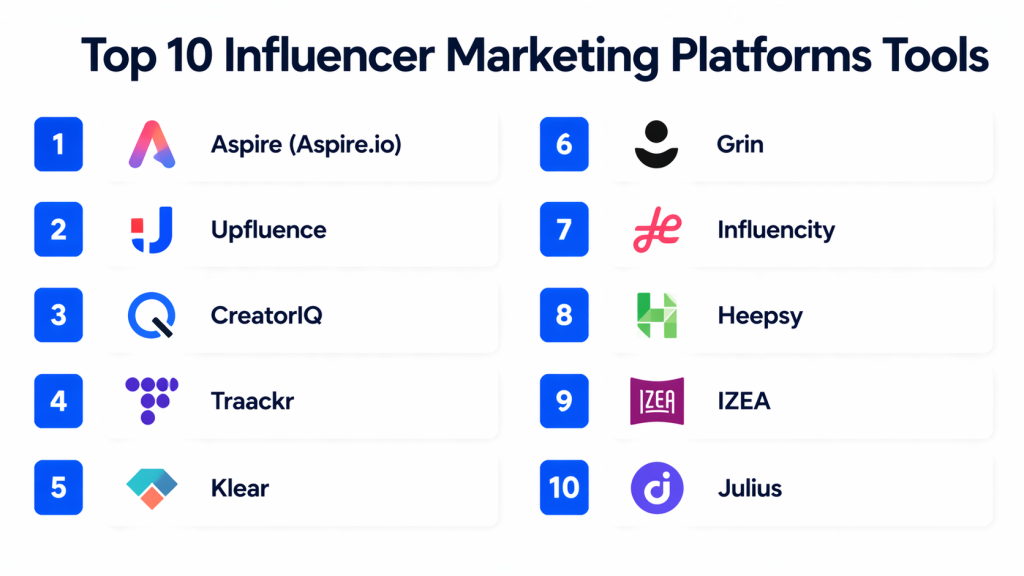
Top 10 Influencer Marketing Platforms Tools
#1 — Aspire (Aspire.io)
Short description: Aspire is an influencer marketing platform that helps brands discover, manage, and track influencer collaborations from planning to performance.
Key Features
- Influencer discovery with advanced search filters
- Campaign workflows and approvals
- Content scheduling and publisher tools
- Custom performance dashboards
- Relationship tracking and creator CRM
- Payment tracking and contract management
- Engagement quality and ROI reporting
Pros
- Balanced feature set for mid‑size and enterprise
- Strong CRM and workflow tools
- Detailed reporting for performance evaluation
Cons
- May be more than needed for simple campaigns
- Learning curve for new users
Platforms / Deployment
- Web
- Cloud
Security & Compliance
- Not publicly stated
Integrations & Ecosystem
Aspire integrates with CRM systems, social analytics, and content planning tools.
- Audience analytics platforms
- Social media publishers
- CRM connectors
Support & Community
- Comprehensive documentation
- Onboarding support
- Email and tiered support plans
#2 — Upfluence
Short description: Upfluence provides influencer discovery, campaign management, and performance tracking, suitable for agencies and e‑commerce brands.
Key Features
- Global influencer search across major platforms
- Automated outreach campaigns
- Real‑time performance dashboards
- Affiliate tracking and conversion measurement
- Audience demographic filters
- Workflow automation
Pros
- Strong discovery filters
- E‑commerce and affiliate capabilities
- Real‑time analytics
Cons
- Pricing can scale steeply
- Advanced features may require training
Platforms / Deployment
- Web
- Cloud
Security & Compliance
- Not publicly stated
Integrations & Ecosystem
- E‑commerce platforms
- CRM systems
- Analytics and reporting tools
Support & Community
- Documentation and onboarding
- Support tiers based on plan
#3 — CreatorIQ
Short description: Enterprise influencer marketing platform with deep analytics, AI‑driven discovery, and integration capabilities for large brands.
Key Features
- AI‑powered influencer matching
- Cross‑network performance analytics
- Fraud and audience authenticity scoring
- Team collaboration workflows
- Custom dashboards and reporting
- Integrated CRM and automation connectors
Pros
- Enterprise‑grade scalability
- Strong analytics and AI capabilities
- Integration flexibility
Cons
- Premium pricing
- Requires onboarding and training
Platforms / Deployment
- Web
- Cloud
Security & Compliance
- Not publicly stated
Integrations & Ecosystem
CreatorIQ supports integrations with CRM, CDPs, analytics suites, and social publishers.
- Enterprise CRM
- Data analytics platforms
- Workflow automation
Support & Community
- Enterprise support tiers
- Onboarding and training resources
#4 — Traackr
Short description: Traackr is a relationship‑focused influencer marketing platform, emphasizing influencer management, analytics, and performance ROI.
Key Features
- Influencer ranking and scoring
- Relationship CRM features
- Campaign planning and measurement
- Competitive benchmarking
- Content performance insights
- Custom reporting tools
Pros
- Strong CRM for influencers
- Competitive analysis features
- Good for strategic programs
Cons
- Less intuitive UI for beginners
- Premium investment
Platforms / Deployment
- Web
- Cloud
Security & Compliance
- Not publicly stated
Integrations & Ecosystem
- CRM connections
- Business intelligence tools
- Analytics platforms
Support & Community
- Documentation
- Support tiers by plan
#5 — Klear
Short description: Klear offers influencer discovery, campaign management, and analytics with social listening and competitor insights.
Key Features
- Discovery across platforms with filtering
- Campaign workflow tools
- Influencer performance tracking
- Social listening and sentiment signals
- Audience analytics
- Collaboration and approval tools
Pros
- Social listening built‑in
- Audience and sentiment insights
- Strong search filters
Cons
- May require external analytics for deeper insights
- Feature depth varies by plan
Platforms / Deployment
- Web
- Cloud
Security & Compliance
- Not publicly stated
Integrations & Ecosystem
- CRM systems
- Social analytics tools
- Collaboration platforms
Support & Community
- Documentation
- Support tiers or email support
#6 — Grin
Short description: Grin is designed for direct commerce and product‑centric influencer campaigns, especially for D2C brands and e‑commerce.
Key Features
- Influencer discovery and outreach
- Commerce and affiliate link tracking
- Product seeding and fulfillment workflows
- ROI and revenue attribution
- SMS and email communication tools
- Content approval and workflows
Pros
- E‑commerce‑centric capabilities
- Product seeding management
- Revenue‑linked ROI insights
Cons
- E‑commerce focus may not suit all use cases
- Learning curve for new teams
Platforms / Deployment
- Web
- Cloud
Security & Compliance
- Not publicly stated
Integrations & Ecosystem
- E‑commerce platforms
- CRM and marketing automation
Support & Community
- Documentation
- Customer support tiers
#7 — Influencity
Short description: Influencity offers large‑scale influencer discovery and campaign analytics with multilingual and multi‑platform support.
Key Features
- Global influencer database
- Audience demographic filters
- Campaign tracking and analytics
- Bulk outreach tools
- Social listening inputs
- Performance dashboards
Pros
- Multilingual and multi‑region support
- Detailed discovery filters
- Bulk campaign tools
Cons
- Analytics may require external tools for depth
- UI complexity for first‑time users
Platforms / Deployment
- Web
- Cloud
Security & Compliance
- Not publicly stated
Integrations & Ecosystem
- CRM systems
- Analytics dashboards
Support & Community
- Documentation
- Email support
#8 — Heepsy
Short description: Heepsy focuses on influencer discovery with robust filters and audience authenticity metrics, ideal for SMBs and agencies.
Key Features
- Influencer search with advanced filters
- Audience authenticity and engagement metrics
- Campaign lists and tracking
- Competitor tracking
- CSV export and team notes
Pros
- Strong discovery and filtering
- Good for smaller teams
- Fast list generation
Cons
- Less robust workflow or payment tools
- Reporting limited compared to larger platforms
Platforms / Deployment
- Web
- Cloud
Security & Compliance
- Not publicly stated
Integrations & Ecosystem
- Export formats
- CRM import support
Support & Community
- Documentation
- Email support
#9 — IZEA
Short description: IZEA provides influencer marketplace capabilities and campaign management for brands and agencies.
Key Features
- Marketplace for influencer bids
- Campaign creation tools
- Performance tracking
- Payment workflows
- Content approval
- Engagement metrics
Pros
- Marketplace simplifies matching
- Built‑in payment workflows
- Good for varied campaign types
Cons
- Marketplace activity varies by region
- Analytics depth variable
Platforms / Deployment
- Web
- Cloud
Security & Compliance
- Not publicly stated
Integrations & Ecosystem
- CRM and tracking tools
- Analytics connectors
Support & Community
- Documentation
- Support tiers
#10 — Julius
Short description: Julius offers influencer discovery and relationship management with data‑rich profiles and audience insights.
Key Features
- Influencer profiles with demographic detail
- Audience metrics and engagement tracking
- Campaign tracking
- CRM workflows
- Collaborative notes and team access
Pros
- Detailed profiles
- Relationship tools
- Audience insights
Cons
- Not as deep in automation
- May require additional reporting tools
Platforms / Deployment
- Web
- Cloud
Security & Compliance
- Not publicly stated
Integrations & Ecosystem
- CRM and analytics support
- Workflow integrations
Support & Community
- Documentation
- Email support
Comparison Table (Top 10)
| Tool Name | Best For | Platform(s) Supported | Deployment | Standout Feature | Public Rating |
|---|---|---|---|---|---|
| Aspire | Mid‑size and enterprise | Web | Cloud | Relationship CRM + performance | N/A |
| Upfluence | Agencies and e‑commerce | Web | Cloud | Discovery + affiliate tracking | N/A |
| CreatorIQ | Enterprise | Web | Cloud | AI‑driven discovery and analytics | N/A |
| Traackr | Strategic programs | Web | Cloud | Influencer CRM and benchmarking | N/A |
| Klear | Discovery + social listening | Web | Cloud | Social listening insights | N/A |
| Grin | D2C and commerce campaigns | Web | Cloud | Product seeding + revenue attribution | N/A |
| Influencity | Large‑scale discovery | Web | Cloud | Bulk outreach and demographics | N/A |
| Heepsy | SMB and agencies | Web | Cloud | Audience authenticity metrics | N/A |
| IZEA | Marketplace campaigns | Web | Cloud | Built‑in marketplace | N/A |
| Julius | Influencer profiling | Web | Cloud | Detailed audience profiles | N/A |
Evaluation & Scoring of Influencer Marketing Platforms
| Tool Name | Core (25%) | Ease (15%) | Integrations (15%) | Security (10%) | Performance (10%) | Support (10%) | Value (15%) | Weighted Total (0–10) |
|---|---|---|---|---|---|---|---|---|
| Aspire | 9 | 8 | 8 | 7 | 8 | 8 | 7 | 8.3 |
| Upfluence | 8 | 7 | 7 | 7 | 8 | 7 | 7 | 7.5 |
| CreatorIQ | 9 | 7 | 8 | 7 | 9 | 8 | 6 | 8.1 |
| Traackr | 8 | 7 | 7 | 7 | 8 | 7 | 6 | 7.5 |
| Klear | 7 | 8 | 7 | 7 | 8 | 7 | 7 | 7.5 |
| Grin | 8 | 8 | 7 | 7 | 8 | 7 | 7 | 7.7 |
| Influencity | 7 | 7 | 7 | 7 | 7 | 7 | 8 | 7.4 |
| Heepsy | 6 | 8 | 6 | 7 | 7 | 7 | 8 | 7.3 |
| IZEA | 7 | 7 | 6 | 7 | 7 | 7 | 8 | 7.3 |
| Julius | 7 | 8 | 6 | 7 | 7 | 7 | 7 | 7.1 |
Interpretation:
The weighted scores provide a comparative snapshot of how each platform balances core functionality, ease of use, integration flexibility, and value. Higher scores indicate a mix of robust features and practical usability. Scoring is relative — a high score means stronger comparative positioning against others in this list rather than absolute perfection in every scenario. Select tools based on your specific scale, campaign complexity, and tech stack alignment.
Which Influencer Marketing Platforms Tool Is Right for You?
Solo / Freelancer
- Heepsy, IZEA: Quick discovery tools and marketplace options for short campaigns or consultant workflows without heavy overhead.
SMB
- Aspire, Grin, Klear: Balanced tools with discovery, workflow, and performance tracking that fit growing internal or agency teams.
Mid‑Market
- Upfluence, Traackr, Influencity: Scalable search and campaign management with audience insights and multi‑brand support.
Enterprise
- CreatorIQ, Aspire (enterprise tier), Traackr: Enterprise‑focused analytics, integrations, and CRM capabilities for complex global influencer programs.
Budget vs Premium
- Budget: Heepsy, IZEA — focused discovery and campaign basics with sensible pricing.
- Premium: CreatorIQ, Aspire — deeper analytics, AI discovery, and broader integrations.
Feature Depth vs Ease of Use
- Feature Depth: CreatorIQ, Aspire, Grin — comprehensive tools for large programs.
- Ease of Use: Heepsy, Klear — intuitive discovery and entry‑level workflows.
Integrations & Scalability
- Choose platforms with API support, CRM connectors, CDP synchronization, and analytics integration to embed influencer data into broader marketing ecosystems.
Security & Compliance Needs
- Evaluate platforms that offer enterprise access controls, audit logs, and encryption to align with organizational governance requirements, especially for regulated brands.
Frequently Asked Questions (FAQs)
1. What pricing models do influencer marketing platforms use?
Platforms often use subscription tiers based on influencer count, audience reach, campaign volume, or feature sets. Some include usage‑based pricing and enterprise licensing.
2. How long does implementation take?
Smaller tools can be set up in days; enterprise platforms may require weeks of onboarding, data integration, and training.
3. Can I manage multiple campaigns simultaneously?
Yes — most platforms include campaign management dashboards and workflow tools to coordinate multiple simultaneous influencer programs.
4. How do platforms ensure audience authenticity?
Many use engagement quality metrics, bot detection signals, and audience analysis algorithms to estimate authentic reach and flag suspicious behavior.
5. Do influencer tools integrate with CRM or analytics systems?
Top platforms offer native or API‑based integrations with CRM, CDP, analytics, and marketing automation stacks for unified insights.
6. Are influencer marketplaces reliable?
Marketplaces match brands and creators efficiently, but vetting quality and alignment remains a strategic responsibility to ensure campaign fit.
7. Can I automate payments to influencers?
Some platforms include payment workflows and contract management to streamline compensation, though regional payment connectivity may vary.
8. How do I measure ROI from influencers?
ROI is measured via engagement metrics, traffic, conversions, revenue attributed to influencer content, and brand lift studies when available.
9. What compliance concerns should I consider?
Ensure clear disclosure of sponsorships, FTC or regional advertising requirements, data privacy compliance, and platform terms of service.
10. Is influencer marketing worth the investment?
When aligned with strategy, audience fit, and measurable KPIs, influencer campaigns can drive brand awareness, engagement, community growth, and conversions.
Conclusion
Influencer marketing platforms have evolved into sophisticated tools that help brands scale meaningful creator collaborations, streamline workflows, and measure performance across diverse digital channels. From discovery and campaign automation to data‑driven insights and audience authenticity signals, modern platforms offer capabilities that align with strategic audience engagement goals. While enterprise tools like CreatorIQ and Aspire deliver deep analytics and integration flexibility, mid‑market and SMB‑friendly tools such as Grin, Klear, and Heepsy provide approachable entry points with strong discovery and performance tracking. The best platform depends on your organization’s scale, campaign complexity, and integration needs — shortlist a few tools, pilot campaigns, and validate integration and compliance to identify the right fit.

Find Trusted Cardiac Hospitals
Compare heart hospitals by city and services — all in one place.
Explore Hospitals
This explains how influencer marketing platforms make it easier to find the right creators and manage campaigns in one place.