Introduction
Kubernetes Policy Enforcement Tools are security and governance solutions that ensure workloads running on Kubernetes clusters comply with organizational rules, security standards, and operational best practices. These tools act as guardrails, automatically validating configurations, enforcing policies at deployment time, and preventing risky workloads from reaching production. In modern cloud-native environments, Kubernetes clusters are highly dynamic, with thousands of microservices, containers, and configurations being deployed continuously. Without automated policy enforcement, misconfigurations can easily lead to security breaches, compliance violations, or operational failures.
Real-world use cases include:
- Blocking privileged containers from being deployed in production clusters
- Enforcing image security policies before workloads are scheduled
- Ensuring only signed and trusted container images are used
- Validating network policies and pod security standards
- Enforcing compliance rules for regulated industries like finance and healthcare
What buyers should evaluate:
- Kubernetes-native integration depth
- Policy language flexibility (YAML, Rego, etc.)
- Admission controller capabilities
- Real-time enforcement vs. audit-only modes
- Multi-cluster governance support
- Integration with CI/CD pipelines
- Performance overhead on clusters
- Policy versioning and lifecycle management
- Reporting and compliance visibility
- Ease of adoption for platform teams
Best for: Platform engineering teams, DevSecOps engineers, Kubernetes administrators, cloud security teams, and enterprises running large-scale containerized workloads.
Not ideal for: Small-scale applications without Kubernetes adoption, traditional monolithic deployments, or teams without automated infrastructure pipelines.
Key Trends in Kubernetes Policy Enforcement Tools
- AI-assisted policy generation and recommendation engines
- Shift-left enforcement integrated into CI/CD pipelines
- Standardization of Kubernetes policy frameworks (OPA, Kyverno dominance)
- Real-time runtime policy enforcement at scale
- Increased adoption of zero-trust Kubernetes architectures
- Policy-as-code convergence with GitOps workflows
- Automated compliance reporting for audits and certifications
- Cross-cluster and multi-cloud policy synchronization
- Lightweight sidecar-based enforcement models
- Stronger integration with supply chain security (SBOM, image signing)
How We Selected These Tools (Methodology)
- Market adoption across Kubernetes and DevSecOps ecosystems
- Depth of policy enforcement capabilities
- Kubernetes-native integration quality
- Flexibility of policy definition languages
- Performance impact on cluster workloads
- Security and governance features
- Multi-cluster scalability support
- Ecosystem maturity and community strength
- CI/CD and GitOps compatibility
- Enterprise readiness and compliance support
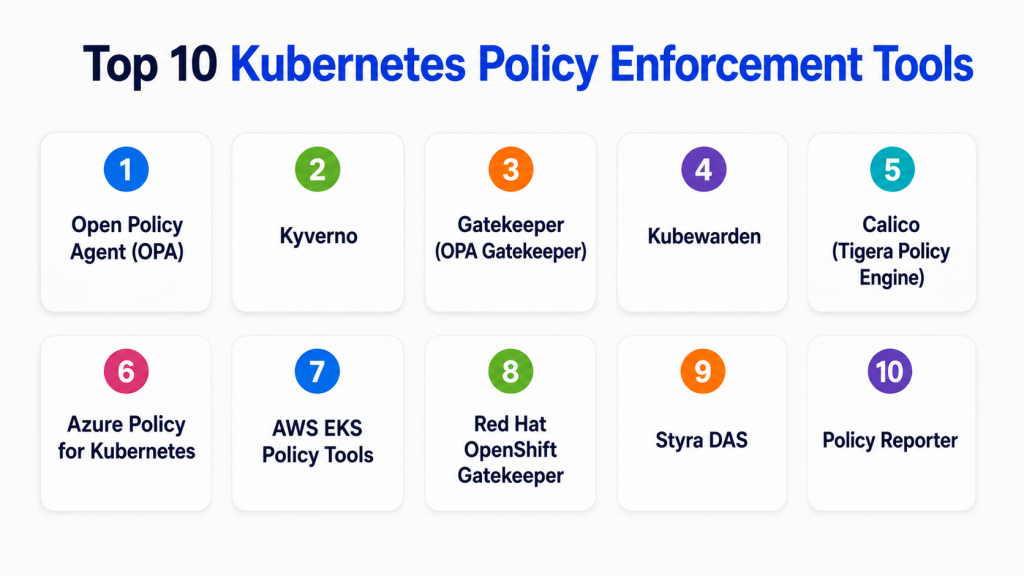
Top 10 Kubernetes Policy Enforcement Tools
1- Kyverno
Short description:
Kyverno is a Kubernetes-native policy engine that allows users to define policies using YAML instead of complex policy languages. It is widely used for admission control and cluster governance.
Key Features
- Kubernetes-native policy engine
- YAML-based policy definitions
- Admission control enforcement
- Policy validation and mutation
- Resource generation rules
- Namespace-level policies
- CI/CD integration support
Pros
- Easy to learn for Kubernetes users
- No custom policy language required
- Strong Kubernetes integration
Cons
- Limited outside Kubernetes scope
- Advanced policies can become complex
- Requires tuning at scale
Platforms / Deployment
Cloud / Self-hosted
Security & Compliance
- Kubernetes RBAC integration
- Audit logging support
- Policy enforcement controls
- Compliance certifications: Not publicly stated
Integrations & Ecosystem
Kyverno integrates deeply into Kubernetes-native ecosystems and GitOps workflows.
- Kubernetes API server
- Helm
- Argo CD
- Flux CD
- CI/CD pipelines
- Git repositories
Support & Community
Strong CNCF-backed open-source community with active development.
2- Open Policy Agent (OPA)
Short description:
OPA is a general-purpose policy engine used across Kubernetes, APIs, microservices, and cloud environments. It uses the Rego language for flexible policy definitions.
Key Features
- Rego-based policy language
- Kubernetes admission control
- Multi-environment policy enforcement
- API authorization policies
- Centralized policy engine
- Integration with service mesh
- Fine-grained access control
Pros
- Extremely flexible and powerful
- Works beyond Kubernetes
- Large ecosystem adoption
Cons
- Steep learning curve (Rego)
- Complex policy authoring
- Requires governance structure
Platforms / Deployment
Cloud / Self-hosted / Hybrid
Security & Compliance
- RBAC support
- Audit logging
- Policy decision logs
- Encryption support: Not publicly stated
Integrations & Ecosystem
OPA is widely integrated across cloud-native ecosystems.
- Kubernetes
- Envoy
- Istio
- Terraform
- CI/CD pipelines
- API gateways
Support & Community
One of the largest open-source policy communities.
3- Gatekeeper (OPA Kubernetes Extension)
Short description:
Gatekeeper is a Kubernetes-native extension of OPA that provides admission control and policy enforcement using Kubernetes CRDs.
Key Features
- Kubernetes admission controller
- Constraint-based policy enforcement
- Policy templates
- Audit mode enforcement
- CRD-based policy management
- Multi-cluster support
- Integration with OPA engine
Pros
- Native Kubernetes integration
- Strong OPA compatibility
- Declarative policy management
Cons
- Requires OPA understanding
- Limited outside Kubernetes
- Performance tuning needed at scale
Platforms / Deployment
Cloud / Self-hosted
Security & Compliance
- RBAC support
- Audit logging
- Policy enforcement modes
- Compliance: Not publicly stated
Integrations & Ecosystem
- Kubernetes API server
- OPA ecosystem
- Helm
- CI/CD pipelines
- GitOps tools
Support & Community
Strong open-source CNCF community support.
4- Kubewarden
Short description:
Kubewarden is a policy engine for Kubernetes that allows policies to be written in multiple languages like Rust, Go, or WebAssembly modules.
Key Features
- WebAssembly-based policies
- Multi-language policy support
- Kubernetes admission control
- Policy lifecycle management
- Secure sandbox execution
- Policy distribution system
- Audit capabilities
Pros
- Flexible policy language support
- Strong security isolation
- Modern WebAssembly architecture
Cons
- Smaller ecosystem
- Newer compared to OPA/Kyverno
- Limited enterprise adoption
Platforms / Deployment
Cloud / Self-hosted
Security & Compliance
- Sandboxed execution
- RBAC support
- Audit logs
- Compliance: Not publicly stated
Integrations & Ecosystem
- Kubernetes
- CI/CD pipelines
- GitOps workflows
- WebAssembly runtime
- Helm
Support & Community
Growing open-source community.
5- Kyverno Policy Reporter (Ecosystem Tooling)
Short description:
Policy Reporter complements Kyverno by providing visibility and reporting for policy violations and enforcement results.
Key Features
- Policy violation reporting
- Dashboard visualization
- Kubernetes integration
- Audit trail tracking
- Multi-cluster reporting
- CI/CD integration
- Notification systems
Pros
- Improves visibility
- Strong Kyverno integration
- Easy reporting setup
Cons
- Depends on Kyverno ecosystem
- Limited standalone functionality
- Basic policy enforcement features
Platforms / Deployment
Cloud / Self-hosted
Security & Compliance
- RBAC integration
- Audit logging
- Reporting controls
- Compliance: Not publicly stated
Integrations & Ecosystem
- Kyverno
- Kubernetes
- Prometheus
- Grafana
- CI/CD tools
Support & Community
Active open-source community.
6- Red Hat OpenShift Gatekeeper
Short description:
OpenShift Gatekeeper provides enterprise policy enforcement capabilities within Red Hat OpenShift environments using OPA Gatekeeper.
Key Features
- Enterprise policy enforcement
- OpenShift integration
- Multi-cluster governance
- Admission control
- Security policy templates
- Audit and compliance reporting
- RBAC enforcement
Pros
- Enterprise-grade Kubernetes governance
- Strong support ecosystem
- Deep OpenShift integration
Cons
- OpenShift dependency
- Licensing costs
- Less flexible outside ecosystem
Platforms / Deployment
Cloud / Self-hosted / Hybrid
Security & Compliance
- SSO integration
- RBAC controls
- Audit logging
- Enterprise compliance support
Integrations & Ecosystem
- OpenShift
- Kubernetes
- OPA
- CI/CD pipelines
- Red Hat ecosystem
Support & Community
Enterprise Red Hat support.
7- AWS Pod Security Admission / EKS Policy Tools
Short description:
AWS provides native Kubernetes policy enforcement capabilities through EKS integrations and IAM-based controls.
Key Features
- Pod security enforcement
- IAM-based policy control
- EKS integration
- Admission control policies
- Cloud-native governance
- Security baselines enforcement
- Audit logging via AWS services
Pros
- Deep AWS integration
- Managed service simplicity
- Strong cloud governance
Cons
- AWS ecosystem dependency
- Limited portability
- Less flexible policy customization
Platforms / Deployment
Cloud (AWS only)
Security & Compliance
- IAM policies
- CloudTrail logging
- RBAC integration
- Compliance: Not publicly stated
Integrations & Ecosystem
- AWS EKS
- IAM
- CloudWatch
- CI/CD pipelines
- AWS security services
Support & Community
Enterprise AWS support ecosystem.
8- Gatekeeper Policy Manager (Enterprise Extensions)
Short description:
Enterprise Gatekeeper solutions provide centralized policy lifecycle management for Kubernetes environments.
Key Features
- Centralized policy management
- Multi-cluster enforcement
- Policy versioning
- Compliance dashboards
- RBAC governance
- Audit reporting
- CI/CD integration
Pros
- Strong governance capabilities
- Enterprise scalability
- Policy lifecycle control
Cons
- Commercial licensing
- Complex setup
- Requires Kubernetes maturity
Platforms / Deployment
Cloud / Self-hosted
Security & Compliance
- SSO/SAML support
- Audit logs
- RBAC enforcement
- Compliance: Not publicly stated
Integrations & Ecosystem
- Kubernetes
- OPA Gatekeeper
- CI/CD tools
- GitOps platforms
- Security dashboards
Support & Community
Enterprise vendor support.
9- Tigera Calico Policy Engine
Short description:
Calico provides Kubernetes network security and policy enforcement with strong identity-based controls.
Key Features
- Network policy enforcement
- Microsegmentation
- Kubernetes-native policies
- Identity-based access control
- Traffic monitoring
- Security policy automation
- Multi-cluster support
Pros
- Strong network security integration
- High scalability
- Mature Kubernetes adoption
Cons
- Focused on networking policies
- Complex configuration
- Requires Kubernetes expertise
Platforms / Deployment
Cloud / Self-hosted
Security & Compliance
- RBAC support
- Network-level security enforcement
- Audit logging
- Compliance: Not publicly stated
Integrations & Ecosystem
- Kubernetes
- Istio
- Cloud providers
- CI/CD pipelines
- Security tools
Support & Community
Strong enterprise and open-source ecosystem.
10- Microsoft Azure Policy for Kubernetes
Short description:
Azure Policy extends governance capabilities to Kubernetes clusters running in Azure or connected environments.
Key Features
- Kubernetes policy enforcement
- Azure Arc integration
- Compliance management
- Policy assignment at scale
- Audit and reporting dashboards
- Built-in policy definitions
- Multi-cluster governance
Pros
- Deep Azure integration
- Strong compliance tools
- Easy enterprise adoption
Cons
- Azure ecosystem dependency
- Limited flexibility outside Azure
- Less customizable than OPA
Platforms / Deployment
Cloud (Azure / Hybrid via Arc)
Security & Compliance
- Azure RBAC
- SSO integration
- Audit logs
- Compliance frameworks: Not publicly stated
Integrations & Ecosystem
- Azure Kubernetes Service (AKS)
- Azure Arc
- CI/CD pipelines
- Microsoft Defender for Cloud
- GitHub Actions
Support & Community
Enterprise Microsoft support.
Comparison Table (Top 10)
| Tool Name | Best For | Platform Supported | Deployment | Standout Feature | Public Rating |
|---|---|---|---|---|---|
| Kyverno | Kubernetes-native teams | Kubernetes | Cloud/Self-hosted | YAML policies | N/A |
| OPA | Universal policy engine | Multi-platform | Hybrid | Rego flexibility | N/A |
| Gatekeeper | Kubernetes admission control | Kubernetes | Cloud/Self-hosted | OPA Kubernetes extension | N/A |
| Kubewarden | Multi-language policies | Kubernetes | Cloud/Self-hosted | WebAssembly policies | N/A |
| Policy Reporter | Policy visibility | Kubernetes | Cloud/Self-hosted | Reporting dashboards | N/A |
| OpenShift Gatekeeper | Enterprise OpenShift | Kubernetes | Hybrid | Enterprise governance | N/A |
| AWS Policy Tools | AWS Kubernetes governance | Kubernetes | Cloud | Native AWS control | N/A |
| Enterprise Gatekeeper | Multi-cluster governance | Kubernetes | Cloud/Self-hosted | Centralized policy mgmt | N/A |
| Calico | Network security policies | Kubernetes | Cloud/Self-hosted | Microsegmentation | N/A |
| Azure Policy | Azure Kubernetes governance | Kubernetes | Cloud/Hybrid | Azure Arc integration | N/A |
Evaluation & Scoring of Kubernetes Policy Enforcement Tools
| Tool | Core | Ease | Integrations | Security | Performance | Support | Value | Weighted Total |
|---|---|---|---|---|---|---|---|---|
| Kyverno | 9 | 9 | 9 | 9 | 9 | 8 | 10 | 9.05 |
| OPA | 10 | 7 | 10 | 10 | 9 | 9 | 9 | 9.15 |
| Gatekeeper | 9 | 8 | 9 | 9 | 9 | 8 | 10 | 8.90 |
| Kubewarden | 8 | 8 | 8 | 8 | 9 | 8 | 9 | 8.25 |
| Policy Reporter | 7 | 9 | 8 | 8 | 8 | 8 | 10 | 8.10 |
| OpenShift Gatekeeper | 9 | 8 | 9 | 10 | 9 | 9 | 7 | 8.70 |
| AWS Policy Tools | 8 | 9 | 9 | 9 | 9 | 9 | 8 | 8.75 |
| Enterprise Gatekeeper | 9 | 8 | 9 | 9 | 9 | 9 | 7 | 8.65 |
| Calico | 9 | 8 | 9 | 9 | 9 | 9 | 8 | 8.85 |
| Azure Policy | 9 | 9 | 8 | 9 | 9 | 9 | 8 | 8.80 |
Which Kubernetes Policy Enforcement Tool Is Right for You?
Solo / Freelancer
- Kyverno
- OPA (learning use)
- Kubewarden
SMB
- Kyverno
- Gatekeeper
- Calico
Mid-Market
- OPA
- Calico
- Azure Policy
Enterprise
- OPA
- OpenShift Gatekeeper
- Azure Policy
- AWS Policy Tools
Budget vs Premium
- Budget-friendly: Kyverno, OPA, Kubewarden
- Premium enterprise: OpenShift Gatekeeper, Azure Policy, AWS tools
Feature Depth vs Ease of Use
- Deep flexibility: OPA
- Easy Kubernetes-native approach: Kyverno
Integrations & Scalability
- Best integrations: OPA, Azure Policy, Gatekeeper
- Best scalability: Calico, OPA, OpenShift Gatekeeper
Security & Compliance Needs
- Strong compliance: Azure Policy, OpenShift Gatekeeper, OPA
- Strong network security: Calico
Frequently Asked Questions
1. What are Kubernetes policy enforcement tools?
They are tools that enforce security, compliance, and governance rules inside Kubernetes clusters automatically by validating workloads before deployment, ensuring only safe and approved configurations are allowed, and reducing human errors in production environments.
2. Why are Kubernetes policy enforcement tools important?
They are important because Kubernetes environments are highly dynamic and manual governance is not scalable; these tools prevent misconfigurations, enforce security standards, and help maintain compliance across large distributed systems.
3. What is the difference between OPA and Kyverno?
OPA uses the Rego language for defining flexible and advanced policies, while Kyverno uses Kubernetes-native YAML-based policies that are easier for teams to adopt without learning a new language, making Kyverno more beginner-friendly and OPA more powerful.
4. Do Kubernetes policy tools impact performance?
Yes, they can introduce minor overhead depending on policy complexity, but most modern tools are optimized to run efficiently at scale and typically have minimal impact when properly configured in production clusters.
5. Can these tools be used in multi-cluster environments?
Yes, many Kubernetes policy enforcement tools support multi-cluster governance, allowing centralized policy management and consistent enforcement across hybrid and multi-cloud environments.
6. Are these tools difficult to implement?
It depends on the tool; Kyverno is easier to implement due to YAML-based policies, while OPA and enterprise-grade tools require more setup effort, governance planning, and deeper Kubernetes knowledge.
7. Do they integrate with CI/CD pipelines?
Yes, most tools integrate directly with CI/CD pipelines to enable shift-left security, ensuring policies are validated during build and deployment stages before workloads reach production.
8. What is Kubernetes admission control?
Admission control is a mechanism that intercepts requests to the Kubernetes API server before objects are created, and policy tools use this stage to validate, modify, or reject workloads based on defined rules.
9. Can these tools help with compliance?
Yes, they are widely used for compliance enforcement by ensuring workloads follow security standards, regulatory requirements, and internal governance policies, while also generating audit logs for reporting.
10. What is the biggest challenge in policy enforcement?
The biggest challenge is balancing strict security with developer productivity, as overly restrictive policies can slow deployments while weak policies can expose systems to security risks.
Conclusion
Kubernetes Policy Enforcement Tools are essential for maintaining secure, compliant, and stable cloud-native environments. As Kubernetes adoption continues to grow, organizations must implement automated policy systems to prevent misconfigurations and enforce governance at scale. While tools like Kyverno offer simplicity and ease of use, OPA provides unmatched flexibility, and enterprise solutions like Azure Policy, OpenShift Gatekeeper, and Calico deliver advanced governance capabilities. The right choice depends on your Kubernetes maturity, cloud provider strategy, and compliance needs. A practical approach is to shortlist 2–3 tools, test them in a staging Kubernetes environment, evaluate performance and policy coverage, and then scale gradually across clusters.

Find Trusted Cardiac Hospitals
Compare heart hospitals by city and services — all in one place.
Explore Hospitals
Kubernetes policy enforcement becomes far more effective when security rules are aligned with developer workflows instead of being introduced only after deployment. Teams usually achieve better compliance when policies are validated early in the delivery pipeline rather than enforced solely at runtime.