Introduction
Runtime Application Self-Protection (RASP) is a modern application security technology that embeds directly into an application’s runtime environment to detect and block attacks in real time. Unlike traditional perimeter-based security tools, RASP operates inside the application itself, giving it deep visibility into application behavior, inputs, and execution flows. cloud-native world, applications are distributed, API-driven, and continuously deployed. This makes runtime protection critical because attacks increasingly bypass network defenses and directly target application logic.
Real-world use cases include:
- Blocking SQL injection and command injection attacks at runtime
- Detecting and preventing API abuse in microservices architectures
- Protecting SaaS applications from zero-day exploitation attempts
- Monitoring runtime behavior for suspicious application activity
- Enforcing security policies inside containers and serverless functions
What buyers should evaluate:
- Runtime visibility and instrumentation depth
- Language and framework support (Java, .NET, Node.js, etc.)
- Performance overhead on production workloads
- Ability to block vs. detect-only capabilities
- Integration with CI/CD and DevSecOps pipelines
- API and microservices protection capabilities
- False positive reduction accuracy
- Cloud-native and container compatibility
- Ease of deployment in production environments
- Reporting, analytics, and forensic visibility
Best for: Enterprise security teams, DevSecOps engineers, SaaS providers, fintech and healthcare platforms, and organizations running high-risk web or API-driven applications.
Not ideal for: Static websites, low-risk internal tools, or environments without continuous application runtime exposure.
Key Trends in RASP
- Shift from passive detection to active runtime blocking
- AI-driven anomaly detection for runtime behavior analysis
- Deep integration with API security and microservices protection
- Expansion into serverless and edge computing environments
- Lightweight agents reducing application performance overhead
- Convergence of RASP with API security platforms
- Increased adoption in zero-trust application architectures
- Automated threat response and remediation workflows
- Cloud-native RASP designed for Kubernetes environments
- Enhanced observability combining runtime security + APM data
How We Selected These Tools (Methodology)
- Market adoption across enterprise application security ecosystems
- Depth of runtime instrumentation capabilities
- Accuracy in attack detection and prevention
- Support for multiple languages and frameworks
- Performance impact on production applications
- Integration with DevSecOps and CI/CD pipelines
- Cloud-native and container compatibility
- API security and web application protection features
- Security posture and enterprise readiness
- Community maturity and vendor ecosystem strength
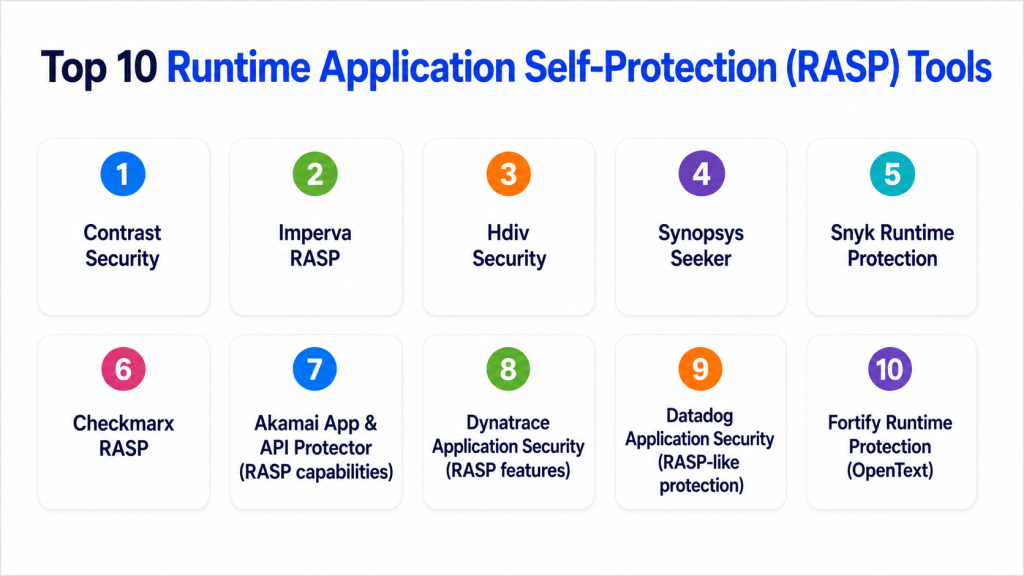
Top 10 Runtime Application Self-Protection (RASP) Tools
1- Imperva RASP
Short description:
Imperva RASP provides real-time application protection by embedding security controls directly into applications to detect and block attacks during execution.
Key Features
- Real-time attack detection and blocking
- Application-level instrumentation
- SQL injection and XSS protection
- API security monitoring
- Behavioral anomaly detection
- Integration with WAF systems
- Centralized security dashboards
Pros
- Strong enterprise-grade protection
- Effective real-time blocking capabilities
- Broad application coverage
Cons
- Complex deployment in legacy apps
- Requires tuning for large environments
- Premium pricing model
Platforms / Deployment
Cloud / Hybrid
Security & Compliance
- SSO/SAML support
- MFA authentication
- Audit logging
- Compliance certifications: Not publicly stated
Integrations & Ecosystem
Imperva integrates deeply with web application security stacks and DevSecOps pipelines.
- Web Application Firewalls
- API gateways
- SIEM platforms
- CI/CD pipelines
- Cloud security tools
Support & Community
Strong enterprise vendor support with extensive documentation.
2- Contrast Security RASP
Short description:
Contrast Security is one of the most widely adopted RASP platforms, focusing on continuous application security inside runtime environments.
Key Features
- Code-level runtime instrumentation
- Real-time vulnerability detection
- Attack path tracing
- API and microservice protection
- Automatic threat detection
- Developer security feedback loop
- Continuous application monitoring
Pros
- Deep application visibility
- Strong developer-centric approach
- High detection accuracy
Cons
- Requires agent instrumentation
- Learning curve for configuration
- Enterprise licensing cost
Platforms / Deployment
Cloud / Self-hosted / Hybrid
Security & Compliance
- SSO/SAML support
- RBAC controls
- Audit logs
- Compliance: Not publicly stated
Integrations & Ecosystem
- CI/CD pipelines
- Kubernetes environments
- SIEM tools
- DevOps toolchains
- Cloud platforms
Support & Community
Strong enterprise support with active developer community.
3- Cloudflare Application Security (RASP-like runtime protections)
Short description:
Cloudflare provides runtime application protection capabilities integrated into its edge security platform.
Key Features
- Edge-based runtime protection
- API abuse detection
- Bot mitigation
- Real-time traffic analysis
- DDoS protection integration
- WAF + runtime correlation
- Threat intelligence engine
Pros
- Strong global edge network
- Easy deployment at scale
- High performance protection
Cons
- Not traditional agent-based RASP
- Limited deep application instrumentation
- Vendor ecosystem dependency
Platforms / Deployment
Cloud
Security & Compliance
- TLS encryption
- DDoS protection
- RBAC support
- Compliance: Not publicly stated
Integrations & Ecosystem
- APIs
- SIEM systems
- Cloud platforms
- DevOps pipelines
- Security tools
Support & Community
Strong global enterprise support ecosystem.
4- Dynatrace RASP (Application Security Module)
Short description:
Dynatrace provides runtime application protection integrated into its observability platform for real-time security monitoring.
Key Features
- Runtime vulnerability detection
- Application observability integration
- AI-driven anomaly detection
- Code-level tracing
- API monitoring
- Attack visualization
- Performance-security correlation
Pros
- Strong observability + security integration
- AI-driven insights
- High scalability
Cons
- Complex platform setup
- Premium pricing
- Requires Dynatrace ecosystem adoption
Platforms / Deployment
Cloud / Hybrid
Security & Compliance
- SSO integration
- RBAC support
- Audit logs
- Compliance: Not publicly stated
Integrations & Ecosystem
- Kubernetes
- Cloud providers
- CI/CD tools
- SIEM platforms
- DevOps monitoring stacks
Support & Community
Strong enterprise support and documentation ecosystem.
5- Hdiv Security
Short description:
Hdiv Security provides RASP capabilities focused on application self-protection and vulnerability detection at runtime.
Key Features
- Runtime vulnerability protection
- Input validation monitoring
- API security enforcement
- Attack pattern detection
- Continuous application analysis
- Developer feedback integration
- Web application protection
Pros
- Strong application-layer protection
- Good API security coverage
- Developer-friendly insights
Cons
- Smaller ecosystem
- Requires instrumentation effort
- Limited brand adoption vs competitors
Platforms / Deployment
Cloud / Self-hosted
Security & Compliance
- RBAC support
- Audit logging
- Encryption support
- Compliance: Not publicly stated
Integrations & Ecosystem
- CI/CD pipelines
- Application servers
- API gateways
- DevOps tools
- Security monitoring systems
Support & Community
Moderate enterprise support and documentation availability.
6- Seeker (Synopsys RASP)
Short description:
Seeker by Synopsys provides runtime application security testing and protection by embedding agents into applications.
Key Features
- Runtime application monitoring
- Vulnerability detection
- Attack simulation insights
- API protection
- Code-level tracing
- Continuous security feedback
- Integration with AppSec pipelines
Pros
- Strong enterprise security ecosystem
- Accurate vulnerability detection
- Good integration with DevSecOps
Cons
- Requires agent deployment
- Enterprise-focused pricing
- Complex onboarding
Platforms / Deployment
Cloud / Hybrid
Security & Compliance
- SSO support
- RBAC controls
- Audit logs
- Compliance: Not publicly stated
Integrations & Ecosystem
- CI/CD tools
- DevSecOps platforms
- SIEM systems
- Cloud environments
- Security orchestration tools
Support & Community
Strong enterprise vendor support.
7- Snyk Runtime Protection (Emerging capabilities)
Short description:
Snyk focuses on developer-first security with expanding runtime protection capabilities for modern applications.
Key Features
- Application vulnerability detection
- Runtime security monitoring
- API security insights
- Developer-first security alerts
- CI/CD integration
- Dependency-aware runtime analysis
- Cloud-native security visibility
Pros
- Developer-friendly experience
- Strong CI/CD integration
- Fast security feedback loop
Cons
- Runtime capabilities still evolving
- Limited deep instrumentation vs pure RASP tools
- Requires Snyk ecosystem adoption
Platforms / Deployment
Cloud / Hybrid
Security & Compliance
- SSO/SAML support
- MFA authentication
- Audit logging
- Compliance: Not publicly stated
Integrations & Ecosystem
- GitHub
- GitLab
- Kubernetes
- CI/CD pipelines
- Cloud platforms
Support & Community
Strong developer community and enterprise support tiers.
8- Fortify Runtime Protection (OpenText)
Short description:
Fortify provides runtime application security integrated with its broader application security testing suite.
Key Features
- Runtime vulnerability detection
- Application behavior monitoring
- Attack prevention mechanisms
- Code-level instrumentation
- Security analytics dashboard
- Enterprise policy enforcement
- Integration with Fortify suite
Pros
- Strong enterprise security ecosystem
- Good compliance support
- Deep application testing integration
Cons
- Complex deployment
- High enterprise cost
- Requires Fortify ecosystem
Platforms / Deployment
Cloud / Self-hosted / Hybrid
Security & Compliance
- SSO support
- RBAC
- Audit logging
- Compliance frameworks: Not publicly stated
Integrations & Ecosystem
- CI/CD tools
- DevSecOps pipelines
- SIEM systems
- Application servers
- Security testing tools
Support & Community
Enterprise-grade vendor support.
9- New Relic Security + RASP Capabilities
Short description:
New Relic integrates application observability with runtime security insights for application protection.
Key Features
- Runtime application monitoring
- Security anomaly detection
- API performance + security correlation
- Real-time alerting
- Distributed tracing
- Cloud-native monitoring
- Incident response integration
Pros
- Strong observability integration
- Easy adoption for DevOps teams
- Unified performance + security view
Cons
- Not a pure RASP solution
- Limited deep enforcement capabilities
- Requires platform adoption
Platforms / Deployment
Cloud
Security & Compliance
- RBAC support
- SSO integration
- Audit logging
- Compliance: Not publicly stated
Integrations & Ecosystem
- Kubernetes
- Cloud providers
- CI/CD pipelines
- SIEM systems
- DevOps monitoring tools
Support & Community
Strong enterprise observability ecosystem support.
10- Datadog Application Security (RASP-like features)
Short description:
Datadog provides application security monitoring integrated into its observability and infrastructure monitoring platform.
Key Features
- Runtime application monitoring
- Threat detection engine
- API security insights
- Code-level tracing
- Vulnerability correlation
- Cloud-native integration
- Security alerting system
Pros
- Unified observability + security
- Strong cloud-native adoption
- Easy integration into pipelines
Cons
- Not a dedicated RASP solution
- Advanced features require configuration
- Cost scales with usage
Platforms / Deployment
Cloud
Security & Compliance
- SSO support
- RBAC controls
- Audit logs
- Compliance: Not publicly stated
Integrations & Ecosystem
- Kubernetes
- AWS / Azure / GCP
- CI/CD pipelines
- Security tools
- DevOps platforms
Support & Community
Strong enterprise support and documentation ecosystem.
Comparison Table (Top 10)
| Tool Name | Best For | Platform Supported | Deployment | Standout Feature | Public Rating |
|---|---|---|---|---|---|
| Imperva RASP | Enterprise web security | Multi-platform | Cloud/Hybrid | Real-time blocking | N/A |
| Contrast Security | DevSecOps teams | Multi-platform | Hybrid | Code-level RASP | N/A |
| Cloudflare | Edge security | Cloud apps | Cloud | Edge protection | N/A |
| Dynatrace | Observability + security | Multi-platform | Cloud/Hybrid | AI-driven detection | N/A |
| Hdiv Security | App-layer protection | Multi-platform | Cloud/Self-hosted | Input validation | N/A |
| Synopsys Seeker | Enterprise AppSec | Multi-platform | Hybrid | Runtime testing | N/A |
| Snyk Runtime | Developers | Multi-platform | Cloud/Hybrid | Developer-first security | N/A |
| Fortify | Enterprise compliance | Multi-platform | Hybrid | Security suite integration | N/A |
| New Relic | Observability teams | Multi-platform | Cloud | Security + performance | N/A |
| Datadog | Cloud-native teams | Multi-platform | Cloud | Unified monitoring | N/A |
Evaluation & Scoring of RASP Tools
| Tool | Core | Ease | Integrations | Security | Performance | Support | Value | Weighted Total |
|---|---|---|---|---|---|---|---|---|
| Imperva | 10 | 8 | 9 | 10 | 9 | 9 | 8 | 9.05 |
| Contrast Security | 10 | 8 | 10 | 10 | 9 | 9 | 8 | 9.20 |
| Cloudflare | 9 | 10 | 10 | 9 | 10 | 9 | 9 | 9.30 |
| Dynatrace | 9 | 8 | 10 | 9 | 9 | 9 | 8 | 9.00 |
| Hdiv | 8 | 8 | 8 | 9 | 8 | 8 | 8 | 8.20 |
| Seeker | 9 | 8 | 9 | 9 | 9 | 9 | 8 | 8.90 |
| Snyk | 8 | 9 | 10 | 9 | 8 | 9 | 9 | 8.80 |
| Fortify | 9 | 7 | 9 | 10 | 9 | 9 | 7 | 8.75 |
| New Relic | 8 | 9 | 10 | 8 | 9 | 9 | 9 | 8.85 |
| Datadog | 8 | 9 | 10 | 8 | 9 | 9 | 9 | 8.85 |
Which RASP Tool Is Right for You?
Solo / Freelancer
- Snyk Runtime
- Datadog
- New Relic
SMB
- Hdiv Security
- Snyk Runtime
- Contrast Security
Mid-Market
- Dynatrace
- Fortify
- Seeker
Enterprise
- Imperva
- Contrast Security
- Dynatrace
- Fortify
Budget vs Premium
- Budget-friendly: Snyk, Hdiv, Datadog
- Premium enterprise: Imperva, Fortify, Contrast Security
Feature Depth vs Ease of Use
- Deep RASP capability: Contrast Security, Imperva
- Easy adoption: Datadog, New Relic, Snyk
Integrations & Scalability
- Best integrations: Datadog, Dynatrace, Cloudflare
- Best scalability: Imperva, Dynatrace, Contrast Security
Security & Compliance Needs
- Strong compliance focus: Fortify, Imperva, Seeker
- Strong cloud-native security: Datadog, Cloudflare
Frequently Asked Questions
1. What is RASP in cybersecurity?
RASP is a security technology embedded into applications to detect and block attacks during runtime. It provides real-time protection inside the application itself. It is different from perimeter-based security tools like WAF.
2. How is RASP different from WAF?
WAF protects traffic at the network edge. RASP protects inside the application runtime.
RASP provides deeper context and accuracy.
3. Does RASP slow down applications?
It can introduce minimal overhead depending on implementation. Modern tools are optimized for performance.
Impact is usually low in production environments.
4. Is RASP suitable for microservices?
Yes, RASP is widely used in microservices architectures. It helps secure APIs and distributed services.
It integrates well with cloud-native environments.
5. Can RASP block attacks automatically?
Yes, many RASP tools can block attacks in real time. Some also offer detection-only modes.
Blocking depends on configuration policies.
6. Is RASP used in DevSecOps?
Yes, RASP is a key part of DevSecOps pipelines. It provides runtime security feedback.
It complements CI/CD security testing.
7. Does RASP work in cloud environments?
Yes, most modern RASP tools support cloud-native applications. They work in containers and Kubernetes environments.
Some also support serverless workloads.
8. What languages do RASP tools support?
Common support includes Java, .NET, Node.js, Python, and PHP. Coverage varies by vendor.
Enterprise tools support broader language stacks.
9. What is the biggest challenge with RASP?
Balancing security enforcement with performance impact. Proper tuning is required for production workloads.
Integration complexity is another challenge.
10. Is RASP replacing WAF?
No, RASP complements WAF rather than replacing it. Both work together for layered security.
RASP provides deeper application-level protection.
Conclusion
Runtime Application Self-Protection (RASP) is becoming a critical layer in modern application security architectures, especially as organizations move toward cloud-native, API-driven, and microservices-based systems. While tools like Contrast Security and Imperva provide deep runtime protection, platforms like Datadog and Dynatrace extend RASP-like capabilities through observability integration. The best solution depends on your application architecture, performance requirements, and security maturity. A practical strategy is to shortlist 2–3 tools, test them in staging environments, evaluate performance overhead, and validate attack detection accuracy before production rollout.

Find Trusted Cardiac Hospitals
Compare heart hospitals by city and services — all in one place.
Explore Hospitals
RASP solutions tend to show their true value when they can protect applications without introducing noticeable performance overhead. In production environments, striking the right balance between real-time threat blocking and application responsiveness is often what determines long-term adoption.