Introduction
Legal Research Platforms help lawyers, legal teams, law students, paralegals, compliance teams, and corporate counsel find case law, statutes, regulations, legal commentary, secondary sources, citations, court opinions, and practice guidance. In simple words, these tools help legal professionals answer legal questions faster and with stronger source support. Legal research matters now because legal teams are dealing with more information, faster deadlines, AI-assisted drafting, complex compliance issues, and growing pressure to reduce research time without sacrificing accuracy. Modern legal research platforms offer advanced search, citator tools, case summaries, litigation analytics, AI research assistants, document analysis, and workflow integrations.
Real-world use cases include:
- Finding relevant case law and statutes
- Checking whether a case is still good law
- Researching legal arguments and precedents
- Preparing litigation memos, motions, and briefs
- Monitoring legal updates, regulations, and court decisions
What buyers should evaluate:
- Case law, statute, and regulation coverage
- Citation validation and citator quality
- AI search and answer accuracy
- Secondary sources and practice guidance
- Jurisdiction coverage
- Litigation analytics and docket tools
- Ease of use and search relevance
- Integrations with legal workflows
- Security and confidentiality controls
- Pricing transparency and user access model
Best for: Law firms, solo lawyers, in-house legal teams, paralegals, legal researchers, law schools, government legal teams, compliance teams, and litigation practices that need accurate, efficient, and defensible legal research.
Not ideal for: Teams that only need occasional basic legal lookup, non-lawyers seeking general legal information without professional interpretation, or organizations that cannot validate AI-generated outputs with authoritative sources and legal judgment.
Key Trends in Legal Research Platforms
- AI-assisted legal research is becoming standard: Platforms increasingly include AI summaries, natural-language questions, research assistants, and document-aware legal answers.
- Citation-backed answers are essential: Legal users need answers grounded in cases, statutes, regulations, and secondary sources rather than unsupported AI output.
- Integrated legal workflows are expanding: Research platforms are connecting with drafting, document review, litigation analytics, docket tools, e-discovery, and contract workflows.
- Trusted content remains the core differentiator: AI features are useful, but authoritative legal databases, editorial analysis, and citation tools still drive professional trust.
- Litigation analytics is growing: Lawyers increasingly use judge analytics, court trends, motion outcomes, docket patterns, and case strategy data.
- Legal AI governance is becoming important: Firms want clear rules for confidential data, model training, permission controls, and responsible AI use.
- Natural-language search is improving usability: Lawyers can ask research questions more directly instead of relying only on Boolean search.
- Budget pressure is increasing: Smaller firms and legal departments are comparing premium platforms with lower-cost or free legal research alternatives.
- Global and cross-border research is more important: International law firms and multinational companies need broader jurisdiction coverage and multilingual research support.
- Practice guidance is becoming more integrated: Legal research platforms increasingly combine primary law, secondary analysis, templates, checklists, and practical guidance.
How We Selected These Tools
The Top 10 Legal Research Platforms were selected using a practical buyer-focused methodology. The goal is not to name one universal winner, but to compare widely recognized platforms for different legal research needs, firm sizes, budgets, and jurisdictions.
Selection criteria included:
- Market recognition in professional legal research
- Case law, statute, regulation, and court opinion coverage
- Citator, citation validation, and case treatment tools
- AI-assisted research, summaries, and natural-language search
- Secondary sources, practical guidance, and legal commentary
- Litigation analytics, docket tools, and research workflow support
- Suitability for law firms, corporate legal teams, solo lawyers, academics, and public-interest research
- Security and confidentiality posture where publicly available
- Usability for lawyers, paralegals, researchers, and students
- Practical fit across enterprise, mid-market, SMB, and budget-conscious users
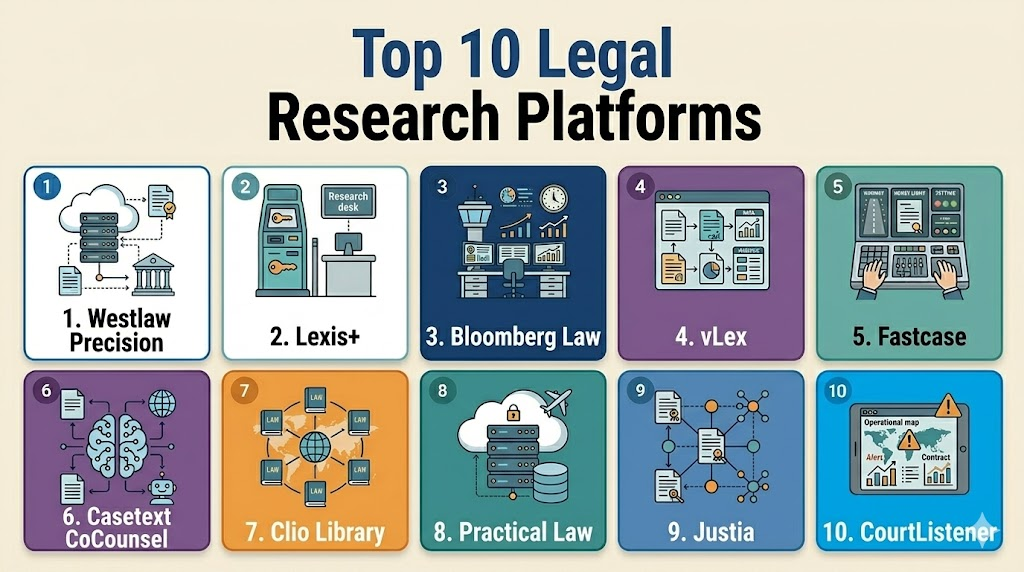
Top 10 Legal Research Platforms
1- Westlaw Precision
Short description: Westlaw Precision is a premium legal research platform from Thomson Reuters designed for professional legal research, case law search, citator review, litigation research, and AI-assisted legal workflows. It is best for law firms and legal departments that need authoritative content, strong citation tools, and advanced research capabilities.
Key Features
- Primary law research across cases, statutes, and regulations
- KeyCite citation validation and case treatment tools
- AI-assisted search and research workflows
- Litigation analytics and legal insights
- Secondary sources and editorial content
- Advanced filtering and jurisdiction controls
- Integration with Thomson Reuters legal ecosystem
Pros
- Strong authority and trust in professional legal research
- Excellent citation validation and case treatment workflows
- Good fit for litigation-heavy and research-intensive legal teams
Cons
- Premium pricing may be difficult for small teams
- Platform complexity can require training
- Full value depends on selected subscription package
Platforms / Deployment
Web / Cloud
Mobile availability: Varies / N/A
Security & Compliance
Not publicly stated in full detail for every subscription and deployment. Buyers should validate SSO, MFA, RBAC, encryption, audit logs, data retention, AI data handling, and confidentiality controls.
Integrations & Ecosystem
Westlaw Precision is strongest when used with Thomson Reuters legal tools, Practical Law, CoCounsel, drafting workflows, litigation analytics, and legal knowledge systems.
- Thomson Reuters legal ecosystem
- Practical Law workflows
- CoCounsel and AI research workflows
- Litigation analytics tools
- Document drafting and review tools
- Research history and citation workflows
Support & Community
Thomson Reuters provides professional support, training, documentation, account management, and legal research guidance. Buyers should confirm training access, support tiers, AI usage policies, and product package coverage.
2- Lexis+
Short description: Lexis+ is a professional legal research platform from LexisNexis that supports case law, statutes, regulations, legal news, practical guidance, analytics, citation tools, and AI-enabled research. It is best for law firms, legal departments, academics, and litigation teams needing broad legal content and workflow tools.
Key Features
- Case law, statute, regulation, and legal news research
- Shepard’s citation analysis
- AI-assisted research and legal answers
- Practical guidance and legal commentary
- Litigation analytics and legal analytics tools
- Brief analysis and document research support
- Advanced search, filters, and alerts
Pros
- Broad legal content and strong research coverage
- Shepard’s remains a widely recognized citator
- Good fit for litigation, transactional, and academic research
Cons
- Pricing can be premium and package-dependent
- Advanced tools may require training
- Users should validate AI answers with cited authority
Platforms / Deployment
Web / Cloud
Mobile availability: Varies / N/A
Security & Compliance
Not publicly stated in full detail for every buyer requirement. Buyers should validate SSO, MFA, RBAC, encryption, audit logs, data retention, AI data handling, and confidentiality requirements.
Integrations & Ecosystem
Lexis+ works well when legal research needs to connect with practical guidance, litigation analytics, legal news, court analytics, and document analysis workflows.
- LexisNexis legal content ecosystem
- Practical guidance tools
- Litigation analytics and court analytics
- Document and brief analysis workflows
- Legal news and alerting
- APIs and enterprise content options
Support & Community
LexisNexis provides support, training, documentation, account management, research assistance, and onboarding resources. Buyers should confirm training options, subscription scope, and AI governance documentation.
3- Bloomberg Law
Short description: Bloomberg Law combines legal research, legal news, dockets, business intelligence, litigation analytics, and practical tools in one platform. It is best for firms and legal departments that need legal research connected with business, regulatory, and market context.
Key Features
- Case law, statutes, regulations, and legal news
- Docket and litigation tracking
- Business and regulatory intelligence
- Practical guidance and legal analysis
- Litigation analytics and workflow tools
- Alerts and monitoring
- Integrated research and news experience
Pros
- Strong combination of legal research and business intelligence
- Useful for corporate legal, regulatory, and litigation teams
- Good docket and legal news integration
Cons
- May be more expensive than narrower research tools
- Content needs depend on practice area and jurisdiction
- Some users may prefer dedicated citator-heavy platforms
Platforms / Deployment
Web / Cloud
Mobile availability: Varies / N/A
Security & Compliance
Not publicly stated in full detail for all buyer requirements. Buyers should validate SSO, MFA, RBAC, encryption, audit logs, data retention, AI data use, and confidentiality requirements.
Integrations & Ecosystem
Bloomberg Law is useful when legal research must connect with legal news, business intelligence, docket monitoring, regulatory updates, and corporate legal workflows.
- Legal news and analysis
- Dockets and litigation tracking
- Regulatory monitoring
- Business intelligence workflows
- Alerts and research dashboards
- Legal workflow tools
Support & Community
Bloomberg Law provides support, training, documentation, account management, and research assistance. Buyers should validate onboarding, training depth, and practice-area coverage.
4- vLex
Short description: vLex is a global legal research platform that combines legal content, AI-powered research, multilingual coverage, and international legal resources. It is best for lawyers, law firms, universities, and organizations that need cross-border or global legal research.
Key Features
- Global legal content coverage
- AI-powered legal research tools
- Case law, legislation, commentary, and legal resources
- Multilingual and cross-jurisdiction research support
- Search, alerts, and legal analytics features
- Integration with Fastcase ecosystem
- Tools for firms, academics, and legal researchers
Pros
- Strong for global and multi-jurisdiction research
- AI research capabilities are central to the platform
- Useful for firms and academics needing broader legal coverage
Cons
- Coverage depth can vary by jurisdiction
- Users should validate authority and source availability by region
- May require training for advanced AI and comparative workflows
Platforms / Deployment
Web / Cloud
Mobile availability: Varies / N/A
Security & Compliance
Not publicly stated in full detail for every buyer need. Buyers should validate SSO, MFA, RBAC, encryption, audit logs, GDPR, data residency, AI data handling, and confidentiality requirements.
Integrations & Ecosystem
vLex is useful when legal research needs global content, AI-assisted search, comparative law workflows, and integration with broader legal research tools.
- Fastcase and vLex legal content ecosystem
- AI legal research workflows
- International legal databases
- Alerts and research monitoring
- Legal document and drafting workflows
- APIs and enterprise content options where available
Support & Community
vLex provides customer support, onboarding, documentation, and training resources. Buyers should validate jurisdiction-specific coverage, AI training, and institutional support options.
5- Fastcase
Short description: Fastcase is a legal research platform offering case law, statutes, regulations, search tools, and legal research access through direct subscriptions and bar association partnerships. It is best for solo lawyers, small firms, associations, and cost-conscious legal researchers.
Key Features
- Case law and statute research
- Search and filtering tools
- Legal research through bar association partnerships
- Citation and case analysis features
- Research history and saved searches
- Integration with broader vLex and Clio ecosystem
- Practical access for smaller firms and associations
Pros
- Often more accessible for cost-conscious users
- Strong presence through bar association benefits
- Good fit for solo and small firm research needs
Cons
- May not match premium platforms for every secondary source or analytics need
- Coverage and features can vary by subscription
- Advanced AI and workflow tools may depend on package or ecosystem
Platforms / Deployment
Web / Cloud
Mobile availability: Varies / N/A
Security & Compliance
Not publicly stated in full detail for all buyer requirements. Buyers should validate account security, MFA, encryption, research confidentiality, data retention, and AI data handling where applicable.
Integrations & Ecosystem
Fastcase is increasingly relevant as part of a broader legal tech ecosystem connected with vLex and Clio. It is practical for research workflows where affordability and primary law access matter.
- vLex and Fastcase legal content ecosystem
- Clio-related legal workflows
- Bar association access programs
- Case law and statute databases
- Research history and saved search workflows
- Enterprise or association licensing options
Support & Community
Fastcase provides customer support, documentation, training resources, and association-based access support. Buyers should confirm content scope, subscription coverage, and support availability.
6- Casetext CoCounsel
Short description: Casetext CoCounsel is an AI-assisted legal research and legal workflow platform known for natural-language research, case analysis, document review, and legal task support. It is best for lawyers and legal teams that want AI-supported research while still validating results with legal authority.
Key Features
- AI-powered legal research assistance
- Natural-language legal questions
- Case search and summarization
- Document review and analysis support
- Legal drafting and workflow assistance
- Research citations and authority review
- Integration with broader Thomson Reuters legal AI ecosystem
Pros
- Strong AI-assisted research and workflow support
- Useful for accelerating early-stage legal analysis
- Helps lawyers ask research questions in plain language
Cons
- AI outputs must be validated carefully
- Content access and capabilities depend on subscription and ecosystem
- Not a replacement for attorney judgment or citation review
Platforms / Deployment
Web / Cloud
Mobile availability: Varies / N/A
Security & Compliance
Not publicly stated in full detail for every buyer requirement. Buyers should validate SSO, MFA, RBAC, encryption, audit logs, AI data handling, confidentiality, and retention policies.
Integrations & Ecosystem
Casetext CoCounsel is relevant where legal teams want AI-supported research, drafting, document review, and citation-backed legal workflows.
- Thomson Reuters legal AI ecosystem
- Westlaw-related workflows where available
- Document review workflows
- Legal drafting and analysis tools
- Research history and citation workflows
- Integration options depending on package
Support & Community
Casetext and CoCounsel users should evaluate vendor support, onboarding, AI usage training, responsible AI guidance, and research validation resources. Buyers should confirm content access and security controls.
7- Clio Library
Short description: Clio Library is a legal research solution connected with Clio’s legal technology ecosystem. It is best for law firms that want legal research available alongside practice management, matter workflows, and firm operations.
Key Features
- Legal research access for law firms
- Integration with Clio ecosystem
- Case law and legal resource search
- Matter-oriented research workflows
- Research organization and access tools
- Practical fit for small and mid-sized firms
- Support for legal practice productivity
Pros
- Useful for firms already using Clio
- Helps connect research with practice workflows
- Practical option for small and mid-sized law firms
Cons
- May not replace premium research platforms for advanced needs
- Coverage and feature depth should be validated by jurisdiction
- Best fit depends on Clio ecosystem adoption
Platforms / Deployment
Web / Cloud
Mobile availability: Varies / N/A
Security & Compliance
Not publicly stated in full detail for all buyer needs. Buyers should validate SSO, MFA, RBAC, encryption, audit logs, confidentiality controls, and data handling policies.
Integrations & Ecosystem
Clio Library is useful when legal research should sit close to practice management, client matters, documents, and firm workflows.
- Clio practice management
- Matter and document workflows
- Legal research access
- Calendar and task workflows
- Firm productivity tools
- Ecosystem integrations depending on plan
Support & Community
Clio provides support, training, documentation, and a strong law firm technology ecosystem. Buyers should confirm research coverage, onboarding, support tiers, and integration limits.
8- Practical Law
Short description: Practical Law from Thomson Reuters is a legal know-how and practice guidance platform that provides templates, checklists, practice notes, clauses, and legal guidance. It is best for lawyers who need practical legal resources alongside traditional legal research.
Key Features
- Practice notes and legal guidance
- Templates, standard documents, and checklists
- Clause and drafting resources
- Practice-area specific guidance
- Legal updates and workflow resources
- Integration with Thomson Reuters ecosystem
- Useful support for transactional and advisory work
Pros
- Strong practical guidance for lawyers
- Useful for drafting, checklists, and legal workflows
- Helps reduce time spent building documents from scratch
Cons
- Not a full case law research platform by itself
- Best used alongside primary law research tools
- Coverage depends on jurisdiction and practice area
Platforms / Deployment
Web / Cloud
Security & Compliance
Not publicly stated in full detail for every buyer need. Buyers should validate SSO, MFA, RBAC, encryption, audit logs, data access controls, and confidentiality requirements.
Integrations & Ecosystem
Practical Law works best when used with Westlaw, drafting workflows, document automation, legal know-how programs, and training resources.
- Westlaw and Thomson Reuters ecosystem
- Drafting and document workflows
- Practice-area guidance
- Legal update monitoring
- Templates and checklist workflows
- Knowledge management processes
Support & Community
Thomson Reuters provides training, documentation, support, and account management for Practical Law users. Buyers should validate practice-area coverage, jurisdiction fit, and subscription scope.
9- Justia
Short description: Justia provides free legal information, case law, statutes, legal articles, and public legal resources. It is best for basic legal lookup, public legal education, law students, solo researchers, and budget-conscious users who need accessible legal information.
Key Features
- Free legal information access
- Case law and statute resources
- Legal topic guides and articles
- Public court opinion access
- Searchable legal materials
- Lawyer directory and public legal resources
- Useful starting point for basic legal research
Pros
- Free and accessible for broad users
- Useful starting point for basic legal research
- Good for public legal information and education
Cons
- Not a replacement for premium professional legal research
- Limited advanced citator and analytics capabilities
- Users must validate legal authority and current status carefully
Platforms / Deployment
Web / Cloud
Security & Compliance
Not publicly stated. Since Justia is generally used as a public legal information resource, buyers should not treat it as a confidential research workspace without validating account, privacy, and data handling controls.
Integrations & Ecosystem
Justia is primarily a public legal information resource rather than an enterprise legal research workflow platform.
- Public case law resources
- Statute and legal topic pages
- Legal articles and guides
- Lawyer directory ecosystem
- Public legal search workflows
- General legal education resources
Support & Community
Support is more limited compared with premium enterprise platforms. Users should treat Justia as a helpful public research starting point and validate important findings through official or professional legal sources.
10- CourtListener
Short description: CourtListener is a free legal research platform from the Free Law Project that provides access to court opinions, dockets, oral arguments, and legal data. It is best for public-interest researchers, journalists, academics, developers, and lawyers needing open legal data access.
Key Features
- Free court opinion search
- Docket and oral argument access
- Legal data from public sources
- Alerts and search tools
- Open legal data orientation
- Useful for academics and public-interest research
- Developer-friendly legal data ecosystem
Pros
- Free and open legal research resource
- Useful for public-interest and academic research
- Good access to court opinions and legal data
Cons
- Not a full premium legal research platform
- Coverage and tools may differ from commercial systems
- Users must validate authority, completeness, and current status
Platforms / Deployment
Web / Cloud
Open data access: Varies / N/A
Security & Compliance
Not publicly stated in full detail. Since CourtListener is an open legal data resource, organizations should validate whether it fits confidentiality, privacy, and professional research workflow requirements.
Integrations & Ecosystem
CourtListener is useful for open legal research, public-interest legal data, academic analysis, and legal technology projects.
- Court opinion databases
- Docket and oral argument data
- Free Law Project ecosystem
- Legal data research workflows
- Alerts and search workflows
- Developer and data access use cases
Support & Community
CourtListener has a public-interest and open legal data orientation. Support expectations differ from commercial vendors, so professional teams should evaluate documentation, coverage, and reliability for their use case.
Comparison Table
| Tool Name | Best For | Platform Supported | Deployment | Standout Feature | Public Rating |
|---|---|---|---|---|---|
| Westlaw Precision | Premium professional legal research | Web | Cloud | KeyCite and advanced legal research workflows | N/A |
| Lexis+ | Broad legal research and analytics | Web | Cloud | Shepard’s citation analysis and legal content breadth | N/A |
| Bloomberg Law | Legal research plus business intelligence | Web | Cloud | Legal news, dockets, and business context | N/A |
| vLex | Global and AI-assisted legal research | Web | Cloud | Cross-jurisdiction legal research and AI tools | N/A |
| Fastcase | Cost-conscious legal research | Web | Cloud | Accessible legal research through bar partnerships | N/A |
| Casetext CoCounsel | AI-assisted legal research | Web | Cloud | Natural-language legal research and AI workflows | N/A |
| Clio Library | Legal research inside practice workflows | Web | Cloud | Research connected with law firm operations | N/A |
| Practical Law | Practical legal guidance and templates | Web | Cloud | Practice notes, clauses, and legal templates | N/A |
| Justia | Free public legal information | Web | Cloud | Accessible case law and legal topic resources | N/A |
| CourtListener | Open court opinions and legal data | Web | Cloud | Free court opinions, dockets, and open legal data | N/A |
Evaluation and Scoring of Legal Research Platforms
| Tool Name | Core 25% | Ease 15% | Integrations 15% | Security 10% | Performance 10% | Support 10% | Value 15% | Weighted Total |
|---|---|---|---|---|---|---|---|---|
| Westlaw Precision | 10 | 8 | 9 | 9 | 9 | 9 | 7 | 8.85 |
| Lexis+ | 10 | 8 | 9 | 9 | 9 | 9 | 7 | 8.85 |
| Bloomberg Law | 9 | 8 | 8 | 8 | 9 | 8 | 7 | 8.20 |
| vLex | 9 | 8 | 8 | 8 | 8 | 8 | 8 | 8.25 |
| Fastcase | 8 | 8 | 7 | 7 | 8 | 8 | 9 | 7.95 |
| Casetext CoCounsel | 8 | 9 | 8 | 8 | 8 | 8 | 7 | 8.05 |
| Clio Library | 7 | 9 | 8 | 8 | 8 | 8 | 8 | 7.95 |
| Practical Law | 8 | 9 | 8 | 8 | 8 | 9 | 8 | 8.30 |
| Justia | 6 | 9 | 5 | 5 | 7 | 6 | 10 | 6.85 |
| CourtListener | 7 | 7 | 6 | 5 | 7 | 6 | 10 | 6.95 |
Which Legal Research Platform Is Right for You?
Solo / Freelancer
Solo lawyers and freelance legal researchers should balance content quality, cost, and workflow simplicity. Fastcase, vLex, Clio Library, Justia, CourtListener, and selected AI-assisted tools may be practical depending on jurisdiction and research depth. For litigation-heavy work, Westlaw or Lexis+ may still be worth considering if citation reliability and premium content are critical.
SMB
Small and mid-sized law firms need reliable legal content, manageable pricing, strong citation tools, and easy adoption. Fastcase, vLex, Clio Library, Lexis+, Westlaw, and Bloomberg Law can all fit different budgets and practice areas. SMBs should compare subscription scope carefully and avoid paying for content they rarely use.
Mid-Market
Mid-market firms and corporate legal teams usually need broader research coverage, practice guidance, alerts, analytics, and integration with document workflows. Westlaw Precision, Lexis+, Bloomberg Law, vLex, Practical Law, and Casetext CoCounsel can be strong options. Buyers should prioritize practice-area coverage, research accuracy, AI governance, and workflow integrations.
Enterprise
Large law firms, enterprise legal departments, government legal teams, and academic institutions need scalable access, permissions, training, citation reliability, analytics, and multi-user governance. Westlaw Precision, Lexis+, Bloomberg Law, vLex, Practical Law, and Casetext CoCounsel are strong enterprise candidates. Enterprises should evaluate content licensing, user management, SSO, AI data handling, and jurisdiction coverage.
Budget vs Premium
Budget-conscious users may start with Fastcase, Justia, CourtListener, and bar association research benefits. Premium platforms make sense when legal work requires comprehensive coverage, trusted citators, editorial analysis, litigation analytics, and professional support. The right choice depends on matter value, risk level, practice area, and research frequency.
Feature Depth vs Ease of Use
Premium platforms offer deep content, advanced filtering, citators, secondary sources, analytics, and AI features, but they may require training. Simpler tools are easier to adopt but may not provide enough authority validation or advanced research support. Buyers should test common research tasks before selecting a platform.
Integrations & Scalability
Legal research increasingly connects with drafting tools, document management, practice management, litigation analytics, AI assistants, e-discovery, and knowledge management systems. Teams should evaluate whether research results can be saved, shared, cited, exported, or integrated into existing matter workflows. Scalability matters for firms with multiple practice groups, offices, or jurisdictions.
Security & Compliance Needs
Legal research may involve confidential client facts, litigation strategy, regulated matters, and sensitive internal questions. Buyers should validate SSO, MFA, RBAC, audit logs, encryption, research history controls, data retention, AI training policies, and confidentiality protections. AI-assisted platforms should be reviewed carefully before users enter privileged or confidential information.
Frequently Asked Questions
1- What is a legal research platform?
A legal research platform helps users find case law, statutes, regulations, legal commentary, practice guidance, court opinions, and citation history. It supports legal analysis, litigation preparation, compliance research, and advisory work.
2- Which legal research platform is best for law firms?
Westlaw Precision, Lexis+, Bloomberg Law, vLex, Practical Law, and Casetext CoCounsel are strong options for law firms. The best fit depends on practice area, jurisdiction, budget, citator needs, and AI workflow requirements.
3- What is the difference between Westlaw and Lexis+?
Both are premium legal research platforms with broad content, citator tools, and legal workflow features. Westlaw is known for KeyCite, while Lexis+ is known for Shepard’s; the better choice depends on user preference, content needs, and subscription scope.
4- Are free legal research tools reliable?
Free tools like Justia and CourtListener can be useful starting points, especially for public legal information and court opinions. However, professional users should validate authority, current status, completeness, and citation treatment before relying on findings.
5- Do legal research platforms use AI?
Many modern platforms now include AI-assisted search, summaries, question answering, and research workflows. Users should validate AI-generated answers against cited primary law, statutes, regulations, or trusted secondary sources.
6- How much do legal research platforms cost?
Pricing varies widely by vendor, content package, number of users, practice area, jurisdiction, AI features, and support level. Premium platforms are usually quote-based or subscription-based, while some public legal research tools are free.
7- What are common mistakes when choosing legal research software?
Common mistakes include choosing based only on price, ignoring jurisdiction coverage, failing to test citator workflows, overlooking training needs, and assuming AI answers are correct without checking cited authority.
8- Can AI replace traditional legal research?
AI can speed up research, summarize materials, and suggest starting points, but it should not replace professional legal judgment. Lawyers must verify citations, authority, jurisdiction, and current legal status before relying on results.
9- Which legal research platform is best for global research?
vLex is strong for global and cross-jurisdiction research. Lexis+, Westlaw, and Bloomberg Law may also support international or specialized content depending on subscription and jurisdiction coverage.
10- What should buyers test before subscribing?
Buyers should test real research questions, jurisdiction coverage, citator quality, secondary source availability, AI answer accuracy, export options, training needs, security controls, and total cost for the required user group.
Conclusion
Legal Research Platforms help legal professionals find reliable authority, validate citations, understand legal issues, and work faster across cases, statutes, regulations, commentary, and practical guidance. The best platform depends on practice area, jurisdiction, budget, research volume, AI comfort level, and whether the team needs premium content, global coverage, litigation analytics, practice guidance, or free public resources. Westlaw Precision and Lexis+ remain strong premium options for professional legal research, while Bloomberg Law is valuable for legal research connected with business intelligence and dockets. vLex is strong for global and AI-assisted research, Fastcase is practical for cost-conscious lawyers, and Casetext CoCounsel is useful for AI-assisted workflows. Clio Library connects research with law firm operations, Practical Law supports practical legal guidance, and Justia and CourtListener are helpful free resources.

Find Trusted Cardiac Hospitals
Compare heart hospitals by city and services — all in one place.
Explore Hospitals
Legal research platforms are most valuable when they help legal professionals quickly find, analyze, and interpret statutes, case law, regulations, legal precedents, and secondary legal sources. By providing comprehensive legal databases, AI-powered search, citation analysis, case law tracking, document drafting support, legal analytics, collaboration tools, and real-time updates on legal developments, these platforms enable lawyers and legal teams to conduct faster, more accurate research, strengthen legal arguments, improve productivity, and make well-informed legal decisions.