Introduction
Matter Management Systems help legal teams organize, track, and manage legal work such as cases, disputes, contracts, investigations, compliance requests, outside counsel work, legal spend, documents, tasks, deadlines, and internal legal requests. In simple terms, these platforms give legal teams one place to manage each legal matter from intake to resolution. Matter management matters because legal departments and law firms are handling more work, tighter budgets, faster turnaround expectations, and rising pressure to prove legal value. Manual matter tracking through spreadsheets, shared inboxes, and disconnected folders often creates missed deadlines, unclear ownership, poor reporting, and limited visibility.
Real-world use cases include:
- Tracking litigation, advisory, contract, and compliance matters
- Managing legal intake and request triage
- Coordinating tasks, documents, budgets, and deadlines
- Monitoring outside counsel spend and performance
- Reporting on legal workload, cycle time, risk, and outcomes
What buyers should evaluate:
- Matter intake and workflow automation
- Task, deadline, and document management
- Legal spend and e-billing capabilities
- Reporting and legal operations dashboards
- Outside counsel and vendor management
- Integrations with email, document, finance, and e-signature systems
- Security, access controls, and audit logs
- Ease of use for lawyers, paralegals, and business users
- Scalability across teams, practice areas, and regions
- Data migration and implementation support
Best for: Law firms, corporate legal departments, legal operations teams, in-house counsel, litigation teams, compliance teams, government legal teams, insurance legal teams, and organizations that need structured visibility into legal work.
Not ideal for: Very small teams with only a few matters, organizations that only need simple document storage, or teams without defined matter intake, ownership, workflow, reporting, or budget processes.
Key Trends in Matter Management Systems
- AI-assisted matter intake: Modern systems are increasingly using AI to classify legal requests, suggest routing, summarize matter history, and identify missing information.
- Legal operations analytics: Legal teams now want dashboards for matter volume, cycle time, spend, outside counsel performance, workload, and business impact.
- Matter management and e-billing convergence: Corporate legal departments increasingly prefer platforms that connect matter records with invoices, budgets, accruals, vendor performance, and spend controls.
- Workflow automation: Teams are automating request triage, approvals, task assignment, document routing, deadline reminders, and matter status updates.
- Self-service legal portals: Business users increasingly submit requests through structured intake portals instead of email, reducing back-and-forth communication.
- Integration with legal ecosystems: Matter data needs to connect with document management, CLM, e-signature, finance, CRM, email, compliance, and knowledge systems.
- Confidentiality and permissioning: Sensitive legal matters require strong role-based permissions, ethical walls, audit trails, and access governance.
- Cloud-first adoption: Cloud-based systems are becoming more common because they support distributed teams, faster updates, and easier collaboration.
- Outside counsel collaboration: In-house teams want better visibility into law firm assignments, budgets, invoices, status updates, and outcomes.
- AI governance and data security: Legal teams are reviewing how platforms handle confidential matter data, AI features, retention policies, and model training boundaries.
How We Selected These Tools
The Top 10 Matter Management Systems were selected using a practical buyer-focused methodology. The goal is not to name one universal winner, but to compare credible platforms for law firms, corporate legal departments, legal operations teams, and enterprise legal functions.
Selection criteria included:
- Market recognition in legal matter management, legal operations, practice management, or enterprise legal management
- Matter intake, matter tracking, workflow automation, and reporting capabilities
- Suitability for law firms, in-house legal teams, or enterprise legal departments
- Support for documents, tasks, deadlines, notes, collaboration, and matter history
- Legal spend, e-billing, budget, or outside counsel management capabilities where relevant
- Integration ecosystem with email, finance, DMS, CLM, e-signature, and business systems
- Security posture signals where publicly available
- Ease of use for legal professionals and business users
- Scalability across practice areas, regions, business units, and matter types
- Implementation, support, data migration, and onboarding resources
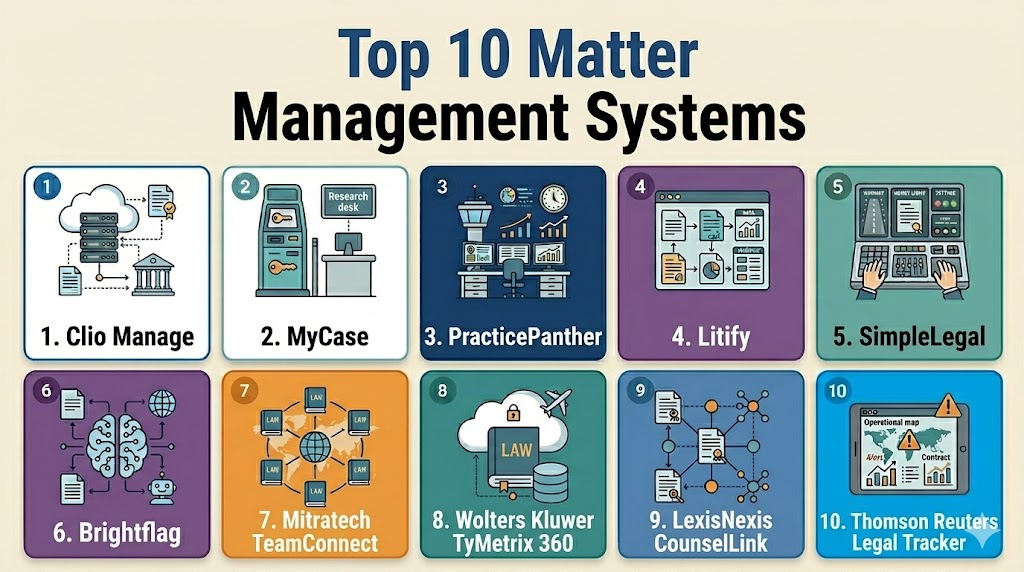
Top 10 Matter Management Systems
1- Clio Manage
Short description: Clio Manage is a cloud-based legal practice and matter management platform widely used by law firms to manage cases, contacts, documents, calendars, tasks, billing, and client communication. It is best for solo, small, and mid-sized law firms that want an easy-to-use legal operations hub.
Key Features
- Matter and case management dashboard
- Contact, client, and document organization
- Task, calendar, and deadline tracking
- Time tracking, billing, and online payments
- Client communication and portal workflows
- Mobile access for lawyers on the go
- Integration ecosystem for law firm tools
Pros
- Strong usability for small and mid-sized law firms
- Broad practice management capabilities beyond matter tracking
- Good ecosystem of legal integrations and partner tools
Cons
- Not primarily designed for large corporate legal department e-billing workflows
- Advanced enterprise legal operations needs may require other tools
- Feature availability depends on plan and configuration
Platforms / Deployment
Web / Cloud
iOS / Android availability: Varies by app and plan
Security & Compliance
Not publicly stated in full detail for every buyer requirement. Buyers should validate SSO, MFA, RBAC, encryption, audit logs, SOC 2, ISO 27001, GDPR, HIPAA, and legal confidentiality requirements based on plan and region.
Integrations & Ecosystem
Clio works well for law firms that need matter management connected with practice management, client intake, billing, documents, accounting, payments, and communication tools.
- Email and calendar integrations
- Accounting and payment tools
- Document management workflows
- E-signature and form tools
- Client intake and CRM workflows
- Legal app marketplace integrations
Support & Community
Clio provides documentation, onboarding resources, training, customer support, and a large law firm technology ecosystem. Buyers should confirm migration support, training, plan-specific support, and integration assistance.
2- MyCase
Short description: MyCase is a cloud-based legal practice management system that supports matter management, case organization, document storage, client communication, billing, payments, and workflows. It is best for small and mid-sized law firms seeking an accessible all-in-one system.
Key Features
- Matter and case tracking
- Client communication portal
- Document storage and sharing
- Task, calendar, and deadline management
- Time tracking, billing, and payments
- Workflow and automation support
- Reporting for firm operations
Pros
- Practical all-in-one option for smaller law firms
- Strong client communication and billing workflows
- Easier adoption than many enterprise systems
Cons
- May not fit complex enterprise legal operations needs
- Advanced customization can be limited compared with larger platforms
- Best suited for law firm practice workflows rather than corporate legal departments
Platforms / Deployment
Web / Cloud
iOS / Android availability: Varies / N/A
Security & Compliance
Not publicly stated in full detail for every buyer requirement. Buyers should validate MFA, RBAC, encryption, audit logs, data residency, SOC 2, ISO 27001, GDPR, HIPAA, and client confidentiality controls.
Integrations & Ecosystem
MyCase is useful when matter management needs to connect with billing, communication, documents, payments, and practice management workflows.
- Email and calendar tools
- Accounting and payment workflows
- Document storage and sharing
- Client portal workflows
- E-signature and intake tools
- Reporting and firm operations dashboards
Support & Community
MyCase provides support, onboarding resources, documentation, training materials, and migration assistance options. Buyers should confirm support availability, data import help, and plan-specific service levels.
3- PracticePanther
Short description: PracticePanther is a cloud-based legal practice management and matter management platform for law firms. It supports matter tracking, time billing, payments, client communication, calendaring, workflows, and firm productivity.
Key Features
- Matter and case management
- Time tracking and billing
- Calendar and deadline management
- Client portal and communication tools
- Document management support
- Workflow automation
- Reporting and firm management dashboards
Pros
- Good fit for small and mid-sized law firms
- Practical billing and payment workflows
- User-friendly interface for everyday practice management
Cons
- Not built primarily for large corporate legal departments
- Advanced legal operations analytics may be limited
- Complex enterprise workflow needs may require customization or another tool
Platforms / Deployment
Web / Cloud
iOS / Android availability: Varies / N/A
Security & Compliance
Not publicly stated in full detail for all buyer requirements. Buyers should validate MFA, RBAC, encryption, audit logs, SOC 2, ISO 27001, GDPR, HIPAA, data residency, and confidentiality controls.
Integrations & Ecosystem
PracticePanther works best when legal matter management must connect with firm billing, calendars, payment processing, client communication, and documents.
- Email and calendar integrations
- Payment and accounting systems
- Document management tools
- Client portal workflows
- E-signature and automation tools
- Reporting exports and dashboards
Support & Community
PracticePanther provides customer support, documentation, training, onboarding guidance, and migration assistance options. Buyers should confirm support tiers and available implementation help.
4- Litify
Short description: Litify is a legal operating platform built on Salesforce, supporting matter management, intake, case workflows, reporting, automation, and firm operations. It is best for growing law firms and legal organizations that want Salesforce-based scalability and customization.
Key Features
- Matter and case management
- Intake and lead management workflows
- Salesforce-based reporting and dashboards
- Workflow automation and task routing
- Document and communication tracking
- Customizable legal workflows
- Integration with Salesforce ecosystem
Pros
- Strong scalability and customization through Salesforce
- Useful for firms with complex intake and case workflows
- Good reporting and operational visibility
Cons
- May require Salesforce expertise or admin support
- Implementation can be more involved than simpler law firm tools
- Smaller firms may not need the platform depth
Platforms / Deployment
Web / Cloud
Mobile availability: Varies by Salesforce configuration
Security & Compliance
Not publicly stated in full detail for all buyer requirements. Buyers should validate Salesforce security configuration, SSO, MFA, RBAC, encryption, audit logs, SOC 2, ISO 27001, GDPR, HIPAA, and confidentiality requirements.
Integrations & Ecosystem
Litify is strongest where matter management needs to connect with Salesforce CRM, intake, marketing, reporting, document workflows, and business automation.
- Salesforce ecosystem
- Intake and CRM workflows
- Document management tools
- E-signature integrations
- Reporting and analytics
- APIs and Salesforce AppExchange integrations
Support & Community
Litify provides implementation resources, customer support, documentation, training, and partner services. Buyers should validate Salesforce administration needs, migration support, and workflow configuration assistance.
5- SimpleLegal
Short description: SimpleLegal is an enterprise legal management platform focused on matter management, legal spend management, e-billing, vendor management, accruals, and reporting. It is best for in-house legal teams that want to connect matters with outside counsel spend and legal operations visibility.
Key Features
- Corporate matter management
- Legal e-billing and invoice review
- Vendor and outside counsel management
- Budgeting and accrual tracking
- Reporting and legal operations analytics
- Workflow and matter status tracking
- Integration with finance and business systems
Pros
- Strong fit for in-house legal departments
- Good connection between matter management and legal spend
- Useful for legal operations reporting and cost control
Cons
- Less suited for law firm practice management
- Best value depends on legal spend and vendor complexity
- Implementation requires clean matter and billing processes
Platforms / Deployment
Web / Cloud
Security & Compliance
Not publicly stated in full detail for all buyer requirements. Buyers should validate SSO, MFA, RBAC, encryption, audit logs, SOC 2, ISO 27001, GDPR, data residency, and financial data controls.
Integrations & Ecosystem
SimpleLegal works well for corporate legal departments that need matter data connected with invoices, finance, outside counsel, vendors, and legal operations reporting.
- Finance and ERP systems
- E-billing workflows
- Vendor management processes
- Contract and document tools
- Reporting and analytics systems
- APIs and integration options
Support & Community
SimpleLegal provides onboarding, customer support, implementation guidance, training, and legal operations resources. Buyers should confirm migration support, finance integration assistance, and vendor onboarding support.
6- Brightflag
Short description: Brightflag is a legal operations platform combining matter management, e-billing, AI-assisted invoice review, legal spend analytics, and outside counsel management. It is best for in-house legal teams that need matter visibility connected with legal spend control and analytics.
Key Features
- Matter management for in-house legal teams
- AI-assisted invoice review
- Legal spend analytics and reporting
- Budget and accrual management
- Outside counsel and vendor management
- Matter-level financial visibility
- Dashboards for legal operations leaders
Pros
- Strong matter and spend visibility for corporate legal teams
- AI-assisted invoice review can reduce manual billing review effort
- Useful for legal operations and finance collaboration
Cons
- Not designed as a full law firm practice management system
- Best value depends on outside counsel spend volume
- Implementation requires legal billing and matter process alignment
Platforms / Deployment
Web / Cloud
Security & Compliance
Not publicly stated in full detail for all buyer requirements. Buyers should validate SSO, MFA, RBAC, encryption, audit logs, SOC 2, ISO 27001, GDPR, data residency, and sensitive financial data controls.
Integrations & Ecosystem
Brightflag fits legal departments that need matter tracking connected to legal spend, invoice review, budgeting, reporting, and finance workflows.
- Finance and ERP systems
- E-billing workflows
- Outside counsel billing data
- Legal operations reporting
- Vendor management processes
- APIs and integration options
Support & Community
Brightflag provides onboarding, support, customer success resources, documentation, and legal operations guidance. Buyers should confirm implementation support, invoice rule setup, vendor enablement, and reporting configuration help.
7- Mitratech TeamConnect
Short description: Mitratech TeamConnect is an enterprise legal management platform for matter management, legal spend, e-billing, workflow automation, reporting, and legal operations. It is best for large corporate legal departments and regulated enterprises needing configurable matter and spend governance.
Key Features
- Enterprise matter management
- E-billing and legal spend management
- Workflow automation and approvals
- Outside counsel and vendor management
- Reporting and legal operations analytics
- Configurable matter types and processes
- Integration with enterprise systems
Pros
- Strong fit for large legal departments
- Highly configurable for enterprise legal workflows
- Useful for matter, spend, and vendor governance
Cons
- Implementation can be complex
- May require admin resources and process ownership
- Smaller legal teams may find it too heavy
Platforms / Deployment
Web / Cloud
Hybrid availability: Varies / N/A
Security & Compliance
Not publicly stated in full detail for every buyer requirement. Buyers should validate SSO, MFA, RBAC, encryption, audit logs, SOC 2, ISO 27001, GDPR, data residency, and enterprise compliance controls.
Integrations & Ecosystem
TeamConnect is suitable where matter management needs to connect with e-billing, finance, document management, contracts, compliance, and enterprise workflows.
- ERP and finance systems
- E-billing systems
- Document management tools
- Contract and compliance workflows
- Reporting and BI systems
- APIs and enterprise integrations
Support & Community
Mitratech provides enterprise implementation services, support, documentation, training, and legal operations expertise. Buyers should validate support tiers, configuration support, migration services, and admin training.
8- Wolters Kluwer TyMetrix 360
Short description: Wolters Kluwer TyMetrix 360 is an enterprise legal management platform focused on matter management, e-billing, legal spend analytics, outside counsel management, and legal operations reporting. It is best for large corporate legal teams with complex vendor and spend oversight needs.
Key Features
- Enterprise matter management
- E-billing and invoice review
- Outside counsel management
- Legal spend analytics
- Budget and accrual tracking
- Matter-level reporting
- Workflow and compliance support
Pros
- Strong enterprise legal spend and matter management focus
- Useful for large legal teams managing many law firms
- Good fit for data-driven legal operations reporting
Cons
- May be complex for smaller departments
- Implementation depends on matter and billing process maturity
- User experience should be tested by legal operations teams
Platforms / Deployment
Web / Cloud
Hybrid availability: Varies / N/A
Security & Compliance
Not publicly stated in full detail for every buyer requirement. Buyers should validate SSO, MFA, RBAC, encryption, audit logs, SOC 2, ISO 27001, GDPR, data residency, and financial data governance controls.
Integrations & Ecosystem
TyMetrix 360 works well when legal teams need to connect matters, invoices, outside counsel performance, finance systems, and legal analytics.
- Finance and ERP systems
- E-billing workflows
- Outside counsel billing systems
- Legal analytics and reporting
- Vendor management workflows
- APIs and integration options
Support & Community
Wolters Kluwer provides enterprise support, implementation assistance, training, documentation, and legal operations resources. Buyers should validate onboarding, vendor enablement, migration, and reporting setup support.
9- LexisNexis CounselLink
Short description: LexisNexis CounselLink is an enterprise legal management platform that supports matter management, legal spend management, e-billing, vendor management, analytics, and legal operations workflows. It is best for corporate legal departments that need visibility into matters, law firms, budgets, and invoices.
Key Features
- Matter management for corporate legal teams
- E-billing and invoice review
- Outside counsel and vendor management
- Budgeting and accrual tracking
- Legal spend analytics
- Reporting and dashboards
- Integration with legal and finance workflows
Pros
- Strong fit for corporate legal operations
- Useful for managing outside counsel and legal spend
- Provides matter and financial visibility in one platform
Cons
- Less suited for small law firm practice management
- Implementation requires legal operations maturity
- Full value depends on law firm participation and clean billing processes
Platforms / Deployment
Web / Cloud
Security & Compliance
Not publicly stated in full detail for all buyer requirements. Buyers should validate SSO, MFA, RBAC, encryption, audit logs, SOC 2, ISO 27001, GDPR, data residency, and confidential matter data controls.
Integrations & Ecosystem
CounselLink is strongest where matter data must connect with e-billing, legal spend, law firm management, budgeting, and legal operations reporting.
- Finance and ERP integrations
- E-billing workflows
- Outside counsel management
- Legal analytics and reporting
- Budgeting and accrual workflows
- APIs and enterprise integrations
Support & Community
LexisNexis provides enterprise support, documentation, implementation services, training, and legal operations resources. Buyers should validate migration support, vendor onboarding, and reporting assistance.
10- Thomson Reuters Legal Tracker
Short description: Thomson Reuters Legal Tracker is an enterprise legal management platform for matter management, e-billing, legal spend, budgeting, outside counsel management, and reporting. It is best for corporate legal departments that want a recognized platform for legal operations and spend visibility.
Key Features
- Matter management and tracking
- Legal e-billing and invoice management
- Outside counsel and vendor management
- Budgeting and accrual workflows
- Legal spend analytics
- Reporting and dashboards
- Enterprise legal operations support
Pros
- Strong fit for in-house legal operations
- Connects matter management with legal spend visibility
- Useful for managing outside counsel relationships
Cons
- Not designed for law firm practice management
- Implementation depends on legal operations process maturity
- May require training for reporting and workflow optimization
Platforms / Deployment
Web / Cloud
Security & Compliance
Not publicly stated in full detail for every buyer requirement. Buyers should validate SSO, MFA, RBAC, encryption, audit logs, SOC 2, ISO 27001, GDPR, data residency, and confidentiality requirements.
Integrations & Ecosystem
Legal Tracker is useful when corporate legal teams need matter data connected with spend, invoices, outside counsel, finance systems, and enterprise legal reporting.
- Finance and ERP systems
- E-billing workflows
- Outside counsel management
- Legal operations reporting
- Thomson Reuters legal ecosystem
- APIs and integration options
Support & Community
Thomson Reuters provides enterprise support, training, documentation, implementation resources, and account management. Buyers should validate onboarding, vendor rollout, reporting setup, and support tiers.
Comparison Table
| Tool Name | Best For | Platform Supported | Deployment | Standout Feature | Public Rating |
|---|---|---|---|---|---|
| Clio Manage | Solo, small, and mid-sized law firms | Web / iOS / Android varies | Cloud | All-in-one law firm matter and practice management | N/A |
| MyCase | Small and mid-sized law firms | Web / iOS / Android varies | Cloud | Client communication and matter workflows | N/A |
| PracticePanther | Law firm matter, billing, and workflow management | Web / iOS / Android varies | Cloud | User-friendly practice management | N/A |
| Litify | Salesforce-based legal operations | Web | Cloud | Customizable matter workflows on Salesforce | N/A |
| SimpleLegal | In-house legal operations and spend visibility | Web | Cloud | Matter management with e-billing | N/A |
| Brightflag | AI-assisted legal spend and matter visibility | Web | Cloud | AI invoice review and matter spend analytics | N/A |
| Mitratech TeamConnect | Enterprise legal departments | Web | Cloud / Hybrid varies | Configurable enterprise legal management | N/A |
| Wolters Kluwer TyMetrix 360 | Large corporate legal teams | Web | Cloud / Hybrid varies | Enterprise matter and legal spend management | N/A |
| LexisNexis CounselLink | Corporate legal operations | Web | Cloud | Matter, e-billing, and outside counsel management | N/A |
| Thomson Reuters Legal Tracker | In-house legal spend and matter management | Web | Cloud | Legal operations and outside counsel spend visibility | N/A |
Evaluation and Scoring of Matter Management Systems
| Tool Name | Core 25% | Ease 15% | Integrations 15% | Security 10% | Performance 10% | Support 10% | Value 15% | Weighted Total |
|---|---|---|---|---|---|---|---|---|
| Clio Manage | 8 | 9 | 9 | 8 | 8 | 9 | 8 | 8.45 |
| MyCase | 8 | 9 | 8 | 7 | 8 | 8 | 8 | 8.10 |
| PracticePanther | 8 | 8 | 8 | 7 | 8 | 8 | 8 | 7.95 |
| Litify | 9 | 7 | 9 | 8 | 8 | 8 | 7 | 8.05 |
| SimpleLegal | 8 | 8 | 8 | 8 | 8 | 8 | 8 | 8.00 |
| Brightflag | 8 | 8 | 8 | 8 | 8 | 8 | 8 | 8.00 |
| Mitratech TeamConnect | 9 | 7 | 9 | 8 | 8 | 8 | 7 | 8.05 |
| Wolters Kluwer TyMetrix 360 | 9 | 7 | 8 | 8 | 8 | 8 | 7 | 7.90 |
| LexisNexis CounselLink | 8 | 7 | 8 | 8 | 8 | 8 | 7 | 7.65 |
| Thomson Reuters Legal Tracker | 8 | 8 | 8 | 8 | 8 | 8 | 7 | 7.90 |
Which Matter Management System Is Right for You?
Solo / Freelancer
Solo lawyers and freelance legal professionals usually need a simple, affordable, and easy-to-use system that combines matter tracking, documents, calendars, billing, and client communication. Clio Manage, MyCase, and PracticePanther are practical options because they cover everyday law firm operations without requiring enterprise-level setup. Solo users should prioritize speed of adoption, billing workflows, client communication, and mobile access.
SMB
Small and mid-sized law firms need matter management systems that improve organization, billing, document handling, task tracking, and client service. Clio Manage, MyCase, PracticePanther, and Litify can be strong options depending on firm size and complexity. SMBs should avoid enterprise legal management platforms unless they have corporate-style spend management, outside counsel, or advanced reporting needs.
Mid-Market
Mid-market law firms and growing legal departments usually need stronger workflows, reporting, integrations, and team collaboration. Litify is useful for Salesforce-centered legal operations, while SimpleLegal and Brightflag are better for in-house legal teams managing matters and legal spend. Mid-market buyers should evaluate intake, reporting, document workflows, permissions, and finance integration carefully.
Enterprise
Large corporate legal departments need systems that support matter management, e-billing, budgets, outside counsel, analytics, vendor management, auditability, and global governance. Mitratech TeamConnect, Wolters Kluwer TyMetrix 360, LexisNexis CounselLink, Thomson Reuters Legal Tracker, SimpleLegal, and Brightflag are strong enterprise candidates. Enterprises should prioritize scalability, integration with finance, configurable workflows, reporting, and law firm adoption.
Budget vs Premium
Budget-focused buyers should start with essential needs such as matter tracking, tasks, deadlines, documents, and billing. Premium platforms make sense when matter volume is high, outside counsel spend is significant, reporting requirements are complex, or legal operations needs executive-level visibility. Buyers should compare software cost against time savings, spend control, improved reporting, and reduced risk.
Feature Depth vs Ease of Use
Simple systems are easier to adopt and work well for small law firms and straightforward legal teams. Advanced enterprise systems provide deeper e-billing, outside counsel management, reporting, workflow automation, and configuration, but they may require implementation support and administration. The right balance depends on legal team size, matter complexity, and operational maturity.
Integrations & Scalability
Matter management systems should connect with email, calendars, document management, accounting, ERP, finance, e-signature, CLM, legal research, and reporting systems. Without integrations, teams may keep duplicating data across tools. Scalability matters because matter types, users, departments, outside counsel firms, and reporting needs can expand over time.
Security & Compliance Needs
Matter management systems store confidential legal strategy, client information, privileged communications, sensitive documents, billing records, and business risk data. Buyers should validate SSO, MFA, RBAC, encryption, audit logs, data residency, ethical walls, retention policies, backups, and compliance documentation. Legal teams should also define internal access rules before migration.
Frequently Asked Questions
1- What is a matter management system?
A matter management system helps legal teams organize, track, and manage legal matters, cases, documents, tasks, deadlines, budgets, invoices, and related communication. It creates one central workspace for legal work.
2- How is matter management different from case management?
Case management is often used by law firms to manage client cases and practice workflows. Matter management is broader and commonly used by legal departments to track legal work, outside counsel, budgets, compliance, and operations.
3- Which matter management system is best for law firms?
Clio Manage, MyCase, PracticePanther, and Litify are strong options for law firms. The best fit depends on firm size, practice area, billing needs, workflow complexity, and integration requirements.
4- Which matter management system is best for corporate legal departments?
SimpleLegal, Brightflag, Mitratech TeamConnect, Wolters Kluwer TyMetrix 360, LexisNexis CounselLink, and Thomson Reuters Legal Tracker are strong options for corporate legal departments. The best choice depends on matter volume, e-billing, outside counsel spend, and reporting needs.
5- How much do matter management systems cost?
Pricing varies by vendor, users, modules, matter volume, billing features, integrations, data migration, and support level. Many enterprise systems use quote-based pricing, while law firm tools may offer tiered monthly plans.
6- How long does implementation take?
Implementation can take days or weeks for small law firm tools and several months for enterprise legal management platforms. Timeline depends on data migration, integrations, workflows, invoice rules, user training, and vendor onboarding.
7- Can matter management software reduce legal costs?
Yes, especially when it improves workload visibility, outside counsel management, invoice review, budgeting, and reporting. Legal departments can use matter and spend data to control costs and make better resourcing decisions.
8- What are common mistakes when choosing matter management software?
Common mistakes include ignoring user adoption, skipping data migration planning, choosing a tool without workflow fit, underestimating integrations, and failing to define matter types, reporting needs, and ownership rules.
9- Do matter management systems use AI?
Many modern systems include AI or automation for intake routing, invoice review, matter summaries, reporting, and workflow suggestions. Buyers should validate AI accuracy, confidentiality controls, and whether AI features fit real legal workflows.
10- What should teams prepare before implementation?
Teams should prepare matter lists, document structures, user roles, workflows, deadlines, billing rules, outside counsel data, reporting requirements, integrations, and security policies. Clean data and clear process ownership make implementation easier.
Conclusion
Matter Management Systems help legal teams move away from scattered emails, spreadsheets, and disconnected folders toward structured, searchable, and reportable legal work management. The best platform depends on whether the buyer is a law firm, corporate legal department, solo lawyer, growing practice, or enterprise legal operations team. Clio Manage, MyCase, and PracticePanther are strong for small and mid-sized law firms, while Litify is a good fit for Salesforce-based legal operations. SimpleLegal and Brightflag are practical for in-house teams that want matter visibility connected with spend management. Mitratech TeamConnect, Wolters Kluwer TyMetrix 360, LexisNexis CounselLink, and Thomson Reuters Legal Tracker are stronger for enterprise legal departments with complex matter, e-billing, vendor, and reporting needs.

Find Trusted Cardiac Hospitals
Compare heart hospitals by city and services — all in one place.
Explore Hospitals
Matter management systems are most valuable when they help legal departments and law firms organize, track, and manage the complete lifecycle of legal matters, including litigation, contracts, investigations, compliance issues, and outside counsel activities. By providing centralized matter tracking, document management, workflow automation, deadline management, budget and spend tracking, collaboration tools, reporting, and integration with legal, financial, and enterprise systems, these platforms improve operational efficiency, enhance legal visibility, control costs, strengthen compliance, and support better legal decision-making.