Introduction
Marketplace Platforms help businesses build online marketplaces where multiple sellers, vendors, service providers, or partners can list products or services and sell to buyers through a shared digital platform. Unlike a standard ecommerce store where one business sells its own catalog, a marketplace connects many sellers with many buyers and manages workflows such as seller onboarding, listings, payments, commissions, orders, reviews, disputes, and payouts. Marketplace platforms matter because businesses now want to create scalable commerce ecosystems instead of managing every product, service, or inventory item themselves. Retailers, B2B distributors, service networks, creator platforms, rental businesses, and niche communities use marketplace software to expand selection, increase reach, and build new revenue models.
Real World Use Cases
- Building a multi-vendor ecommerce marketplace
- Creating a B2B supplier or distributor marketplace
- Launching a service marketplace for bookings or professional services
- Managing seller onboarding, approvals, commissions, and payouts
- Connecting catalog, checkout, payments, reviews, and order management in one platform
Evaluation Criteria for Buyers
- Seller onboarding and vendor management
- Product, service, or listing management
- Commission, payout, and payment workflows
- Buyer and seller dashboards
- Order, booking, fulfillment, and dispute workflows
- Ratings, reviews, messaging, and trust features
- API, customization, and integration flexibility
- Security, permissions, and fraud controls
- Scalability for sellers, listings, traffic, and transactions
- Total cost including platform fees, development, payment processing, hosting, and support
Best for: Entrepreneurs, SaaS founders, retailers, B2B distributors, service marketplace operators, digital commerce teams, agencies, enterprise commerce teams, and businesses that want to connect third-party sellers or providers with buyers through a controlled platform.
Not ideal for: Businesses that only sell their own products, teams that do not need seller management or commission workflows, or companies that want a very simple ecommerce store without multi-vendor complexity.
Key Trends in Marketplace Platforms
- Vertical marketplaces are growing: Many businesses are building niche marketplaces for specific industries, categories, regions, communities, or professional services instead of broad general-purpose marketplaces.
- B2B marketplace adoption is increasing: Manufacturers, distributors, and procurement networks are using marketplace models for supplier discovery, account pricing, bulk ordering, approvals, and negotiated commerce.
- Composable marketplace architecture: Larger businesses want flexible marketplace components that can connect with existing ecommerce, ERP, PIM, OMS, payment, and identity systems.
- AI-assisted search and discovery: Marketplace platforms are increasingly using AI to improve product discovery, listing quality, recommendations, moderation, fraud detection, and customer support.
- Trust and safety is a core requirement: Buyer protection, seller verification, ratings, reviews, dispute management, content moderation, and fraud prevention are now essential marketplace features.
- Embedded payments and split payouts: Marketplace operators need reliable payment workflows that support commissions, seller payouts, refunds, tax handling, and regional payment methods.
- Service marketplaces need richer workflows: Service-based marketplaces require bookings, availability, messaging, calendars, quote requests, provider profiles, and service fulfillment tracking.
- Headless and API-first models are expanding: Teams with custom front-end needs prefer marketplace platforms that expose APIs for seller, listing, order, checkout, and payment workflows.
- Operational automation is becoming important: Seller approvals, catalog imports, commission rules, dispute routing, notifications, and compliance checks are increasingly automated.
- Data governance matters more: Marketplace operators handle buyer data, seller data, payout details, product information, and transaction records, so permissions and audit controls are key.
How We Selected These Tools
- We selected tools widely recognized for marketplace creation, multi-vendor commerce, seller management, marketplace operations, and digital commerce workflows.
- We included a mix of SaaS platforms, enterprise marketplace tools, open-source frameworks, ecommerce extensions, and developer-friendly platforms.
- We prioritized tools that support seller onboarding, listings, commissions, payments, orders, dashboards, and marketplace governance.
- We considered fit across B2C marketplaces, B2B marketplaces, service marketplaces, product marketplaces, and niche community marketplaces.
- We evaluated integration flexibility with payment gateways, ecommerce systems, CMS platforms, ERP systems, CRM tools, fulfillment platforms, and analytics tools.
- We considered usability for founders, small businesses, agencies, developers, marketplace operators, and enterprise commerce teams.
- We looked at scalability across sellers, buyers, listings, traffic, transactions, regions, and business models.
- We considered security expectations such as role permissions, admin controls, payment security, fraud prevention, and data protection.
- We avoided guessing public ratings, exact pricing, certifications, or compliance claims where details are not clearly known.
- We focused on practical buyer fit rather than naming one universal best platform.
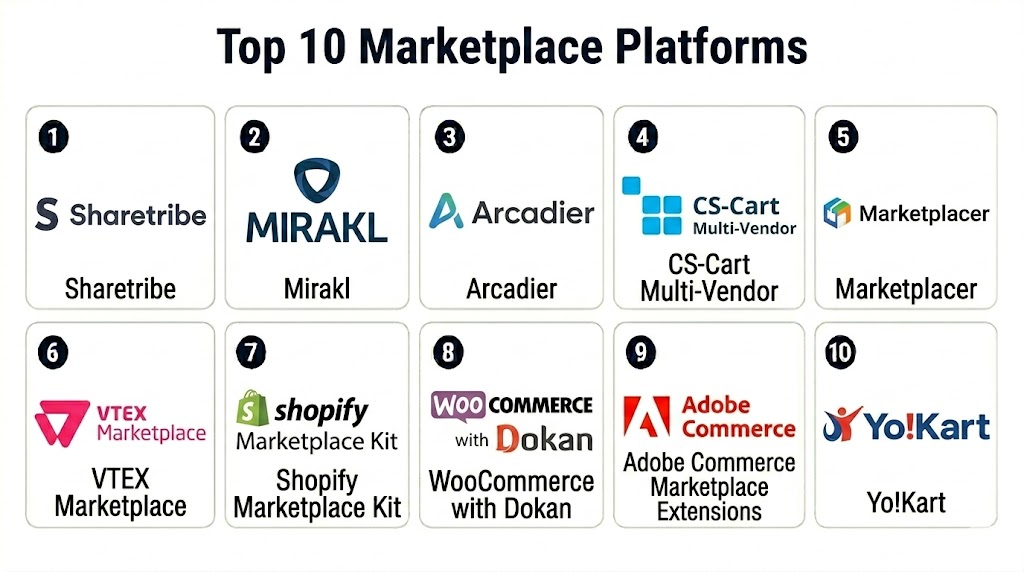
Top 10 Marketplace Platforms
1- Sharetribe
Short description: Sharetribe is a marketplace platform designed for building product, service, rental, and booking marketplaces. It is popular with founders and teams that want to launch a marketplace faster without building everything from scratch.
Key Features
- Marketplace website builder
- Seller and buyer account management
- Listing creation and marketplace search
- Payments and commission workflows
- Booking, product, and service marketplace support
- Messaging between buyers and sellers
- Customization options through developer tools
Pros
- Good fit for marketplace startups and MVP launches
- Supports multiple marketplace models beyond product sales
- Reduces the need to build core marketplace workflows from zero
Cons
- Highly customized marketplaces may need development work
- Enterprise-grade workflows should be validated before scaling
- Advanced operational needs may require custom implementation
Platforms / Deployment
Web
Cloud
Security & Compliance
Security capabilities vary by plan and configuration. Buyers should verify payment security, admin permissions, encryption, fraud controls, data protection, and compliance documentation directly with the vendor.
Integrations & Ecosystem
Sharetribe fits teams that need a marketplace foundation connected with payments, analytics, automation, and custom workflows.
- Payment gateways
- Analytics tools
- Email and notification tools
- Custom APIs
- Automation platforms
- Front-end customization workflows
Support & Community
Sharetribe provides documentation, onboarding resources, marketplace education, developer guidance, and customer support options. Support depth may vary by plan.
2- Mirakl
Short description: Mirakl is an enterprise marketplace platform for retailers, B2B companies, distributors, and large digital commerce teams. It is designed to help organizations launch and operate third-party seller marketplaces at scale.
Key Features
- Enterprise seller onboarding and management
- Product catalog and seller offer management
- Marketplace order and fulfillment workflows
- Commission and payout support
- Seller quality and performance management
- B2B and B2C marketplace capabilities
- Integration with enterprise commerce and ERP systems
Pros
- Strong fit for enterprise marketplace programs
- Suitable for large retailers and B2B commerce organizations
- Supports complex marketplace operations and seller governance
Cons
- May be too advanced for small startups
- Implementation usually requires strong commerce and integration planning
- Best value depends on enterprise marketplace scale and maturity
Platforms / Deployment
Web
Cloud
Security & Compliance
Security capabilities vary by enterprise agreement and configuration. Buyers should verify SSO, RBAC, encryption, audit logs, data governance, seller access controls, and compliance documentation.
Integrations & Ecosystem
Mirakl is built for enterprise marketplace ecosystems where seller management must connect with existing commerce and operations platforms.
- Ecommerce platforms
- ERP systems
- Product information management tools
- Order management systems
- Payment and payout providers
- Analytics and reporting systems
Support & Community
Mirakl provides enterprise onboarding, implementation support, documentation, partner services, and marketplace strategy resources. Support scope depends on contract and deployment size.
3- Arcadier
Short description: Arcadier is a marketplace platform for building product, service, rental, and booking marketplaces. It is useful for businesses that want a flexible marketplace builder with multi-vendor workflows and customization options.
Key Features
- Multi-vendor marketplace setup
- Product, service, rental, and booking marketplace support
- Seller and buyer dashboards
- Listing, search, and transaction workflows
- Commission and payment settings
- Admin controls and marketplace management
- API and customization options
Pros
- Supports different marketplace business models
- Good fit for startups, agencies, and niche marketplace operators
- Provides core marketplace workflows out of the box
Cons
- Complex enterprise use cases may need custom development
- Design and workflow depth should be tested before purchase
- Integration needs may vary by marketplace model
Platforms / Deployment
Web
Cloud
Security & Compliance
Security capabilities vary by plan and configuration. Buyers should verify payment security, user permissions, admin controls, encryption, audit capabilities, and compliance documentation.
Integrations & Ecosystem
Arcadier supports integrations and customization for marketplace operators that need to connect payments, communication, analytics, and external tools.
- Payment gateways
- Shipping tools
- Analytics platforms
- Custom APIs
- Communication workflows
- Business automation tools
Support & Community
Arcadier provides documentation, support resources, onboarding guidance, and marketplace setup assistance. Support depth may vary by plan.
4- CS-Cart Multi-Vendor
Short description: CS-Cart Multi-Vendor is a marketplace platform for building product-focused multi-vendor ecommerce marketplaces. It is suitable for businesses that want vendor storefronts, commissions, marketplace admin controls, and self-hosted or controlled deployment options.
Key Features
- Multi-vendor ecommerce marketplace management
- Vendor storefronts and seller dashboards
- Product catalog and order workflows
- Commission and payout support
- Admin controls and marketplace moderation
- Shipping and payment configuration
- Add-ons and customization options
Pros
- Strong fit for product-based multi-vendor marketplaces
- Gives marketplace owners more control over setup and customization
- Useful for teams wanting a packaged marketplace solution
Cons
- Requires more technical management than simple SaaS builders
- Hosting, updates, and maintenance must be planned
- Best suited for product marketplaces rather than complex service marketplaces
Platforms / Deployment
Web
Self-hosted / Cloud options may vary
Security & Compliance
Security depends on hosting, configuration, updates, payment setup, and admin practices. Buyers should verify encryption, access controls, backups, payment security, and compliance responsibilities.
Integrations & Ecosystem
CS-Cart Multi-Vendor can connect marketplace workflows with payments, shipping, marketing, analytics, and custom add-ons.
- Payment gateways
- Shipping providers
- Marketing tools
- Analytics platforms
- Add-on marketplace
- Custom development integrations
Support & Community
CS-Cart offers documentation, support options, add-ons, and developer resources. Support depth may vary by license, plan, and implementation approach.
5- Marketplacer
Short description: Marketplacer is a marketplace platform that helps businesses launch and manage curated product or service marketplaces. It is especially useful for brands, retailers, media companies, and communities that want to expand offerings through third-party sellers.
Key Features
- Seller onboarding and marketplace management
- Product and service listing workflows
- Marketplace catalog management
- Order and transaction workflows
- Commission and seller controls
- Enterprise integration support
- Curated marketplace operations
Pros
- Good fit for curated and enterprise marketplace models
- Useful for businesses adding third-party supply to existing channels
- Supports seller and catalog governance
Cons
- May be too advanced for very small marketplace experiments
- Implementation and integration needs should be validated
- Best fit depends on marketplace strategy and seller model
Platforms / Deployment
Web
Cloud
Security & Compliance
Security capabilities vary by contract and configuration. Buyers should verify SSO, permissions, encryption, audit logs, admin controls, payment security, and compliance documentation.
Integrations & Ecosystem
Marketplacer works well for organizations that need marketplace capabilities connected with existing commerce, content, payment, and operational systems.
- Ecommerce platforms
- Payment systems
- Product catalogs
- Order management tools
- CRM and marketing tools
- APIs and enterprise connectors
Support & Community
Marketplacer provides support, implementation guidance, marketplace expertise, and enterprise onboarding resources. Support scope depends on contract.
6- VTEX Marketplace
Short description: VTEX Marketplace is part of the VTEX commerce platform and supports marketplace, seller management, commerce, and order management workflows. It is best for retailers and brands that need marketplace capabilities connected with enterprise ecommerce and omnichannel operations.
Key Features
- Marketplace and seller management
- Product catalog and offer management
- Order management and omnichannel workflows
- Seller onboarding and governance
- B2B and B2C commerce support
- API and integration capabilities
- Enterprise commerce scalability
Pros
- Strong for retailers needing marketplace plus commerce infrastructure
- Useful for omnichannel and multi-seller commerce models
- Supports complex order and seller workflows
Cons
- May be too complex for small marketplaces
- Implementation requires commerce and operations planning
- Best value depends on broader VTEX ecosystem fit
Platforms / Deployment
Web
Cloud
Security & Compliance
Security capabilities vary by enterprise agreement and configuration. Buyers should verify SSO, permissions, payment security, encryption, audit controls, data governance, and compliance documentation.
Integrations & Ecosystem
VTEX fits businesses that need marketplace operations connected with ecommerce, order management, fulfillment, and enterprise systems.
- ERP systems
- Order management platforms
- Payment gateways
- Product information systems
- Fulfillment and logistics tools
- APIs and commerce integrations
Support & Community
VTEX provides enterprise support, implementation guidance, documentation, and partner resources. Support model depends on contract and deployment scope.
7- Shopify Marketplace Kit
Short description: Shopify Marketplace Kit provides tools and APIs for building marketplace experiences on top of Shopify commerce infrastructure. It is useful for developers and commerce teams that want marketplace capabilities connected with Shopify’s ecosystem.
Key Features
- Marketplace-oriented APIs and tools
- Seller, product, and commerce workflow support
- Shopify ecosystem compatibility
- Checkout and commerce infrastructure access
- Custom front-end possibilities
- Developer-focused marketplace architecture
- Integration with Shopify merchant workflows
Pros
- Good fit for teams already using Shopify infrastructure
- Useful for developers building custom marketplace experiences
- Connects marketplace workflows with Shopify commerce capabilities
Cons
- Requires technical implementation
- Not a simple no-code marketplace builder
- Marketplace model fit should be validated before development
Platforms / Deployment
Web / API-based
Cloud
Security & Compliance
Security capabilities depend on Shopify environment, app architecture, permissions, and implementation. Buyers should verify admin controls, payment security, encryption, access permissions, and compliance responsibilities.
Integrations & Ecosystem
Shopify Marketplace Kit fits marketplace teams that want to build on Shopify’s commerce and app ecosystem.
- Shopify commerce tools
- Payment workflows
- Custom storefronts
- Apps and extensions
- APIs and developer tools
- Fulfillment and order workflows
Support & Community
Shopify provides documentation, developer resources, partner ecosystem support, and commerce education. Support depends on implementation model and Shopify plan.
8- WooCommerce with Dokan
Short description: WooCommerce with Dokan is a WordPress-based marketplace setup that uses WooCommerce for ecommerce and Dokan for multi-vendor marketplace workflows. It is popular with teams that want a customizable marketplace using the WordPress ecosystem.
Key Features
- Multi-vendor marketplace setup
- Vendor dashboards and store pages
- Product and order management
- Commission and withdrawal workflows
- Vendor shipping and coupon options depending on configuration
- WordPress and WooCommerce plugin ecosystem
- Customization through themes and extensions
Pros
- Flexible and familiar for WordPress users
- Good for budget-conscious marketplace projects
- Large plugin ecosystem for customization
Cons
- Requires hosting, plugin maintenance, and technical governance
- Performance and security depend on implementation quality
- Scaling large marketplaces may require experienced developers
Platforms / Deployment
Web
Self-hosted / Cloud hosting through third-party providers
Security & Compliance
Security depends on hosting, plugin updates, payment setup, admin configuration, and development practices. Buyers should verify backups, encryption, access controls, malware protection, payment security, and compliance responsibilities.
Integrations & Ecosystem
WooCommerce with Dokan benefits from WordPress and WooCommerce ecosystems, making it flexible for content, commerce, and marketplace extensions.
- WordPress plugins
- Payment gateways
- Shipping tools
- Marketing platforms
- Analytics tools
- Custom APIs and development workflows
Support & Community
Support depends on WooCommerce, Dokan, hosting provider, plugins, and implementation partners. The WordPress community is large, but marketplace stability requires careful maintenance.
9- Magento Adobe Commerce Marketplace Extensions
Short description: Adobe Commerce can be extended with marketplace modules to support multi-vendor selling, vendor dashboards, catalog workflows, and marketplace operations. It is suitable for businesses that already use Adobe Commerce and want marketplace capabilities inside a highly customizable commerce environment.
Key Features
- Multi-vendor marketplace extensions
- Seller storefront and dashboard workflows
- Product and order management
- Commission and seller payout support depending on extension
- B2B and B2C commerce flexibility
- Advanced catalog and pricing capabilities
- Enterprise customization options
Pros
- Strong fit for Adobe Commerce users needing marketplace extensions
- Highly customizable for complex marketplace models
- Useful for enterprise commerce teams with developer resources
Cons
- Requires technical implementation and extension management
- Marketplace quality depends on selected modules and development approach
- Total cost can be high for complex requirements
Platforms / Deployment
Web
Cloud / Self-hosted options may vary
Security & Compliance
Security depends on Adobe Commerce environment, hosting, extension quality, payment setup, admin permissions, and configuration. Buyers should verify SSO, encryption, payment security, permissions, and compliance documentation.
Integrations & Ecosystem
Adobe Commerce marketplace setups are best when connected with enterprise commerce, content, ERP, PIM, order management, and marketing systems.
- Adobe Commerce ecosystem
- ERP platforms
- PIM systems
- Payment gateways
- Marketing automation tools
- Custom APIs and extensions
Support & Community
Support depends on Adobe Commerce plan, marketplace extension vendor, implementation agency, and hosting model. Enterprise teams should plan partner support carefully.
10- Yo!Kart
Short description: Yo!Kart is a multi-vendor marketplace platform designed for businesses launching product marketplaces. It provides marketplace workflows such as vendor management, catalog setup, commissions, orders, and buyer-seller interaction.
Key Features
- Multi-vendor marketplace functionality
- Seller and buyer account management
- Product catalog and order workflows
- Commission and payment workflows
- Admin dashboard and marketplace controls
- Mobile app options may vary by package
- Marketplace reporting and operational tools
Pros
- Built specifically for multi-vendor marketplace use cases
- Useful for product marketplace launches
- Offers structured marketplace workflows out of the box
Cons
- Customization and scaling needs should be validated
- Best suited for product marketplaces rather than highly complex service models
- Buyers should review implementation, hosting, and support requirements carefully
Platforms / Deployment
Web
Self-hosted / Deployment options may vary
Security & Compliance
Security capabilities vary by deployment and configuration. Buyers should verify payment security, user permissions, encryption, admin controls, backups, and compliance responsibilities.
Integrations & Ecosystem
Yo!Kart supports marketplace operations with integrations and customization depending on deployment and package.
- Payment gateways
- Shipping tools
- Marketing tools
- Analytics tools
- Mobile app options
- Custom integrations depending on project needs
Support & Community
Yo!Kart provides product support, setup assistance, documentation, and implementation guidance depending on package and agreement. Buyers should confirm support scope before purchase.
Comparison Table
| Tool Name | Best For | Platform Supported | Deployment | Standout Feature | Public Rating |
|---|---|---|---|---|---|
| Sharetribe | Marketplace startups and MVPs | Web | Cloud | Fast marketplace launch for product, service, rental, and booking models | N/A |
| Mirakl | Enterprise B2B and B2C marketplaces | Web | Cloud | Enterprise seller onboarding and marketplace governance | N/A |
| Arcadier | Flexible niche marketplace creation | Web | Cloud | Product, service, rental, and booking marketplace support | N/A |
| CS-Cart Multi-Vendor | Product-based multi-vendor marketplaces | Web | Self-hosted / Cloud varies | Vendor storefronts and marketplace admin controls | N/A |
| Marketplacer | Curated enterprise marketplaces | Web | Cloud | Seller and catalog governance for curated marketplace models | N/A |
| VTEX Marketplace | Retailers needing marketplace plus commerce operations | Web | Cloud | Marketplace connected with order management and commerce | N/A |
| Shopify Marketplace Kit | Shopify-based custom marketplace builds | Web / API-based | Cloud | Developer tools for marketplace experiences on Shopify | N/A |
| WooCommerce with Dokan | WordPress-based marketplace projects | Web | Self-hosted / Cloud hosting varies | Flexible marketplace setup inside WordPress | N/A |
| Adobe Commerce Marketplace Extensions | Adobe Commerce marketplace expansion | Web | Cloud / Self-hosted varies | Enterprise marketplace customization | N/A |
| Yo!Kart | Product marketplace launches | Web | Self-hosted / Varies | Multi-vendor marketplace workflows out of the box | N/A |
Evaluation & Scoring of Marketplace Platforms
| Tool Name | Core 25% | Ease 15% | Integrations 15% | Security 10% | Performance 10% | Support 10% | Value 15% | Weighted Total |
|---|---|---|---|---|---|---|---|---|
| Sharetribe | 8 | 9 | 7 | 7 | 8 | 8 | 8 | 8.00 |
| Mirakl | 10 | 6 | 9 | 9 | 9 | 9 | 7 | 8.50 |
| Arcadier | 8 | 8 | 7 | 7 | 8 | 7 | 8 | 7.65 |
| CS-Cart Multi-Vendor | 8 | 7 | 7 | 7 | 8 | 7 | 8 | 7.50 |
| Marketplacer | 9 | 7 | 8 | 8 | 8 | 8 | 7 | 7.95 |
| VTEX Marketplace | 9 | 6 | 9 | 8 | 9 | 8 | 7 | 8.10 |
| Shopify Marketplace Kit | 8 | 6 | 9 | 8 | 8 | 8 | 7 | 7.70 |
| WooCommerce with Dokan | 7 | 7 | 9 | 6 | 7 | 7 | 9 | 7.40 |
| Adobe Commerce Marketplace Extensions | 9 | 5 | 9 | 8 | 8 | 8 | 7 | 7.90 |
| Yo!Kart | 8 | 7 | 7 | 7 | 7 | 7 | 8 | 7.40 |
Which Marketplace Platform Is Right for You?
Solo / Freelancer
Solo founders and small marketplace experiments usually need speed, simplicity, and lower technical overhead. Sharetribe, Arcadier, Yo!Kart, or WooCommerce with Dokan can be practical depending on the marketplace model. If the goal is to validate demand, avoid starting with a complex enterprise marketplace system before proving buyer and seller activity.
SMB
SMBs should focus on seller onboarding, payment workflows, listing management, commissions, admin controls, and support needs. Sharetribe, Arcadier, CS-Cart Multi-Vendor, Yo!Kart, and WooCommerce with Dokan are good candidates. Businesses that already use WordPress may prefer WooCommerce with Dokan, while teams wanting a more packaged marketplace solution may evaluate Sharetribe, Arcadier, or Yo!Kart.
Mid-Market
Mid-market businesses usually need stronger integrations, seller governance, catalog workflows, reporting, and scalability. CS-Cart Multi-Vendor, Marketplacer, VTEX Marketplace, Shopify Marketplace Kit, and Adobe Commerce marketplace extensions are worth evaluating. These buyers should test seller onboarding, payout workflows, product approval, customer service, refunds, and order routing before launch.
Enterprise
Enterprise marketplace buyers should prioritize scalability, data governance, compliance, integration depth, seller lifecycle management, catalog quality, and operational reporting. Mirakl, Marketplacer, VTEX Marketplace, Adobe Commerce marketplace extensions, and Shopify Marketplace Kit are strong candidates depending on existing architecture. Enterprises should run a structured pilot with real sellers, products, payments, and fulfillment workflows.
Budget vs Premium
Budget-conscious marketplace builders may consider WooCommerce with Dokan, Yo!Kart, Arcadier, or CS-Cart Multi-Vendor. Premium buyers may choose Mirakl, Marketplacer, VTEX Marketplace, Adobe Commerce extensions, or custom Shopify marketplace architecture when marketplace scale, seller governance, and enterprise integrations justify the investment. Total cost should include platform fees, development, hosting, payment processing, seller onboarding, support, and maintenance.
Feature Depth vs Ease of Use
Sharetribe and Arcadier are easier starting points for marketplace founders. CS-Cart Multi-Vendor and Yo!Kart offer more packaged marketplace functionality but may need technical setup. WooCommerce with Dokan is flexible but requires careful plugin and hosting management. Mirakl, VTEX, Marketplacer, Adobe Commerce, and Shopify Marketplace Kit offer deeper enterprise or ecosystem capabilities but need more planning and implementation expertise.
Integrations & Scalability
Marketplace platforms should connect with payments, payouts, tax tools, ecommerce systems, ERP, CRM, PIM, shipping, fulfillment, analytics, identity management, customer support, and fraud prevention systems. Buyers should test seller onboarding, product data imports, order routing, refunds, commissions, payout timing, and support workflows before committing. Scalability matters when marketplace transactions, sellers, and listing volume grow.
Security & Compliance Needs
Marketplace operators should verify SSO, MFA, RBAC, encryption, admin permissions, audit logs, payment security, seller data protection, payout controls, fraud prevention, and data retention. Marketplaces involve more risk than single-seller ecommerce because multiple sellers, buyers, listings, and transactions interact inside one environment. Security and trust controls should be part of the platform selection process from the beginning.
Frequently Asked Questions
1. What is a marketplace platform?
A marketplace platform is software that allows multiple sellers, vendors, or service providers to offer products or services to buyers through one shared website or app. It manages seller onboarding, listings, orders, commissions, payments, and marketplace operations.
2. How is a marketplace platform different from an ecommerce platform?
An ecommerce platform usually helps one business sell its own products. A marketplace platform supports multiple sellers, vendor dashboards, commissions, payouts, seller approvals, buyer-seller communication, and marketplace governance.
3. What is the best marketplace platform for startups?
Sharetribe, Arcadier, Yo!Kart, CS-Cart Multi-Vendor, and WooCommerce with Dokan are common options for startups. The best choice depends on whether the marketplace sells products, services, rentals, bookings, or digital goods.
4. What is the best marketplace platform for enterprises?
Mirakl, VTEX Marketplace, Marketplacer, Adobe Commerce marketplace extensions, and Shopify Marketplace Kit are strong candidates for enterprise marketplace programs. Enterprises should evaluate integrations, governance, scalability, and seller operations.
5. Can I build a marketplace on WordPress?
Yes, WordPress marketplaces can be built using WooCommerce with multi-vendor plugins such as Dokan. This approach offers flexibility but requires careful hosting, plugin management, security, and performance planning.
6. What features should marketplace software include?
Important features include seller onboarding, vendor dashboards, listings, catalog management, payments, commissions, payouts, reviews, messaging, dispute handling, admin controls, reporting, and integrations.
7. Do marketplace platforms support service marketplaces?
Some marketplace platforms support services, rentals, bookings, appointments, and provider profiles. Sharetribe and Arcadier are often considered for service marketplace workflows, but buyers should validate exact requirements.
8. How do marketplace platforms handle payments?
Marketplace platforms may support split payments, commissions, seller payouts, refunds, and payment gateway integrations. Payment capabilities vary widely, so buyers should test payout timing, fees, refunds, tax handling, and regional payment support.
9. What are common mistakes when choosing marketplace software?
Common mistakes include choosing a tool before defining marketplace model, underestimating seller onboarding, ignoring payment complexity, skipping trust and safety features, and failing to test scalability with real workflows.
10. How long does it take to launch a marketplace?
Launch time depends on platform choice, customization, payment setup, seller onboarding, catalog complexity, design, integrations, and testing. Simple marketplace MVPs can launch faster, while enterprise marketplace programs often need phased rollout.
Conclusion
Marketplace Platforms help businesses create digital ecosystems where multiple sellers, vendors, or service providers can connect with buyers through a managed commerce experience. The right marketplace platform can support seller onboarding, listings, payments, commissions, reviews, order workflows, dispute handling, reporting, and marketplace governance. Sharetribe and Arcadier are practical for startups and MVPs, while CS-Cart Multi-Vendor, Yo!Kart, and WooCommerce with Dokan are useful for product-focused and budget-conscious marketplace projects. Mirakl, Marketplacer, VTEX Marketplace, Shopify Marketplace Kit, and Adobe Commerce marketplace extensions are stronger fits for mid-market and enterprise teams with deeper integration, governance, and scalability needs. The best choice depends on marketplace model, seller volume, buyer experience, payment complexity, technical resources, security requirements, and long-term growth plans. Start by shortlisting two or three platforms, test real buyer and seller workflows, validate payments and payouts, review integrations and security controls, and choose the platform that supports both launch speed and marketplace scalability.

Find Trusted Cardiac Hospitals
Compare heart hospitals by city and services — all in one place.
Explore Hospitals
Marketplace platforms make it easier for buyers and sellers to connect, manage transactions, and grow online business operations efficiently.