Introduction
Product Feedback & Roadmap Tools help product teams collect customer feedback, organize feature requests, prioritize product decisions, and communicate roadmap progress across internal and external stakeholders. Instead of relying on scattered spreadsheets, support tickets, sales notes, and Slack messages, these platforms create a structured system for turning feedback into product strategy. These tools matter because product teams now need faster discovery, clearer prioritization, tighter engineering alignment, and stronger customer communication. Modern buyers expect platforms that support AI-assisted feedback analysis, roadmap visualization, customer portals, integration with engineering tools, and secure stakeholder collaboration.
Real-world use cases include:
- Collecting customer feature requests from support, sales, success, and in-app channels
- Prioritizing roadmap items using impact, effort, revenue, and strategic alignment
- Sharing public or private product roadmaps with customers and executives
- Closing the feedback loop when requested features are planned, shipped, or declined
- Connecting product discovery with Jira, Linear, GitHub, Slack, CRM, and support systems
What buyers should evaluate:
- Feedback collection channels
- Prioritization frameworks
- Roadmap visualization options
- Customer portal experience
- Engineering workflow integrations
- AI-assisted feedback analysis
- Security, permissions, and audit controls
- Ease of onboarding and adoption
- Reporting and stakeholder communication
- Pricing flexibility and scalability
Best for: Product managers, product operations teams, SaaS companies, customer success teams, support leaders, founders, and growth-stage companies that need a structured way to connect customer feedback with product planning.
Not ideal for: Very small teams with only a few users, teams that only need simple task tracking, or organizations that already manage feedback effectively inside a lightweight project management tool.
Key Trends in Product Feedback & Roadmap Tools
- AI-assisted feedback analysis: More tools are using AI to summarize customer comments, detect duplicate requests, identify sentiment, and group feedback into themes.
- Revenue-aware prioritization: Product teams increasingly connect feedback with customer value, account size, deal impact, churn risk, and expansion opportunities.
- Deeper product operations workflows: Roadmap tools are moving beyond simple planning into intake governance, prioritization scoring, executive reporting, and cross-team alignment.
- Public roadmap transparency: SaaS companies are using public portals and changelogs to improve trust, reduce repeated support questions, and show progress to customers.
- Integration-first product planning: Strong integrations with Jira, Linear, GitHub, Azure DevOps, Slack, Salesforce, Zendesk, Intercom, HubSpot, and analytics tools are now essential.
- Security and access control expectations: Enterprise buyers increasingly expect SSO, RBAC, audit logs, workspace permissions, data controls, and clear vendor security documentation.
- Customer feedback from multiple channels: Teams want one place to consolidate feedback from support tickets, sales calls, surveys, in-app widgets, customer interviews, and user communities.
- Outcome-based roadmaps: Teams are shifting from feature lists to outcome-driven planning tied to goals, OKRs, customer problems, and measurable business impact.
- Embedded feedback widgets: Product-led teams prefer tools that capture feedback directly inside applications, portals, and customer-facing workflows.
- Smarter stakeholder communication: Roadmaps are becoming more audience-specific, with separate views for executives, engineering, sales, customers, and customer success teams.
How We Selected These Tools
The tools below were selected using a practical SaaS buyer evaluation approach:
- Strong recognition in product management, roadmap planning, and customer feedback workflows
- Ability to collect, organize, and prioritize feedback from multiple sources
- Roadmap visualization quality for internal and external stakeholders
- Fit across startups, SMBs, mid-market teams, and enterprise product organizations
- Integration strength with engineering, support, CRM, collaboration, and analytics systems
- Support for product discovery, prioritization, and stakeholder communication
- Security posture signals such as permissions, SSO support, audit controls, and enterprise administration
- Flexibility for different roadmap styles, including outcome-based, theme-based, release-based, and customer-facing roadmaps
- Practical usability for product managers, product operations teams, and cross-functional stakeholders
- Overall value based on feature depth, adoption effort, and scalability
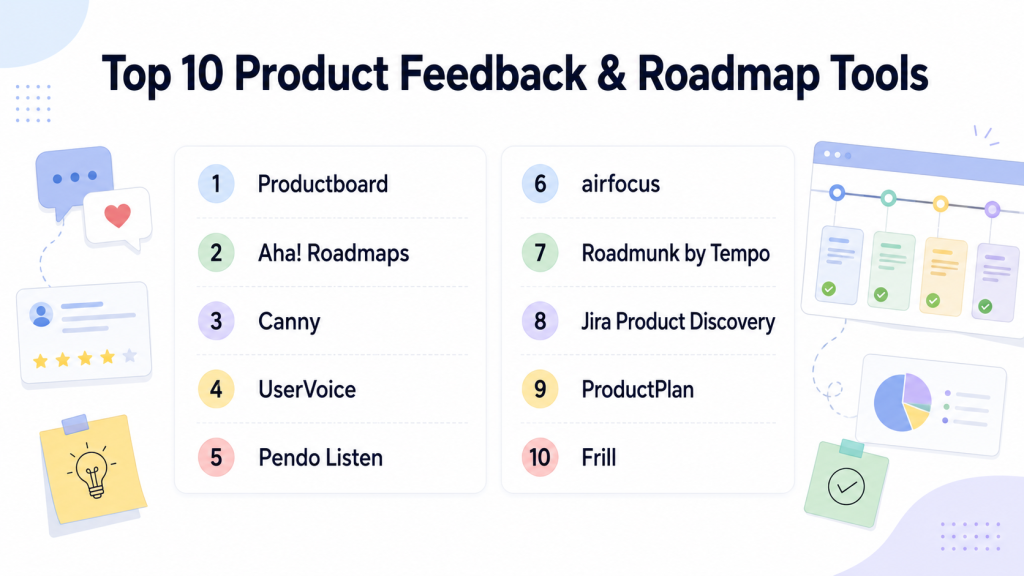
Top 10 Product Feedback & Roadmap Tools
1- Productboard
Short description: Productboard is a product management platform designed to help teams centralize customer insights, prioritize features, and build roadmaps. It is especially useful for product organizations that want to connect feedback, strategy, prioritization, and delivery planning in one system.
Key Features
- Centralized customer feedback repository
- Feature prioritization based on customer needs and business impact
- Roadmap planning and stakeholder views
- Customer insights linked to feature ideas
- Integration with support, collaboration, and engineering tools
- Product objectives and strategic alignment workflows
- Feedback segmentation by customer, company, or theme
Pros
- Strong fit for product-led SaaS companies
- Good balance of feedback management and roadmap planning
- Useful for connecting customer evidence to product decisions
Cons
- May require structured onboarding for larger teams
- Can feel more advanced than needed for very small teams
- Pricing and configuration may vary by team size and plan
Platforms / Deployment
Web
Cloud
Security & Compliance
Security controls vary by plan. Enterprise buyers should verify SSO, SAML, MFA, RBAC, audit logs, data retention, and compliance documentation directly with the vendor.
Integrations & Ecosystem
Productboard works well for teams that need to connect product discovery with delivery and customer-facing systems. Its ecosystem is useful for bringing feedback from multiple touchpoints into a central product workspace.
- Jira
- Azure DevOps
- Slack
- Zendesk
- Intercom
- Salesforce
- API and automation tools
Support & Community
Productboard provides product management resources, documentation, onboarding support, and enterprise guidance. Support depth may vary by plan and company size.
2- Aha! Roadmaps
Short description: Aha! Roadmaps is a comprehensive product management and roadmap platform for strategy, ideas, prioritization, releases, and visual planning. It is a strong choice for mature product teams that need structured planning and executive-level roadmap communication.
Key Features
- Product strategy and goal management
- Idea portals for feedback collection
- Visual roadmaps and release planning
- Feature prioritization and scoring
- Product hierarchy and portfolio planning
- Custom workflows and product templates
- Reporting for executives and stakeholders
Pros
- Excellent for structured product strategy and portfolio planning
- Strong roadmap visualization options
- Useful for enterprise and multi-product organizations
Cons
- Can be complex for new or lightweight teams
- Requires process discipline to get full value
- May be more than small startups need
Platforms / Deployment
Web
Cloud
Security & Compliance
Enterprise security capabilities may include advanced permissions and access controls depending on plan. Buyers should verify SSO, SAML, audit logs, encryption, data residency, and compliance documentation before purchase.
Integrations & Ecosystem
Aha! Roadmaps is built for product organizations that need to connect strategy with execution. It supports integrations with development, collaboration, and customer-facing tools.
- Jira
- Azure DevOps
- GitHub
- Salesforce
- Slack
- Microsoft Teams
- API and automation workflows
Support & Community
Aha! offers strong documentation, training resources, templates, and product management education. Larger teams can benefit from onboarding and structured implementation support.
3- Canny
Short description: Canny is a customer feedback platform focused on collecting feature requests, prioritizing ideas, publishing roadmaps, and communicating updates. It is especially popular with SaaS teams that want a simple customer-facing feedback portal.
Key Features
- Public and private feedback boards
- Customer voting and comments
- Roadmap sharing
- Changelog and product updates
- Feedback deduplication and organization
- Customer segmentation and prioritization
- In-app feedback collection options
Pros
- Simple and easy for customers to use
- Strong for feedback portals and changelog workflows
- Good fit for SaaS startups and product-led teams
Cons
- Less comprehensive than full product portfolio platforms
- Advanced enterprise roadmap planning may require additional tools
- Prioritization depth may not match heavier product management suites
Platforms / Deployment
Web
Cloud
Security & Compliance
Security details vary by plan. Buyers should verify SSO, access controls, role permissions, audit capabilities, and compliance documentation with the vendor.
Integrations & Ecosystem
Canny fits well into customer feedback workflows where product, support, and customer success teams need shared visibility into user requests.
- Slack
- Intercom
- Zendesk
- Jira
- GitHub
- Linear
- Zapier
- API options
Support & Community
Canny provides documentation, onboarding resources, and support options. Its community and customer-facing feedback model make it approachable for fast-moving SaaS teams.
4- UserVoice
Short description: UserVoice is a feedback management and product discovery platform designed for collecting customer input, prioritizing requests, and understanding demand. It is useful for companies that need structured customer feedback across support, sales, and product teams.
Key Features
- Feedback collection portals
- Feature request tracking
- Customer voting and demand signals
- Prioritization based on customer segments
- Feedback analytics and reporting
- Internal stakeholder collaboration
- Integrations with support and CRM workflows
Pros
- Strong history in customer feedback management
- Useful for B2B SaaS teams with many customer requests
- Helps connect feedback with customer and account context
Cons
- Roadmap visualization may not be as flexible as dedicated roadmap tools
- Best value depends on disciplined feedback tagging
- May require process setup for cross-functional adoption
Platforms / Deployment
Web
Cloud
Security & Compliance
Security controls may vary by plan. Buyers should confirm SSO, role-based permissions, audit logs, data protection practices, and compliance documentation before rollout.
Integrations & Ecosystem
UserVoice is useful where support, success, sales, and product teams all contribute feedback. Its integrations help reduce scattered feedback across disconnected tools.
- Salesforce
- Zendesk
- Slack
- Jira
- Microsoft Teams
- API and workflow tools
Support & Community
UserVoice offers documentation, onboarding guidance, and customer support. Enterprise teams should confirm implementation services and support SLAs.
5- Pendo Listen
Short description: Pendo Listen supports product discovery by combining customer feedback, requests, and product insights within the broader Pendo product experience platform. It is best for teams already using product analytics and in-app guidance.
Key Features
- Feedback collection and request management
- Product analytics context
- In-app feedback and engagement workflows
- Roadmap and prioritization support
- Customer segmentation
- Product usage insights
- Integration with broader product experience workflows
Pros
- Strong when feedback is paired with usage analytics
- Good fit for product-led growth teams
- Useful for in-app discovery and customer engagement
Cons
- Best value often comes when using the broader Pendo platform
- May be more complex than standalone feedback tools
- Pricing and packaging can vary depending on modules
Platforms / Deployment
Web
Cloud
Security & Compliance
Pendo offers enterprise-oriented controls across its platform, but buyers should verify the exact security features available for their plan, including SSO, permissions, audit logs, and compliance documentation.
Integrations & Ecosystem
Pendo is valuable for teams that want feedback, analytics, guides, and customer engagement connected in one product experience ecosystem.
- Salesforce
- Slack
- Jira
- Zendesk
- Segment
- Product analytics and data tools
- API options
Support & Community
Pendo has a broad ecosystem of documentation, training resources, product education, and customer support. Larger organizations may benefit from dedicated onboarding and success programs.
6- airfocus
Short description: airfocus is a modular product management platform for prioritization, roadmapping, feedback, and product strategy. It is a strong choice for teams that want flexible workflows rather than rigid product management structures.
Key Features
- Modular product workspace
- Prioritization scoring frameworks
- Roadmap views and stakeholder communication
- Feedback collection and insight management
- Custom workflows and fields
- Product strategy alignment
- Integration with development and collaboration tools
Pros
- Flexible and customizable for different product processes
- Strong prioritization capabilities
- Good fit for teams that want lightweight but structured product management
Cons
- Flexibility may require setup decisions
- Less familiar to some enterprise buyers than older platforms
- Advanced workflows may need careful configuration
Platforms / Deployment
Web
Cloud
Security & Compliance
Security features vary by plan. Buyers should verify SSO, access controls, workspace permissions, audit logs, and compliance documentation.
Integrations & Ecosystem
airfocus is designed to fit into existing product and delivery workflows. It is useful for product teams that need integrations but still want flexible prioritization and roadmap modeling.
- Jira
- Azure DevOps
- Trello
- Slack
- Intercom
- Zapier
- API support
Support & Community
airfocus provides documentation, onboarding materials, and support resources. Teams should confirm support tiers and implementation assistance based on plan.
7- Roadmunk by Tempo
Short description: Roadmunk by Tempo is a roadmap planning tool focused on visual roadmaps, prioritization, and stakeholder communication. It is useful for teams that need clear roadmap views for executives, customers, and cross-functional teams.
Key Features
- Timeline and swimlane roadmap views
- Prioritization frameworks
- Feedback and idea management
- Stakeholder-ready roadmap sharing
- Custom roadmap fields
- Portfolio-level roadmap planning
- Export and presentation-friendly views
Pros
- Strong visual roadmap communication
- Good for executive and stakeholder alignment
- Useful for teams that need multiple roadmap views
Cons
- Feedback management may not be as deep as dedicated feedback platforms
- Best results require roadmap governance
- May need integrations for full engineering workflow coverage
Platforms / Deployment
Web
Cloud
Security & Compliance
Security details may vary. Buyers should verify SSO, RBAC, audit logs, data controls, and compliance documentation with the vendor.
Integrations & Ecosystem
Roadmunk supports roadmap alignment for teams that use separate tools for execution, support, and collaboration.
- Jira
- Azure DevOps
- Slack
- Export and sharing workflows
- API and integration options depending on plan
Support & Community
Roadmunk provides documentation and support resources. Larger teams should validate onboarding, admin guidance, and roadmap governance support.
8- Jira Product Discovery
Short description: Jira Product Discovery is a product discovery and prioritization tool from Atlassian. It is best for teams already using Jira and Atlassian products who want to connect ideas, insights, prioritization, and delivery work.
Key Features
- Idea and opportunity management
- Prioritization views
- Custom fields and scoring
- Roadmap-style planning views
- Tight connection with Jira delivery workflows
- Stakeholder collaboration
- Atlassian ecosystem integration
Pros
- Strong fit for teams already using Jira
- Easy connection between discovery and delivery
- Useful for engineering-heavy product organizations
Cons
- Less ideal for teams outside the Atlassian ecosystem
- Customer-facing feedback portals may require additional tools
- Roadmap presentation depth may not satisfy all executive needs
Platforms / Deployment
Web
Cloud
Security & Compliance
Security depends on Atlassian Cloud plan and organization configuration. Buyers should verify SSO, user provisioning, audit logs, data residency, and compliance requirements.
Integrations & Ecosystem
Jira Product Discovery works best inside the Atlassian ecosystem and connects product discovery directly to software delivery.
- Jira Software
- Confluence
- Slack
- Microsoft Teams
- Atlassian Marketplace apps
- Automation and API options
Support & Community
Atlassian provides extensive documentation, marketplace resources, community forums, and enterprise support options depending on plan.
9- ProductPlan
Short description: ProductPlan is a roadmap software platform designed to help product teams build, share, and manage visual roadmaps. It is especially useful for teams that need clean roadmap communication without heavy product management complexity.
Key Features
- Visual roadmap creation
- Timeline and portfolio views
- Roadmap sharing with stakeholders
- Custom fields and planning views
- Prioritization support
- Collaboration and commenting
- Presentation-friendly roadmap exports
Pros
- Easy to understand for stakeholders
- Strong roadmap visualization experience
- Good for teams focused on communication and alignment
Cons
- Feedback collection may require another tool
- Less comprehensive than full product management suites
- Advanced prioritization and discovery workflows may be limited
Platforms / Deployment
Web
Cloud
Security & Compliance
Security information varies by plan. Buyers should verify SSO, access permissions, audit logs, and compliance documentation directly with the vendor.
Integrations & Ecosystem
ProductPlan works well for teams that want roadmap communication connected to existing delivery systems.
- Jira
- Azure DevOps
- Slack
- Confluence
- Microsoft Teams
- API and workflow options depending on plan
Support & Community
ProductPlan offers documentation, support resources, and onboarding assistance. It is approachable for teams that prioritize roadmap clarity and stakeholder communication.
10- Frill
Short description: Frill is a lightweight customer feedback, roadmap, and changelog tool for SaaS teams. It is a strong option for startups and SMBs that want a simple way to collect ideas, show progress, and announce updates.
Key Features
- Feedback boards
- Public roadmap
- Changelog publishing
- Customer voting
- Idea status updates
- Simple feedback widgets
- Lightweight collaboration workflows
Pros
- Simple and easy to launch
- Good for startups and smaller SaaS teams
- Combines feedback, roadmap, and changelog in one lightweight tool
Cons
- Less suitable for complex enterprise product portfolios
- Advanced prioritization may be limited
- Fewer deep product operations workflows than larger platforms
Platforms / Deployment
Web
Cloud
Security & Compliance
Not publicly stated. Buyers should verify SSO, access controls, data protection, audit logs, and compliance documentation before enterprise use.
Integrations & Ecosystem
Frill is designed for simple feedback collection and customer communication. It works best when paired with existing product, support, and collaboration workflows.
- Slack
- Intercom
- Zapier
- Web widgets
- API or automation options depending on plan
Support & Community
Frill provides documentation and product support. It is generally best for teams that want a fast, lightweight setup rather than a highly customized enterprise implementation.
Comparison Table
| Tool Name | Best For | Platform Supported | Deployment | Standout Feature | Public Rating |
|---|---|---|---|---|---|
| Productboard | Customer-centric product teams | Web | Cloud | Connecting feedback to prioritization and roadmap planning | N/A |
| Aha! Roadmaps | Enterprise product strategy and portfolio planning | Web | Cloud | Strategic roadmaps and product hierarchy | N/A |
| Canny | SaaS feedback portals and changelogs | Web | Cloud | Customer voting and public feedback boards | N/A |
| UserVoice | Structured customer feedback management | Web | Cloud | Account-based feedback and demand signals | N/A |
| Pendo Listen | Product-led teams using analytics | Web | Cloud | Feedback connected with product usage insights | N/A |
| airfocus | Flexible prioritization and roadmapping | Web | Cloud | Modular product management workspace | N/A |
| Roadmunk by Tempo | Visual roadmap communication | Web | Cloud | Stakeholder-ready roadmap views | N/A |
| Jira Product Discovery | Atlassian and engineering-led teams | Web | Cloud | Discovery connected to Jira delivery | N/A |
| ProductPlan | Visual roadmap sharing | Web | Cloud | Simple roadmap visualization | N/A |
| Frill | Startups and lightweight SaaS teams | Web | Cloud | Feedback, roadmap, and changelog simplicity | N/A |
Evaluation & Scoring of Product Feedback & Roadmap Tools
| Tool Name | Core 25% | Ease 15% | Integrations 15% | Security 10% | Performance 10% | Support 10% | Value 15% | Weighted Total |
|---|---|---|---|---|---|---|---|---|
| Productboard | 9 | 8 | 9 | 8 | 8 | 8 | 8 | 8.35 |
| Aha! Roadmaps | 9 | 7 | 9 | 8 | 8 | 9 | 8 | 8.35 |
| Canny | 8 | 9 | 8 | 7 | 8 | 8 | 9 | 8.15 |
| UserVoice | 8 | 8 | 8 | 7 | 8 | 8 | 8 | 7.90 |
| Pendo Listen | 8 | 7 | 8 | 8 | 8 | 8 | 7 | 7.70 |
| airfocus | 8 | 8 | 8 | 7 | 8 | 8 | 8 | 7.90 |
| Roadmunk by Tempo | 8 | 8 | 7 | 7 | 8 | 8 | 8 | 7.75 |
| Jira Product Discovery | 8 | 8 | 9 | 8 | 8 | 8 | 8 | 8.15 |
| ProductPlan | 7 | 9 | 7 | 7 | 8 | 8 | 8 | 7.75 |
| Frill | 7 | 9 | 7 | 6 | 8 | 7 | 9 | 7.65 |
Which Product Feedback & Roadmap Tool Is Right for You?
Solo / Freelancer
Solo product consultants, indie founders, and small product teams usually need simplicity more than enterprise complexity. Canny, Frill, and ProductPlan are strong options because they are easier to explain, launch, and maintain. If your main need is customer voting, roadmap visibility, and changelog communication, avoid overbuying a large product management suite too early.
SMB
SMBs should look for tools that balance feedback collection, roadmap communication, and integrations. Canny, airfocus, Productboard, and Jira Product Discovery are strong options depending on workflow. SaaS teams that rely heavily on customer feedback may prefer Canny or Productboard, while engineering-led teams already using Jira may prefer Jira Product Discovery.
Mid-Market
Mid-market teams usually need stronger governance, prioritization, stakeholder reporting, and integration with delivery systems. Productboard, Aha! Roadmaps, airfocus, Roadmunk, and UserVoice are good fits. These teams should evaluate how well each tool handles multiple products, teams, customer segments, and executive roadmap views.
Enterprise
Enterprise buyers should prioritize security, permissions, auditability, portfolio planning, admin controls, and integration depth. Aha! Roadmaps, Productboard, UserVoice, Pendo Listen, Roadmunk by Tempo, and Jira Product Discovery are worth evaluating. Enterprises should run a structured pilot with product, engineering, security, customer success, and sales stakeholders.
Budget vs Premium
Budget-conscious teams should consider lightweight tools like Frill, Canny, or ProductPlan when they need fast setup and simple workflows. Premium buyers may get more value from Productboard, Aha!, Pendo Listen, or UserVoice when they need customer segmentation, advanced prioritization, portfolio planning, and enterprise support.
Feature Depth vs Ease of Use
If ease of use is the top priority, Canny, Frill, and ProductPlan are easier starting points. If feature depth matters more, Productboard, Aha! Roadmaps, UserVoice, and Pendo Listen provide broader product management capabilities. airfocus sits in the middle with strong flexibility and prioritization.
Integrations & Scalability
Engineering-led teams should closely evaluate Jira, Azure DevOps, GitHub, Linear, and Slack integrations. Productboard, Aha!, Jira Product Discovery, airfocus, and Canny are strong choices for connected workflows. Teams should also check whether integrations are one-way or two-way and whether field mapping is flexible enough for their process.
Security & Compliance Needs
Security-sensitive buyers should verify SSO, SAML, SCIM, RBAC, audit logs, encryption, data residency, data retention, and vendor compliance documentation. Enterprise teams should not rely only on marketing claims. The best tool is the one that fits product workflow and passes internal security review.
Frequently Asked Questions
1. What are Product Feedback & Roadmap Tools?
Product Feedback & Roadmap Tools help teams collect customer feedback, organize feature requests, prioritize product decisions, and communicate roadmap progress. They connect customer needs with product strategy and delivery planning.
2. How are these tools different from project management tools?
Project management tools focus on tasks, deadlines, and execution. Product feedback and roadmap tools focus on customer needs, prioritization, roadmap visibility, and product decision-making before work reaches engineering.
3. Do small teams need a dedicated product feedback tool?
Small teams may not need one immediately if feedback volume is low. However, once requests start coming from customers, sales, support, and internal teams, a dedicated tool helps prevent feedback from getting lost.
4. What pricing model do these tools usually follow?
Most tools use subscription pricing based on users, workspaces, modules, or feature tiers. Some tools also charge differently for admin users, contributor users, viewer seats, or customer-facing portal features.
5. How long does implementation usually take?
Lightweight tools can be launched quickly with a feedback board and roadmap. Enterprise platforms may require more time for workspace structure, permissions, integrations, import cleanup, training, and governance.
6. What are common mistakes when choosing a roadmap tool?
Common mistakes include choosing based only on visual design, ignoring integrations, failing to define prioritization rules, overcomplicating workflows, and not involving engineering, customer success, and leadership early.
7. Are these tools secure enough for enterprise use?
Many leading tools offer enterprise security features, but buyers should verify details directly. Check SSO, SAML, MFA, RBAC, audit logs, encryption, data retention, and compliance documentation before purchasing.
8. Can these tools integrate with Jira or engineering systems?
Yes, many roadmap platforms integrate with Jira, Azure DevOps, GitHub, Linear, or similar tools. The depth of integration varies, so buyers should test field mapping, sync rules, permissions, and workflow behavior.
9. Can customers see the roadmap?
Many tools support public or private roadmap portals. Teams can decide what customers see, such as planned features, in-progress work, launched updates, or high-level themes without exposing internal details.
10. What is the best alternative to a dedicated feedback platform?
For very small teams, alternatives include spreadsheets, forms, help desk tags, CRM notes, project boards, or shared documents. These can work temporarily but often become difficult to manage as feedback volume grows.
Conclusion
Product Feedback & Roadmap Tools help product teams move from scattered opinions to structured, evidence-based product planning. The best platform depends on your company size, feedback volume, product maturity, engineering workflow, customer communication needs, and security requirements. Productboard and Aha! Roadmaps are strong choices for mature product organizations, while Canny and Frill are practical options for faster customer-facing feedback loops. Jira Product Discovery is especially useful for Atlassian-heavy teams, and tools like airfocus, UserVoice, Roadmunk, ProductPlan, and Pendo Listen each serve different planning and discovery needs. The right next step is to shortlist two or three tools, run a pilot with real feedback and roadmap data, validate integrations with engineering and support workflows, and confirm security requirements before scaling the tool across your product organization.

Find Trusted Cardiac Hospitals
Compare heart hospitals by city and services — all in one place.
Explore Hospitals
Product feedback and roadmap tools are most valuable when they help product teams collect, organize, prioritize, and turn customer feedback into actionable product plans. By providing feedback collection, idea management, feature voting, customer segmentation, prioritization frameworks, roadmap creation, product planning, stakeholder collaboration, progress tracking, analytics, and integration with development and project management tools, these platforms enable organizations to better understand customer needs, align product decisions with business goals, improve transparency, and deliver more relevant product improvements.