Introduction
Recruiting platforms are software systems that help organizations manage the complete hiring lifecycle—from posting job openings and sourcing candidates to interviewing, selecting, and onboarding new hires. Instead of relying on emails, spreadsheets, and disconnected tools, these platforms provide a centralized environment that improves efficiency, collaboration, and decision-making. recruiting platforms have become essential due to global talent competition, remote hiring trends, and the growing use of AI in recruitment. Companies are not just hiring faster—they are focusing on hiring better by leveraging automation, structured workflows, and data insights.
Real-World Use Cases
Recruiting platforms are used across industries and company sizes. Here are some practical, real-world scenarios:
- Fast-growing startups scaling globally: A SaaS startup expanding into multiple countries uses a recruiting platform to manage hundreds of applicants, automate interview scheduling, and maintain consistent hiring standards across regions.
- Enterprise organizations handling high-volume hiring: A large retail or manufacturing company uses an enterprise platform to process thousands of applications, ensure compliance, and generate hiring analytics for leadership.
- Staffing and recruitment agencies: Agencies manage multiple clients and candidate pipelines simultaneously, using CRM-like features to track relationships and placements.
- Remote-first companies: Organizations hiring globally rely on built-in video interviews, timezone coordination, and automated communication workflows.
- Regulated industries (finance, healthcare): Companies use platforms with compliance tracking and audit logs to ensure hiring processes meet legal and regulatory standards.
Evaluation Criteria for Buyers:
Choosing the right recruiting platform requires evaluating multiple key factors together to ensure long-term success. Ease of use is essential, as a simple and intuitive interface improves adoption and recruiter productivity. AI and automation capabilities help streamline tasks like resume screening, scheduling, and candidate communication, saving time and effort. A strong integration ecosystem ensures smooth connectivity with HR, payroll, and communication tools, reducing manual work. Customization and workflow flexibility allow organizations to tailor hiring pipelines based on their unique needs. Candidate experience is equally important, as a smooth and mobile-friendly application process improves engagement and employer branding. Reporting and analytics provide insights into hiring performance and help optimize recruitment strategies. Security and compliance features like SSO, encryption, and GDPR support protect sensitive data. Finally, scalability, pricing, and support should be evaluated to ensure the platform grows with your business while delivering strong value and reliable assistance.
Best For
Recruiting platforms are particularly valuable for:
- Startups and scaling companies that need structured hiring processes
- SMBs looking to replace manual hiring methods
- Mid-market companies requiring automation and analytics
- Enterprises managing global and high-volume hiring
- Recruitment agencies handling multiple clients and pipelines
- Remote-first organizations hiring across geographies
Not Ideal For
Recruiting platforms may not be necessary for:
- Small teams hiring occasionally, where spreadsheets or job boards are sufficient
- Freelancers or solo entrepreneurs with minimal hiring needs
- Organizations without HR staff, where managing a platform may be overkill
- Companies needing fully on-premise solutions, as most platforms are cloud-based
Key Trends in Recruiting Platforms
- AI-powered candidate screening and ranking
- Automation of repetitive hiring tasks
- Shift toward skills-based hiring over resumes
- Enhanced candidate engagement and communication
- Deep integrations with HR and business tools
- Increased focus on compliance and data privacy
- Mobile-first recruiting experiences
- Real-time analytics and hiring insights
- Global and remote hiring capabilities
How We Selected These Tools (Methodology)
- Market adoption and industry reputation
- Feature completeness and innovation
- Ease of use and user experience
- Integration capabilities
- Security and compliance signals
- Scalability across business sizes
- Support and onboarding quality
- Overall value and flexibility
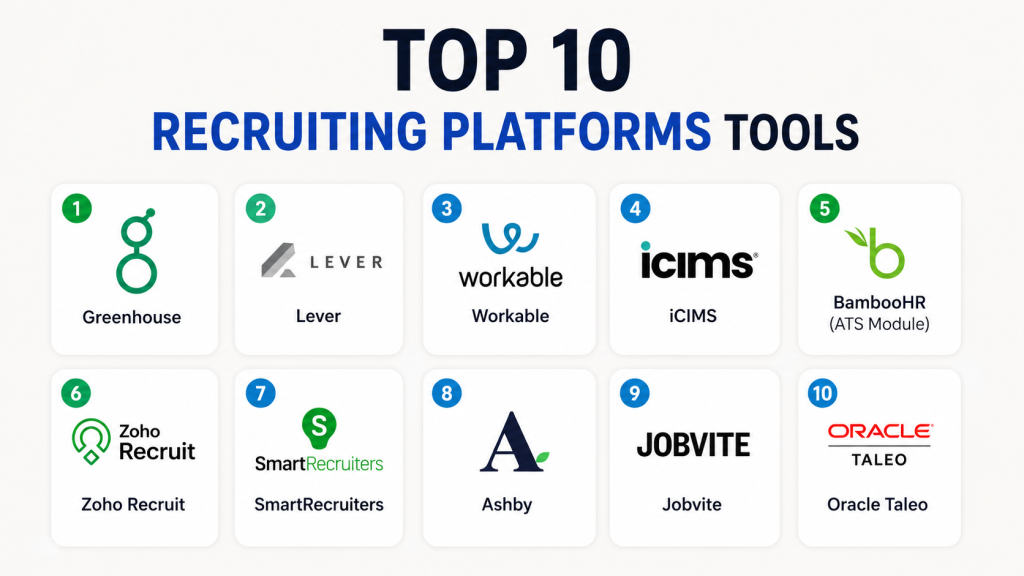
Top 10 Recruiting Platforms Tools
1 — Greenhouse
Short description: A structured hiring platform designed for companies that want consistent, data-driven hiring processes.
Key Features
- Structured interview workflows
- Advanced analytics and reporting
- Candidate sourcing tools
- DE&I hiring features
- Automated scheduling
- Custom pipelines
Pros
- Strong structured hiring approach
- Excellent reporting capabilities
Cons
- Complex setup for beginners
- Pricing not publicly stated
Platforms / Deployment
Web / Cloud
Security & Compliance
SSO, RBAC, GDPR support (others not publicly stated)
Integrations & Ecosystem
- HRIS systems
- Job boards
- Communication tools
- APIs
Support & Community
Enterprise-level support with strong documentation.
2 — Lever
Short description: A recruiting platform combining ATS and CRM features for relationship-driven hiring.
Key Features
- Candidate CRM
- Pipeline analytics
- Automated workflows
- Talent nurturing
- Collaboration tools
Pros
- Strong pipeline management
- Easy to use
Cons
- Limited customization
- Reporting setup needed
Platforms / Deployment
Web / Cloud
Security & Compliance
SSO, GDPR support (others not publicly stated)
Integrations & Ecosystem
- Email tools
- HR systems
- APIs
Support & Community
Good onboarding and support.
3 — Workable
Short description: A simple and affordable recruiting platform ideal for small and mid-sized businesses.
Key Features
- Job posting automation
- AI candidate sourcing
- Resume parsing
- Interview scheduling
- Mobile app
Pros
- Very user-friendly
- Cost-effective
Cons
- Limited advanced features
- Basic customization
Platforms / Deployment
Web / iOS / Android / Cloud
Security & Compliance
GDPR support (others not publicly stated)
Integrations & Ecosystem
- Job boards
- HR tools
- APIs
Support & Community
Responsive support and easy onboarding.
4 — iCIMS
Short description: A powerful enterprise recruiting platform with advanced features and scalability.
Key Features
- Full recruitment suite
- AI matching
- Analytics dashboards
- Career site builder
- Compliance tools
Pros
- Highly scalable
- Feature-rich
Cons
- Complex implementation
- Expensive
Platforms / Deployment
Web / Cloud
Security & Compliance
SOC 2, GDPR (others not publicly stated)
Integrations & Ecosystem
- ERP systems
- HRIS
- APIs
Support & Community
Strong enterprise support.
5 — BambooHR (ATS Module)
Short description: An HR platform with built-in recruiting features for SMBs.
Key Features
- Applicant tracking
- Employee records
- Onboarding
- Reporting
Pros
- Easy to use
- All-in-one HR solution
Cons
- Limited recruiting depth
- Not for large enterprises
Platforms / Deployment
Web / iOS / Android / Cloud
Security & Compliance
SSO, GDPR (others not publicly stated)
Integrations & Ecosystem
- Payroll
- HR tools
Support & Community
Strong SMB support.
6 — Zoho Recruit
Short description: A customizable recruiting solution for agencies and SMBs.
Key Features
- ATS + CRM
- Automation
- Resume parsing
- Custom dashboards
Pros
- Affordable
- Flexible
Cons
- Outdated UI
- Learning curve
Platforms / Deployment
Web / iOS / Android / Cloud
Security & Compliance
Not publicly stated
Integrations & Ecosystem
- Zoho apps
- APIs
Support & Community
Good documentation and support.
7 — SmartRecruiters
Short description: A modern enterprise recruiting platform focused on automation and collaboration.
Key Features
- AI matching
- Scheduling automation
- Career site builder
- Analytics
Pros
- Modern UI
- Automation features
Cons
- Pricing unclear
- Add-ons required
Platforms / Deployment
Web / Cloud
Security & Compliance
SSO, GDPR (others not publicly stated)
Integrations & Ecosystem
- HR tools
- APIs
Support & Community
Enterprise onboarding support.
8 — Ashby
Short description: A data-driven recruiting platform built for scaling startups.
Key Features
- Advanced analytics
- Scheduling automation
- CRM features
- Custom workflows
Pros
- Strong insights
- Flexible
Cons
- Smaller ecosystem
- Limited resources
Platforms / Deployment
Web / Cloud
Security & Compliance
Not publicly stated
Integrations & Ecosystem
- APIs
- HR tools
Support & Community
Growing support ecosystem.
9 — Jobvite
Short description: A comprehensive recruiting platform for enterprise hiring.
Key Features
- AI recruiting
- Engagement tools
- Social recruiting
- Analytics
Pros
- Scalable
- Strong engagement
Cons
- Complex setup
- UI issues
Platforms / Deployment
Web / Cloud
Security & Compliance
Not publicly stated
Integrations & Ecosystem
- HR systems
- APIs
Support & Community
Enterprise support available.
10 — Oracle Taleo
Short description: A legacy enterprise recruiting platform with deep customization and integration capabilities.
Key Features
- End-to-end hiring
- Compliance tools
- Reporting
- Workflow customization
Pros
- Highly configurable
- Reliable
Cons
- Outdated UI
- Complex implementation
Platforms / Deployment
Web / Cloud
Security & Compliance
Not publicly stated
Integrations & Ecosystem
- ERP systems
- APIs
Support & Community
Strong enterprise support.
Comparison Table (Top 10)
| Tool Name | Best For | Platform(s) | Deployment | Standout Feature | Public Rating |
|---|---|---|---|---|---|
| Greenhouse | Enterprise | Web | Cloud | Structured hiring | N/A |
| Lever | Mid-market | Web | Cloud | CRM features | N/A |
| Workable | SMB | Web, Mobile | Cloud | Ease of use | N/A |
| iCIMS | Enterprise | Web | Cloud | Scalability | N/A |
| BambooHR | SMB | Web, Mobile | Cloud | HR + ATS | N/A |
| Zoho Recruit | SMB | Web, Mobile | Cloud | Customization | N/A |
| SmartRecruiters | Enterprise | Web | Cloud | Automation | N/A |
| Ashby | Startups | Web | Cloud | Analytics | N/A |
| Jobvite | Enterprise | Web | Cloud | Engagement | N/A |
| Oracle Taleo | Enterprise | Web | Cloud | Integration | N/A |
Evaluation & Scoring of Recruiting Platforms
| Tool | Core | Ease | Integrations | Security | Performance | Support | Value | Total |
|---|---|---|---|---|---|---|---|---|
| Greenhouse | 9 | 7 | 9 | 8 | 9 | 8 | 7 | 8.3 |
| Lever | 8 | 8 | 8 | 7 | 8 | 7 | 8 | 7.9 |
| Workable | 7 | 9 | 7 | 7 | 8 | 8 | 9 | 8.0 |
| iCIMS | 9 | 6 | 9 | 8 | 9 | 8 | 6 | 8.1 |
| BambooHR | 7 | 9 | 7 | 7 | 8 | 8 | 9 | 8.0 |
| Zoho Recruit | 7 | 7 | 8 | 6 | 7 | 7 | 9 | 7.5 |
| SmartRecruiters | 8 | 8 | 8 | 7 | 8 | 8 | 7 | 7.9 |
| Ashby | 8 | 8 | 7 | 6 | 8 | 7 | 8 | 7.6 |
| Jobvite | 8 | 7 | 8 | 7 | 8 | 8 | 7 | 7.8 |
| Oracle Taleo | 9 | 5 | 9 | 8 | 9 | 8 | 6 | 7.9 |
These scores are comparative and help identify strengths and weaknesses across tools. Enterprise tools typically score higher in features, while SMB tools excel in usability and value. Always choose based on your specific needs rather than just total score.
Which Recruiting Platform Is Right for You?
Solo / Freelancer
Choose simple tools like Workable or Zoho Recruit for affordability and ease of use.
SMB
BambooHR and Workable are best for small businesses needing quick setup and minimal complexity.
Mid-Market
Lever and SmartRecruiters offer a balance of automation and scalability.
Enterprise
Greenhouse, iCIMS, and Oracle Taleo are ideal for large-scale, global hiring.
Budget vs Premium
Budget: Zoho Recruit, Workable
Premium: Greenhouse, iCIMS
Feature Depth vs Ease of Use
Deep features: iCIMS, Oracle Taleo
Easy to use: Workable, BambooHR
Integrations & Scalability
Best integrations: Greenhouse, Oracle Taleo
Scaling teams: Lever, Ashby
Security & Compliance Needs
Enterprise tools provide stronger compliance capabilities than SMB tools.
Frequently Asked Questions (FAQs)
1. What is a recruiting platform?
A recruiting platform is a software system that helps manage the entire hiring process from job posting to onboarding. It centralizes candidate data, automates repetitive tasks, and improves collaboration among hiring teams. This leads to faster, more efficient, and data-driven hiring decisions.
2. How much do recruiting platforms cost?
The cost varies depending on features, company size, and vendor pricing models. Some platforms charge monthly subscriptions, while others charge per user or per job posting. SMB tools are generally more affordable, while enterprise solutions can be significantly more expensive.
3. Are recruiting platforms suitable for small businesses?
Yes, many recruiting platforms are designed specifically for small businesses with simple interfaces and affordable pricing. These tools help replace manual hiring processes and improve efficiency without requiring a large HR team or technical expertise.
4. What features should I prioritize when choosing a platform?
Key features to focus on include ease of use, automation capabilities, integration options, and reporting tools. These directly impact hiring efficiency and productivity. The right priorities depend on your hiring volume and organizational needs.
5. Do recruiting platforms support remote hiring?
Most modern recruiting platforms support remote hiring through features like video interviews, automated scheduling, and global candidate tracking. These tools make it easier to hire talent from different locations without physical meetings.
6. Can recruiting platforms integrate with other tools?
Yes, most platforms offer integrations with HR systems, payroll software, communication tools, and job boards. These integrations streamline workflows and eliminate manual data entry, improving overall efficiency.
7. How long does it take to implement a recruiting platform?
Implementation time depends on the complexity of the platform and your organization’s requirements. Simple tools can be set up within a few days, while enterprise solutions may take several weeks or months due to customization and data migration.
8. Are recruiting platforms secure?
Most recruiting platforms include security features like data encryption, role-based access control, and compliance with data protection regulations. However, the level of security varies, so it is important to evaluate this before making a decision.
9. Can I switch recruiting platforms later?
Yes, switching platforms is possible, but it may require effort in data migration, employee training, and workflow adjustments. Planning ahead and choosing a scalable solution can reduce the need for frequent switching.
10. What are alternatives to recruiting platforms?
Alternatives include spreadsheets, job boards, or outsourcing hiring to recruitment agencies. While these options may work for small-scale hiring, they lack the automation, scalability, and efficiency of dedicated recruiting platforms.
Conclusion
Recruiting platforms are essential tools for modern hiring, helping organizations streamline workflows, improve candidate experience, and make better hiring decisions. With advancements in AI and automation, these platforms continue to evolve and deliver increasing value. The best choice depends on your company size, hiring needs, and budget. Instead of selecting a tool based solely on features, it is important to evaluate how well it fits your workflows. A practical approach is to shortlist two or three platforms, test them through demos or trials, and validate integrations and usability before making a final decision.

Find Trusted Cardiac Hospitals
Compare heart hospitals by city and services — all in one place.
Explore Hospitals
I now understand how recruiting platforms help streamline hiring, manage candidates, and improve overall recruitment efficiency. I’d like to explore more about which platform works best for fast-growing companies.
I now understand how time tracking software helps accurately record working hours and improve productivity, payroll accuracy, and project accountability. I’d like to explore more about which tools are best for remote teams and freelancers.