Introduction
Robotics Fleet Management Tools are specialized platforms designed to monitor, coordinate, and optimize fleets of autonomous robots. These tools provide centralized visibility into fleet operations, task scheduling, telemetry monitoring, predictive maintenance, and operational analytics. They are essential for organizations managing large-scale automated warehouses, delivery robots, or industrial robot fleets.
With the rapid adoption of autonomous mobile robots (AMRs) and automated guided vehicles (AGVs), efficient fleet management ensures reduced downtime, higher productivity, and enhanced safety. Robotics Fleet Management Tools are now critical for industries such as e-commerce, logistics, manufacturing, and healthcare automation.
Real-world use cases include:
- Coordinating hundreds of warehouse AMRs for order fulfillment
- Managing delivery drones in urban logistics
- Monitoring robot health and predictive maintenance in manufacturing
- Optimizing route planning for transport robots within facilities
- Integrating autonomous robots with warehouse management systems (WMS) for real-time efficiency
Best for: Operations managers, warehouse automation teams, logistics coordinators, industrial engineers, and large-scale robotics integrators.
Not ideal for: Organizations with minimal robotics deployments or small pilot projects where manual coordination is sufficient.
Key Trends in Robotics Fleet Management Tools
- Increased use of AI for predictive maintenance and task optimization
- Integration with warehouse management and enterprise resource planning (ERP) systems
- Cloud-based platforms enabling real-time fleet monitoring from anywhere
- Autonomous route planning and dynamic task assignment
- Standardization of robot communication protocols for interoperability
- Enhanced cybersecurity features including role-based access and encrypted telemetry
- Analytics-driven decision making with real-time dashboards
- Support for mixed fleets including AGVs, AMRs, drones, and collaborative robots
- Subscription and SaaS pricing models replacing traditional licensing
- Focus on human-robot collaboration and safety compliance
How We Selected These Tools (Methodology)
- Assessed market adoption and customer mindshare
- Evaluated core feature sets including task management, telemetry, and analytics
- Reviewed performance and reliability indicators from user reviews and benchmarks
- Verified security posture and compliance certifications
- Analyzed integrations with popular robotics hardware and enterprise systems
- Considered usability and suitability for different organization sizes
- Accounted for community and support availability
- Balanced open-source, enterprise, and SaaS-based options
- Focused on tools with proven results in real-world deployments
- Verified future-proofing and AI/automation capabilities
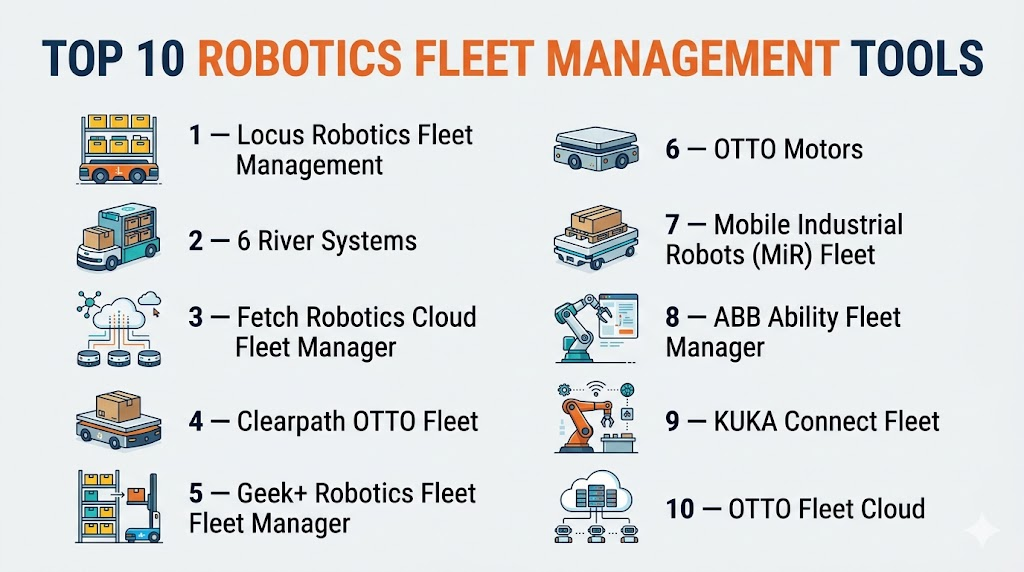
Top 10 Robotics Fleet Management Tools
#1 — Locus Robotics Fleet Management
Short description: Locus Robotics Fleet Management provides a centralized platform to coordinate autonomous warehouse robots for order picking and material transport. It is designed for e-commerce and logistics warehouses looking to optimize throughput and efficiency.
Key Features
- Real-time robot tracking and telemetry
- Task assignment and dynamic routing
- Fleet health monitoring and predictive maintenance
- Integration with WMS and ERP systems
- Analytics dashboards for operational insights
- Scalable fleet management for hundreds of robots
- Cloud-based monitoring and reporting
Pros
- Enhances operational efficiency and throughput
- Provides predictive maintenance alerts
- Strong integration ecosystem
Cons
- Primarily tailored for warehouse environments
- Can be costly for smaller operations
- Customization may require professional services
Platforms / Deployment
- Web
- Cloud
Security & Compliance
- Not publicly stated
Integrations & Ecosystem
Supports WMS, ERP, and robotics APIs for seamless operations
- WMS integration
- ERP integration
- Robot SDK support
- Cloud analytics
- Task automation APIs
Support & Community
- Strong documentation and dedicated support
- Training and onboarding programs
#2 — 6 River Systems
Short description: 6 River Systems offers a mobile robot fleet management solution focused on collaborative AMRs for warehouse environments. It provides automated task allocation and monitoring.
Key Features
- Intelligent task routing
- Real-time fleet monitoring
- Analytics for productivity and bottlenecks
- Integration with enterprise systems
- Collaborative robot management
- Predictive maintenance alerts
Pros
- Easy deployment in existing warehouses
- User-friendly dashboards
- Enhances team collaboration
Cons
- Limited outside warehouse logistics
- Customization requires technical support
Platforms / Deployment
- Web / Cloud
Security & Compliance
- Not publicly stated
Integrations & Ecosystem
- WMS, ERP, API-based extensions
- Real-time messaging integration
Support & Community
- Dedicated support team
- Online resources and forums
#3 — Fetch Robotics Cloud Fleet Manager
Short description: Fetch Robotics Cloud Fleet Manager is designed for managing AMR fleets in industrial and commercial settings, providing telemetry, task management, and analytics.
Key Features
- Cloud-based robot monitoring
- Dynamic task allocation
- Safety compliance tools
- Fleet diagnostics and health reports
- Data analytics dashboards
Pros
- Scalable for large fleets
- Cloud accessibility for multi-site operations
- Supports mixed robot types
Cons
- Dependency on internet connectivity
- Pricing can scale with fleet size
Platforms / Deployment
- Web / Cloud
Security & Compliance
- Not publicly stated
Integrations & Ecosystem
- APIs for WMS, ERP, and robot SDKs
- Cloud analytics integration
Support & Community
- Documentation and dedicated support
- Training resources
#4 — Clearpath OTTO Fleet
Short description: OTTO Fleet by Clearpath Robotics provides centralized fleet control for autonomous mobile robots in manufacturing and distribution environments.
Key Features
- Fleet tracking and telemetry
- Task scheduling and optimization
- Integration with automation systems
- Predictive maintenance
- Safety monitoring and collision avoidance
Pros
- Industrial-grade reliability
- Advanced safety features
- Flexible deployment options
Cons
- Focused primarily on industrial facilities
- Requires hardware purchase
Platforms / Deployment
- Web / Hybrid
Security & Compliance
- Not publicly stated
Integrations & Ecosystem
- API and SDK support
- ERP/WMS integration
- IoT sensor integration
Support & Community
- Strong enterprise support
- Professional services available
#5 — Geek+ Robotics Fleet Manager
Short description: Geek+ provides a cloud-based fleet management platform for AMRs in warehouses and logistics hubs, enabling dynamic routing and real-time monitoring.
Key Features
- Robot task scheduling
- Fleet status monitoring
- Analytics dashboards
- Predictive maintenance
- Safety compliance and alerts
Pros
- High scalability
- Easy integration with warehouse systems
- Efficient real-time routing
Cons
- Limited support outside logistics
- Hardware dependency
Platforms / Deployment
- Web / Cloud
Security & Compliance
- Not publicly stated
Integrations & Ecosystem
- WMS, ERP integration
- REST APIs
- IoT sensor connectivity
Support & Community
- Strong online documentation
- Technical support
#6 — OTTO Motors
Short description: OTTO Motors provides robotics fleet software with advanced AI-driven scheduling and predictive analytics for autonomous material transport in industrial environments.
Key Features
- AI-driven task allocation
- Fleet health and diagnostics
- Safety and collision monitoring
- Real-time dashboards
- Cloud-based monitoring
Pros
- Optimizes throughput and productivity
- Supports mixed robot fleets
- Predictive maintenance reduces downtime
Cons
- Enterprise-focused pricing
- Requires full hardware ecosystem
Platforms / Deployment
- Web / Cloud
Security & Compliance
- Not publicly stated
Integrations & Ecosystem
- APIs, WMS, ERP
- IoT and sensor integration
Support & Community
- Dedicated enterprise support
- Documentation and onboarding
#7 — Mobile Industrial Robots (MiR) Fleet
Short description: MiR Fleet is a solution for AMR fleet management, focusing on route optimization, task scheduling, and fleet analytics for industrial facilities.
Key Features
- Autonomous route planning
- Task management and scheduling
- Fleet monitoring and reporting
- Safety compliance features
- Analytics dashboards
Pros
- Intuitive user interface
- Efficient routing reduces idle time
- Integration-friendly
Cons
- Limited to indoor operations
- Hardware-specific features
Platforms / Deployment
- Web / Cloud
Security & Compliance
- Not publicly stated
Integrations & Ecosystem
- WMS/ERP connectivity
- API integration
- Sensor and IoT support
Support & Community
- Online help and support
- Technical guidance
#8 — ABB Ability Fleet Manager
Short description: ABB Ability Fleet Manager controls fleets of autonomous industrial robots, providing task management, telemetry, and predictive maintenance insights.
Key Features
- Fleet monitoring dashboards
- Predictive analytics for maintenance
- Task scheduling and routing
- Safety and compliance tools
- Integration with industrial systems
Pros
- Enterprise-grade reliability
- Advanced analytics and insights
- Industrial IoT compatibility
Cons
- Complex deployment
- Requires ABB hardware ecosystem
Platforms / Deployment
- Web / Hybrid
Security & Compliance
- Not publicly stated
Integrations & Ecosystem
- Industrial automation integration
- API and cloud support
Support & Community
- Enterprise support
- Documentation available
#9 — KUKA Connect Fleet
Short description: KUKA Connect Fleet manages mobile and industrial robots, providing centralized task orchestration, monitoring, and analytics for manufacturing and logistics.
Key Features
- Robot telemetry monitoring
- Task scheduling and allocation
- Fleet health and maintenance reports
- Integration with MES and ERP
- Safety and compliance management
Pros
- Optimizes manufacturing workflows
- Strong analytics capabilities
- Scalable fleet management
Cons
- Hardware dependency
- Enterprise-level pricing
Platforms / Deployment
- Web / Hybrid
Security & Compliance
- Not publicly stated
Integrations & Ecosystem
- MES and ERP APIs
- IoT sensor integration
Support & Community
- Technical support
- Documentation and training
#10 — OTTO Fleet Cloud
Short description: OTTO Fleet Cloud is a SaaS-based platform for fleet coordination, telemetry, and predictive maintenance of autonomous robots in logistics and industrial settings.
Key Features
- Cloud fleet monitoring
- AI-based task assignment
- Predictive maintenance alerts
- Safety compliance monitoring
- Integration with WMS and ERP
Pros
- Cloud-based access from anywhere
- AI-driven optimization
- Supports mixed fleets
Cons
- Subscription-based pricing
- Requires stable internet connectivity
Platforms / Deployment
- Web / Cloud
Security & Compliance
- Not publicly stated
Integrations & Ecosystem
- API and WMS/ERP integrations
- Cloud analytics support
Support & Community
- Dedicated support
- Documentation and online training
Comparison Table (Top 10)
| Tool Name | Best For | Platform(s) Supported | Deployment | Standout Feature | Public Rating |
|---|---|---|---|---|---|
| Locus Robotics Fleet Management | Warehouses | Web | Cloud | Task scheduling & telemetry | N/A |
| 6 River Systems | Warehouses | Web | Cloud | Collaborative AMR management | N/A |
| Fetch Robotics Cloud Fleet Manager | Industrial/Commercial | Web | Cloud | Cloud-based fleet monitoring | N/A |
| Clearpath OTTO Fleet | Manufacturing | Web | Hybrid | Industrial fleet optimization | N/A |
| Geek+ Robotics Fleet Manager | Logistics Hubs | Web | Cloud | Real-time routing | N/A |
| OTTO Motors | Industrial | Web | Cloud | AI-driven task allocation | N/A |
| Mobile Industrial Robots (MiR) Fleet | Industrial/Logistics | Web | Cloud | Autonomous route planning | N/A |
| ABB Ability Fleet Manager | Industrial | Web | Hybrid | Predictive maintenance | N/A |
| KUKA Connect Fleet | Manufacturing | Web | Hybrid | Task orchestration | N/A |
| OTTO Fleet Cloud | Logistics/Industrial | Web | Cloud | Cloud-based AI optimization | N/A |
Evaluation & Scoring of Robotics Fleet Management Tools
| Tool Name | Core | Ease | Integrations | Security | Performance | Support | Value | Weighted Total |
|---|---|---|---|---|---|---|---|---|
| Locus Robotics | 9 | 8 | 8 | 7 | 9 | 8 | 7 | 8.3 |
| 6 River Systems | 8 | 9 | 7 | 7 | 8 | 8 | 7 | 8.1 |
| Fetch Robotics | 8 | 8 | 8 | 7 | 8 | 7 | 8 | 8.0 |
| Clearpath OTTO | 9 | 7 | 8 | 8 | 9 | 8 | 7 | 8.3 |
| Geek+ Robotics | 8 | 8 | 8 | 7 | 8 | 7 | 7 | 7.9 |
| OTTO Motors | 9 | 7 | 8 | 8 | 9 | 8 | 7 | 8.3 |
| MiR Fleet | 8 | 9 | 7 | 7 | 8 | 7 | 7 | 7.9 |
| ABB Ability | 9 | 7 | 8 | 8 | 9 | 8 | 7 | 8.3 |
| KUKA Connect | 9 | 7 | 8 | 8 | 9 | 8 | 7 | 8.3 |
| OTTO Fleet Cloud | 9 | 8 | 8 | 7 | 9 | 8 | 8 | 8.4 |
Scores are comparative across categories, showing relative strengths in features, usability, integrations, and value.
Which Robotics Fleet Management Tool Is Right for You?
Solo / Freelancer
Smaller robotics teams or pilot projects may start with cloud-based SaaS platforms like OTTO Fleet Cloud or Fetch Robotics to test fleets without heavy infrastructure.
SMB
For small to medium warehouses, tools like 6 River Systems or Geek+ provide scalable AMR management with easy onboarding.
Mid-Market
Mid-sized operations benefit from Locus Robotics or MiR Fleet for multi-site visibility and fleet coordination.
Enterprise
Large-scale industrial deployments should consider Clearpath OTTO, ABB Ability, or KUKA Connect for advanced analytics, predictive maintenance, and mixed fleet management.
Budget vs Premium
Cloud SaaS solutions reduce upfront cost but may scale with fleet size. Premium enterprise tools provide robust analytics, AI optimization, and integration for high-value deployments.
Feature Depth vs Ease of Use
Select solutions with strong automation and AI if fleet complexity is high. For smaller fleets, ease of use and setup may be prioritized.
Integrations & Scalability
Ensure integration with WMS, ERP, and IoT devices. Enterprise deployments need flexible APIs and scalability for hundreds of robots.
Security & Compliance Needs
Evaluate RBAC, encryption, and telemetry security. Industrial facilities may require compliance with safety and cybersecurity standards.
Frequently Asked Questions (FAQs)
1. What is a robotics fleet management tool?
It is a software platform that enables centralized monitoring, task assignment, route optimization, predictive maintenance, and analytics for fleets of autonomous robots.
2. Can these tools manage both AMRs and AGVs?
Yes, most enterprise solutions support mixed fleets including autonomous mobile robots (AMRs) and automated guided vehicles (AGVs).
3. Are cloud-based solutions reliable?
Cloud platforms provide centralized monitoring and scalability but require stable internet connections for real-time operations.
4. Do these tools integrate with WMS/ERP?
Most tools offer APIs and native integrations to synchronize tasks and operations with warehouse or enterprise systems.
5. How do predictive maintenance features work?
Sensors and telemetry data are analyzed to predict failures, schedule maintenance, and reduce downtime.
6. Is security a concern?
Yes, look for role-based access, encryption, SSO, and audit logging to secure robot telemetry and operational data.
7. Can these tools scale for large fleets?
Enterprise tools are designed to manage hundreds of robots across multiple sites, with analytics and optimization for complex operations.
8. Are these tools suitable for small pilot projects?
Cloud SaaS solutions like Fetch Robotics or OTTO Fleet Cloud are ideal for small pilots with minimal infrastructure.
9. How do pricing models work?
Most platforms offer subscription-based pricing. Enterprise tools may include licensing and professional services.
10. What are common mistakes in adoption?
Skipping integration planning, ignoring safety compliance, or underestimating scalability requirements are common pitfalls.
Conclusion
Robotics Fleet Management Tools are essential for organizations leveraging AMRs, AGVs, and industrial robots to optimize operations, improve safety, and reduce downtime. Selection depends on fleet size, operational complexity, and integration requirements. Cloud SaaS solutions are ideal for smaller pilots or SMBs, while enterprise deployments require robust analytics, AI-based optimization, and integration with WMS/ERP systems. Buyers should evaluate task management, predictive maintenance, telemetry, scalability, and security features. The best approach is to shortlist tools, run pilot programs, and validate integration, security, and scalability requirements to identify the right platform for your fleet.

Find Trusted Cardiac Hospitals
Compare heart hospitals by city and services — all in one place.
Explore Hospitals
The system should be able to move the task to another suitable robot without creating delays or confusion. Teams should also be able to see which tasks were affected and why. This can make fleet operations more reliable when unexpected problems happen.