Introduction
Robotics Simulation Tools are specialized software platforms designed to model, test, and validate robotic systems in a virtual environment. These tools allow engineers, researchers, and developers to simulate robotic behaviors, motion planning, sensor integration, and environmental interactions without the risks or costs associated with physical prototyping. They play a crucial role in accelerating development cycles, improving safety, and optimizing robotic performance before deployment.
Robotics simulation is essential for industrial automation, autonomous vehicles, warehouse robotics, healthcare robots, and research in AI-driven robotics. Buyers should evaluate simulation accuracy, physics engine fidelity, sensor support, multi-robot coordination, scalability, programming language support, integration with development tools, visualization capabilities, real-time performance, and licensing or deployment flexibility.
Best for: Robotics engineers, AI researchers, product designers, and enterprises building or testing robotic systems.
Not ideal for: Hobbyists or teams with minimal technical expertise or those requiring only basic robotics demonstrations without advanced simulation needs.
Key Trends in Robotics Simulation Tools
- Integration of AI and reinforcement learning for autonomous decision-making
- High-fidelity physics engines for accurate real-world simulations
- Multi-robot and swarm simulation capabilities
- Cloud-based simulation and collaboration platforms
- Real-time simulation for testing autonomous vehicles and drones
- Open-source frameworks gaining adoption alongside commercial platforms
- Hybrid simulation combining virtual and physical robots (hardware-in-the-loop)
- Enhanced visualization and 3D rendering for better scenario analysis
- Interoperability with robotics middleware such as ROS
- Subscription and usage-based pricing models
How We Selected These Tools (Methodology)
- Evaluated market adoption and mindshare in robotics research and industry
- Analyzed completeness of features including multi-robot support, physics fidelity, and sensor simulation
- Considered reliability and real-time performance under complex scenarios
- Reviewed security and compliance for enterprise deployments
- Assessed integrations with ROS, Python, MATLAB, and CAD software
- Verified suitability across different enterprise sizes and research institutions
- Evaluated learning curve and ease of use for developers
- Considered extensibility and customization options
- Included community and vendor support
- Reviewed licensing models and total cost of ownership
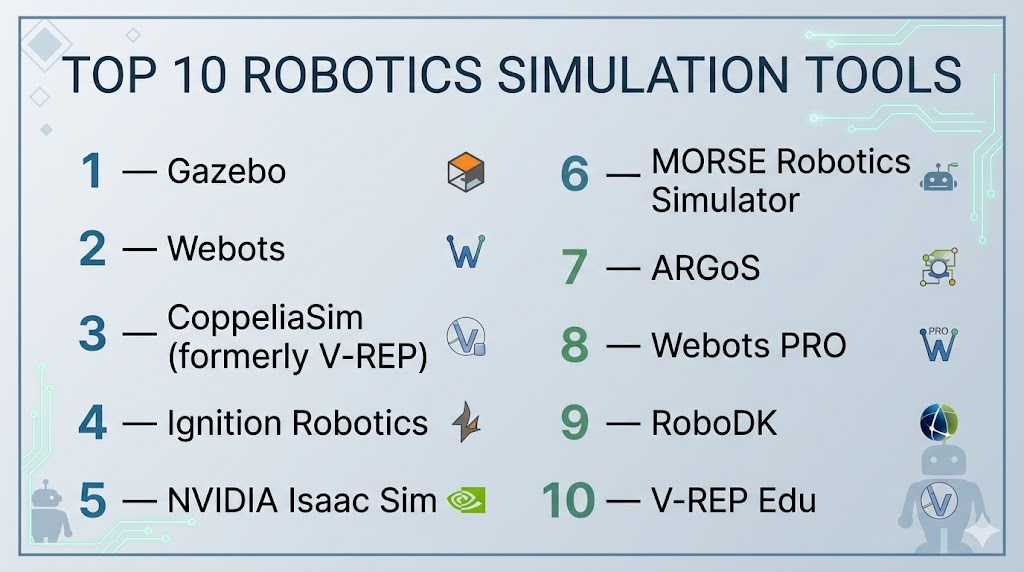
Top 10 Robotics Simulation Tools
#1 — Gazebo
Short description: Gazebo is an open-source robotics simulator offering a robust physics engine, 3D rendering, and multi-robot simulation. Ideal for academic and industrial projects, it integrates well with ROS for controlling robots and testing algorithms.
Key Features
- High-fidelity physics simulation
- Sensor and actuator modeling
- Multi-robot support
- Realistic 3D environment rendering
- Integration with ROS and other middleware
- Plugin system for custom behavior
- Extensive documentation and tutorials
Pros
- Open-source and highly extensible
- Strong ROS ecosystem integration
- Active research and developer community
Cons
- Steeper learning curve for beginners
- Resource-intensive for complex simulations
Platforms / Deployment
- Linux / macOS / Windows
- Self-hosted
Security & Compliance
- Varies / N/A
Integrations & Ecosystem
- ROS, MATLAB, Python APIs
- Supports CAD model imports
- Compatible with external physics engines
Support & Community
- Active forums, GitHub issues, and ROS community support
#2 — Webots
Short description: Webots is a professional-grade robot simulator providing accurate modeling, ready-to-use robots, and an integrated development environment suitable for both education and industrial research.
Key Features
- Pre-built robot models
- Integrated programming environment
- Physics-based simulation
- Sensor and actuator libraries
- Cross-platform support
- Cloud simulation options
- Export and import of 3D models
Pros
- User-friendly interface for rapid prototyping
- Ready-to-use models for fast simulation
- Cross-platform compatibility
Cons
- Commercial features require licensing
- Less flexible for deep custom simulations
Platforms / Deployment
- Windows / macOS / Linux
- Cloud / Self-hosted
Security & Compliance
- Not publicly stated
Integrations & Ecosystem
- ROS, Python, C/C++
- VR/AR visualization support
- CAD software integration
Support & Community
- Official support, user forums, educational resources
#3 — CoppeliaSim (V-REP)
Short description: CoppeliaSim is a versatile robot simulation platform with advanced control, scripting, and real-time physics capabilities, suitable for multi-robot simulations and complex automation scenarios.
Key Features
- Multi-robot simulation
- Built-in physics engines
- Remote API and scripting
- Sensor and actuator simulation
- Integrated scene editor
- Real-time simulation and visualization
- Support for reinforcement learning experiments
Pros
- Extensive scripting and API support
- Supports complex scenarios with multiple robots
Cons
- Commercial license required for advanced features
- Interface may be complex for beginners
Platforms / Deployment
- Windows / macOS / Linux
- Cloud / Self-hosted
Security & Compliance
- Not publicly stated
Integrations & Ecosystem
- ROS, MATLAB, Python
- Supports external physics engines
- CAD model import/export
Support & Community
- Professional support for license holders
- Active user forum
#4 — Ignition Robotics
Short description: Ignition Robotics provides a next-generation simulation framework with modular components, realistic physics, and powerful rendering, focused on high-performance robotics development.
Key Features
- Modular plugin architecture
- Advanced physics and collision detection
- High-quality 3D rendering
- Multi-robot simulation
- Integration with ROS 2
- Cloud-enabled simulation
- Sensor modeling and customization
Pros
- Open-source and scalable
- Strong ROS 2 ecosystem support
Cons
- Requires experience with robotics frameworks
- Limited ready-made robot models
Platforms / Deployment
- Linux
- Self-hosted / Cloud
Security & Compliance
- Not publicly stated
Integrations & Ecosystem
- ROS 2, Python, C++ APIs
- CAD model import/export
- Supports distributed simulation
Support & Community
- Active open-source community
- Documentation and examples available
#5 — NVIDIA Isaac Sim
Short description: Isaac Sim is a simulation platform for robotics and AI development leveraging NVIDIA’s Omniverse technology for photorealistic rendering and GPU-accelerated physics.
Key Features
- Photorealistic simulation
- GPU-accelerated physics
- Multi-robot and warehouse simulation
- Reinforcement learning support
- ROS and Python integration
- High-fidelity sensor simulation
Pros
- Exceptional graphics and physics fidelity
- Optimized for AI training
Cons
- High system requirements
- Limited open-source flexibility
Platforms / Deployment
- Windows / Linux
- Cloud / Self-hosted
Security & Compliance
- Not publicly stated
Integrations & Ecosystem
- ROS, Omniverse, Python, CUDA
- Supports ML pipelines
- CAD model integration
Support & Community
- NVIDIA enterprise support, community forums
#6 — MORSE
Short description: MORSE is an open-source simulator focused on academic and research robotics applications with flexibility in scripting and middleware integration.
Key Features
- Multi-robot simulation
- 3D environment rendering
- Scripting with Python
- ROS and YARP support
- Sensor and actuator simulation
- Extensible via plugins
Pros
- Lightweight and research-friendly
- Python scripting simplifies automation
Cons
- Limited commercial-grade features
- Less intuitive UI
Platforms / Deployment
- Linux
- Self-hosted
Security & Compliance
- Not publicly stated
Integrations & Ecosystem
- ROS, YARP
- Python APIs
- External visualization tools
Support & Community
- Academic and open-source community
#7 — ARGoS
Short description: ARGoS is a highly efficient simulator for swarm robotics and large-scale multi-robot experiments with emphasis on speed and modularity.
Key Features
- Multi-robot and swarm simulation
- Modular simulation engine
- Physics-based interactions
- Python and C++ APIs
- High performance for large robot swarms
Pros
- Extremely fast for large simulations
- Suitable for swarm robotics research
Cons
- Limited 3D rendering quality
- Requires technical expertise
Platforms / Deployment
- Linux / macOS
- Self-hosted
Security & Compliance
- Not publicly stated
Integrations & Ecosystem
- Python, C++ APIs
- ROS integration
- Customizable plugins
Support & Community
- Academic research community
#8 — Webots PRO
Short description: Webots PRO offers a commercial version of Webots with extended support, additional robot models, and enterprise-ready features for large-scale projects.
Key Features
- Pre-built industrial and research robot models
- Enterprise support and licensing
- Cross-platform deployment
- Advanced physics and sensors
- Integration with ROS
Pros
- Ready-to-use models for quick setup
- Commercial support and updates
Cons
- Paid license
- Limited flexibility compared to open-source frameworks
Platforms / Deployment
- Windows / macOS / Linux
- Cloud / Self-hosted
Security & Compliance
- Not publicly stated
Integrations & Ecosystem
- ROS, Python, C++
- CAD model support
Support & Community
- Vendor support and user community
#9 — RoboDK
Short description: RoboDK is a simulation and offline programming tool for industrial robots, offering rapid deployment, robot path planning, and integration with production systems.
Key Features
- Industrial robot simulation
- Offline programming and path planning
- Multi-vendor robot support
- Python and API scripting
- Integration with PLCs and production software
Pros
- Supports wide range of industrial robots
- Rapid deployment and offline programming
Cons
- Focused on industrial robots only
- Paid license required
Platforms / Deployment
- Windows / macOS / Linux
- Self-hosted / Cloud
Security & Compliance
- Not publicly stated
Integrations & Ecosystem
- Python APIs, PLCs, CAD software
- Multi-vendor robot support
Support & Community
- Vendor support, user forums
#10 — V-REP Edu
Short description: V-REP Edu is an educational edition of CoppeliaSim designed for students and universities, providing a fully featured simulation environment for learning robotics concepts.
Key Features
- Multi-robot and single-robot simulation
- Scripting and plugin support
- Physics engine for realistic behavior
- Sensor simulation
- Integration with ROS
Pros
- Free for educational purposes
- Ideal for learning and prototyping
Cons
- Limited for commercial deployment
- Less optimized for large-scale simulations
Platforms / Deployment
- Windows / macOS / Linux
- Self-hosted
Security & Compliance
- Not publicly stated
Integrations & Ecosystem
- ROS, Python scripting
- Plugin support
- Educational resources
Support & Community
- Academic community, tutorials, forums
Comparison Table (Top 10)
| Tool Name | Best For | Platform(s) Supported | Deployment | Standout Feature | Public Rating |
|---|---|---|---|---|---|
| Gazebo | Academic & industrial simulation | Linux, Windows, macOS | Self-hosted | ROS integration and multi-robot support | N/A |
| Webots | Education & industrial research | Windows, macOS, Linux | Cloud / Self-hosted | Pre-built robot models | N/A |
| CoppeliaSim | Multi-robot research | Windows, macOS, Linux | Cloud / Self-hosted | Advanced scripting & control | N/A |
| Ignition Robotics | High-performance research | Linux | Cloud / Self-hosted | Modular plugin architecture | N/A |
| NVIDIA Isaac Sim | AI & autonomous robotics | Windows, Linux | Cloud / Self-hosted | GPU-accelerated physics & rendering | N/A |
| MORSE | Academic research | Linux | Self-hosted | Python scripting and ROS integration | N/A |
| ARGoS | Swarm robotics | Linux, macOS | Self-hosted | Efficient large-scale swarm simulation | N/A |
| Webots PRO | Enterprise robotics | Windows, macOS, Linux | Cloud / Self-hosted | Extended robot models & support | N/A |
| RoboDK | Industrial robotics | Windows, macOS, Linux | Self-hosted / Cloud | Offline programming & path planning | N/A |
| V-REP Edu | Educational | Windows, macOS, Linux | Self-hosted | Fully featured educational simulation | N/A |
Evaluation & Scoring of Robotics Simulation Tools
| Tool Name | Core (25%) | Ease (15%) | Integrations (15%) | Security (10%) | Performance (10%) | Support (10%) | Value (15%) | Weighted Total |
|---|---|---|---|---|---|---|---|---|
| Gazebo | 9 | 7 | 8 | 7 | 8 | 8 | 9 | 8.0 |
| Webots | 8 | 8 | 8 | 7 | 8 | 8 | 8 | 7.9 |
| CoppeliaSim | 9 | 7 | 8 | 7 | 9 | 8 | 8 | 8.1 |
| Ignition Robotics | 8 | 7 | 8 | 7 | 9 | 7 | 8 | 7.8 |
| NVIDIA Isaac Sim | 9 | 7 | 8 | 7 | 9 | 8 | 7 | 7.9 |
| MORSE | 7 | 8 | 7 | 7 | 7 | 7 | 8 | 7.3 |
| ARGoS | 7 | 7 | 7 | 7 | 9 | 7 | 7 | 7.4 |
| Webots PRO | 8 | 8 | 8 | 7 | 8 | 8 | 8 | 7.9 |
| RoboDK | 8 | 8 | 8 | 7 | 8 | 8 | 8 | 7.9 |
| V-REP Edu | 7 | 8 | 7 | 7 | 7 | 7 | 8 | 7.3 |
Scores are comparative and highlight tool suitability based on core features, integration capabilities, usability, and value.
Which Robotics Simulation Tools Tool Is Right for You?
Solo / Freelancer
Lightweight and open-source tools like MORSE, ARGoS, and V-REP Edu allow individuals and students to learn robotics and prototype experiments with minimal cost.
SMB
Webots and Webots PRO provide ready-to-use robot models and easier deployment for small to medium enterprises developing robotic applications.
Mid-Market
CoppeliaSim, Gazebo, and Ignition Robotics support multi-robot scenarios, advanced scripting, and medium-scale simulation workloads.
Enterprise
NVIDIA Isaac Sim, Webots PRO, and RoboDK offer GPU-accelerated physics, industrial robot simulation, and enterprise-grade support for large-scale robotics projects.
Budget vs Premium
Open-source options reduce licensing costs but require technical expertise; premium tools provide support, commercial features, and optimized simulation engines.
Feature Depth vs Ease of Use
For rapid prototyping, Webots and Webots PRO are ideal; for research and complex multi-robot scenarios, CoppeliaSim, Gazebo, and Isaac Sim provide deep capabilities.
Integrations & Scalability
Select tools compatible with ROS, Python, and CAD software to enable seamless integration with existing robotics workflows and scalable simulation environments.
Security & Compliance Needs
Enterprise deployments should consider access control, secure cloud environments, and compliance features if using simulation platforms in production or sensitive research contexts.
Frequently Asked Questions (FAQs)
1. Can these simulators handle multiple robots at once?
Yes, most tools like Gazebo, CoppeliaSim, and Ignition Robotics support multi-robot simulation for coordinated tasks.
2. Are open-source simulators production-ready?
Open-source tools are ideal for prototyping and research; production use may require additional infrastructure and testing.
3. Do these tools support real-time physics simulation?
Yes, most simulators include high-fidelity physics engines to simulate realistic robotic behaviors.
4. Can I simulate sensors and actuators accurately?
Yes, tools like Isaac Sim and CoppeliaSim provide detailed sensor and actuator modeling.
5. Are these simulators cross-platform?
Most support Linux, Windows, and macOS; some cloud-enabled platforms extend deployment flexibility.
6. Is GPU acceleration supported?
Yes, NVIDIA Isaac Sim and some other simulators leverage GPU for faster and more accurate simulations.
7. Do these tools integrate with ROS?
Yes, Gazebo, Ignition, and CoppeliaSim have deep integration with ROS and ROS 2.
8. Can these tools simulate drones or mobile robots?
Yes, many platforms support aerial, wheeled, and industrial robots for versatile simulation scenarios.
9. Are there educational versions available?
Yes, V-REP Edu and Webots provide free or academic licenses for learning and teaching robotics.
10. What are the alternatives to simulation tools?
Physical prototyping, testbeds, and simpler 2D simulations can be used for lightweight or initial testing.
Conclusion
Robotics Simulation Tools are crucial for designing, testing, and validating robotic systems safely and efficiently. Open-source platforms like Gazebo, MORSE, and ARGoS are ideal for research and learning, whereas commercial tools such as NVIDIA Isaac Sim, Webots PRO, and RoboDK provide enterprise-grade performance, advanced physics, and industrial robot support. Choosing the right simulator depends on project scale, complexity, integration needs, budget, and the level of realism required. Organizations should evaluate platform capabilities, extensibility, and support options to maximize productivity and achieve successful robotic development outcomes.

Find Trusted Cardiac Hospitals
Compare heart hospitals by city and services — all in one place.
Explore Hospitals
If the robot, sensors, workspace, or software changes, an old simulation may give misleading test results. Teams should have a simple process to update and verify models before using them for important decisions. This can make simulation results much more useful in real-world deployments.