Introduction
RSS aggregators are specialized applications that collect, organize, and display news, blogs, and content from multiple RSS feeds in one centralized location. They allow users to efficiently monitor information from a wide variety of sources without visiting each website individually. the rise of AI-powered curation, personalized content, and cross-platform synchronization has made RSS aggregators a critical tool for professionals, researchers, marketers, and avid readers.
Real-world use cases include:
- Market intelligence: Businesses track competitor news, industry trends, and regulatory updates.
- Content curation: Marketing teams and bloggers compile relevant content to share with audiences.
- Academic research: Researchers gather updates from journals, preprint servers, and news sources.
- Personal productivity: Professionals maintain a curated feed of topics relevant to their work or interests.
- Team collaboration: Shared feeds help teams collectively monitor and annotate incoming information.
Evaluation criteria for buyers include:
- Feed aggregation and source management
- Personalization and AI recommendations
- Offline reading and caching
- Cross-device synchronization
- Search, tagging, and filtering features
- Integration with productivity tools or APIs
- Security and privacy compliance
- Performance and reliability
- Collaboration and sharing features
- Pricing and subscription models
Best for: Researchers, marketers, professionals, and teams requiring centralized, real-time access to information from multiple sources. Suitable for organizations of all sizes that rely on up-to-date knowledge streams.
Not ideal for: Casual readers who only consume content occasionally or rely solely on social media feeds for information.
Key Trends in RSS Aggregators
- AI-assisted feed prioritization and content summarization
- Integration with note-taking, project management, and team collaboration platforms
- Multi-device synchronization with offline reading capabilities
- Cross-format support, including podcasts, videos, and newsletters
- Enhanced security with encryption, SSO, and privacy compliance (GDPR/CCPA)
- Personalized notifications and topic-based alerts
- Visual feed presentation with magazine-style layouts
- Automation of feed organization and filtering rules
- Subscription flexibility including freemium and enterprise tiers
- Analytics on feed engagement and content performance
How We Selected These Tools (Methodology)
- Evaluated market adoption and popularity among professionals
- Assessed completeness of features, including AI personalization and automation
- Reviewed reliability, performance, and update frequency
- Considered security posture and compliance certifications
- Examined integration capabilities with productivity and collaboration tools
- Evaluated multi-platform support and deployment flexibility
- Checked suitability for individual users, SMBs, and enterprise clients
- Analyzed subscription and pricing models
- Considered community engagement and support resources
- Verified alignment with 2026+ news consumption trends
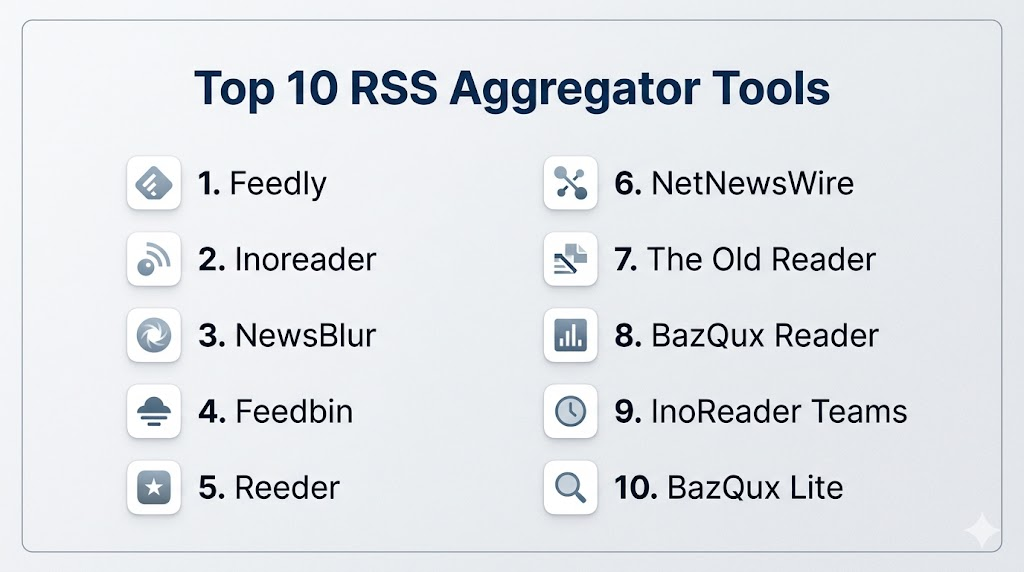
Top 10 RSS Aggregators
1- Feedly
Short description: Feedly is an AI-powered RSS aggregator for professionals who want curated content, trend monitoring, and workflow integration.
Key Features
- AI-assisted content recommendations
- RSS feed aggregation and categorization
- Boards and saved articles
- Team collaboration with shared feeds
- Mobile and desktop access
- Integration with productivity tools
Pros
- Highly customizable feeds
- AI-driven curation
- Scales from solo users to enterprises
Cons
- Full features require subscription
- Learning curve for advanced boards
Platforms / Deployment
- Web / Windows / macOS / iOS / Android
- Cloud
Security & Compliance
- SSO/SAML, encryption
- GDPR compliant
Integrations & Ecosystem
- Slack
- Trello
- Evernote
- OneNote
- Zapier
Support & Community
- Documentation and tutorials
- Active user community
- Email support for premium plans
2- Inoreader
Short description: Inoreader is a feature-rich RSS reader for power users requiring automation, keyword monitoring, and advanced filtering.
Key Features
- RSS feed aggregation
- Automation rules and filters
- Keyword and topic monitoring
- Offline reading
- Multi-device sync
- Saved searches and smart folders
Pros
- Customizable automation
- Supports a broad range of content sources
- Free tier offers substantial functionality
Cons
- Complex interface
- Premium needed for advanced automation
Platforms / Deployment
- Web / Windows / macOS / iOS / Android
- Cloud
Security & Compliance
- Not publicly stated
Integrations & Ecosystem
- Evernote
- OneNote
- Zapier
Support & Community
- Tutorials and forums
- Email support
3- NewsBlur
Short description: NewsBlur combines RSS aggregation with social features, allowing users to comment, share, and personalize feeds.
Key Features
- RSS feed aggregation
- Story training for content relevance
- Social commenting and sharing
- Offline reading
- Folder-based organization
Pros
- Strong personalization
- Social and collaborative features
- Suitable for individuals and teams
Cons
- Premium subscription needed for full RSS access
- Interface slightly dated
Platforms / Deployment
- Web / iOS / Android
- Cloud
Security & Compliance
- Not publicly stated
Integrations & Ecosystem
- Evernote
Support & Community
- Forums, tutorials, email support
4- Feedbin
Short description: Feedbin is a minimalist RSS aggregator focused on speed, privacy, and distraction-free reading.
Key Features
- RSS feed aggregation
- Email subscriptions
- Tagging and folder organization
- Clean, simple interface
- Offline reading
Pros
- Privacy-focused
- Minimalist and efficient
- Supports email subscriptions
Cons
- Paid subscription only
- Limited advanced features
Platforms / Deployment
- Web / iOS / Android
- Cloud
Security & Compliance
- Not publicly stated
Integrations & Ecosystem
- IFTTT
- Slack
- Zapier
Support & Community
- Email support
- Documentation
5- Reeder
Short description: Reeder is a fast, elegant RSS reader for macOS and iOS users, providing offline reading and feed management.
Key Features
- RSS feed aggregation
- Read-later support
- Offline access
- Minimalist interface
- Multi-service synchronization
Pros
- Lightweight and fast
- Excellent for Apple devices
- Offline reading reliable
Cons
- Apple-only platform
- Limited automation
Platforms / Deployment
- macOS / iOS
- Cloud sync
Security & Compliance
- Not publicly stated
Integrations & Ecosystem
- Feedly, Inoreader, Pocket
- Export options
Support & Community
- Email support
- Documentation
6- NetNewsWire
Short description: NetNewsWire is a free, open-source RSS reader for macOS and iOS focused on simplicity, speed, and transparency.
Key Features
- RSS feed aggregation
- Lightweight interface
- Fast performance
- Read-later support
- Open-source
Pros
- Free and open-source
- Minimalist and fast
- Transparent codebase
Cons
- macOS/iOS only
- Manual syncing required
Platforms / Deployment
- macOS / iOS
- Self-hosted / local sync
Security & Compliance
- Not publicly stated
Integrations & Ecosystem
- iCloud sync (manual)
- Pocket, Instapaper
Support & Community
- GitHub community
- Documentation
7- The Old Reader
Short description: The Old Reader is a web-based RSS aggregator that emphasizes simplicity and social sharing features.
Key Features
- Web-based feed aggregation
- Social sharing and subscriptions
- Tagging and folder management
- Import/export of feeds
- Minimalist interface
Pros
- Easy to use
- Simple interface
- Supports shared subscriptions
Cons
- Limited mobile apps
- Fewer advanced features
Platforms / Deployment
- Web / iOS / Android
- Cloud
Security & Compliance
- Not publicly stated
Integrations & Ecosystem
Support & Community
- Help documentation
- Forums
8- BazQux Reader
Short description: BazQux Reader is a lightweight RSS aggregator focusing on speed, ad-free experience, and social comments integration.
Key Features
- RSS feed aggregation
- Comments from social platforms
- Speed-optimized interface
- Tagging and folder support
- Read-later functionality
Pros
- Fast and responsive
- Ad-free experience
- Lightweight design
Cons
- Paid subscription
- Limited integrations
Platforms / Deployment
- Web / iOS / Android
- Cloud
Security & Compliance
- Not publicly stated
Integrations & Ecosystem
- Twitter, Instapaper
Support & Community
- Email support
- Documentation
9- InoReader Teams
Short description: InoReader Teams is the enterprise-grade version of Inoreader, providing collaboration, monitoring, and feed management at scale.
Key Features
- Multi-user collaboration
- Shared feed boards
- Advanced automation and filters
- Analytics on feed engagement
- Keyword monitoring
Pros
- Scales to enterprise needs
- Collaboration features
- Advanced feed automation
Cons
- Requires subscription
- Slight learning curve
Platforms / Deployment
- Web / iOS / Android / Windows / macOS
- Cloud
Security & Compliance
- Not publicly stated
Integrations & Ecosystem
- Slack
- Trello
- Evernote
Support & Community
- Enterprise support
- Documentation
10- BazQux Lite
Short description: BazQux Lite is the simplified version for individuals seeking fast, minimalist RSS reading without additional enterprise features.
Key Features
- Lightweight and fast
- Feed aggregation
- Tagging and organization
- Read-later support
Pros
- Very lightweight
- Simple to use
- Fast performance
Cons
- No advanced automation
- Minimal integrations
Platforms / Deployment
- Web / iOS / Android
- Cloud
Security & Compliance
- Not publicly stated
Integrations & Ecosystem
- Basic feed imports
- Read-later services
Support & Community
- Documentation available
- Email support
Comparison Table (Top 10)
| Tool Name | Best For | Platform(s) Supported | Deployment | Standout Feature | Public Rating |
|---|---|---|---|---|---|
| Feedly | Professionals | Web, Windows, macOS, iOS, Android | Cloud | AI curation | N/A |
| Inoreader | Power users | Web, Windows, macOS, iOS, Android | Cloud | Automation & filters | N/A |
| NewsBlur | Social readers | Web, iOS, Android | Cloud | Story training & commenting | N/A |
| Feedbin | Privacy-focused users | Web, iOS, Android | Cloud | Minimalist & private | N/A |
| Reeder | Apple users | macOS, iOS | Cloud | Sleek interface & offline | N/A |
| NetNewsWire | Open-source users | macOS, iOS | Self-hosted | Lightweight & free | N/A |
| The Old Reader | Casual readers | Web, iOS, Android | Cloud | Social sharing | N/A |
| BazQux Reader | Fast readers | Web, iOS, Android | Cloud | Speed & comments | N/A |
| InoReader Teams | Enterprise | Web, iOS, Android, Windows, macOS | Cloud | Team collaboration | N/A |
| BazQux Lite | Individuals | Web, iOS, Android | Cloud | Minimalist fast reading | N/A |
Evaluation & Scoring of RSS Aggregators
| Tool Name | Core (25%) | Ease (15%) | Integrations (15%) | Security (10%) | Performance (10%) | Support (10%) | Value (15%) | Weighted Total |
|---|---|---|---|---|---|---|---|---|
| Feedly | 9 | 8 | 9 | 8 | 9 | 8 | 8 | 8.65 |
| Inoreader | 9 | 7 | 8 | 8 | 8 | 7 | 8 | 8.2 |
| NewsBlur | 8 | 7 | 7 | 7 | 8 | 7 | 7 | 7.55 |
| Feedbin | 7 | 8 | 6 | 7 | 8 | 7 | 7 | 7.45 |
| Reeder | 7 | 9 | 6 | 7 | 8 | 7 | 7 | 7.55 |
| NetNewsWire | 6 | 8 | 5 | 7 | 8 | 7 | 8 | 7.1 |
| The Old Reader | 6 | 8 | 6 | 7 | 8 | 7 | 7 | 7.15 |
| BazQux Reader | 7 | 8 | 6 | 7 | 8 | 7 | 7 | 7.45 |
| InoReader Teams | 9 | 7 | 8 | 8 | 8 | 7 | 8 | 8.2 |
| BazQux Lite | 6 | 8 | 5 | 7 | 8 | 7 | 7 | 7.05 |
Which RSS Aggregator Tool Is Right for You?
Solo / Freelancer
Use Feedly, NetNewsWire, or BazQux Lite for personal RSS feeds, lightweight automation, and offline reading.
SMB
Inoreader or NewsBlur provide collaboration features, automation, and shared feeds for small teams.
Mid-Market
Feedly Enterprise, InoReader Teams, or BazQux Reader offer AI-driven curation, analytics, and multi-user capabilities.
Enterprise
InoReader Teams and Feedly Enterprise are ideal for large-scale feed monitoring, security, and enterprise integration.
Budget vs Premium
Free tools like NetNewsWire and BazQux Lite provide core RSS functionality. Premium plans add AI, advanced automation, and team features.
Feature Depth vs Ease of Use
Tools like Inoreader offer extensive automation and customization but require learning. Simpler tools like Feedbin or Reeder prioritize ease of use.
Integrations & Scalability
For workflows requiring collaboration and productivity app integration, Feedly Enterprise and InoReader Teams are optimal.
Security & Compliance Needs
Enterprises handling sensitive information should prioritize apps with encryption, SSO, and GDPR compliance such as Feedly Enterprise.
Frequently Asked Questions (FAQs)
1. What pricing models are available for RSS aggregators?
Most RSS tools offer freemium, subscription-based, and enterprise plans. Free tiers provide basic feeds, while premium subscriptions enable AI recommendations, automation, and team collaboration.
2. How easy is onboarding for teams?
Cloud-based aggregators like Feedly and Inoreader allow smooth onboarding with shared feeds and role-based access. More advanced tools may require setup and training for workflow automation.
3. Can I read feeds offline?
Yes, apps like Reeder, NetNewsWire, and Feedbin allow offline reading by caching articles, ideal for commuting or low-connectivity environments.
4. Are RSS aggregators secure for enterprise use?
Enterprise versions provide encryption, SSO, and GDPR/CCPA compliance. Free tools may not have advanced security or administrative controls.
5. Do these tools use AI for feed recommendations?
Yes, platforms like Feedly and InoReader use AI for content prioritization and personalized feed curation, improving relevance and efficiency.
6. Can multiple users collaborate on feeds?
Yes, enterprise and team-focused tools like InoReader Teams and NewsBlur allow shared boards, annotations, and feed management across teams.
7. What platforms are supported?
Most apps support Web, iOS, Android, macOS, and Windows. Some are platform-specific, so verify device compatibility before selection.
8. Are RSS feeds still relevant in 2026?
Yes, RSS remains key for efficient content aggregation, professional research, and enterprise knowledge management, bypassing social media filtering.
9. Can RSS aggregators integrate with other productivity tools?
Yes, many support integrations with Slack, Trello, Evernote, Microsoft Teams, and Zapier for workflow automation and content distribution.
10. Are there free alternatives?
Yes, NetNewsWire, Feedbin, and BazQux Lite provide effective free options for individual users or small teams, though enterprise features are paid.
Conclusion
RSS aggregators provide efficient, AI-powered, and multi-platform solutions for personal and professional content monitoring. Solo users can leverage NetNewsWire or BazQux Lite for lightweight, offline-friendly reading. SMBs and mid-market teams benefit from Inoreader or Feedly Enterprise for collaboration and automation. Free options remain viable for casual users, while enterprise plans ensure security, scalability, and advanced analytics. Shortlist 2–3 tools, pilot for real-world usage, and validate integration, personalization, and security features for optimal results.

Find Trusted Cardiac Hospitals
Compare heart hospitals by city and services — all in one place.
Explore Hospitals
RSS aggregators are most effective when they help users collect, organize, and consume information from multiple sources in one place. By providing feed management, content filtering, and personalized reading experiences, these tools help individuals and organizations stay updated, save time, and efficiently monitor relevant topics.