Introduction
Enterprise Service Bus (ESB) platforms are middleware solutions that enable organizations to integrate applications, services, and data across complex IT environments. ESBs facilitate seamless communication between heterogeneous systems, providing routing, transformation, and orchestration capabilities while reducing point-to-point integration complexity.
ESB platforms remain critical as enterprises adopt hybrid-cloud architectures, microservices, and API-driven workflows. They ensure data consistency, improve operational efficiency, and simplify the governance of complex integrations.
Real-world use cases include:
- Centralizing communication between ERP, CRM, and HR systems.
- Orchestrating workflows across on-premises and cloud applications.
- Transforming and routing data between legacy systems and modern applications.
- Enabling real-time event-driven processing across enterprise systems.
- Supporting regulatory compliance through auditing and logging of integrations.
Evaluation Criteria for Buyers:
- Protocol and application support (SOAP, REST, JMS, MQTT).
- Scalability for high-volume messaging.
- Orchestration and transformation capabilities.
- Monitoring, logging, and analytics.
- Security and compliance standards.
- Ease of deployment and administration.
- Integration with cloud, on-premises, and hybrid environments.
- Vendor support and community engagement.
Best for: Large enterprises, IT integration teams, and organizations managing complex, heterogeneous IT environments across finance, healthcare, retail, and manufacturing.
Not ideal for: Small teams or simple application integrations that do not require enterprise-grade orchestration or message routing.
Key Trends in Enterprise Service Bus Platforms
- Shift towards cloud-native and hybrid deployment models.
- Support for microservices and event-driven architectures.
- AI-assisted monitoring, error detection, and workflow optimization.
- Enhanced security with OAuth, JWT, encryption, and audit logs.
- Integration with iPaaS and API management platforms for hybrid ecosystems.
- Real-time monitoring dashboards with predictive analytics.
- Low-code and no-code orchestration interfaces for faster implementation.
- Multi-protocol support including REST, SOAP, JMS, and MQTT.
- Usage-based and subscription pricing models for scalability.
- Emphasis on interoperability and standardized messaging formats like JSON, XML, and Avro.
How We Selected These Tools (Methodology)
- Evaluated market adoption and enterprise mindshare.
- Assessed feature completeness including routing, transformation, and orchestration.
- Reviewed reliability and performance under high-volume enterprise workloads.
- Verified security posture including encryption, SSO/SAML, and compliance standards.
- Considered integrations and compatibility with cloud, on-prem, and hybrid systems.
- Evaluated customer fit for small, mid-market, and enterprise organizations.
- Analyzed monitoring, logging, and analytics capabilities.
- Reviewed vendor support, documentation, and community activity.
- Prioritized modern relevance for 2026 and beyond.
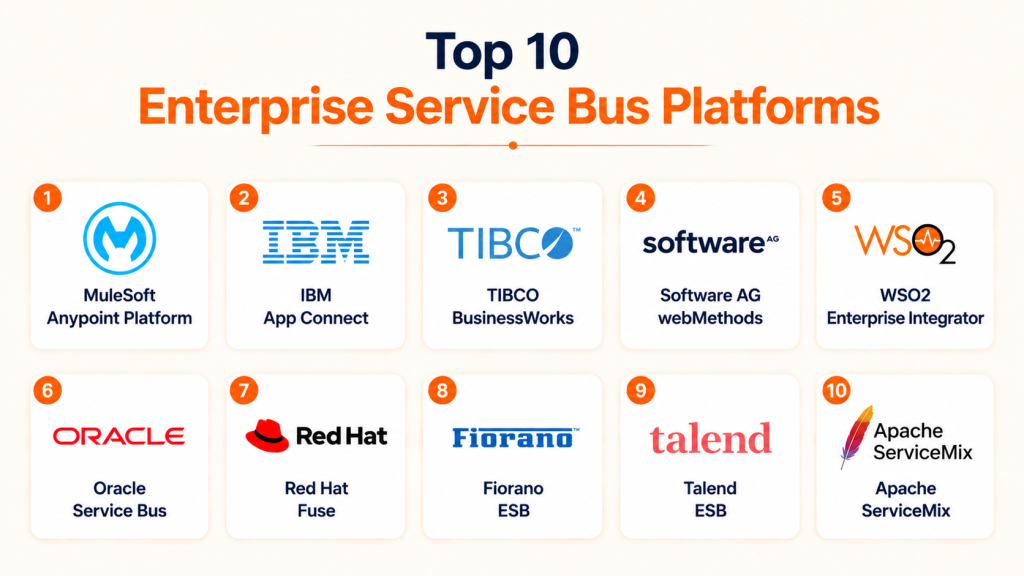
Top 10 Enterprise Service Bus Platforms
1- MuleSoft Anypoint Platform
Short description: Enterprise ESB with API-led connectivity, supporting hybrid and cloud deployments.
Key Features
- API-led integration and orchestration.
- Extensive prebuilt connectors for SaaS and enterprise apps.
- Real-time and batch data transformation.
- Centralized monitoring and analytics dashboards.
- Low-code development interface.
- Hybrid deployment across cloud and on-premises.
Pros
- Comprehensive enterprise-grade solution.
- Strong API management integration.
- Scales for complex workflows.
Cons
- High cost for smaller teams.
- Steep learning curve.
- Complex setup for legacy systems.
Platforms / Deployment
- Web
- Cloud / Hybrid
Security & Compliance
- SSO/SAML, encryption, RBAC
- SOC 2, ISO 27001, GDPR
Integrations & Ecosystem
Supports Salesforce, SAP, Oracle, AWS, Azure, and more.
- Prebuilt SaaS connectors
- REST and SOAP APIs
- CI/CD pipeline integration
Support & Community
- Enterprise support tiers
- Extensive documentation
- Active developer community
2- IBM App Connect
Short description: Enterprise ESB with hybrid integration capabilities, connecting cloud and on-prem applications.
Key Features
- Drag-and-drop integration workflows.
- Real-time and scheduled data flows.
- Prebuilt connectors for multiple enterprise systems.
- Error handling and retry mechanisms.
- Centralized monitoring.
- Cloud and on-prem deployment support.
Pros
- Suitable for hybrid enterprise environments.
- Strong security and governance features.
- Scalable for high-volume integrations.
Cons
- Premium pricing.
- Configuration complexity.
- Limited flexibility for smaller use cases.
Platforms / Deployment
- Web
- Cloud / Hybrid
Security & Compliance
- Encryption, RBAC, audit logging
- SOC 2, GDPR
Integrations & Ecosystem
- Salesforce, SAP, Oracle ERP
- REST/SOAP APIs
- Cloud services
Support & Community
- Enterprise support tiers
- Documentation and tutorials
- Active IBM community
3- TIBCO BusinessWorks
Short description: Enterprise ESB for integration and orchestration across on-premise and cloud systems.
Key Features
- Visual orchestration and mapping tools.
- Extensive connector library.
- Real-time messaging and event handling.
- Cloud and on-prem deployment.
- Monitoring dashboards and analytics.
- Security and compliance features.
Pros
- Strong enterprise adoption.
- Supports complex, multi-system workflows.
- Scalable and reliable.
Cons
- Costly licensing.
- Steep learning curve.
- Requires skilled developers.
Platforms / Deployment
- Web / Windows / Linux
- Cloud / Hybrid
Security & Compliance
- Encryption, audit logging
- Not publicly stated
Integrations & Ecosystem
- REST, SOAP, JMS, database connectors
- SaaS and enterprise systems
- Workflow automation
Support & Community
- Documentation and tutorials
- Paid enterprise support
- Community forums
4- Software AG webMethods
Short description: Robust ESB platform enabling enterprise integration and API management.
Key Features
- API-led connectivity
- Cloud and on-prem integration
- Real-time monitoring and analytics
- Prebuilt adapters for multiple applications
- Security and compliance features
- Workflow orchestration
Pros
- Comprehensive integration capabilities.
- Enterprise-grade monitoring.
- Strong support for legacy systems.
Cons
- High cost.
- Steep learning curve.
- Complex deployment for smaller teams.
Platforms / Deployment
- Web
- Cloud / Hybrid
Security & Compliance
- Encryption, SSO/SAML
- ISO 27001, GDPR
Integrations & Ecosystem
- ERP, CRM, SaaS connectors
- REST and SOAP APIs
- Event-driven architectures
Support & Community
- Enterprise support
- Documentation and tutorials
- Active forums
5- WSO2 Enterprise Integrator
Short description: Open-source ESB and integration suite offering middleware capabilities for enterprise applications.
Key Features
- Message routing and transformation
- Prebuilt connectors for popular apps
- Microservices and API integration
- Hybrid deployment options
- Monitoring and logging
- Low-code configuration
Pros
- Open-source and flexible
- Good for SMBs and mid-market
- Extensible with custom adapters
Cons
- Community support may vary
- Advanced enterprise features require customization
- Initial setup can be technical
Platforms / Deployment
- Web
- Cloud / Hybrid
Security & Compliance
- Encryption, RBAC
- Not publicly stated
Integrations & Ecosystem
- REST/SOAP APIs
- Cloud services
- Enterprise apps
Support & Community
- Documentation and tutorials
- Active GitHub community
- Paid enterprise support available
6- Oracle Service Bus
Short description: Enterprise middleware for orchestrating services, integrating applications, and managing APIs.
Key Features
- Service routing and mediation
- Transformation and validation
- Real-time monitoring
- Policy enforcement
- Cloud and on-prem support
- Prebuilt adapters for Oracle and third-party apps
Pros
- Reliable for enterprise-grade integration
- Strong governance features
- Supports hybrid deployments
Cons
- Premium pricing
- Complexity for small deployments
- Requires skilled developers
Platforms / Deployment
- Web
- Cloud / Hybrid
Security & Compliance
- SSO, encryption
- Not publicly stated
Integrations & Ecosystem
- Oracle ERP, CRM, SaaS apps
- REST/SOAP APIs
- Event-driven workflows
Support & Community
- Enterprise support
- Documentation and training
- Community forums
7- Red Hat Fuse
Short description: Cloud-native and hybrid ESB for microservices and enterprise integration.
Key Features
- Microservices orchestration
- API integration
- Prebuilt connectors
- Low-code workflow builder
- Monitoring dashboards
- Cloud and on-prem support
Pros
- Cloud-native flexibility
- Suitable for microservices
- Enterprise-grade reliability
Cons
- Licensing cost
- Steep learning curve
- Advanced workflows may require coding
Platforms / Deployment
- Web
- Cloud / Hybrid
Security & Compliance
- Encryption, RBAC
- Not publicly stated
Integrations & Ecosystem
- REST/SOAP APIs
- SaaS and enterprise systems
- Microservices connectors
Support & Community
- Documentation and tutorials
- Paid enterprise support
- Active developer forums
8- Fiorano ESB
Short description: Event-driven ESB platform for mid-market and enterprise integration projects.
Key Features
- Event-driven messaging
- Transformation and routing
- Hybrid deployment
- Monitoring dashboards
- Prebuilt connectors
- Security features
Pros
- Lightweight and reliable
- Supports real-time event processing
- Hybrid deployment flexibility
Cons
- Limited global adoption
- Documentation less extensive
- Advanced connectors may require development
Platforms / Deployment
- Web
- Cloud / Hybrid
Security & Compliance
- Encryption, access control
- Not publicly stated
Integrations & Ecosystem
- ERP, CRM, databases
- REST/SOAP APIs
- Event-driven apps
Support & Community
- Vendor support available
- Documentation and tutorials
- Small developer community
9- Talend ESB
Short description: Data-focused ESB platform providing integration, transformation, and routing capabilities.
Key Features
- ETL and data transformation
- Prebuilt connectors
- Hybrid deployment
- Workflow orchestration
- Monitoring and logging
- Security and compliance support
Pros
- Strong data integration capabilities
- Scalable for high-volume processing
- Low-code development
Cons
- May require Talend Studio expertise
- Licensing cost for advanced features
- Cloud deployment may need configuration
Platforms / Deployment
- Web
- Cloud / Hybrid
Security & Compliance
- Encryption, RBAC
- Not publicly stated
Integrations & Ecosystem
- Database connectors
- Cloud applications
- ERP and CRM
Support & Community
- Documentation and tutorials
- Paid enterprise support
- Active Talend community
10- Apache ServiceMix
Short description: Open-source lightweight ESB for small to mid-sized enterprise integration projects.
Key Features
- Messaging, routing, and transformation
- REST/SOAP protocol support
- Open-source adapters
- Lightweight architecture
- Hybrid deployment
- Logging and monitoring
Pros
- Free and open-source
- Flexible for small integrations
- Lightweight and modular
Cons
- Limited enterprise features
- Requires technical expertise
- Community support varies
Platforms / Deployment
- Web
- Self-hosted / Cloud
Security & Compliance
- Not publicly stated
Integrations & Ecosystem
- REST/SOAP APIs
- Databases and legacy systems
- Open-source adapters
Support & Community
- Community documentation
- Active forums
- Paid support via third-party vendors
Comparison Table (Top 10)
| Tool Name | Best For | Platform(s) Supported | Deployment | Standout Feature | Public Rating |
|---|---|---|---|---|---|
| MuleSoft Anypoint | Enterprise integration | Web | Cloud/Hybrid | API-led orchestration | N/A |
| IBM App Connect | Hybrid enterprise | Web | Cloud/Hybrid | Real-time hybrid integration | N/A |
| TIBCO BusinessWorks | Enterprise integration | Web/Windows/Linux | Cloud/Hybrid | Visual orchestration | N/A |
| Software AG webMethods | Enterprise & legacy | Web | Cloud/Hybrid | Prebuilt connectors | N/A |
| WSO2 Enterprise Integrator | Open-source & enterprise | Web | Cloud / Hybrid | Flexible integration | N/A |
| Oracle Service Bus | Enterprise | Web | Hybrid | Middleware orchestration | N/A |
| Red Hat Fuse | Cloud-native & hybrid | Web | Cloud / Hybrid | Microservices integration | N/A |
| Fiorano ESB | Mid-market & enterprise | Web | Cloud / Hybrid | Event-driven architecture | N/A |
| Talend ESB | Data-focused integrations | Web | Cloud / Hybrid | ETL and transformation | N/A |
| Apache ServiceMix | Open-source | Web | Self-hosted | Lightweight ESB | N/A |
Evaluation & Scoring
| Tool Name | Core (25%) | Ease (15%) | Integrations (15%) | Security (10%) | Performance (10%) | Support (10%) | Value (15%) | Weighted Total (0–10) |
|---|---|---|---|---|---|---|---|---|
| MuleSoft | 9 | 7 | 9 | 9 | 9 | 8 | 7 | 8.5 |
| IBM App Connect | 8 | 7 | 8 | 8 | 8 | 7 | 7 | 7.8 |
| TIBCO BusinessWorks | 8 | 7 | 8 | 8 | 8 | 7 | 7 | 7.8 |
| Software AG webMethods | 8 | 7 | 8 | 8 | 8 | 7 | 7 | 7.8 |
| WSO2 Enterprise Integrator | 8 | 7 | 7 | 7 | 7 | 7 | 8 | 7.5 |
| Oracle Service Bus | 8 | 7 | 7 | 7 | 7 | 7 | 7 | 7.3 |
| Red Hat Fuse | 8 | 7 | 8 | 7 | 8 | 7 | 7 | 7.5 |
| Fiorano ESB | 7 | 7 | 7 | 7 | 7 | 7 | 7 | 7.0 |
| Talend ESB | 7 | 7 | 7 | 7 | 7 | 7 | 7 | 7.0 |
| Apache ServiceMix | 6 | 7 | 6 | 6 | 6 | 6 | 7 | 6.5 |
Interpretation: Weighted totals reflect overall suitability for enterprise integration, considering core features, ease-of-use, integrations, security, performance, support, and value.
Which ESB Tool Is Right for You?
Solo / Freelancer
- Apache ServiceMix or WSO2 Enterprise Integrator are suitable for small projects or developers experimenting with ESB solutions.
SMB
- Talend ESB, Fiorano ESB, or Red Hat Fuse provide moderate complexity integration with low-code options.
Mid-Market
- Oracle Service Bus, Red Hat Fuse, and TIBCO BusinessWorks are suitable for mid-size companies with multiple system integrations.
Enterprise
- MuleSoft Anypoint, IBM App Connect, and Software AG webMethods scale for large, complex, multi-cloud integrations.
Budget vs Premium
- Open-source tools like WSO2 and Apache ServiceMix are cost-effective for SMBs.
- Enterprise tools like MuleSoft, IBM, and TIBCO offer advanced analytics, monitoring, and compliance at a premium cost.
Feature Depth vs Ease of Use
- Talend ESB and Red Hat Fuse balance usability with functionality.
- MuleSoft and Software AG webMethods provide advanced capabilities but require technical expertise.
Integrations & Scalability
- MuleSoft, IBM, and TIBCO scale for thousands of messages per second and integrate across multi-cloud and hybrid systems.
Security & Compliance Needs
- Enterprise ESBs provide encryption, SSO/SAML, RBAC, audit logs, and compliance with SOC 2, ISO 27001, and GDPR.
Frequently Asked Questions (FAQs)
1. What pricing models do ESB platforms use?
ESB platforms generally offer subscription-based pricing for cloud deployments or perpetual licensing for on-premises installations. Open-source options are free but may require paid support for enterprise features. Pricing often depends on the number of connections, message volume, and additional enterprise modules.
2. Can I implement an ESB without coding?
Many ESBs provide visual orchestration, drag-and-drop workflow builders, and low-code interfaces. However, complex transformations, custom adapters, or API orchestrations still require developer expertise, especially in enterprise environments.
3. How long does deployment take?
Simple integrations can be deployed within days, while enterprise-scale deployments connecting multiple applications across cloud and on-prem systems may take several weeks. Testing, monitoring, and validation are critical to ensure smooth operation.
4. Do ESB tools support cloud and on-prem integrations?
Yes, modern ESB platforms provide hybrid deployment options, allowing seamless integration between cloud-based SaaS, on-premise ERP/CRM systems, and legacy applications. This flexibility is crucial for multi-environment enterprises.
5. Are ESBs suitable for real-time messaging?
Most ESB platforms support both real-time event-driven messaging and batch processing. They can route messages, transform data formats, and handle high-volume traffic with reliable delivery and failover mechanisms.
6. Are ESB platforms secure for enterprise use?
Enterprise-grade ESBs include encryption, authentication, SSO/SAML, RBAC, and audit logging. Many also comply with SOC 2, ISO 27001, and GDPR, making them suitable for regulated industries like finance, healthcare, and government.
7. Can I migrate workflows between different ESBs?
Migration is possible using exported workflow definitions and templates. However, complex workflows involving custom adapters, legacy protocols, or proprietary features may require manual adjustments and testing after migration.
8. Do ESBs include monitoring and analytics?
Yes, ESBs provide dashboards to monitor message flow, track errors, and analyze performance. Administrators can set aler
Conclusion
Enterprise Service Bus platforms provide essential middleware for connecting applications, orchestrating workflows, and enabling hybrid and cloud integrations. Small teams can leverage open-source ESBs like WSO2 or Apache ServiceMix, while mid-market and enterprise teams benefit from MuleSoft, IBM, or TIBCO for advanced, high-volume integrations. The choice depends on company size, integration complexity, scalability, security, and budget. Shortlist 2–3 tools, run pilot integrations, and validate monitoring, security, and scalability before enterprise deployment.

Find Trusted Cardiac Hospitals
Compare heart hospitals by city and services — all in one place.
Explore Hospitals
I now have a better idea of how ESB platforms help different systems communicate smoothly inside large organizations. I’d like to explore how this approach is changing with cloud-based integrations.