Introduction
Synthetic Data Generation Tools help organizations create artificial datasets that statistically resemble real-world data without exposing sensitive or personally identifiable information. These platforms are increasingly important as companies adopt AI, machine learning, analytics, testing automation, and privacy-first development practices. Instead of relying entirely on production datasets, teams can generate safe, scalable, and customizable synthetic data for experimentation, training, validation, and simulation. In the modern AI ecosystem, synthetic data has become a strategic asset. Organizations face stricter privacy regulations, rising cybersecurity concerns, and growing demand for AI-ready datasets. Synthetic data tools help solve challenges around data scarcity, compliance, bias reduction, and faster development cycles.
Common Real-world use cases include:
- AI and machine learning model training
- Software testing and QA automation
- Financial fraud simulation
- Healthcare research without exposing patient records
- Autonomous vehicle and computer vision training
- Cybersecurity attack simulation
- Data sharing across departments or vendors
Key Evaluation criteria buyers should consider:
- Data realism and statistical accuracy
- Privacy preservation capabilities
- Structured and unstructured data support
- AI/ML integration depth
- Scalability and performance
- Ease of synthetic scenario generation
- Compliance and governance features
- API and workflow automation support
- Deployment flexibility
- Cost efficiency for large datasets
Best for: AI teams, data scientists, software engineering organizations, healthcare analytics teams, fintech companies, cybersecurity platforms, research institutions, and enterprises handling sensitive datasets.
Not ideal for: Very small teams with minimal testing requirements, organizations relying only on public datasets, or companies that do not process regulated or sensitive information.
Key Trends in Synthetic Data Generation Tools
- Generative AI models are increasingly powering synthetic data realism through GANs, diffusion models, and LLM-based generation.
- Privacy-preserving AI techniques such as differential privacy and federated learning are becoming standard requirements.
- Enterprises are adopting synthetic data for AI governance and compliance validation.
- Multimodal synthetic data generation is expanding beyond tabular data into text, video, images, and sensor data.
- Cloud-native synthetic data pipelines are replacing manual data masking workflows.
- Synthetic cybersecurity datasets are gaining importance for SOC simulation and attack training.
- AI testing environments now require continuously refreshed synthetic datasets for model drift analysis.
- Real-time synthetic data streaming is becoming more common in IoT and financial systems.
- Open-source synthetic data frameworks continue gaining popularity among developers and research teams.
- Integration with MLOps and DataOps pipelines is becoming a major competitive differentiator.
How We Selected These Tools (Methodology)
The tools in this list were evaluated using a combination of practical enterprise considerations and market visibility factors:
- Strong adoption among AI, analytics, and testing teams
- Support for modern synthetic data generation methods
- Breadth of structured and unstructured data capabilities
- Security, governance, and compliance features
- Integration with ML ecosystems and cloud platforms
- Flexibility across enterprise and developer workflows
- Deployment options including cloud and self-hosted models
- Documentation quality and onboarding experience
- Vendor innovation in generative AI and privacy engineering
- Ability to support enterprise-scale workloads reliably
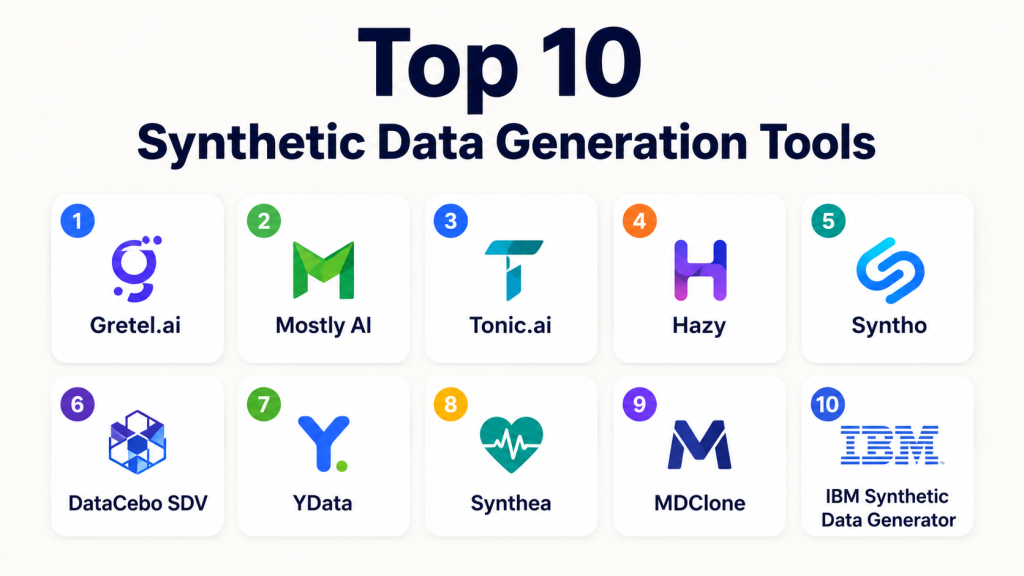
Top 10 Synthetic Data Generation Tools
1- Gretel.ai
Short description: Gretel.ai is a modern synthetic data platform designed for AI, software testing, and privacy-safe analytics. It is widely used by enterprises seeking scalable synthetic datasets while preserving compliance and data utility.
Key Features
- AI-powered synthetic tabular and text data generation
- Privacy-preserving data transformation
- Data labeling and anonymization
- APIs for automated synthetic pipelines
- Fine-tuning support for generative AI workflows
- Data quality validation tools
- Cloud-native architecture
Pros
- Strong developer-first automation capabilities
- Excellent API integration support
- Suitable for modern AI workflows
Cons
- Advanced configurations may require technical expertise
- Enterprise pricing may be expensive for small teams
Platforms / Deployment
- Cloud / Hybrid
Security & Compliance
- Encryption
- RBAC
- GDPR-focused privacy tooling
- SSO/SAML support
- Additional certifications not publicly stated
Integrations & Ecosystem
Gretel integrates well with AI development stacks, cloud data warehouses, and CI/CD pipelines. Its API-centric design supports automation-heavy engineering environments.
- Snowflake
- Databricks
- AWS
- Google Cloud
- Python SDK
- REST APIs
Support & Community
Strong documentation and developer onboarding experience. Enterprise support options are available alongside an active technical community.
2- Mostly AI
Short description: Mostly AI specializes in privacy-safe synthetic structured data generation for regulated industries including finance, insurance, and healthcare.
Key Features
- Synthetic relational database generation
- Privacy-preserving AI models
- High-fidelity tabular data simulation
- Statistical validation dashboards
- Bias reduction tools
- Data governance controls
- Secure enterprise deployment
Pros
- Strong compliance-oriented design
- Excellent relational data handling
- Trusted in regulated industries
Cons
- Less focused on unstructured AI datasets
- Enterprise onboarding can take time
Platforms / Deployment
- Cloud / Self-hosted / Hybrid
Security & Compliance
- GDPR-focused capabilities
- RBAC
- Encryption
- Audit logging
- Additional certifications vary
Integrations & Ecosystem
Mostly AI integrates with enterprise databases and analytics environments for privacy-safe data sharing and testing.
- Snowflake
- PostgreSQL
- Oracle
- AWS
- Azure
- REST APIs
Support & Community
Strong enterprise support and onboarding programs. Community footprint is smaller compared to open-source alternatives.
3- Tonic.ai
Short description: Tonic.ai focuses heavily on synthetic data for software development, testing, and staging environments. It is popular among DevOps and engineering teams.
Key Features
- Synthetic database cloning
- Developer-friendly data provisioning
- Referential integrity preservation
- Test environment automation
- Data masking and subsetting
- API-driven workflows
- Fast environment refresh support
Pros
- Excellent for engineering workflows
- Simplifies staging environment management
- Strong usability for developers
Cons
- Primarily focused on structured data
- Limited advanced generative AI capabilities
Platforms / Deployment
- Cloud / Self-hosted
Security & Compliance
- RBAC
- Encryption
- Audit controls
- SSO/SAML support
- Compliance certifications vary
Integrations & Ecosystem
Tonic integrates deeply with DevOps and database tooling commonly used in enterprise development teams.
- PostgreSQL
- MySQL
- SQL Server
- Kubernetes
- CI/CD tools
- REST APIs
Support & Community
Good onboarding experience with practical engineering documentation and responsive support channels.
4- Hazy
Short description: Hazy is an enterprise synthetic data platform emphasizing privacy-enhanced AI and regulated data sharing for financial services and healthcare.
Key Features
- Synthetic structured data generation
- Differential privacy techniques
- AI training dataset support
- Regulatory-safe data sharing
- Statistical fidelity analysis
- Secure deployment controls
- Scalable synthetic modeling
Pros
- Strong privacy engineering focus
- Enterprise-grade governance
- Effective for regulated environments
Cons
- Narrower developer ecosystem
- Premium enterprise pricing
Platforms / Deployment
- Cloud / Hybrid
Security & Compliance
- GDPR-focused tooling
- Encryption
- RBAC
- Audit logs
- Compliance support varies
Integrations & Ecosystem
Hazy supports enterprise analytics and AI environments through API-based workflows and database integrations.
- Snowflake
- AWS
- Azure
- REST APIs
- Data warehouses
Support & Community
Enterprise-focused support with implementation assistance and governance consulting.
5- Syntho
Short description: Syntho provides AI-generated synthetic data for analytics, AI development, and secure testing environments with strong emphasis on compliance.
Key Features
- AI-generated synthetic datasets
- Privacy risk measurement
- Data utility scoring
- Synthetic data quality analytics
- Database replication support
- AI model training support
- Automated pipeline integration
Pros
- Strong analytics and privacy visibility
- Easy enterprise adoption
- Good balance of realism and compliance
Cons
- Smaller ecosystem compared to major competitors
- Advanced features may require enterprise licensing
Platforms / Deployment
- Cloud / Hybrid
Security & Compliance
- GDPR support
- Encryption
- RBAC
- Audit controls
- Additional certifications not publicly stated
Integrations & Ecosystem
Syntho integrates with enterprise data ecosystems and analytics pipelines for scalable synthetic dataset operations.
- Snowflake
- AWS
- Azure
- Databricks
- APIs
Support & Community
Strong onboarding assistance and implementation support for enterprise customers.
6- DataCebo SDV
Short description: SDV by DataCebo is a widely recognized open-source synthetic data generation framework used by researchers and developers.
Key Features
- Open-source synthetic data generation
- Relational and tabular data support
- Python-based customization
- Statistical modeling libraries
- AI-ready dataset generation
- Developer extensibility
- Research-oriented flexibility
Pros
- Free and open-source
- Highly customizable
- Strong developer flexibility
Cons
- Requires technical expertise
- Limited enterprise governance features
Platforms / Deployment
- Windows / macOS / Linux
- Self-hosted
Security & Compliance
- Not publicly stated
Integrations & Ecosystem
SDV integrates well with Python-based AI and analytics ecosystems and is commonly used in research and experimentation workflows.
- Python
- Jupyter
- Pandas
- ML frameworks
- Open-source tooling
Support & Community
Large open-source community with active documentation and GitHub activity.
7- YData
Short description: YData provides synthetic data generation and observability tools for AI model training and analytics optimization.
Key Features
- Synthetic tabular data generation
- Data observability tools
- Bias monitoring
- ML dataset optimization
- AI-ready pipeline support
- Privacy enhancement tools
- Monitoring dashboards
Pros
- Strong AI workflow alignment
- Helpful observability capabilities
- Good analytics visibility
Cons
- Smaller market footprint
- Some advanced capabilities are enterprise-focused
Platforms / Deployment
- Cloud / Hybrid
Security & Compliance
- RBAC
- Encryption
- Privacy-focused controls
- Additional certifications vary
Integrations & Ecosystem
YData integrates with modern machine learning and analytics stacks commonly used in AI operations.
- Databricks
- AWS
- Python
- Jupyter
- APIs
Support & Community
Good technical documentation and growing AI practitioner community.
8- Synthea
Short description: Synthea is an open-source synthetic patient data generator designed for healthcare simulations, analytics, and interoperability testing.
Key Features
- Synthetic healthcare record generation
- FHIR compatibility
- Clinical simulation modeling
- Patient journey simulation
- Healthcare interoperability testing
- Open-source customization
- Public health dataset support
Pros
- Excellent for healthcare use cases
- Free and open-source
- Strong interoperability support
Cons
- Healthcare-specific scope
- Requires technical customization
Platforms / Deployment
- Windows / macOS / Linux
- Self-hosted
Security & Compliance
- Not publicly stated
Integrations & Ecosystem
Synthea integrates with healthcare interoperability systems and research platforms.
- HL7 FHIR
- SMART on FHIR
- Healthcare analytics tools
- APIs
Support & Community
Strong healthcare research community and extensive open-source documentation.
9- MDClone
Short description: MDClone focuses on synthetic healthcare data generation and collaborative clinical analytics environments.
Key Features
- Synthetic patient data environments
- Clinical analytics tools
- Secure healthcare collaboration
- Data exploration interfaces
- Privacy-safe healthcare research
- Self-service analytics
- AI-ready healthcare datasets
Pros
- Strong healthcare analytics workflow
- Privacy-first design
- Good collaboration features
Cons
- Primarily healthcare-focused
- Enterprise-oriented pricing
Platforms / Deployment
- Cloud / Hybrid
Security & Compliance
- HIPAA-oriented capabilities
- RBAC
- Encryption
- Audit logging
- Compliance certifications vary
Integrations & Ecosystem
MDClone integrates with healthcare data systems and analytics environments.
- EHR systems
- Healthcare databases
- APIs
- Analytics tools
Support & Community
Enterprise healthcare onboarding and strong implementation guidance.
10- IBM Synthetic Data Generator
Short description: IBM offers synthetic data capabilities as part of its broader AI and enterprise data ecosystem, targeting large organizations with governance-heavy environments.
Key Features
- Enterprise synthetic data workflows
- AI model training support
- Data governance tooling
- Privacy preservation
- AI lifecycle integration
- Enterprise scalability
- Automation support
Pros
- Strong enterprise ecosystem integration
- Broad governance capabilities
- Suitable for large regulated organizations
Cons
- Complex enterprise deployment
- May be excessive for small teams
Platforms / Deployment
- Cloud / Hybrid
Security & Compliance
- Enterprise IAM support
- Encryption
- RBAC
- Audit logging
- Compliance capabilities vary by deployment
Integrations & Ecosystem
IBM integrates synthetic data capabilities across enterprise AI and analytics ecosystems.
- IBM Watson ecosystem
- Cloud platforms
- APIs
- Enterprise analytics systems
- AI governance tools
Support & Community
Strong enterprise support and professional services ecosystem.
Comparison Table (Top 10)
| Tool Name | Best For | Platform(s) Supported | Deployment | Standout Feature | Public Rating |
|---|---|---|---|---|---|
| Gretel.ai | AI teams and developers | Web | Cloud / Hybrid | AI-powered synthetic pipelines | N/A |
| Mostly AI | Regulated enterprises | Web | Cloud / Hybrid / Self-hosted | Relational synthetic data | N/A |
| Tonic.ai | DevOps and testing | Web | Cloud / Self-hosted | Developer staging workflows | N/A |
| Hazy | Privacy-focused enterprises | Web | Cloud / Hybrid | Differential privacy focus | N/A |
| Syntho | Analytics and compliance | Web | Cloud / Hybrid | Privacy risk analytics | N/A |
| DataCebo SDV | Developers and researchers | Windows/macOS/Linux | Self-hosted | Open-source flexibility | N/A |
| YData | AI observability teams | Web | Cloud / Hybrid | Data observability integration | N/A |
| Synthea | Healthcare simulation | Windows/macOS/Linux | Self-hosted | Synthetic patient journeys | N/A |
| MDClone | Clinical analytics | Web | Cloud / Hybrid | Healthcare collaboration | N/A |
| IBM Synthetic Data Generator | Large enterprises | Web | Cloud / Hybrid | Enterprise governance | N/A |
Evaluation & Scoring of Synthetic Data Generation Tools
| Tool Name | Core (25%) | Ease (15%) | Integrations (15%) | Security (10%) | Performance (10%) | Support (10%) | Value (15%) | Weighted Total |
|---|---|---|---|---|---|---|---|---|
| Gretel.ai | 9 | 8 | 9 | 8 | 8 | 8 | 7 | 8.3 |
| Mostly AI | 9 | 7 | 8 | 9 | 8 | 8 | 7 | 8.2 |
| Tonic.ai | 8 | 9 | 8 | 8 | 8 | 8 | 8 | 8.2 |
| Hazy | 8 | 7 | 7 | 9 | 8 | 7 | 6 | 7.6 |
| Syntho | 8 | 8 | 7 | 8 | 8 | 7 | 7 | 7.7 |
| DataCebo SDV | 8 | 6 | 7 | 5 | 7 | 7 | 10 | 7.3 |
| YData | 7 | 7 | 8 | 7 | 7 | 7 | 7 | 7.2 |
| Synthea | 7 | 6 | 6 | 5 | 7 | 8 | 10 | 7.0 |
| MDClone | 8 | 7 | 7 | 9 | 8 | 8 | 6 | 7.7 |
| IBM Synthetic Data Generator | 9 | 6 | 9 | 9 | 9 | 9 | 5 | 8.0 |
These scores are comparative rather than absolute. A higher weighted total generally indicates broader enterprise readiness and feature completeness. Smaller organizations may prioritize ease of use and cost efficiency over governance-heavy capabilities. Open-source tools can deliver excellent value but may require more engineering investment. Enterprises should also evaluate long-term scalability, compliance needs, and ecosystem fit before selecting a platform.
Which Synthetic Data Generation Tool Is Right for You?
Solo / Freelancer
Independent developers and small research teams often benefit most from open-source solutions like DataCebo SDV or Synthea. These tools provide flexibility and low cost, though they require technical expertise and self-management.
SMB
Small and medium businesses typically need a balance between usability, automation, and affordability. Tonic.ai and Syntho are strong options for teams that want faster testing workflows and manageable synthetic data pipelines without massive enterprise overhead.
Mid-Market
Mid-market organizations often require stronger governance and scalability. Gretel.ai and YData provide modern AI-friendly capabilities with better automation, integrations, and analytics visibility.
Enterprise
Large enterprises handling regulated or highly sensitive datasets should prioritize Mostly AI, Hazy, MDClone, or IBM Synthetic Data Generator. These tools offer stronger governance, compliance alignment, and deployment flexibility.
Budget vs Premium
Open-source tools such as SDV and Synthea offer strong value for technically skilled teams. Premium enterprise tools provide automation, governance, support, and scalability that can justify higher costs in regulated environments.
Feature Depth vs Ease of Use
Developer-oriented tools may provide extensive customization but require more setup. Enterprise platforms often simplify governance and workflows while adding operational complexity and licensing costs.
Integrations & Scalability
Organizations with mature AI or DataOps environments should prioritize integration-friendly platforms with APIs, cloud compatibility, and pipeline automation capabilities.
Security & Compliance Needs
Healthcare, banking, insurance, and public sector organizations should focus heavily on auditability, RBAC, encryption, and privacy-preserving AI capabilities before selecting a platform.
Frequently Asked Questions (FAQs)
1. What are synthetic data generation tools?
Synthetic data generation tools create artificial datasets that mimic real-world data patterns without exposing actual sensitive information. They are commonly used for AI training, testing, analytics, and compliance-safe development.
2. Why is synthetic data important for AI?
AI models require large datasets, but real-world data often contains privacy risks or limited availability. Synthetic data helps scale AI development safely while reducing compliance exposure.
3. Can synthetic data fully replace real data?
Not always. Synthetic data is highly useful for testing, experimentation, and model training, but some production-grade AI systems may still require carefully validated real-world datasets.
4. Are synthetic data tools secure?
Most enterprise platforms include encryption, RBAC, audit logs, and privacy-preserving methods. However, security maturity varies significantly across vendors and open-source projects.
5. Which industries use synthetic data the most?
Healthcare, banking, insurance, cybersecurity, automotive, telecommunications, and AI research organizations are among the largest adopters.
6. Is open-source synthetic data generation good enough?
Open-source tools can be highly effective for developers and researchers, especially for experimentation and prototyping. Enterprise governance and compliance capabilities are usually more limited.
7. How difficult is implementation?
Implementation complexity depends on the platform and dataset type. Open-source frameworks may require strong data engineering skills, while enterprise platforms often simplify onboarding.
8. What is the difference between data masking and synthetic data?
Data masking modifies existing data, while synthetic data creates entirely new artificial datasets that preserve statistical characteristics without exposing original records.
9. Can synthetic data reduce AI bias?
It can help if used correctly. Synthetic data platforms may rebalance datasets and simulate underrepresented scenarios, though poor-quality synthetic generation can also introduce new biases.
10. How do companies evaluate synthetic data quality?
Organizations typically assess statistical similarity, privacy leakage risk, downstream AI model performance, and business relevance before approving synthetic datasets for production use.
Conclusion
Synthetic Data Generation Tools have evolved from niche testing utilities into foundational components of modern AI, analytics, and privacy engineering strategies. As organizations continue expanding AI adoption while facing stricter data regulations, synthetic data platforms provide a practical way to accelerate innovation without compromising compliance or security. The market now includes a diverse mix of enterprise governance platforms, developer-first tools, healthcare-focused solutions, and open-source frameworks. The best platform ultimately depends on your environment, technical maturity, regulatory exposure, and AI ambitions. Small teams may prioritize flexibility and affordability, while enterprises often require governance-heavy workflows, deployment controls, and scalable integrations. Instead of selecting a tool purely based on features, shortlist two or three platforms that align with your use cases, run a controlled pilot, validate integration and security requirements, and evaluate long-term operational fit before scaling organization-wide.

Find Trusted Cardiac Hospitals
Compare heart hospitals by city and services — all in one place.
Explore Hospitals
Synthetic data generation tools are very useful because they help create realistic fake data for testing and training AI models without risking real user information.