Introduction
PLC Programming Tools are software platforms used to configure, program, test, debug, and maintain Programmable Logic Controllers across industrial automation environments. These tools allow engineers and automation professionals to develop logic for machinery, manufacturing systems, robotics, utilities, process control, and smart factory operations. PLC programming platforms are evolving rapidly with Industry 4.0 technologies, Industrial IoT connectivity, cloud engineering workflows, AI-assisted diagnostics, and integrated cybersecurity capabilities. Modern industrial environments increasingly require scalable automation systems that can integrate seamlessly with SCADA, MES, HMI, robotics, and edge computing infrastructure.
Common Real-world use cases include:
- Manufacturing process automation
- Industrial robotics programming
- Packaging line control
- Smart factory operations
- Utility and infrastructure automation
When Evaluating PLC Programming Tools, buyers should consider:
- PLC compatibility
- Ease of programming and debugging
- Industrial protocol support
- Simulation and testing features
- Integration with SCADA and HMI systems
- Scalability and deployment flexibility
- Cybersecurity capabilities
- Licensing and operational costs
- Vendor ecosystem strength
- Long-term industrial support
Best for: Industrial automation engineers, system integrators, manufacturing companies, utilities, infrastructure operators, robotics developers, and smart factory teams.
Not ideal for: Small organizations with limited automation needs or businesses that do not rely on programmable industrial control systems.
Key Trends in PLC Programming Tools
- AI-assisted code generation and diagnostics are becoming more common.
- Cloud-based engineering environments are expanding in industrial automation.
- IEC 61131-3 standardization remains critical across industrial ecosystems.
- Cybersecurity features are becoming mandatory in automation workflows.
- Digital twin integration is improving industrial testing and validation.
- Industrial IoT support is now expected in modern PLC environments.
- Low-code automation engineering tools are growing in popularity.
- Edge computing support is improving real-time industrial operations.
- Unified engineering platforms are reducing operational complexity.
- Simulation and virtual commissioning capabilities continue to evolve.
How We Selected These Tools Methodology
The tools in this list were selected using practical technical and operational evaluation criteria:
- Global industrial adoption and reputation
- PLC programming capabilities and flexibility
- Industrial protocol compatibility
- Simulation and debugging quality
- Ecosystem integrations and scalability
- Cybersecurity and operational reliability
- Vendor support and documentation quality
- Smart factory and Industry 4.0 readiness
- Long-term industrial ecosystem maturity
- Customer fit across multiple industrial sectors
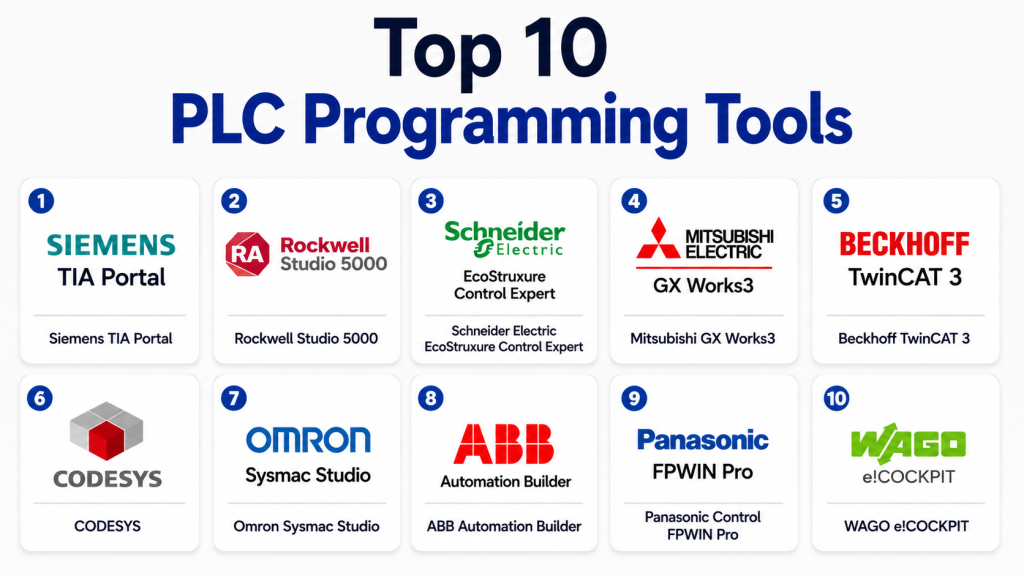
Top 10 PLC Programming Tools
1- Siemens TIA Portal
Short description: Siemens TIA Portal is a unified engineering platform for PLC programming, HMI development, industrial networking, and automation system management.
Key Features
- Unified engineering environment
- PLC and HMI programming
- Integrated diagnostics
- Simulation capabilities
- Industrial network configuration
- Motion control support
- Digital twin integration
Pros
- Comprehensive industrial automation ecosystem
- Excellent scalability
- Strong Industry 4.0 readiness
Cons
- Steep learning curve
- High licensing costs
- Resource-intensive environment
Platforms / Deployment
- Windows
- Self-hosted / Hybrid
Security & Compliance
- RBAC
- Encryption
- Audit logging
- Secure industrial communication support
Integrations & Ecosystem
TIA Portal integrates deeply with Siemens industrial automation infrastructure and smart manufacturing ecosystems.
- Siemens PLCs
- SCADA systems
- Industrial IoT platforms
- OPC UA
- MES integrations
Support & Community
Excellent enterprise support, global industrial adoption, and strong engineering documentation.
2- Rockwell Studio 5000
Short description: Studio 5000 is Rockwell Automation’s PLC programming platform designed for industrial automation and manufacturing process control.
Key Features
- Ladder logic programming
- Motion control engineering
- Integrated diagnostics
- Simulation tools
- Safety programming
- HMI integration
- Industrial networking
Pros
- Strong manufacturing ecosystem
- Reliable industrial performance
- Deep Allen-Bradley integration
Cons
- Enterprise licensing complexity
- Best optimized for Rockwell environments
- Advanced workflows require training
Platforms / Deployment
- Windows
- Self-hosted
Security & Compliance
- RBAC
- Encryption
- Enterprise authentication support
Integrations & Ecosystem
Studio 5000 integrates closely with manufacturing automation and operational systems.
- Allen-Bradley PLCs
- FactoryTalk
- SCADA systems
- Industrial networks
Support & Community
Large enterprise ecosystem with extensive industrial support resources.
3- Schneider Electric EcoStruxure Control Expert
Short description: EcoStruxure Control Expert is Schneider Electric’s industrial automation engineering platform for PLC programming and process automation.
Key Features
- IEC 61131-3 programming
- Process automation support
- Real-time diagnostics
- Industrial communications
- Motion control
- Safety automation
- Distributed control support
Pros
- Strong process automation capabilities
- Good scalability
- Flexible industrial integrations
Cons
- Interface complexity
- Enterprise-oriented deployment
- Training requirements for advanced engineering
Platforms / Deployment
- Windows
- Self-hosted / Hybrid
Security & Compliance
- Encryption
- RBAC
- Secure remote access support
Integrations & Ecosystem
EcoStruxure integrates with industrial automation and energy management ecosystems.
- Schneider PLCs
- SCADA systems
- Energy management tools
- Industrial IoT platforms
Support & Community
Strong industrial engineering support and enterprise automation expertise.
4- Mitsubishi GX Works3
Short description: GX Works3 is Mitsubishi Electric’s PLC engineering platform designed for industrial control, manufacturing automation, and motion applications.
Key Features
- PLC programming
- Motion control engineering
- Integrated simulation
- Device configuration
- Industrial diagnostics
- IEC standard programming
- Multi-device project management
Pros
- Strong Mitsubishi compatibility
- Reliable industrial performance
- Good manufacturing automation support
Cons
- Primarily optimized for Mitsubishi ecosystems
- User interface modernization varies
- Limited cloud engineering support
Platforms / Deployment
- Windows
- Self-hosted
Security & Compliance
- RBAC
- Encryption
- Not publicly stated for certifications
Integrations & Ecosystem
GX Works3 integrates with Mitsubishi industrial automation infrastructure.
- Mitsubishi PLCs
- HMI systems
- SCADA integrations
- Motion control systems
Support & Community
Strong industrial support within manufacturing-focused sectors.
5- Beckhoff TwinCAT 3
Short description: TwinCAT 3 is a powerful automation engineering environment combining PLC programming, motion control, and PC-based automation.
Key Features
- PC-based automation
- IEC 61131-3 programming
- Real-time control
- Motion control integration
- Industrial communication support
- Robotics integration
- Simulation tools
Pros
- High-performance automation platform
- Excellent motion control capabilities
- Strong flexibility for advanced automation
Cons
- Advanced engineering expertise required
- Complex deployments for beginners
- Learning curve for PC-based automation
Platforms / Deployment
- Windows
- Self-hosted / Hybrid
Security & Compliance
- RBAC
- Secure communication support
- Encryption
Integrations & Ecosystem
TwinCAT supports advanced industrial automation and robotics ecosystems.
- EtherCAT
- Robotics systems
- Industrial PCs
- SCADA integrations
Support & Community
Strong automation engineering community and technical documentation.
6- CODESYS
Short description: CODESYS is an open and flexible PLC programming platform widely used across multiple industrial hardware vendors.
Key Features
- IEC 61131-3 programming
- Vendor-neutral platform
- Integrated simulation
- Industrial protocol support
- Motion control
- Visualization tools
- SoftPLC capabilities
Pros
- Vendor flexibility
- Strong interoperability
- Cost-effective automation development
Cons
- Advanced customization may require expertise
- Enterprise support varies by deployment
- Ecosystem complexity can increase with scale
Platforms / Deployment
- Windows / Linux
- Self-hosted
Security & Compliance
- RBAC
- Encryption support
- Varies by implementation
Integrations & Ecosystem
CODESYS supports broad industrial interoperability and automation engineering flexibility.
- OPC UA
- Industrial protocols
- SoftPLC environments
- Third-party hardware vendors
Support & Community
Very active industrial automation community with broad adoption.
7- Omron Sysmac Studio
Short description: Sysmac Studio is Omron’s integrated automation software platform for PLC programming, motion control, robotics, and machine vision.
Key Features
- Unified automation engineering
- PLC programming
- Robotics integration
- Motion control
- Machine vision support
- Safety automation
- Simulation tools
Pros
- Strong robotics integration
- Unified industrial workflows
- Reliable automation performance
Cons
- Primarily optimized for Omron environments
- Advanced deployments may require expertise
- Enterprise licensing costs
Platforms / Deployment
- Windows
- Self-hosted
Security & Compliance
- RBAC
- Secure communication support
- Encryption
Integrations & Ecosystem
Sysmac Studio integrates with Omron automation and robotics ecosystems.
- Omron PLCs
- Robotics systems
- Vision systems
- SCADA integrations
Support & Community
Strong industrial engineering support and automation expertise.
8- ABB Automation Builder
Short description: ABB Automation Builder is an integrated engineering suite for PLC programming, motion control, and industrial automation projects.
Key Features
- PLC engineering
- IEC programming support
- Motion control
- Device configuration
- Safety automation
- Integrated diagnostics
- Industrial networking
Pros
- Strong industrial automation integration
- Reliable operational stability
- Good scalability
Cons
- Enterprise complexity
- Specialized engineering training required
- Smaller developer ecosystem compared to major competitors
Platforms / Deployment
- Windows
- Self-hosted
Security & Compliance
- RBAC
- Encryption
- Secure industrial communications
Integrations & Ecosystem
ABB Automation Builder supports industrial infrastructure and manufacturing ecosystems.
- ABB PLCs
- SCADA systems
- Industrial drives
- Motion systems
Support & Community
Good industrial support and engineering documentation.
9- Panasonic Control FPWIN Pro
Short description: FPWIN Pro is Panasonic’s PLC programming software designed for industrial automation and machine control applications.
Key Features
- IEC standard programming
- Ladder logic engineering
- Industrial communications
- Debugging tools
- Simulation support
- PLC diagnostics
- Compact automation workflows
Pros
- User-friendly engineering environment
- Good value for smaller deployments
- Reliable machine automation support
Cons
- Smaller ecosystem
- Limited advanced enterprise capabilities
- Reduced scalability for very large operations
Platforms / Deployment
- Windows
- Self-hosted
Security & Compliance
- Basic authentication controls
- Not publicly stated for advanced certifications
Integrations & Ecosystem
FPWIN Pro integrates with Panasonic automation systems and industrial hardware.
- Panasonic PLCs
- HMI systems
- Industrial controllers
- Automation networks
Support & Community
Good industrial documentation and machine automation support.
10- WAGO e!COCKPIT
Short description: WAGO e!COCKPIT is a modern PLC engineering platform designed for industrial automation, control systems, and Industry 4.0 workflows.
Key Features
- IEC 61131-3 support
- Integrated visualization
- Cloud connectivity
- Industrial communication support
- Automation diagnostics
- Simulation tools
- Modular engineering workflows
Pros
- Modern engineering interface
- Good Industry 4.0 readiness
- Flexible automation workflows
Cons
- Smaller enterprise footprint
- Advanced deployments may require customization
- Ecosystem maturity varies by region
Platforms / Deployment
- Windows
- Self-hosted / Hybrid
Security & Compliance
- RBAC
- Encryption support
- Secure communication protocols
Integrations & Ecosystem
e!COCKPIT supports modern industrial automation and connectivity environments.
- WAGO PLCs
- OPC UA
- Industrial IoT systems
- SCADA integrations
Support & Community
Growing industrial automation ecosystem with good technical documentation.
Comparison Table
| Tool Name | Best For | Platform(s) Supported | Deployment | Standout Feature | Public Rating |
|---|---|---|---|---|---|
| Siemens TIA Portal | Enterprise automation | Windows | Hybrid | Unified engineering platform | N/A |
| Rockwell Studio 5000 | Manufacturing automation | Windows | Self-hosted | Allen-Bradley integration | N/A |
| EcoStruxure Control Expert | Process automation | Windows | Hybrid | Distributed automation support | N/A |
| Mitsubishi GX Works3 | Manufacturing systems | Windows | Self-hosted | Mitsubishi compatibility | N/A |
| Beckhoff TwinCAT 3 | PC-based automation | Windows | Hybrid | Real-time control performance | N/A |
| CODESYS | Vendor-neutral automation | Windows, Linux | Self-hosted | Broad interoperability | N/A |
| Omron Sysmac Studio | Robotics integration | Windows | Self-hosted | Unified robotics workflows | N/A |
| ABB Automation Builder | Industrial automation | Windows | Self-hosted | Integrated diagnostics | N/A |
| Panasonic FPWIN Pro | Machine automation | Windows | Self-hosted | Simplicity and usability | N/A |
| WAGO e!COCKPIT | Industry 4.0 workflows | Windows | Hybrid | Modern engineering interface | N/A |
Evaluation & Scoring of PLC Programming Tools
| Tool Name | Core | Ease | Integrations | Security | Performance | Support | Value | Weighted Total |
|---|---|---|---|---|---|---|---|---|
| Siemens TIA Portal | 9.5 | 7.8 | 9.4 | 8.8 | 9.4 | 9.0 | 7.1 | 8.9 |
| Rockwell Studio 5000 | 9.2 | 7.5 | 8.9 | 8.4 | 9.1 | 8.8 | 7.0 | 8.5 |
| EcoStruxure Control Expert | 8.9 | 7.4 | 8.7 | 8.5 | 8.8 | 8.4 | 7.3 | 8.3 |
| Mitsubishi GX Works3 | 8.5 | 7.8 | 8.0 | 7.9 | 8.6 | 8.1 | 8.0 | 8.1 |
| Beckhoff TwinCAT 3 | 9.1 | 7.0 | 8.8 | 8.3 | 9.3 | 8.5 | 8.2 | 8.6 |
| CODESYS | 8.8 | 8.4 | 9.0 | 7.8 | 8.7 | 8.7 | 9.1 | 8.7 |
| Omron Sysmac Studio | 8.7 | 7.9 | 8.4 | 8.0 | 8.8 | 8.2 | 7.8 | 8.2 |
| ABB Automation Builder | 8.6 | 7.3 | 8.2 | 8.1 | 8.7 | 8.0 | 7.7 | 8.1 |
| Panasonic FPWIN Pro | 7.9 | 8.3 | 7.4 | 7.0 | 8.0 | 7.6 | 8.5 | 7.9 |
| WAGO e!COCKPIT | 8.3 | 8.1 | 8.0 | 7.8 | 8.4 | 7.9 | 8.3 | 8.1 |
These scores are comparative and designed to help industrial buyers evaluate relative strengths across PLC programming platforms. Enterprise-focused tools often score higher in scalability, integrations, and advanced engineering capabilities, while vendor-neutral platforms may provide stronger value and flexibility. Organizations should prioritize tools that align with their automation infrastructure, operational complexity, and long-term modernization goals.
Which PLC Programming Tool Is Right for You?
Solo / Freelancer
Independent automation engineers and smaller machine builders may prefer CODESYS or Panasonic FPWIN Pro due to flexibility, affordability, and simpler deployment workflows.
SMB
Small and medium-sized industrial operations often benefit from Mitsubishi GX Works3, WAGO e!COCKPIT, or CODESYS for balanced functionality and operational value.
Mid-Market
Mid-market manufacturers may find Omron Sysmac Studio, Beckhoff TwinCAT 3, or EcoStruxure Control Expert suitable for advanced automation and scalability.
Enterprise
Large industrial enterprises often prioritize Siemens TIA Portal or Rockwell Studio 5000 because of ecosystem maturity, operational scalability, and extensive industrial integrations.
Budget vs Premium
Vendor-neutral tools may reduce long-term licensing costs, while enterprise ecosystems often involve higher investments but provide broader operational capabilities and support.
Feature Depth vs Ease of Use
Advanced engineering platforms deliver deeper automation functionality but may require specialized training and longer onboarding periods.
Integrations & Scalability
Organizations should carefully evaluate compatibility with PLC hardware, SCADA systems, industrial protocols, and smart factory infrastructure before making decisions.
Security & Compliance Needs
Industrial environments should prioritize secure communication, RBAC, audit logging, and operational technology cybersecurity protections when selecting PLC programming tools.
Frequently Asked Questions FAQs
1- What are PLC Programming Tools?
PLC Programming Tools are software applications used to create, test, debug, and maintain programs for Programmable Logic Controllers in industrial automation systems. These tools help engineers automate machinery, production lines, robotics, and industrial processes efficiently. They provide programming environments for ladder logic, structured text, motion control, and industrial diagnostics. PLC tools are essential for modern manufacturing and automation operations.
2- Why are PLC programming platforms important in industrial automation?
PLC programming platforms help industries automate repetitive tasks, improve operational accuracy, and reduce downtime across industrial environments. They allow engineers to control machines, monitor processes, and integrate automation systems efficiently. Modern platforms also support smart manufacturing, industrial IoT, and predictive maintenance capabilities. As Industry 4.0 adoption grows, PLC tools continue becoming more critical.
3- Which industries commonly use PLC programming tools?
Manufacturing, automotive, food processing, pharmaceuticals, energy, utilities, oil and gas, logistics, and infrastructure industries heavily rely on PLC programming tools. These platforms are used for machine automation, robotics control, process management, and industrial monitoring. Smart factories and industrial robotics environments also depend extensively on PLC engineering systems.
4- What should organizations evaluate before choosing a PLC programming tool?
Organizations should evaluate hardware compatibility, industrial protocol support, scalability, cybersecurity, simulation capabilities, integrations, and ease of engineering. Compatibility with existing PLC infrastructure and long-term vendor support are also very important. Businesses should assess future automation expansion needs carefully before selecting a platform. Operational reliability and training requirements should also be considered.
5- Are PLC programming tools compatible with Industrial IoT systems?
Yes, most modern PLC programming platforms now support Industrial IoT integrations through protocols such as OPC UA, MQTT, and industrial Ethernet technologies. These integrations help organizations improve operational visibility and smart manufacturing workflows. Industrial IoT connectivity also supports predictive maintenance and advanced analytics. Industry 4.0 environments increasingly depend on these capabilities.
6- What is IEC 61131-3 in PLC programming?
IEC 61131-3 is an international standard that defines programming languages and structures for PLC systems. It includes ladder logic, structured text, function block diagrams, and sequential function charts. Most industrial PLC platforms support this standard to ensure interoperability and engineering consistency. It remains foundational for industrial automation engineering.
7- Can PLC programming tools support robotics and motion control?
Yes, many modern PLC engineering platforms now include integrated motion control and robotics programming capabilities. Platforms like Beckhoff TwinCAT 3 and Omron Sysmac Studio are especially strong in robotics integration. These features help manufacturers coordinate robotic systems and machine automation more efficiently. Motion synchronization and high-speed automation are key use cases.
8- How difficult is PLC programming implementation?
Implementation complexity depends on the size of the automation environment and the sophistication of industrial processes. Small machine automation projects may be relatively simple, while enterprise-scale smart factory deployments can require extensive engineering planning. Proper training and simulation testing are important for successful implementation. Pilot projects are commonly recommended.
9- Are cloud-based PLC engineering workflows becoming common?
Yes, cloud integration and remote engineering workflows are becoming increasingly common in modern industrial automation environments. Cloud-connected platforms help teams collaborate more effectively and support remote monitoring and diagnostics. However, many industries still prefer hybrid or edge deployments for operational reliability and cybersecurity reasons. Adoption varies by industry and infrastructure maturity.
10- How can organizations modernize PLC programming environments successfully?
Successful modernization requires careful planning around interoperability, scalability, cybersecurity, and workforce training. Organizations should evaluate existing automation infrastructure before adopting newer platforms. Simulation testing and phased migration strategies can reduce operational risks significantly. Long-term vendor ecosystem support also plays a major role in modernization success.
Conclusion
PLC Programming Tools remain at the center of modern industrial automation, enabling organizations to control machinery, optimize production, improve operational efficiency, and support Industry 4.0 transformation initiatives. As industrial environments become more connected and intelligent, PLC platforms are evolving beyond traditional logic programming into comprehensive engineering ecosystems with integrated motion control, Industrial IoT connectivity, cybersecurity protections, digital twin support, and AI-assisted diagnostics. Enterprise platforms like Siemens TIA Portal and Rockwell Studio 5000 continue to dominate large-scale manufacturing and industrial automation environments, while flexible platforms such as CODESYS and Beckhoff TwinCAT 3 provide strong interoperability and advanced engineering capabilities. Smaller manufacturers may prioritize usability and operational value, while enterprises often focus on scalability, ecosystem integrations, and long-term vendor support. Ultimately, the best PLC programming platform depends on industrial infrastructure, operational complexity, hardware compatibility, engineering expertise, and future automation goals. Organizations should shortlist multiple platforms, validate PLC compatibility, run pilot automation projects, and carefully evaluate scalability, security, and integration capabilities before committing to long-term industrial automation investments.

Find Trusted Cardiac Hospitals
Compare heart hospitals by city and services — all in one place.
Explore Hospitals
PLC programming tools are most valuable when they help automation engineers develop, test, monitor, troubleshoot, and maintain programmable logic controller systems used in industrial environments. By providing ladder logic and other IEC 61131-3 programming languages, simulation, debugging, online monitoring, hardware configuration, diagnostics, version management, code libraries, communication protocols, and integration with industrial automation systems, these tools enable organizations to improve control-system reliability, reduce commissioning time, simplify troubleshooting, enhance automation efficiency, and maintain more consistent industrial operations.