Introduction
Shopping Cart Software helps online businesses let customers select products, review cart items, apply discounts, calculate taxes and shipping, complete checkout, and place orders securely. It is the core buying layer of an ecommerce website, connecting product pages, payment gateways, customer accounts, inventory, promotions, and order processing. Shopping cart software matters because checkout experience directly affects conversion, revenue, trust, and repeat purchases. A slow, confusing, or limited cart can increase abandonment, while a smooth cart can improve sales and customer satisfaction.
Real World Use Cases
- Adding checkout functionality to an online store
- Selling physical products, digital goods, subscriptions, or services
- Managing coupons, taxes, shipping, and payment methods
- Recovering abandoned carts through reminders and automation
- Connecting orders with inventory, fulfillment, CRM, and accounting tools
Evaluation Criteria for Buyers
- Checkout speed and customer experience
- Payment gateway flexibility
- Product catalog and cart customization
- Tax, shipping, and discount support
- Abandoned cart recovery
- Security and fraud prevention
- Mobile checkout experience
- Integrations with ecommerce, CMS, CRM, and fulfillment tools
- Scalability for traffic and order volume
- Total cost, support, and ease of maintenance
Best for: Ecommerce brands, D2C businesses, digital product sellers, subscription businesses, online retailers, creators, SMBs, agencies, and growing companies that need reliable checkout and cart workflows.
Not ideal for: Businesses that only sell through marketplaces, companies that do not need online checkout, or very large enterprises that already use a custom commerce engine and only need specialized checkout infrastructure.
Key Trends in Shopping Cart Software
- Faster checkout experiences: Businesses are prioritizing fewer checkout steps, saved payment methods, guest checkout, wallet payments, and mobile-first cart flows.
- AI-assisted personalization: Shopping carts are increasingly connected with product recommendations, personalized offers, upsells, cross-sells, and dynamic discounts.
- Abandoned cart recovery: Automated reminders through email, SMS, push notifications, and retargeting are becoming essential for revenue recovery.
- Headless and composable commerce: Modern teams want flexible cart and checkout services that can connect with custom storefronts, CMS platforms, mobile apps, and marketplaces.
- Subscription and recurring billing support: More businesses need carts that support memberships, subscriptions, renewals, trials, payment retries, and account management.
- Better tax and shipping automation: Global selling requires accurate tax calculations, shipping rates, duties, local payment options, and regional checkout rules.
- Security and fraud prevention: Buyers expect secure payments, encryption, fraud checks, role permissions, access controls, and clear payment compliance responsibilities.
- B2B cart workflows: Wholesale and B2B sellers need quote requests, bulk ordering, customer-specific pricing, purchase approvals, and account-based checkout.
- Mobile commerce optimization: Cart software must work smoothly on mobile devices because many buyers browse, compare, and purchase from phones.
- Integration-first checkout: Shopping carts now need to connect with ERP, inventory, fulfillment, CRM, email marketing, analytics, affiliate, and accounting systems.
How We Selected These Tools
- We selected platforms that are widely recognized for ecommerce cart, checkout, product, and order workflows.
- We included hosted SaaS platforms, open-source options, WordPress-based solutions, creator-focused carts, and enterprise-ready commerce systems.
- We prioritized tools that support payments, discounts, taxes, shipping, abandoned cart workflows, and integrations.
- We considered usability for small businesses, creators, agencies, developers, growing ecommerce brands, and enterprise teams.
- We evaluated how well each tool supports different business models, including physical products, digital products, subscriptions, and B2B commerce.
- We considered integration strength with CMS, ecommerce platforms, payment gateways, marketing tools, fulfillment systems, and analytics platforms.
- We looked at buyer needs around security, scalability, mobile checkout, admin controls, and customization.
- We avoided guessing public ratings, certifications, or exact pricing where details may vary by plan, contract, region, or deployment.
- We considered long-term value, implementation effort, and ecosystem maturity.
- We focused on practical buyer fit rather than naming one universal best shopping cart tool.
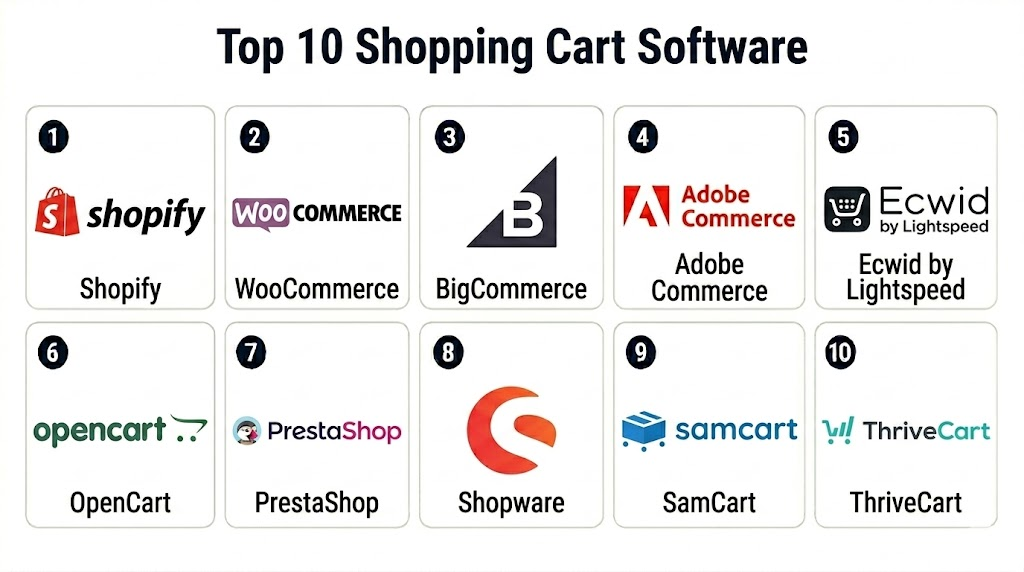
Top 10 Shopping Cart Software
1- Shopify
Short description: Shopify is a hosted ecommerce platform with built-in shopping cart, checkout, product management, payments, inventory, and order workflows. It is best for merchants that want an easy-to-launch online store with a strong app ecosystem.
Key Features
- Built-in cart and checkout
- Product catalog and inventory management
- Discount codes, gift cards, and promotions
- Payment gateway and wallet payment support
- Abandoned cart recovery features depending on plan
- Mobile-optimized storefront and checkout
- Large app marketplace for marketing, shipping, subscriptions, and analytics
Pros
- Easy to set up and manage for non-technical teams
- Strong ecosystem of apps, themes, and integrations
- Suitable for D2C brands, SMBs, and growing ecommerce businesses
Cons
- Advanced customization may require apps or developer support
- Total cost can rise with paid apps and premium themes
- Some complex checkout needs may require higher-tier plans
Platforms / Deployment
Web / iOS / Android
Cloud
Security & Compliance
Security capabilities vary by plan and configuration. Buyers should verify payment security, admin permissions, MFA, fraud controls, encryption, and compliance documentation directly.
Integrations & Ecosystem
Shopify connects shopping cart workflows with product management, marketing, payments, fulfillment, and analytics.
- Payment gateways
- Shipping and fulfillment tools
- Email and SMS marketing tools
- Subscription and loyalty apps
- Accounting platforms
- POS and retail tools
Support & Community
Shopify offers documentation, onboarding resources, merchant education, community support, and partner services. Support depth may vary by plan.
2- WooCommerce
Short description: WooCommerce is a WordPress-based ecommerce plugin that adds shopping cart and checkout functionality to WordPress websites. It is best for businesses that want control over hosting, plugins, themes, and content-driven commerce.
Key Features
- Shopping cart and checkout for WordPress
- Product catalog and order management
- Payment, tax, shipping, and coupon extensions
- Large plugin ecosystem
- Flexible theme and design customization
- Digital and physical product support
- Developer-friendly customization options
Pros
- Highly flexible for WordPress users
- Strong content and commerce combination
- Good control over hosting, plugins, and store design
Cons
- Requires more maintenance than fully hosted SaaS platforms
- Security and performance depend on hosting and plugin quality
- Scaling may require technical expertise
Platforms / Deployment
Web
Self-hosted / Cloud hosting through third-party providers
Security & Compliance
Security depends on hosting, plugin updates, payment setup, admin practices, and configuration. Buyers should verify backups, encryption, malware protection, access controls, and compliance responsibilities.
Integrations & Ecosystem
WooCommerce has a broad ecosystem of WordPress plugins, extensions, and developer tools.
- WordPress plugins
- Payment gateways
- Shipping and tax tools
- Marketing automation platforms
- Accounting tools
- Custom APIs and developer integrations
Support & Community
WooCommerce has a large WordPress community, documentation, agencies, developers, and extension providers. Support depends on hosting, plugins, and implementation partners.
3- BigCommerce
Short description: BigCommerce is a hosted ecommerce platform with shopping cart, checkout, product catalog, order management, and multi-channel selling features. It is useful for growing businesses that want SaaS convenience with strong commerce flexibility.
Key Features
- Hosted shopping cart and checkout
- Product catalog and order management
- Multi-channel selling support
- Payment and shipping integrations
- Promotions, coupons, and pricing rules
- API and headless commerce support
- B2B features depending on plan and setup
Pros
- Strong SaaS platform for scaling ecommerce businesses
- Good API and integration flexibility
- Useful for B2C, B2B, and multi-channel selling
Cons
- Storefront customization may need development support
- App ecosystem may vary compared with larger ecosystems
- Some advanced features depend on plan or configuration
Platforms / Deployment
Web
Cloud
Security & Compliance
Security capabilities vary by plan and configuration. Buyers should verify payment security, admin controls, encryption, fraud features, user permissions, and compliance documentation.
Integrations & Ecosystem
BigCommerce supports integrations across payments, shipping, ERP, marketing, fulfillment, and analytics.
- Payment gateways
- ERP and accounting systems
- Marketplace connectors
- Shipping and fulfillment tools
- Marketing automation tools
- Headless CMS and front-end tools
Support & Community
BigCommerce provides documentation, customer support, partner services, and implementation guidance. Support level may vary by plan and contract.
4- Adobe Commerce
Short description: Adobe Commerce is an enterprise ecommerce platform with advanced shopping cart, checkout, catalog, pricing, promotions, and B2B commerce capabilities. It is best for complex ecommerce businesses needing customization and scale.
Key Features
- Advanced shopping cart and checkout workflows
- Product catalog and merchandising tools
- B2B and B2C commerce support
- Promotions, pricing rules, and customer segmentation
- Multi-store and multi-brand support
- API and headless commerce capabilities
- Enterprise integrations with marketing and experience tools
Pros
- Strong fit for complex and enterprise commerce
- Highly customizable for advanced cart and checkout workflows
- Supports B2B, B2C, and multi-store commerce models
Cons
- Requires technical implementation and maintenance expertise
- Total cost can be high for smaller teams
- Best suited for businesses with development resources
Platforms / Deployment
Web
Cloud / Self-hosted options may vary
Security & Compliance
Security depends on deployment, hosting, extensions, configuration, and Adobe environment. Buyers should verify SSO, permissions, encryption, audit controls, payment security, and compliance documentation.
Integrations & Ecosystem
Adobe Commerce is suitable for businesses that need cart and checkout connected with enterprise marketing, content, ERP, PIM, and analytics tools.
- Adobe experience tools
- ERP systems
- PIM platforms
- Payment gateways
- Marketing automation tools
- Headless front-end frameworks
Support & Community
Adobe Commerce has enterprise support, implementation partners, developer resources, and a large agency ecosystem. Support depends on contract and deployment model.
5- Ecwid by Lightspeed
Short description: Ecwid by Lightspeed is a shopping cart and ecommerce solution that can be added to existing websites, social pages, and online channels. It is useful for small businesses that want to add ecommerce without rebuilding their full website.
Key Features
- Embeddable shopping cart
- Product catalog and checkout
- Multi-channel selling support
- Payment, tax, and shipping options
- Social commerce support
- Mobile store management
- Integration with existing websites
Pros
- Easy to add to an existing website
- Good fit for small businesses and creators
- Supports simple multi-channel selling workflows
Cons
- May be less suitable for complex enterprise commerce
- Advanced customization and scaling needs should be validated
- Some features depend on plan and configuration
Platforms / Deployment
Web / iOS / Android
Cloud
Security & Compliance
Security capabilities vary by plan and configuration. Buyers should verify payment security, user permissions, encryption, admin controls, and compliance responsibilities.
Integrations & Ecosystem
Ecwid works well for businesses that need lightweight ecommerce connected with existing websites and social channels.
- Website builders
- Payment gateways
- Shipping tools
- Social selling channels
- Marketing tools
- Accounting and business apps
Support & Community
Ecwid provides documentation, support resources, onboarding help, and business guidance. Support depth may vary by plan.
6- OpenCart
Short description: OpenCart is an open-source ecommerce platform with shopping cart, product management, checkout, and store administration features. It is suitable for businesses and developers that want a self-hosted cart with customization control.
Key Features
- Open-source shopping cart platform
- Product, category, and order management
- Payment and shipping extensions
- Multi-store support
- Themes and marketplace extensions
- Admin dashboard and reporting
- Developer customization options
Pros
- Open-source flexibility and control
- Useful for developers and technically capable teams
- Can support custom hosting and extension workflows
Cons
- Requires hosting, maintenance, and security management
- Extension quality and support may vary
- Less beginner-friendly than hosted SaaS tools
Platforms / Deployment
Web
Self-hosted
Security & Compliance
Security depends on hosting, extensions, updates, admin configuration, and payment setup. Buyers should verify secure hosting, backups, encryption, access controls, and compliance responsibilities.
Integrations & Ecosystem
OpenCart supports integrations through extensions, custom development, and third-party connectors.
- Payment gateways
- Shipping extensions
- Marketplace modules
- Marketing tools
- Accounting integrations
- Custom APIs and developer extensions
Support & Community
OpenCart has documentation, community support, extension providers, and developer resources. Formal support depends on hosting providers, agencies, or third-party services.
7- PrestaShop
Short description: PrestaShop is an open-source ecommerce platform for building online stores with shopping cart, checkout, catalog, payment, and order management capabilities. It is useful for merchants that want customization and control over their ecommerce environment.
Key Features
- Shopping cart and checkout workflows
- Product catalog and inventory management
- Payment, shipping, and tax modules
- Promotions and discount rules
- Theme and module marketplace
- Multi-language and multi-currency support
- Store analytics and reporting options
Pros
- Flexible open-source ecommerce platform
- Good for merchants needing control and customization
- Strong fit for international stores with localization needs
Cons
- Requires hosting and technical maintenance
- Add-ons and development can increase total cost
- Security and performance depend on implementation quality
Platforms / Deployment
Web
Self-hosted / Cloud hosting options vary
Security & Compliance
Security depends on hosting, modules, updates, payment configuration, and admin practices. Buyers should verify encryption, backups, permissions, payment security, and compliance responsibilities.
Integrations & Ecosystem
PrestaShop supports ecommerce integrations through modules, agencies, and custom development.
- Payment gateways
- Shipping and logistics tools
- Marketing platforms
- Marketplace connectors
- Accounting tools
- Localization and tax modules
Support & Community
PrestaShop has documentation, community resources, agencies, developers, and module providers. Support availability depends on selected services and partners.
8- Shopware
Short description: Shopware is a flexible ecommerce platform with shopping cart, checkout, catalog, storefront, and B2B commerce capabilities. It is suited for businesses that want a customizable commerce platform with modular architecture options.
Key Features
- Storefront and cart management
- Product catalog and checkout workflows
- B2C and B2B commerce support depending on edition
- Rule-based pricing and promotions
- API and headless commerce capabilities
- Extension marketplace
- Multi-channel commerce support
Pros
- Flexible for custom commerce experiences
- Good balance of commerce features and developer control
- Useful for merchants needing modular or headless options
Cons
- Advanced customization may require developer support
- Edition and hosting choices should be evaluated carefully
- Ecosystem depth may vary by region
Platforms / Deployment
Web
Cloud / Self-hosted options may vary
Security & Compliance
Security depends on hosting, edition, extensions, configuration, and admin practices. Buyers should verify access controls, encryption, payment security, audit features, and compliance documentation.
Integrations & Ecosystem
Shopware supports commerce integrations for payments, fulfillment, ERP, product data, and marketing.
- Payment gateways
- ERP systems
- PIM tools
- Shipping and fulfillment tools
- Marketing platforms
- APIs and extension marketplace
Support & Community
Shopware provides documentation, community resources, partner services, and commercial support options. Support depth depends on edition and implementation model.
9- SamCart
Short description: SamCart is a shopping cart and checkout platform focused on digital sellers, creators, course businesses, and marketers. It is useful for businesses that need optimized checkout pages, upsells, subscriptions, and conversion-focused selling.
Key Features
- Checkout page builder
- Digital product and course selling support
- One-click upsells and order bumps
- Subscription and payment plan options
- Coupons and promotions
- Abandoned cart features depending on plan
- Sales and conversion reporting
Pros
- Strong for digital products and creator-led sales funnels
- Easy to build checkout-focused selling pages
- Useful for upsells, offers, and simple product funnels
Cons
- Not a full ecommerce platform for large catalogs
- Physical product operations may require additional tools
- Best suited for checkout and funnel use cases
Platforms / Deployment
Web
Cloud
Security & Compliance
Security capabilities vary by plan and setup. Buyers should verify payment security, permissions, encryption, admin controls, and compliance documentation.
Integrations & Ecosystem
SamCart integrates with tools commonly used by creators, marketers, educators, and digital product sellers.
- Payment gateways
- Email marketing platforms
- Membership tools
- Course platforms
- Automation tools
- Analytics and tracking tools
Support & Community
SamCart provides help resources, onboarding content, support options, and creator-focused education. Support depth may vary by plan.
10- ThriveCart
Short description: ThriveCart is a checkout and shopping cart platform used by digital product sellers, course creators, agencies, and marketers. It focuses on high-converting checkout pages, upsells, affiliate workflows, and digital sales funnels.
Key Features
- Checkout and cart page builder
- One-click upsells and bump offers
- Subscription and payment plan support
- Affiliate management features
- Coupons and offer management
- Digital product and course workflow support
- Sales reporting and funnel tracking
Pros
- Strong for creators, agencies, and digital product sellers
- Useful for checkout optimization and funnel-based sales
- Includes affiliate and offer management capabilities
Cons
- Not ideal for large physical product catalogs
- Less suited for full storefront and merchandising workflows
- Integration needs should be validated before migration
Platforms / Deployment
Web
Cloud
Security & Compliance
Not publicly stated. Buyers should verify payment security, permissions, encryption, audit controls, data handling, and compliance documentation.
Integrations & Ecosystem
ThriveCart fits businesses that need checkout pages connected with marketing, courses, memberships, and payment workflows.
- Payment gateways
- Email marketing tools
- Course platforms
- Membership tools
- Affiliate workflows
- Automation tools
Support & Community
ThriveCart provides documentation, support resources, and user guidance. Support scope may vary by plan and product setup.
Comparison Table
| Tool Name | Best For | Platform Supported | Deployment | Standout Feature | Public Rating |
|---|---|---|---|---|---|
| Shopify | D2C brands and growing ecommerce stores | Web / iOS / Android | Cloud | Built-in cart, checkout, store, and app ecosystem | N/A |
| WooCommerce | WordPress-based ecommerce stores | Web | Self-hosted / Cloud hosting varies | Flexible shopping cart inside WordPress | N/A |
| BigCommerce | Scaling B2C and B2B ecommerce teams | Web | Cloud | Hosted cart with strong API and multi-channel support | N/A |
| Adobe Commerce | Complex enterprise ecommerce | Web | Cloud / Self-hosted varies | Advanced cart, catalog, B2B, and customization depth | N/A |
| Ecwid by Lightspeed | Small businesses adding ecommerce to existing sites | Web / iOS / Android | Cloud | Embeddable cart for websites and social channels | N/A |
| OpenCart | Developers needing open-source cart control | Web | Self-hosted | Open-source shopping cart with extension marketplace | N/A |
| PrestaShop | Customizable international ecommerce stores | Web | Self-hosted / Cloud varies | Open-source cart with localization flexibility | N/A |
| Shopware | Modular B2C and B2B commerce | Web | Cloud / Self-hosted varies | Flexible cart with headless and API options | N/A |
| SamCart | Creators and digital product funnels | Web | Cloud | Conversion-focused checkout and upsells | N/A |
| ThriveCart | Digital sellers and affiliate-driven offers | Web | Cloud | Checkout funnels, upsells, and affiliate workflows | N/A |
Evaluation & Scoring of Shopping Cart Software
| Tool Name | Core 25% | Ease 15% | Integrations 15% | Security 10% | Performance 10% | Support 10% | Value 15% | Weighted Total |
|---|---|---|---|---|---|---|---|---|
| Shopify | 9 | 9 | 10 | 8 | 9 | 9 | 8 | 8.85 |
| WooCommerce | 8 | 7 | 10 | 7 | 7 | 8 | 9 | 8.10 |
| BigCommerce | 9 | 8 | 9 | 8 | 9 | 8 | 8 | 8.50 |
| Adobe Commerce | 10 | 6 | 9 | 9 | 8 | 9 | 7 | 8.45 |
| Ecwid by Lightspeed | 7 | 9 | 8 | 7 | 8 | 8 | 8 | 7.85 |
| OpenCart | 7 | 6 | 7 | 6 | 7 | 7 | 8 | 6.95 |
| PrestaShop | 8 | 6 | 8 | 7 | 7 | 7 | 8 | 7.40 |
| Shopware | 8 | 7 | 8 | 8 | 8 | 8 | 8 | 7.90 |
| SamCart | 7 | 9 | 8 | 7 | 8 | 8 | 8 | 7.85 |
| ThriveCart | 7 | 8 | 8 | 7 | 8 | 7 | 8 | 7.65 |
Which Shopping Cart Software Is Right for You?
Solo / Freelancer
Solo sellers, creators, consultants, and freelancers usually need a simple cart that is easy to launch and maintain. SamCart and ThriveCart are strong for digital products, courses, and service-based offers. Wix-style or hosted ecommerce tools may also work, but Shopify and Ecwid are better when sellers need a more complete online store.
SMB
SMBs should focus on ease of use, payment flexibility, abandoned cart recovery, shipping, discounts, and integrations. Shopify, BigCommerce, WooCommerce, and Ecwid are strong choices. Shopify is usually easier for non-technical teams, WooCommerce is better for WordPress users, BigCommerce fits scaling ecommerce teams, and Ecwid works well for adding ecommerce to an existing website.
Mid-Market
Mid-market businesses usually need stronger integrations, reliable performance, multi-channel selling, catalog management, and checkout customization. Shopify, BigCommerce, Adobe Commerce, Shopware, and WooCommerce are worth evaluating. These companies should test payment flows, tax rules, shipping rates, product variants, customer accounts, abandoned cart workflows, and ERP or fulfillment integrations.
Enterprise
Enterprise buyers should prioritize scalability, performance, security, customization, B2B workflows, approval rules, global payments, and integration depth. Adobe Commerce, BigCommerce Enterprise, Shopify Plus, Shopware, and custom headless commerce stacks are strong candidates depending on architecture. Enterprises should pilot real catalog, checkout, tax, payment, integration, and order scenarios before selecting.
Budget vs Premium
Budget-conscious teams may prefer WooCommerce, OpenCart, PrestaShop, Ecwid, or entry-level hosted carts. Premium buyers may choose Shopify, BigCommerce, Adobe Commerce, or Shopware when better performance, support, ecosystem depth, and scalability justify the investment. Total cost should include platform fees, hosting, transaction costs, apps, extensions, development, maintenance, and support.
Feature Depth vs Ease of Use
Shopify and Ecwid are easier to launch. BigCommerce balances SaaS convenience with deeper commerce features. WooCommerce, OpenCart, PrestaShop, and Shopware offer more control but need stronger technical management. Adobe Commerce provides enterprise depth. SamCart and ThriveCart are not full ecommerce platforms but are strong for checkout funnels and digital offers.
Integrations & Scalability
Shopping cart software should connect with payment gateways, shipping tools, tax engines, CRM, email marketing, subscription systems, analytics, ERP, PIM, WMS, OMS, and accounting platforms. Buyers should test real workflows such as refunds, failed payments, abandoned carts, discounts, product bundles, inventory sync, and order routing before rollout.
Security & Compliance Needs
Buyers should verify payment security, encryption, MFA, admin permissions, fraud controls, audit logs, backups, data retention, and compliance documentation. Hosted SaaS platforms reduce infrastructure maintenance, while self-hosted platforms give more control but require stronger security management. Cart security should be reviewed before accepting live payments.
Frequently Asked Questions
1. What is shopping cart software?
Shopping cart software lets customers add products to a cart, review items, apply discounts, calculate taxes and shipping, pay securely, and place orders. It connects product browsing with checkout and order processing.
2. Is shopping cart software the same as an ecommerce platform?
Not always. An ecommerce platform usually includes a full online store, product management, checkout, orders, and marketing tools. Shopping cart software may focus mainly on cart and checkout workflows.
3. What is the best shopping cart software for small businesses?
Shopify, WooCommerce, BigCommerce, and Ecwid are strong options for small businesses. SamCart and ThriveCart are better for creators selling digital products, courses, and simple checkout funnels.
4. What is the best shopping cart software for WordPress?
WooCommerce is the most common choice for WordPress-based ecommerce. It is flexible and widely supported, but performance and security depend on hosting, plugins, and maintenance practices.
5. What is the best shopping cart software for digital products?
SamCart, ThriveCart, Shopify, WooCommerce, and BigCommerce can support digital product selling. SamCart and ThriveCart are especially useful for checkout pages, upsells, payment plans, and creator-focused funnels.
6. What features should shopping cart software include?
Important features include product cart, checkout, payments, taxes, shipping, discounts, abandoned cart recovery, customer accounts, mobile optimization, security controls, integrations, and reporting.
7. Can shopping cart software reduce cart abandonment?
Yes, better checkout design, faster payment options, guest checkout, clear shipping costs, trust signals, and abandoned cart reminders can reduce abandonment. Results depend on the full customer experience.
8. Is open-source shopping cart software a good option?
Open-source tools such as WooCommerce, OpenCart, and PrestaShop can be good for teams that want control and customization. However, they require more responsibility for hosting, updates, security, and maintenance.
9. How much does shopping cart software cost?
Costs vary based on platform fees, hosting, payment processing, extensions, apps, themes, development, maintenance, and support. Buyers should compare total cost instead of only monthly subscription fees.
10. Can shopping cart software integrate with payment gateways?
Yes, most shopping cart tools integrate with multiple payment gateways. Buyers should verify supported currencies, local payment methods, refunds, failed payments, fraud controls, and settlement reporting.
Conclusion
Shopping Cart Software is one of the most important parts of an online selling system because it directly affects checkout experience, conversion, customer trust, and order accuracy. The right shopping cart helps businesses accept payments, manage discounts, calculate taxes and shipping, recover abandoned carts, and connect orders with fulfillment and marketing workflows. Shopify and BigCommerce are strong hosted options for growing ecommerce brands, while WooCommerce, OpenCart, PrestaShop, and Shopware offer more customization and control for technical teams. Adobe Commerce is suitable for complex enterprise commerce, while Ecwid helps small businesses add ecommerce to existing websites. SamCart and ThriveCart are strong for creators and digital product sellers focused on optimized checkout funnels. The best choice depends on business model, catalog size, technical resources, checkout complexity, integrations, security needs, and budget. Start by shortlisting two or three tools, test real checkout flows, validate payment and shipping integrations, compare total cost, and choose the cart that supports both current sales and future growth.

Find Trusted Cardiac Hospitals
Compare heart hospitals by city and services — all in one place.
Explore Hospitals
Shopping cart software helps make online purchasing smoother by improving checkout experiences and simplifying order management for businesses.