Introduction
Public Transit Scheduling Tools are software platforms used by transit agencies, city transport authorities, operators, and mobility planners to design routes, build timetables, assign vehicles, manage driver schedules, and improve service reliability. These tools help convert passenger demand, fleet capacity, labor rules, route constraints, and service goals into practical operating schedules. Public transit scheduling matters more now because cities are dealing with rising passenger expectations, driver shortages, multimodal mobility, electric bus planning, service equity goals, and the need for real-time operational visibility. A good scheduling platform can help agencies reduce manual planning effort, improve on-time performance, test service scenarios, and publish accurate timetable data.
Real-world use cases include:
- Building bus, tram, metro, and rail timetables
- Optimizing driver and vehicle assignments
- Planning service changes during events, detours, or seasonal demand
- Supporting electric fleet scheduling and depot planning
- Publishing schedule data to passenger information systems
What buyers should evaluate:
- Route and timetable planning depth
- Vehicle and crew scheduling features
- Scenario planning and optimization
- GTFS and open data support
- Integration with CAD, AVL, fare, and passenger systems
- Ease of use for planners and schedulers
- Support for compliance, labor rules, and accessibility
- Reporting, analytics, and performance monitoring
Best for: Public transit agencies, private operators, city mobility teams, regional transport authorities, and consultants managing complex fixed-route or multimodal transit networks.
Not ideal for: Very small shuttle operators with simple manual schedules, teams needing only basic route mapping, or organizations that mainly require delivery dispatch rather than public transit service planning.
Key Trends in Public Transit Scheduling Tools
- AI-assisted scheduling and optimization: More platforms are using optimization engines and AI-assisted planning to reduce manual scheduling effort and test more service scenarios.
- Electric fleet planning: Transit agencies now need scheduling tools that consider charging windows, battery range, depot capacity, and mixed diesel-electric operations.
- Real-time operations alignment: Scheduling is becoming more connected to live dispatch, AVL, disruption management, and passenger information systems.
- GTFS and open data workflows: Agencies increasingly expect schedule publishing support for GTFS and related passenger-facing data formats.
- Equity-focused planning: Modern tools help planners evaluate service access across neighborhoods, job centers, schools, hospitals, and underserved areas.
- Cloud adoption: Cloud-based scheduling platforms are becoming more attractive because they reduce local infrastructure dependency and support faster collaboration.
- Scenario modeling: Agencies want to compare multiple plans quickly before approving service changes.
- Integration-first procurement: Buyers increasingly evaluate APIs, data exports, and interoperability with fare collection, CAD, AVL, workforce, and reporting tools.
- Labor and resource constraint modeling: Scheduling tools must handle union rules, driver availability, vehicle blocks, breaks, layovers, and operational constraints.
- Passenger experience connection: Better schedules directly impact reliability, wait times, transfer quality, and service trust.
How We Selected These Tools
The tools in this list were selected based on practical relevance for public transit planning and scheduling workflows. The evaluation focused on:
- Recognition in public transit planning, scheduling, or operations environments
- Support for timetable, route, vehicle, driver, or service planning workflows
- Fit for agencies, operators, cities, or mobility consultants
- Availability of planning, optimization, analytics, or scenario modeling capabilities
- Ecosystem strength across transit data, dispatch, passenger information, and reporting
- Suitability for fixed-route, demand-responsive, or multimodal services
- Publicly visible product maturity and market presence
- Ability to support integration-heavy transit environments
- Practical buyer fit across enterprise agencies, mid-sized operators, and planning teams
- Balanced coverage of enterprise suites, modern cloud tools, and planning-focused platforms
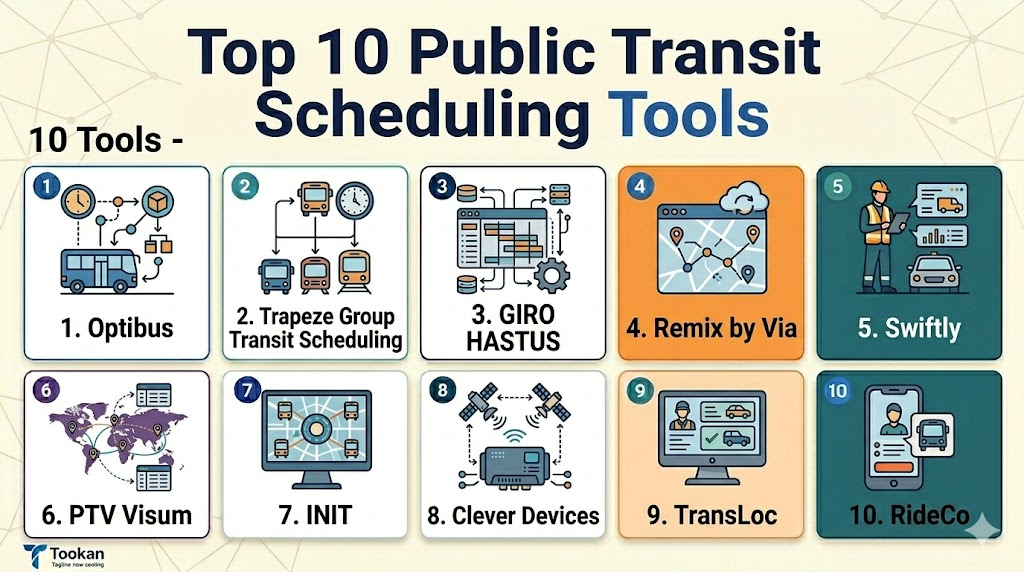
Top 10 Public Transit Scheduling Tools
1- Optibus
Short description: Optibus is a modern public transportation planning and scheduling platform built for agencies, operators, and cities. It is especially strong for route planning, vehicle scheduling, crew scheduling, optimization, scenario comparison, and electric fleet planning.
Key Features
- AI-assisted route and schedule optimization
- Vehicle and crew scheduling workflows
- Scenario planning for service changes
- Electric vehicle scheduling support
- Planning, rostering, and operational visibility
- Tools for agencies, operators, and transit consultants
- Data-driven insights for cost, coverage, and service quality
Pros
- Strong fit for complex transit scheduling and optimization needs
- Modern cloud-based interface compared with many legacy systems
- Useful for testing multiple schedule scenarios quickly
Cons
- May be more advanced than small agencies need
- Implementation can require careful data preparation
- Pricing is usually enterprise-oriented and not publicly simple
Platforms / Deployment
Cloud / Web
Mobile support varies by module
Self-hosted availability: Varies / N/A
Security & Compliance
Not publicly stated in full detail. Buyers should validate SSO, MFA, RBAC, encryption, audit logs, data residency, SOC 2, ISO 27001, and GDPR requirements during procurement.
Integrations & Ecosystem
Optibus is commonly positioned as an end-to-end platform for transit planning and operations. Its ecosystem is relevant for agencies that need planning data to connect with passenger information, operational systems, analytics, and workforce workflows.
- GTFS and transit data workflows
- CAD and AVL integration potential
- Workforce and operations data connections
- Reporting and analytics exports
- APIs and data exchange options
- Electric fleet planning ecosystem
Support & Community
Optibus provides enterprise-style onboarding and support for agencies and operators. Documentation, implementation assistance, and customer success support are generally expected, but buyers should confirm support tiers, training availability, and service-level commitments.
2- Trapeze Group Transit Scheduling
Short description: Trapeze Group offers public transport software used by agencies and operators for scheduling, operations, workforce, dispatch, and passenger transport management. It is a strong fit for larger transit organizations needing a broad operational suite.
Key Features
- Fixed-route scheduling support
- Vehicle and crew planning workflows
- Operations and dispatch alignment
- Passenger transport management modules
- Reporting and performance visibility
- Support for complex agency operations
- Integration with broader transit management systems
Pros
- Mature transit software ecosystem
- Strong fit for large and complex agencies
- Broad module coverage beyond basic scheduling
Cons
- Can require significant implementation effort
- Interface and workflow complexity may be high for smaller teams
- Costs and deployment requirements may vary widely
Platforms / Deployment
Cloud / Hybrid / Varies by product and implementation
Web and desktop availability may vary by module
Security & Compliance
Not publicly stated in full detail for all modules. Buyers should validate SSO, MFA, RBAC, audit logs, encryption, data retention, and compliance requirements directly during evaluation.
Integrations & Ecosystem
Trapeze is often selected by agencies that need scheduling to connect with dispatch, operations, paratransit, workforce, passenger systems, and reporting.
- CAD and AVL systems
- Fare and passenger management systems
- Workforce and payroll-adjacent systems
- Reporting and business intelligence tools
- Transit data publishing workflows
- Enterprise transport operations modules
Support & Community
Trapeze typically serves enterprise transit customers with implementation services, training, and support. Support experience may depend on region, modules purchased, and contract terms.
3- GIRO HASTUS
Short description: HASTUS by GIRO is a well-known transit planning and scheduling system used for complex public transport operations. It is especially relevant for agencies that need strong schedule optimization, crew planning, vehicle scheduling, and operational planning depth.
Key Features
- Timetable and route scheduling
- Vehicle blocking and run cutting
- Crew scheduling and rostering workflows
- Service planning and scenario support
- Tools for large bus, rail, and multimodal networks
- Strong optimization capabilities
- Operational data management for transit teams
Pros
- Deep scheduling functionality for complex operations
- Strong fit for agencies with detailed labor and service constraints
- Recognized in the public transit scheduling market
Cons
- May require specialist knowledge to use effectively
- Implementation can be complex for smaller agencies
- User experience may depend on configuration and training
Platforms / Deployment
Cloud / On-premise / Hybrid availability may vary
Web and desktop access may vary by implementation
Security & Compliance
Not publicly stated in full detail. Buyers should verify access controls, authentication options, audit trails, encryption, hosting model, and compliance documentation.
Integrations & Ecosystem
HASTUS is commonly used in environments where scheduling must connect with operations, workforce planning, passenger information, and agency data workflows.
- Transit operations systems
- Workforce and crew management systems
- Data exports for reporting
- Schedule publishing workflows
- CAD and AVL integrations where supported
- Planning and service change workflows
Support & Community
GIRO serves professional transit agencies and operators, so implementation support and training are important parts of adoption. Buyers should evaluate local partner availability, training depth, and long-term support response expectations.
4- Remix by Via
Short description: Remix by Via is a public transit planning platform focused on route design, service planning, scenario analysis, and data-driven decision-making. It is best suited for planners who need to evaluate route changes, accessibility, demographics, and network impacts.
Key Features
- Route and network planning
- Scenario modeling for service changes
- Demographic and accessibility analysis
- Map-based planning interface
- Public transit planning collaboration
- Support for route redesign and service evaluation
- Useful visual outputs for stakeholder discussions
Pros
- Very strong for planning and visual scenario analysis
- Easier for planning teams than traditional scheduling-heavy tools
- Good fit for service redesign and public-facing planning discussions
Cons
- Not a full replacement for deep crew and vehicle scheduling systems
- May need integration with scheduling or operations platforms
- Best value appears when planning teams actively use scenario modeling
Platforms / Deployment
Cloud / Web
Mobile availability: Varies / N/A
Security & Compliance
Not publicly stated in full detail. Buyers should validate SSO, MFA, RBAC, encryption, audit logs, and public-sector security requirements.
Integrations & Ecosystem
Remix fits well in planning ecosystems where agencies need to analyze service coverage, route changes, equity impacts, and network performance before exporting plans into operational systems.
- GIS and mapping data
- GTFS-related workflows
- Planning and demographic datasets
- Reporting outputs for stakeholders
- Transit agency data exports
- Via mobility ecosystem connections
Support & Community
Support is generally oriented toward agency planning teams and transport professionals. Buyers should confirm onboarding, planning advisory support, data import help, and training options.
5- Swiftly
Short description: Swiftly is a transit data and operations platform focused on real-time passenger information, operational insights, service reliability, and data quality. While it is not a traditional schedule-building tool, it supports schedule adherence, performance analysis, and service planning decisions.
Key Features
- Real-time transit data management
- Schedule adherence and on-time performance insights
- Passenger information support
- Data quality monitoring
- Operational analytics dashboards
- Service reliability reporting
- Integration with agency systems and passenger apps
Pros
- Strong for schedule reliability and operational visibility
- Useful for agencies improving passenger information quality
- Helps connect scheduled service with real-world performance
Cons
- Not a full crew or vehicle scheduling platform
- Best used alongside scheduling and planning systems
- Value depends on quality of real-time data sources
Platforms / Deployment
Cloud / Web
Mobile support varies by use case
Security & Compliance
Not publicly stated in full detail. Buyers should verify SSO, MFA, encryption, role-based permissions, audit logs, and public-sector security standards.
Integrations & Ecosystem
Swiftly is useful in environments where agencies need to connect real-time vehicle data, schedule data, passenger information, and performance reporting.
- GTFS and GTFS-realtime workflows
- CAD and AVL systems
- Passenger information systems
- Agency dashboards and reporting tools
- APIs for third-party applications
- Data quality and operations workflows
Support & Community
Swiftly typically supports transit agencies with onboarding, data setup, and operational analytics guidance. Buyers should confirm support tiers, data validation processes, and service-level expectations.
6- PTV Visum
Short description: PTV Visum is a transport planning and modeling platform used for network analysis, public transport planning, demand modeling, and strategic mobility planning. It is best for agencies and consultants that need advanced modeling rather than only day-to-day schedule production.
Key Features
- Multimodal transport network modeling
- Public transport planning and analysis
- Demand forecasting support
- Scenario comparison for network changes
- GIS-style planning and visualization
- Strategic transport planning workflows
- Support for consultants and public authorities
Pros
- Strong for long-term transport planning and network analysis
- Useful for multimodal and regional mobility studies
- Good fit for consultants and planning departments
Cons
- Not primarily a simple scheduling tool
- Requires transport modeling expertise
- May be more complex than operations teams need
Platforms / Deployment
Windows / Desktop
Cloud availability: Varies / N/A
Security & Compliance
Not publicly stated. Buyers should validate license management, data storage practices, user access controls, and compliance requirements if used in regulated environments.
Integrations & Ecosystem
PTV Visum is commonly used with modeling, GIS, transport datasets, and planning workflows. It can support schedule-informed planning but may need operational scheduling tools for final production schedules.
- GIS data
- Public transport network data
- Demand modeling datasets
- Planning reports and exports
- Simulation and traffic tools
- Regional transport planning workflows
Support & Community
PTV tools are widely used by transport planners and consultants, with professional documentation, training, and support options. Buyers should confirm regional support availability and training resources.
7- INIT
Short description: INIT provides integrated public transport technology covering operations control, ticketing, planning, fleet systems, and passenger information. It is relevant for agencies needing scheduling-adjacent workflows connected to broader transit operations.
Key Features
- Transit operations technology suite
- Fleet and service management support
- Passenger information capabilities
- Operations control integration
- Planning and dispatch-adjacent workflows
- Data-driven service management
- Support for large public transport operators
Pros
- Broad public transport ecosystem
- Strong fit for agencies needing integrated operations
- Useful for connecting scheduling with live service control
Cons
- May be more suite-oriented than standalone scheduling buyers need
- Implementation scope can be large
- Product fit depends on selected modules
Platforms / Deployment
Cloud / On-premise / Hybrid depending on product and project
Web, desktop, and onboard system components may vary
Security & Compliance
Not publicly stated in full detail across all modules. Buyers should validate authentication, permissions, encryption, audit logs, hosting model, and compliance documentation.
Integrations & Ecosystem
INIT is strongest where scheduling, control center operations, passenger information, ticketing, and fleet systems must operate as a connected environment.
- Operations control systems
- Ticketing and fare collection
- Passenger information displays
- Fleet and onboard systems
- Data reporting and analytics
- Public transport agency platforms
Support & Community
INIT generally supports enterprise transit projects with professional services, deployment support, and long-term system maintenance. Buyers should verify local support coverage and implementation methodology.
8- Clever Devices
Short description: Clever Devices provides transit technology for fleet management, real-time information, CAD, AVL, passenger counting, and operational intelligence. It is useful for agencies that want scheduling data connected to real-time operations and performance monitoring.
Key Features
- CAD and AVL capabilities
- Real-time vehicle tracking
- Passenger information support
- Automated passenger counting
- Operational performance reporting
- Fleet and service management tools
- Transit data and analytics workflows
Pros
- Strong operational technology footprint
- Useful for schedule adherence and service reliability tracking
- Good fit for agencies needing real-time operations visibility
Cons
- Not primarily a standalone schedule planning platform
- Best used with planning or scheduling systems
- Implementation may require hardware and systems integration
Platforms / Deployment
Cloud / On-premise / Hybrid depending on solution
Vehicle, control center, and web components may vary
Security & Compliance
Not publicly stated in full detail. Buyers should validate access control, encryption, network security, audit logs, and public-sector procurement requirements.
Integrations & Ecosystem
Clever Devices fits well into transit technology environments where vehicle systems, control centers, real-time data, and passenger communications need to align with schedules.
- CAD and AVL systems
- Passenger information systems
- Automatic passenger counters
- Fleet and onboard equipment
- Reporting and analytics platforms
- Schedule and service data feeds
Support & Community
Support is typically project-based and enterprise-oriented. Buyers should confirm hardware support, software support, maintenance terms, implementation timelines, and training.
9- TransLoc
Short description: TransLoc supports transit technology for real-time tracking, fixed-route visibility, demand response, and campus or agency mobility operations. It is a practical option for smaller agencies, universities, and organizations that need passenger-facing transit operations support.
Key Features
- Real-time vehicle tracking
- Passenger-facing transit information
- Fixed-route and on-demand support
- Mobile rider experience tools
- Operations visibility
- Service performance insights
- Useful for campus and local transit networks
Pros
- Good fit for universities, campuses, and smaller transit systems
- Passenger-facing tools can improve rider communication
- Easier to adopt than large enterprise scheduling suites
Cons
- Not as deep for advanced vehicle and crew scheduling
- May need other tools for complex agency planning
- Best suited for specific transit environments rather than all networks
Platforms / Deployment
Cloud / Web / iOS / Android
Deployment may vary by solution
Security & Compliance
Not publicly stated in full detail. Buyers should verify SSO, MFA, encryption, permissions, data handling, and compliance needs.
Integrations & Ecosystem
TransLoc is useful when agencies need to connect tracking, rider information, and operational visibility with existing transit workflows.
- Real-time vehicle data
- Passenger mobile applications
- Campus transit systems
- On-demand mobility workflows
- Reporting and analytics
- Schedule and route data feeds
Support & Community
Support is generally suited to transit agencies, campuses, and mobility operators. Buyers should confirm onboarding, rider app configuration support, and integration assistance.
10- RideCo
Short description: RideCo is a transit technology platform focused heavily on on-demand transit, microtransit, paratransit, and dynamic scheduling. It is best for agencies and operators that need flexible shared-ride scheduling rather than only fixed-route timetable planning.
Key Features
- On-demand transit scheduling
- Dynamic ride matching
- Microtransit planning and operations
- Paratransit workflow support
- Rider booking and dispatch tools
- Real-time routing and optimization
- Analytics for service performance
Pros
- Strong fit for demand-responsive transit models
- Useful for first-mile and last-mile public mobility
- Helps agencies operate flexible service zones
Cons
- Not a traditional fixed-route timetable scheduling system
- Best for microtransit, paratransit, and flexible services
- Requires clear operating model and service zone design
Platforms / Deployment
Cloud / Web / iOS / Android
Deployment varies by agency program
Security & Compliance
Not publicly stated in full detail. Buyers should validate rider data protection, access controls, encryption, audit logs, and compliance requirements.
Integrations & Ecosystem
RideCo is relevant for agencies that want to connect dynamic transit scheduling with booking, dispatch, rider communication, and performance reporting.
- Rider booking systems
- Dispatch and operations tools
- Payment or fare integrations
- Real-time routing systems
- Agency reporting dashboards
- Public mobility and microtransit programs
Support & Community
RideCo typically works closely with agencies and operators during program launch. Buyers should confirm implementation services, operational support, training, and service design assistance.
Comparison Table
| Tool Name | Best For | Platform(s) Supported | Deployment | Standout Feature | Public Rating |
|---|---|---|---|---|---|
| Optibus | AI-assisted transit scheduling and optimization | Web | Cloud | Fast scenario planning and vehicle or crew optimization | N/A |
| Trapeze Group Transit Scheduling | Large transit agencies and enterprise operations | Web / Desktop varies | Cloud / Hybrid / Varies | Broad transit operations suite | N/A |
| GIRO HASTUS | Complex timetable, vehicle, and crew scheduling | Web / Desktop varies | Cloud / On-premise / Hybrid varies | Deep scheduling optimization | N/A |
| Remix by Via | Route planning and service scenario analysis | Web | Cloud | Visual network planning and demographic analysis | N/A |
| Swiftly | Schedule reliability and real-time transit analytics | Web | Cloud | Real-time data quality and on-time performance insights | N/A |
| PTV Visum | Strategic transport planning and network modeling | Windows | Desktop / Varies | Multimodal transport modeling | N/A |
| INIT | Integrated public transport operations | Web / Desktop / Onboard varies | Cloud / On-premise / Hybrid | Operations control and passenger system integration | N/A |
| Clever Devices | Real-time fleet operations and service monitoring | Web / Vehicle systems varies | Cloud / On-premise / Hybrid | CAD, AVL, and passenger information integration | N/A |
| TransLoc | Campus, local transit, and rider information | Web / iOS / Android | Cloud | Real-time tracking and passenger-facing tools | N/A |
| RideCo | Microtransit, paratransit, and on-demand scheduling | Web / iOS / Android | Cloud | Dynamic shared-ride scheduling | N/A |
Evaluation & Scoring of Public Transit Scheduling Tools
| Tool Name | Core 25% | Ease 15% | Integrations 15% | Security 10% | Performance 10% | Support 10% | Value 15% | Weighted Total |
|---|---|---|---|---|---|---|---|---|
| Optibus | 9 | 8 | 8 | 7 | 9 | 8 | 8 | 8.25 |
| Trapeze Group Transit Scheduling | 9 | 7 | 9 | 7 | 8 | 8 | 7 | 7.90 |
| GIRO HASTUS | 9 | 7 | 8 | 7 | 8 | 8 | 7 | 7.75 |
| Remix by Via | 7 | 9 | 7 | 7 | 7 | 8 | 8 | 7.55 |
| Swiftly | 7 | 8 | 9 | 7 | 8 | 8 | 8 | 7.85 |
| PTV Visum | 8 | 6 | 7 | 6 | 8 | 7 | 7 | 7.10 |
| INIT | 8 | 7 | 9 | 7 | 8 | 8 | 7 | 7.75 |
| Clever Devices | 7 | 7 | 9 | 7 | 8 | 8 | 7 | 7.55 |
| TransLoc | 6 | 8 | 7 | 6 | 7 | 7 | 8 | 7.00 |
| RideCo | 7 | 8 | 7 | 6 | 8 | 8 | 8 | 7.45 |
Which Public Transit Scheduling Tool Is Right for You?
Solo / Freelancer
Independent transport consultants or solo planners usually need tools that help with scenario modeling, route redesign, and clear visual communication. Remix by Via and PTV Visum are strong options depending on whether the work is service planning or deeper transport modeling. For lightweight operational review, Swiftly-style analytics may also be useful when working with agency data.
SMB
Small and mid-sized transit operators should avoid overbuying a complex enterprise suite unless they have the staff to manage it. TransLoc, Remix by Via, RideCo, or Swiftly may be more practical depending on whether the need is real-time visibility, planning, microtransit, or service performance. If fixed-route scheduling complexity is increasing, Optibus can also be considered.
Mid-Market
Mid-sized agencies often need a balance of scheduling depth, operational visibility, and manageable implementation. Optibus, Swiftly, Trapeze, and GIRO HASTUS are good candidates depending on the mix of fixed-route scheduling, crew planning, real-time data, and service reliability goals. Remix may be useful alongside these platforms for planning and public engagement.
Enterprise
Large city, regional, or national transit networks usually need strong scheduling engines, integrations, security controls, and long-term vendor support. Optibus, Trapeze, GIRO HASTUS, INIT, and Clever Devices are more suitable for enterprise environments. The best choice depends on whether the agency prioritizes scheduling optimization, operations control, passenger information, or full-suite standardization.
Budget vs Premium
Budget-conscious teams should begin by identifying the exact workflow gap. If the need is route planning, a planning-focused tool may be enough. If the need is crew scheduling, vehicle blocking, or complex operations, a premium platform may be necessary. Premium systems usually deliver more value when they replace manual workflows, reduce overtime, improve service reliability, or support large-scale scenario planning.
Feature Depth vs Ease of Use
Deep scheduling platforms can handle complex labor rules, blocks, runs, and operational constraints, but they may require more training. Easier planning tools are better for fast route studies, public engagement, and service redesign. Agencies should decide whether the main problem is schedule production, service planning, live operations, or passenger information.
Integrations & Scalability
Transit scheduling does not work in isolation. Buyers should evaluate how each tool connects with CAD, AVL, fare systems, GTFS feeds, workforce systems, analytics tools, passenger apps, and data warehouses. Scalability also matters because service changes, fleet growth, electric buses, and multimodal programs can increase complexity over time.
Security & Compliance Needs
Public transit agencies often handle operational data, employee data, rider information, and critical infrastructure workflows. Buyers should validate SSO, MFA, encryption, RBAC, audit logs, data residency, incident response, backup practices, and compliance documentation. If the vendor cannot clearly explain its security posture, the procurement team should treat that as a risk.
Frequently Asked Questions
1- What is a public transit scheduling tool?
A public transit scheduling tool helps agencies plan routes, create timetables, assign vehicles, manage crew schedules, and prepare service changes. It turns operational constraints into workable public transport schedules.
2- How is transit scheduling software different from route planning software?
Route planning software focuses on designing routes and service coverage. Transit scheduling software goes deeper into timetables, vehicle blocks, driver duties, layovers, labor rules, and operational execution.
3- Which tool is best for large public transit agencies?
Large agencies often evaluate Optibus, Trapeze, GIRO HASTUS, INIT, and Clever Devices. The best choice depends on whether the agency needs scheduling optimization, full operations management, or real-time service control.
4- Which tool is best for smaller transit operators?
Smaller operators may prefer TransLoc, Remix by Via, RideCo, or Swiftly depending on the use case. These tools can be more practical for rider information, planning, microtransit, and service visibility.
5- Do these tools support GTFS?
Many modern transit platforms support GTFS or GTFS-related workflows, but support varies by product and module. Buyers should confirm GTFS export, GTFS-realtime support, data validation, and publishing workflows before purchase.
6- How much do public transit scheduling tools cost?
Pricing is usually quote-based and depends on agency size, modules, number of users, fleet size, integrations, and implementation scope. If pricing is not public, buyers should request a detailed cost breakdown.
7- How long does implementation take?
Implementation can range from a few weeks for lighter planning tools to several months for complex enterprise scheduling suites. Data cleanup, integrations, training, and change management often drive the timeline.
8- What are common mistakes when choosing a scheduling tool?
Common mistakes include focusing only on software features, ignoring data quality, underestimating integration needs, skipping dispatcher and planner feedback, and failing to test real service scenarios before signing a contract.
9- Are cloud-based tools better than on-premise tools?
Cloud tools can improve collaboration, updates, and scalability. On-premise or hybrid models may still be preferred when agencies have strict infrastructure, data residency, or legacy system requirements.
10- Can these tools help with electric bus scheduling?
Some modern platforms support electric fleet planning, including charging constraints, range limits, depot planning, and mixed fleet operations. Buyers should validate the depth of EV scheduling before assuming full support.
Conclusion
Public Transit Scheduling Tools are becoming essential for agencies and operators that need reliable service planning, efficient resource use, and better passenger outcomes. The right tool depends on the agency’s size, route complexity, workforce rules, fleet type, data maturity, and integration needs. Optibus, Trapeze, and GIRO HASTUS are strong options for advanced scheduling and optimization, while Remix by Via is excellent for planning and scenario analysis. Swiftly, Clever Devices, and INIT are valuable when scheduling must connect with real-time operations and passenger information. TransLoc and RideCo are practical choices for campus transit, local systems, microtransit, and demand-responsive services. The best next step is to shortlist 2–3 tools, test them against real routes and scheduling data, validate integrations and security requirements, and run a pilot before committing to a long-term rollout.

Find Trusted Cardiac Hospitals
Compare heart hospitals by city and services — all in one place.
Explore Hospitals
Public transit scheduling tools are most valuable when they help transit agencies efficiently plan, optimize, and manage bus, rail, metro, and other public transportation services. By providing route planning, timetable creation, vehicle and crew scheduling, demand forecasting, service optimization, real-time schedule adjustments, performance analytics, passenger information integration, and compliance reporting, these platforms enable transit operators to improve service reliability, maximize resource utilization, reduce operational costs, and deliver a better travel experience for passengers.