Introduction
Fitness Coaching Platforms are digital tools that enable individuals, trainers, gyms, and organizations to provide structured fitness programs, personalized coaching, exercise tracking, nutrition guidance, and performance monitoring. They allow users to access training plans, log workouts, track progress, and receive feedback remotely. these platforms are increasingly important due to the rise of hybrid fitness models, home workouts, wearable integrations, and AI-based coaching. They help personal trainers manage multiple clients, gyms scale online classes, and enterprises provide employee wellness programs.
Real-world use cases include:
- Personalized training programs with exercise tracking
- Virtual one-on-one coaching and group classes
- Nutrition and meal planning integration
- Fitness challenges for engagement and motivation
- Employee wellness and corporate fitness programs
Evaluation Criteria for Buyers:
- Personalization and coaching flexibility
- Exercise and nutrition tracking capabilities
- Integration with wearables and smart devices
- Mobile and desktop accessibility
- AI-powered recommendations or analytics
- Group class and community support
- Client management and scheduling tools
- Reporting and performance dashboards
- Security and privacy of user data
- Scalability for gyms or enterprise wellness programs
Best for: personal trainers, gyms, wellness coaches, fitness enthusiasts, corporate wellness teams, and hybrid or digital-first fitness programs.
Not ideal for: casual users only seeking generic workout videos or individuals not interested in tracking metrics, analytics, or structured coaching programs.
Key Trends in Fitness Coaching Platforms
- AI-driven personalized fitness and nutrition recommendations
- Integration with wearables, smart scales, heart rate monitors, and IoT devices
- Hybrid coaching combining live streaming, on-demand workouts, and app-based guidance
- Corporate wellness platforms for employee health and engagement
- Gamification and social features to increase adherence and motivation
- Analytics dashboards for trainers, gyms, and enterprises to monitor progress
- Cloud-based solutions for multi-device access and remote coaching
- Privacy and data compliance including GDPR, HIPAA, or regional regulations
- Virtual group classes and community-based engagement
- Adaptive workout plans based on user performance and biofeedback
How We Selected These Tools
- Market adoption and user base among consumers, trainers, gyms, and wellness programs
- Feature completeness for coaching, nutrition, tracking, reporting, and engagement
- Reliability and platform performance signals from user reviews and industry benchmarks
- Security posture and privacy features, including data handling and compliance
- Integrations with wearables, apps, calendars, and health tracking systems
- Scalability for individuals, gyms, and enterprise wellness programs
- Ease of onboarding and user experience for trainers and clients
- Reporting and analytics quality
- AI or automated recommendations for personalized fitness plans
- Support quality, documentation, and community engagement
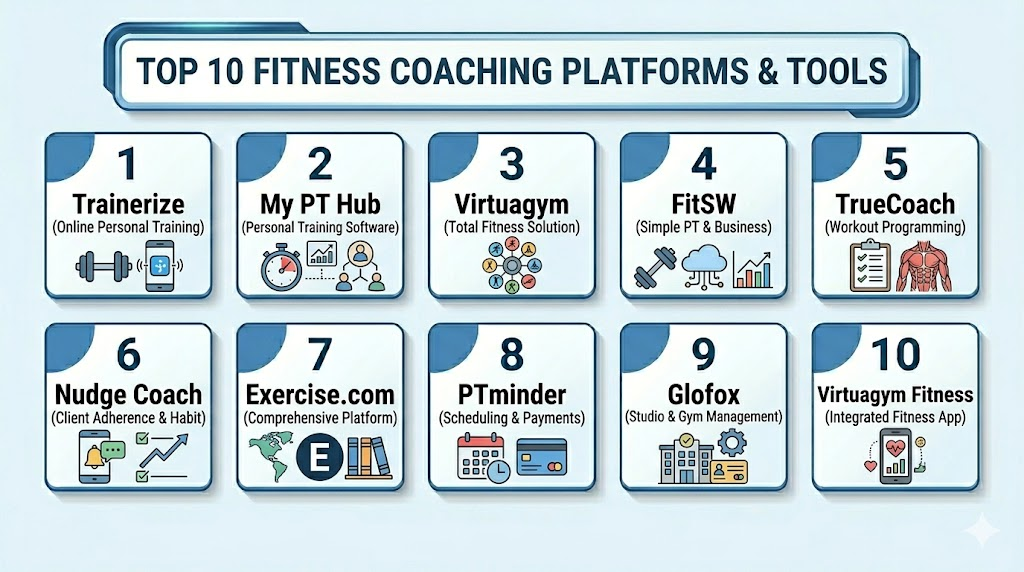
Top 10 Fitness Coaching Platforms
1- Trainerize
Short description: Trainerize is a platform for personal trainers and gyms to deliver custom training programs, track workouts, and manage clients digitally.
Key Features
- Personalized workout plans
- Progress and performance tracking
- Nutrition planning and tracking
- Messaging and client communication
- Integration with wearable devices
- Group classes and challenges
- Mobile and web accessibility
Pros
- Strong client management capabilities
- Scalable for gyms and personal trainers
- Integrates with multiple devices and fitness apps
Cons
- Premium features require subscription
- Some advanced analytics limited to higher plans
- Interface may be complex for casual users
Platforms / Deployment
Web / iOS / Android
Cloud
Security & Compliance
Not publicly stated
Integrations & Ecosystem
- Apple Health, Google Fit, Fitbit
- Nutrition apps
- Calendar and scheduling integrations
- Payment and billing gateways
Support & Community
Documentation, tutorials, email support, and active trainer community
2- My PT Hub
Short description: My PT Hub is designed for trainers to create workouts, track client progress, and deliver nutrition coaching online.
Key Features
- Customizable training programs
- Client tracking and progress reports
- Meal and nutrition planning
- Exercise library and video instructions
- Scheduling and reminders
- Integration with fitness devices
- Mobile and web apps
Pros
- Flexible program creation
- Good client communication tools
- Multi-device support
Cons
- Limited free plan features
- No AI-driven recommendations
- Reporting may require manual input
Platforms / Deployment
Web / iOS / Android
Cloud
Security & Compliance
Not publicly stated
Integrations & Ecosystem
- Fitbit, Garmin, Apple Health
- Nutrition tracking apps
- Payment processing
Support & Community
Email and chat support, user guides
3- Virtuagym
Short description: Virtuagym offers fitness clubs, personal trainers, and employees tools for workouts, nutrition, and community engagement.
Key Features
- Workout plans and exercises
- Nutrition tracking
- Community features and challenges
- Progress tracking dashboards
- Employee wellness programs
- Video exercise library
- Mobile apps
Pros
- Strong for gyms and corporate wellness
- Community engagement features
- Extensive exercise content
Cons
- Enterprise plans may be expensive
- Some features require training
- Integration complexity for external apps
Platforms / Deployment
Web / iOS / Android
Cloud
Security & Compliance
Not publicly stated
Integrations & Ecosystem
- Wearables and smart devices
- HR and wellness programs
- Nutrition apps
Support & Community
Online tutorials, customer service, community forums
4- FitSW
Short description: FitSW is a client management and fitness tracking platform for personal trainers and gyms.
Key Features
- Workout and program creation
- Client progress tracking
- Nutrition logging
- Scheduling and reminders
- Messaging and notifications
- Integration with devices
- Mobile and web apps
Pros
- Affordable for small gyms
- Good client tracking features
- Easy-to-use interface
Cons
- Limited AI support
- Advanced analytics are basic
- Some integrations are limited
Platforms / Deployment
Web / iOS / Android
Cloud
Security & Compliance
Not publicly stated
Integrations & Ecosystem
- Wearables, Fitbit, Apple Health
- Payment processing
Support & Community
Email support, help guides
5- TrueCoach
Short description: TrueCoach provides personal trainers and coaches tools to manage clients, deliver workouts, and monitor progress remotely.
Key Features
- Customized workout plans
- Client progress dashboards
- Video demonstration library
- Messaging and scheduling
- Nutrition coaching
- Group programs and challenges
- Mobile apps
Pros
- Excellent trainer-client communication
- Simple interface
- Scalable for multiple clients
Cons
- Price may be high for small trainers
- Limited built-in AI features
- No large-scale corporate programs
Platforms / Deployment
Web / iOS / Android
Cloud
Security & Compliance
Not publicly stated
Integrations & Ecosystem
- Wearables and tracking apps
- Payment platforms
Support & Community
Documentation, email support, tutorials
6- Nudge Coach
Short description: Nudge Coach is designed for coaches to deliver behavior change programs including fitness, nutrition, and wellness.
Key Features
- Behavior change tracking
- Custom fitness and nutrition programs
- Client messaging
- Analytics dashboards
- Integration with wearable devices
- Progress reports
- Mobile and web apps
Pros
- Strong focus on behavior change
- Good tracking dashboards
- Integrates with wearables
Cons
- Learning curve for new users
- Limited free features
- Enterprise features are premium
Platforms / Deployment
Web / iOS / Android
Cloud
Security & Compliance
Not publicly stated
Integrations & Ecosystem
- Apple Health, Google Fit, Fitbit
- Nutrition tracking apps
Support & Community
Online guides, email support
7- Exercise.com
Short description: Exercise.com offers gyms, trainers, and enterprises a complete platform for workouts, client management, and tracking.
Key Features
- Workout builder and tracking
- Nutrition logging
- Client management tools
- Performance dashboards
- Online booking and scheduling
- Integration with wearables
- Mobile and web apps
Pros
- All-in-one solution
- Good for gyms and fitness brands
- Scalable for multiple clients
Cons
- Can be costly for small trainers
- Complex for casual users
- Setup requires time
Platforms / Deployment
Web / iOS / Android
Cloud
Security & Compliance
Not publicly stated
Integrations & Ecosystem
- Wearables, payment gateways
- Nutrition apps
- Booking platforms
Support & Community
Customer service, online resources
8- PTminder
Short description: PTminder is a fitness coaching platform for personal trainers to manage clients, sessions, and payments.
Key Features
- Workout and program management
- Client tracking
- Scheduling and reminders
- Payments and billing
- Mobile apps
- Progress reporting
- Group programs
Pros
- Easy client management
- Affordable for small trainers
- Mobile-friendly
Cons
- Limited AI or advanced analytics
- Smaller integrations ecosystem
- Enterprise features limited
Platforms / Deployment
Web / iOS / Android
Cloud
Security & Compliance
Not publicly stated
Integrations & Ecosystem
- Payments, calendar apps
- Wearable device tracking
Support & Community
Email support, tutorials
9- Glofox
Short description: Glofox targets gyms and fitness studios, offering member management, class scheduling, and fitness program delivery.
Key Features
- Class scheduling and booking
- Member management
- Payment and billing automation
- Workout programs
- Mobile apps
- Attendance tracking
- Analytics dashboards
Pros
- Great for gyms and studios
- Scalable for multiple locations
- Integrated billing and class management
Cons
- Less suitable for individual trainers
- Advanced AI features limited
- Enterprise customization may cost extra
Platforms / Deployment
Web / iOS / Android
Cloud
Security & Compliance
Not publicly stated
Integrations & Ecosystem
- Wearables and apps
- Payment gateways
- Booking systems
Support & Community
Customer support, tutorials, guides
10- Virtuagym Fitness
Short description: Virtuagym Fitness provides fitness clubs, gyms, and coaches with program delivery, wellness tracking, and client engagement tools.
Key Features
- Workout and training program creation
- Nutrition tracking
- Group classes
- Performance analytics
- Mobile apps
- Employee wellness modules
- Community features
Pros
- Strong enterprise and club focus
- Comprehensive wellness platform
- Multiple engagement options
Cons
- Costly for small businesses
- Setup can be complex
- Some features require training
Platforms / Deployment
Web / iOS / Android
Cloud
Security & Compliance
Not publicly stated
Integrations & Ecosystem
- Wearables, HR systems, booking apps
- Nutrition tracking
- Analytics dashboards
Support & Community
Documentation, tutorials, email support
Comparison Table
| Tool Name | Best For | Platform(s) Supported | Deployment | Standout Feature | Public Rating |
|---|---|---|---|---|---|
| Trainerize | Personal trainers & gyms | Web / iOS / Android | Cloud | Client management & coaching | N/A |
| My PT Hub | Trainers & small gyms | Web / iOS / Android | Cloud | Custom programs & tracking | N/A |
| Virtuagym | Gyms & corporate wellness | Web / iOS / Android | Cloud | Enterprise wellness platform | N/A |
| FitSW | Trainers & small gyms | Web / iOS / Android | Cloud | Affordable client tracking | N/A |
| TrueCoach | Personal trainers | Web / iOS / Android | Cloud | Remote client coaching | N/A |
| Nudge Coach | Health coaches | Web / iOS / Android | Cloud | Behavior change tracking | N/A |
| Exercise.com | Gyms & enterprises | Web / iOS / Android | Cloud | All-in-one solution | N/A |
| PTminder | Personal trainers | Web / iOS / Android | Cloud | Client & payment management | N/A |
| Glofox | Gyms & studios | Web / iOS / Android | Cloud | Membership & class management | N/A |
| Virtuagym Fitness | Clubs & coaches | Web / iOS / Android | Cloud | Training + wellness tracking | N/A |
Evaluation & Scoring of Fitness Coaching Platforms
| Tool Name | Core 25% | Ease 15% | Integrations 15% | Security 10% | Performance 10% | Support 10% | Value 15% | Weighted Total 0–10 |
|---|---|---|---|---|---|---|---|---|
| Trainerize | 9 | 8 | 9 | 7 | 8 | 8 | 8 | 8.20 |
| My PT Hub | 8 | 8 | 8 | 7 | 8 | 7 | 8 | 7.80 |
| Virtuagym | 9 | 7 | 8 | 8 | 8 | 8 | 7 | 7.95 |
| FitSW | 8 | 8 | 7 | 7 | 8 | 7 | 8 | 7.65 |
| TrueCoach | 8 | 9 | 7 | 7 | 8 | 8 | 8 | 7.90 |
| Nudge Coach | 8 | 8 | 8 | 7 | 8 | 7 | 8 | 7.80 |
| Exercise.com | 9 | 7 | 8 | 8 | 8 | 8 | 7 | 7.95 |
| PTminder | 7 | 8 | 7 | 7 | 7 | 7 | 8 | 7.30 |
| Glofox | 8 | 7 | 8 | 8 | 8 | 8 | 7 | 7.75 |
| Virtuagym Fitness | 8 | 7 | 8 | 8 | 8 | 8 | 7 | 7.75 |
Which Fitness Coaching Platform Tool Is Right for You?
Solo / Freelancer
Solo trainers should choose a platform that is easy to set up, affordable, and simple for clients to use.
Trainerize, TrueCoach, FitSW, and PTminder are practical options for individual coaches managing workout plans, client messages, progress tracking, and payments.
If you want a clean coaching workflow, choose TrueCoach.
If you want broader client management and integrations, choose Trainerize.
SMB
Small gyms, boutique studios, and growing coaching businesses need better scheduling, client tracking, billing, group programs, and progress visibility.
My PT Hub, FitSW, Trainerize, and Nudge Coach are useful for teams that want structured programs and client engagement without heavy enterprise complexity.
Choose Nudge Coach if behavior change and habit tracking are important.
Choose My PT Hub if you need a practical balance of workouts, nutrition, and client management.
Mid-Market
Mid-market fitness businesses need stronger reporting, team workflows, branded experiences, integrations, and scalable coaching operations.
Virtuagym, Exercise.com, Trainerize, and Glofox are better fits for gyms, studios, and multi-coach businesses.
Choose Exercise.com if you need an all-in-one fitness business platform.
Choose Glofox if membership, class booking, and studio operations are central.
Enterprise
Enterprise fitness brands, multi-location gyms, corporate wellness programs, and large coaching teams should prioritize scalability, permissions, reporting, integrations, and support.
Virtuagym, Exercise.com, Glofox, and Virtuagym Fitness are stronger options for larger operations.
These platforms can support member management, wellness programs, analytics, online training, and multi-location workflows.
Enterprise buyers should validate implementation support, security controls, integration depth, and reporting needs before final selection.
Budget vs Premium
Budget-focused trainers should start with platforms that cover core workout creation, client messaging, progress tracking, and payments without unnecessary enterprise features.
FitSW, PTminder, and My PT Hub can be practical for smaller coaching businesses.
Premium platforms such as Exercise.com, Virtuagym, and Glofox may be worth it when you need branding, automation, member management, analytics, and multi-location scale.
The best value depends on whether the platform reduces admin time and improves client retention.
Feature Depth vs Ease of Use
If you want simple coaching delivery, choose a tool with clean workout creation, client check-ins, and progress tracking.
TrueCoach and FitSW are useful when ease of use matters more than advanced business operations.
If you need deeper features such as payments, memberships, branded apps, analytics, and group programs, consider Trainerize, Exercise.com, or Virtuagym.
Always test the platform with real client workflows before committing.
Integrations & Scalability
Fitness coaching platforms should connect with wearables, payment tools, nutrition apps, calendars, booking systems, and analytics tools.
For growing teams, integrations reduce duplicate work and improve coaching visibility.
Trainerize, Virtuagym, Exercise.com, and Glofox are better options when integration depth and scalability matter.
Buyers should confirm supported devices, API options, payment workflows, and reporting needs before purchase.
Security & Compliance Needs
Fitness platforms store personal data such as body metrics, progress photos, payment details, health goals, and workout history.
Buyers should review privacy policies, encryption, access controls, user permissions, data retention, and account security before choosing a platform.
For corporate wellness or healthcare-adjacent programs, stronger privacy and compliance review is important.
If certifications or compliance details are unclear, mark them as Not publicly stated and confirm directly with the vendor.
Frequently Asked Questions
1. What are Fitness Coaching Platforms?
Fitness Coaching Platforms are software tools that help trainers, gyms, and wellness coaches deliver workout plans, track client progress, manage communication, and support online coaching.
They usually include exercise libraries, client dashboards, messaging, scheduling, payments, and performance tracking.
These platforms are useful for both in-person and remote coaching models.
They help reduce manual work and give clients a more structured fitness experience.
2. How much do Fitness Coaching Platforms cost?
Pricing varies depending on the platform, number of clients, trainers, features, branding options, and business size.
Solo trainers may find affordable monthly plans, while gyms and enterprises may need higher-tier packages.
Extra costs may include branded apps, payment processing, integrations, analytics, and onboarding support.
Buyers should compare total cost, not just the base subscription fee.
3. Who should use Fitness Coaching Platforms?
These platforms are useful for personal trainers, gyms, boutique studios, online fitness coaches, wellness businesses, and corporate fitness programs.
They help coaches manage clients, deliver structured workouts, monitor progress, and keep users engaged.
Gyms can also use them for class management, memberships, and digital training programs.
They are less useful for casual users who only need free workout videos.
4. What features should buyers evaluate first?
Buyers should check workout creation, exercise libraries, client tracking, messaging, scheduling, payments, and reporting tools.
For digital coaching, mobile app quality and client usability are very important.
For gyms and studios, membership management, class booking, and team workflows may matter more.
Integration with wearables, nutrition apps, and payment systems should also be reviewed.
5. Do Fitness Coaching Platforms support nutrition tracking?
Many platforms include nutrition tracking, meal logging, habit tracking, or integration with nutrition apps.
However, nutrition depth varies from basic calorie tracking to structured meal planning and coaching workflows.
Trainers offering nutrition support should test how easy it is to assign goals, review logs, and track client adherence.
If advanced meal planning is needed, a dedicated nutrition tool may be better.
6. Can trainers manage multiple clients with these platforms?
Yes, most fitness coaching platforms are built to help trainers manage multiple clients from one dashboard.
Coaches can assign workouts, review progress, send messages, schedule sessions, and monitor adherence.
Some platforms also support groups, challenges, memberships, and automated check-ins.
This makes them useful for trainers who want to scale beyond one-on-one manual coaching.
7. Are these platforms useful for gyms and fitness studios?
Yes, many platforms support gyms and studios through member management, class scheduling, booking, payments, and group programs.
Tools like Glofox, Virtuagym, and Exercise.com are especially useful for fitness businesses with multiple members or locations.
They help centralize operations and improve member engagement.
Gyms should validate billing, reporting, app branding, and integration needs before choosing.
8. What common mistakes should buyers avoid?
A common mistake is choosing a platform only by price without testing real coaching workflows.
Buyers should also avoid ignoring client usability, payment fees, integration gaps, and support quality.
Another mistake is selecting an enterprise-heavy platform when a simpler trainer-focused tool would work better.
Always run a trial or demo using real workouts, clients, and billing scenarios.
9. Do Fitness Coaching Platforms integrate with wearables?
Many modern platforms integrate with wearables and health apps such as Apple Health, Google Fit, Fitbit, Garmin, or similar ecosystems.
Integration depth varies, so buyers should check exactly what data can sync, such as steps, heart rate, workouts, calories, or sleep.
Wearable integrations can improve progress tracking and client accountability.
For serious coaching programs, confirm device compatibility before purchase.
10. What alternatives exist to Fitness Coaching Platforms?
Alternatives include spreadsheets, messaging apps, video libraries, generic scheduling tools, payment apps, and manual workout PDFs.
These may work for a few clients but become difficult to manage as the business grows.
Dedicated platforms provide better structure, automation, tracking, communication, and reporting.
The best option depends on coaching volume, budget, client expectations, and business goals.
Conclusion
Fitness Coaching Platforms help trainers, gyms, studios, and wellness businesses deliver structured workouts, manage clients, track progress, handle payments, and support hybrid or online coaching models. The best platform depends on business size, coaching style, budget, client volume, integration needs, and whether the buyer needs simple workout delivery or a full fitness business system. Trainerize, TrueCoach, FitSW, and PTminder are practical for solo trainers and small coaching businesses, while Virtuagym, Exercise.com, Glofox, and Virtuagym Fitness are stronger for gyms, studios, and larger operations. Buyers should shortlist two or three tools, test real client workflows, review mobile usability, validate integrations and privacy controls, and run a small pilot before making the final decision.

Find Trusted Cardiac Hospitals
Compare heart hospitals by city and services — all in one place.
Explore Hospitals
Fitness coaching platforms are most effective when they combine personalized workout plans, progress tracking, and ongoing coach-client communication in one place. By offering features such as exercise libraries, nutrition guidance, goal monitoring, and virtual coaching, these platforms help individuals stay motivated, achieve fitness goals, and maintain long-term healthy habits.