Introduction
Mental Health Therapy Apps are digital platforms that help people access emotional support, therapy sessions, guided self-care, mood tracking, meditation, coaching, and mental wellness resources from a phone or web app. In plain English, these tools make mental health support more accessible by connecting users with licensed therapists, evidence-informed exercises, chat-based support, or guided programs. They matter now because demand for mental health care is high, in-person therapy access can be limited, and many users want flexible support between appointments. Modern apps may include video therapy, messaging, AI-guided coaching, CBT tools, meditation, sleep support, and employer-sponsored mental health benefits.
Real-world use cases include:
- Online therapy sessions through video, audio, or secure messaging
- Anxiety and stress management using CBT exercises, mindfulness, and breathing tools
- Mood tracking and journaling for emotional awareness and self-reflection
- Employee mental health support through workplace wellness benefits
- Care navigation to match users with therapists, coaches, or self-care resources
Evaluation Criteria for Buyers:
- Clinical model such as licensed therapy, coaching, CBT self-help, meditation, or hybrid care
- Therapist access including matching, availability, credentials, and session formats
- Ease of use for users, clinicians, HR teams, and administrators
- Privacy and security controls including encryption, consent, access controls, and data handling
- Crisis support boundaries including clear escalation guidance and emergency disclaimers
- Integrations with employer benefits, EHRs, telehealth, calendars, and reporting tools
- Accessibility including mobile apps, multilingual support, affordability, and inclusive care
- Analytics and reporting for engagement, outcomes, utilization, and program performance
- Scalability for individuals, small practices, employers, payers, and enterprise healthcare groups
- Support quality including onboarding, customer service, therapist switching, and help resources
Best for: individuals seeking flexible mental health support, employees using workplace mental health benefits, therapy seekers who prefer virtual sessions, caregivers supporting family members, HR teams, payers, clinics, and organizations that need scalable mental wellness access.
Not ideal for: people experiencing emergencies, severe crisis situations, high-risk psychiatric needs, or conditions requiring intensive in-person care. In those cases, emergency services, local crisis lines, psychiatrists, hospitals, or specialized clinical care may be more appropriate.
Key Trends in Mental Health Therapy Apps
- Hybrid mental health care is becoming standard: Users increasingly combine in-person therapy, virtual therapy, coaching, self-guided CBT, meditation, and app-based exercises instead of relying on one care channel.
- AI support is growing but needs boundaries: AI chatbots and note assistants can help with self-reflection, triage, journaling, and coaching prompts, but they should not replace licensed clinicians for diagnosis, crisis care, or complex therapy needs.
- Employer mental health platforms are expanding: Companies are investing in mental health benefits that combine therapy, coaching, workshops, care navigation, manager training, and utilization reporting.
- Outcome measurement is becoming more important: Buyers want tools that track engagement, symptom changes, session utilization, completion rates, satisfaction, and access improvements.
- Privacy expectations are rising: Mental health data is sensitive, so users and enterprise buyers are paying closer attention to consent, advertising practices, data sharing, encryption, and account security.
- Specialized care matching is improving: Platforms are increasingly focused on matching users with providers based on therapy type, identity preferences, language, clinical specialty, and availability.
- Self-guided CBT and mindfulness tools remain popular: Apps that provide structured exercises, mood tracking, meditation, breathing, sleep support, and journaling continue to be widely used as therapy companions.
- Integrated psychiatry and medication support are growing: Some therapy platforms now include psychiatry referrals, medication management, or coordination with broader behavioral health services.
- Accessibility and affordability are major differentiators: Flexible pricing, insurance acceptance, employer coverage, low-cost coaching, and multilingual content are key factors for adoption.
- Crisis escalation design is under scrutiny: Apps need clear safety boundaries, emergency guidance, escalation prompts, and responsible handling of high-risk user inputs.
How We Selected These Tools
The tools below were selected using practical buyer-focused evaluation logic for mental health therapy and wellness apps.
- Market adoption and mindshare among consumers, therapists, employers, healthcare buyers, and digital health users
- Feature completeness across therapy access, self-care, coaching, messaging, assessments, meditation, and tracking
- Clinical model clarity including whether the tool offers licensed therapy, coaching, self-guided exercises, AI support, or employer benefits
- Reliability and performance signals based on platform maturity, availability, mobile experience, and user workflow depth
- Security posture signals such as privacy controls, data handling transparency, secure communication, and enterprise access management
- Integrations and ecosystem depth including employer benefits, telehealth, calendars, coaching workflows, EHR-adjacent use, and analytics
- Customer fit across segments including individual users, SMB employers, enterprise HR teams, healthcare organizations, and therapy seekers
- Ease of onboarding including therapist matching, sign-up flow, app usability, support resources, and ability to switch providers where applicable
- Outcome and reporting value for users, clinicians, employers, and care teams
- Responsible use considerations including clear limits for crisis support, AI boundaries, and suitability for different mental health needs
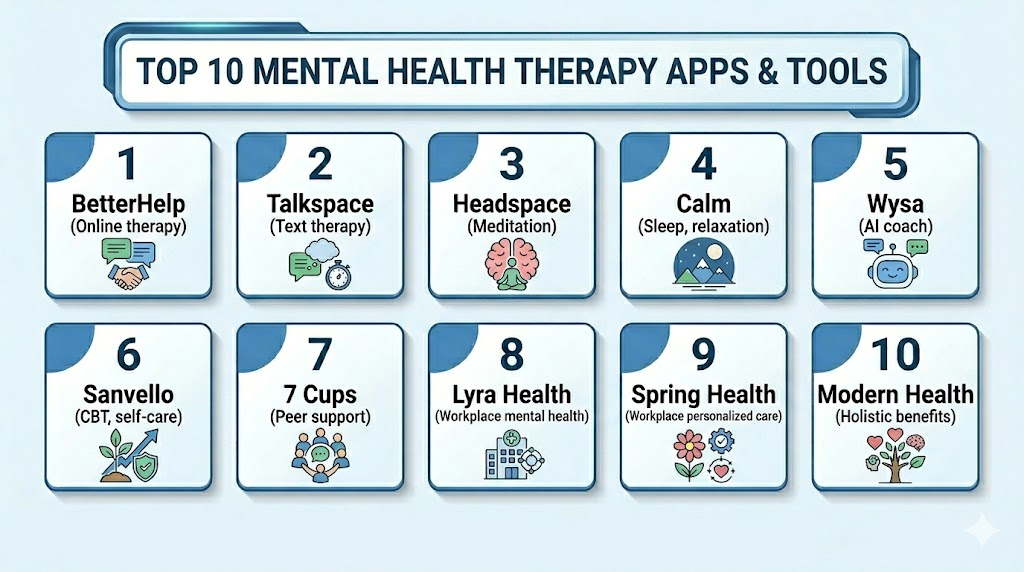
Top 10 Mental Health Therapy Apps Tools
1- BetterHelp
Short description: BetterHelp is an online therapy platform that connects users with licensed therapists through video, phone, live chat, and messaging. It is best for individuals who want flexible therapy access without visiting a traditional office.
Key Features
- Matching with licensed therapists
- Video, phone, live chat, and messaging options
- Therapist switching support
- Individual therapy focus
- Worksheets and between-session communication
- Mobile and web-based therapy access
- Flexible subscription-style therapy model
Pros
- Convenient for users who need remote therapy access
- Multiple communication formats support different comfort levels
- Therapist switching can help users find a better fit
Cons
- Not ideal for crisis care or severe psychiatric emergencies
- Insurance acceptance and reimbursement can vary
- Therapist experience and response style may vary by provider
Platforms / Deployment
Web / iOS / Android
Cloud
Security & Compliance
BetterHelp handles sensitive mental health information, but buyers and users should review current privacy and security documentation directly. Encryption, privacy controls, therapist confidentiality workflows, MFA, audit logs, RBAC, HIPAA, SOC 2, ISO 27001, and GDPR: Not publicly stated for all items.
Integrations & Ecosystem
BetterHelp is primarily a consumer-facing virtual therapy platform. Its ecosystem is focused on therapist matching, sessions, messaging, and digital therapy access rather than deep enterprise system integration.
- Therapist matching workflow
- Video and audio sessions
- Live chat and asynchronous messaging
- Mobile and web access
- Worksheets and therapy resources
- Payment and subscription workflows
Support & Community
BetterHelp provides customer support and platform help resources. Users should review therapist availability, cancellation terms, switching process, financial aid options, and support response expectations before subscribing.
2- Talkspace
Short description: Talkspace is an online therapy and psychiatry platform offering virtual mental health support through messaging, video sessions, and provider matching. It is useful for individuals, employers, payers, and organizations looking for digital behavioral health access.
Key Features
- Online therapy with licensed providers
- Messaging-based therapy support
- Video session options
- Psychiatry and medication management availability may vary
- Employer and payer solutions
- Provider matching workflows
- Digital mental health access from web and mobile apps
Pros
- Strong option for virtual therapy and messaging-based care
- Useful for organizations seeking behavioral health access at scale
- Psychiatry-related workflows may support broader care needs
Cons
- User experience may depend heavily on provider fit
- Insurance, coverage, and costs can vary
- Not a replacement for emergency or intensive psychiatric care
Platforms / Deployment
Web / iOS / Android
Cloud
Security & Compliance
Talkspace operates in a healthcare-adjacent mental health environment, but exact security controls should be validated directly. Encryption, MFA, audit logs, RBAC, HIPAA, SOC 2, ISO 27001, GDPR, and SSO: Not publicly stated for all items.
Integrations & Ecosystem
Talkspace supports individual users and organizational programs, making it relevant for employers, payers, and healthcare buyers that need virtual behavioral health access.
- Therapy and psychiatry workflows
- Employer benefit programs
- Payer and health plan workflows
- Messaging and video sessions
- Provider matching
- Reporting and program management depending on plan
Support & Community
Talkspace provides user support, provider access workflows, and organizational support for eligible buyers. Users should validate provider availability, coverage, session formats, and plan terms.
3- Headspace
Short description: Headspace is a mental wellness and mindfulness app offering meditation, sleep support, stress tools, coaching, and enterprise mental health solutions. It is best for users and organizations seeking preventive mental wellness support.
Key Features
- Guided meditation and mindfulness content
- Sleep stories, soundscapes, and relaxation tools
- Stress and anxiety self-care exercises
- Coaching and care navigation options may vary
- Employer and organization solutions
- Mobile-first user experience
- Content libraries for daily mental wellness routines
Pros
- Strong mindfulness and self-care content library
- Good fit for preventive wellness and stress management
- Useful for employers looking for scalable mental health benefits
Cons
- Not a full replacement for therapy
- Clinical depth depends on the specific service or plan
- Users needing licensed therapy should validate available care options
Platforms / Deployment
Web / iOS / Android
Cloud
Security & Compliance
Privacy and security controls should be validated directly based on the user or employer plan. MFA, encryption, audit logs, RBAC, HIPAA, SOC 2, ISO 27001, GDPR, and SSO: Not publicly stated for all items.
Integrations & Ecosystem
Headspace is well suited for personal wellness routines and employer mental health programs. It can be used as part of a broader wellness strategy, especially when mindfulness and stress support are priorities.
- Meditation and mindfulness content
- Sleep and relaxation tools
- Employer wellness programs
- Coaching and navigation depending on plan
- Mobile app engagement
- Reporting for organizations depending on contract
Support & Community
Headspace provides help resources, app support, and employer program support where applicable. Organizations should validate implementation support, reporting, privacy terms, and engagement resources.
4- Calm
Short description: Calm is a mental wellness app focused on meditation, sleep, relaxation, breathing, and stress support. It is useful for individuals and organizations that want accessible self-guided mental wellness content.
Key Features
- Guided meditation programs
- Sleep stories and soundscapes
- Breathing and relaxation exercises
- Stress reduction content
- Mindfulness programs for daily routines
- Workplace wellness options may vary
- Mobile-first wellness experience
Pros
- Strong sleep and relaxation content
- Easy for beginners to use
- Useful as a low-friction wellness companion
Cons
- Not designed as a full therapy replacement
- Limited direct clinician access compared with therapy platforms
- Advanced enterprise reporting should be validated
Platforms / Deployment
Web / iOS / Android
Cloud
Security & Compliance
Specific security and compliance controls should be confirmed directly. MFA, encryption, audit logs, RBAC, HIPAA, SOC 2, ISO 27001, GDPR, and SSO: Not publicly stated for all items.
Integrations & Ecosystem
Calm is mainly a self-guided wellness app. It can support mental health programs when used alongside therapy, coaching, employee wellness, or personal habit-building tools.
- Meditation content
- Sleep support tools
- Breathing exercises
- Workplace wellness programs depending on plan
- Mobile app reminders
- Wellness engagement reporting depending on contract
Support & Community
Calm provides app support and help resources. Enterprise buyers should confirm rollout support, privacy terms, reporting availability, and employee engagement resources.
5- Wysa
Short description: Wysa is an AI-supported mental health app that offers conversational support, CBT-style exercises, mood tracking, and coaching options. It is useful for users who want guided self-help and emotional support between formal care sessions.
Key Features
- AI chatbot for emotional support
- CBT-inspired self-help exercises
- Mood tracking and journaling
- Stress, sleep, and anxiety tools
- Coaching or human support options may vary
- Mobile-first experience
- Employer and enterprise wellness options may vary
Pros
- Helpful for low-friction self-reflection and coping exercises
- Available outside traditional appointment times
- Useful as a supplement to therapy or wellness programs
Cons
- AI chatbot is not a replacement for human therapy
- Not appropriate for emergencies or complex clinical cases
- Users should review privacy and safety boundaries carefully
Platforms / Deployment
Web / iOS / Android features may vary
Cloud
Security & Compliance
Wysa handles sensitive emotional wellness data, but buyers should validate exact controls. MFA, encryption, audit logs, RBAC, HIPAA, SOC 2, ISO 27001, GDPR, and SSO: Not publicly stated for all items.
Integrations & Ecosystem
Wysa is relevant for users and organizations seeking scalable, always-available mental wellness support. It can fit employer programs, digital health pilots, and self-guided support models.
- AI-guided conversations
- CBT-style exercises
- Mood tracking
- Human coaching options depending on plan
- Employer wellness programs
- Analytics and reporting depending on contract
Support & Community
Wysa provides app support and enterprise resources depending on customer type. Buyers should validate safety protocols, escalation guidance, privacy terms, and support availability.
6- Sanvello
Short description: Sanvello is a mental health app focused on CBT-based tools, mood tracking, mindfulness, coping exercises, and community support. It is useful for users managing stress, anxiety, and mood patterns with structured self-care tools.
Key Features
- CBT-based self-care exercises
- Mood tracking and journaling
- Guided meditations and coping tools
- Goal setting and progress tracking
- Community support features
- Coaching or therapy options may vary
- Stress and anxiety management programs
Pros
- Strong fit for structured self-help and mood awareness
- Combines CBT, mindfulness, and tracking features
- Useful for users wanting daily emotional wellness habits
Cons
- Therapy access may vary by plan or region
- Not suitable for crisis care
- Some advanced features may require paid access
Platforms / Deployment
Web / iOS / Android features may vary
Cloud
Security & Compliance
Specific controls should be validated directly. MFA, encryption, audit logs, RBAC, HIPAA, SOC 2, ISO 27001, GDPR, and SSO: Not publicly stated for all items.
Integrations & Ecosystem
Sanvello works well as a self-guided CBT and mental wellness companion. It can also fit care programs where mood tracking and coping exercises support therapy or coaching.
- Mood tracking
- CBT tools
- Guided meditations
- Community support
- Coaching or care options depending on plan
- Progress and goal tracking
Support & Community
Sanvello provides in-app support resources and self-guided educational content. Buyers should validate coaching availability, support channels, privacy practices, and program fit.
7- 7 Cups
Short description: 7 Cups is an emotional support platform offering listener-based support, community forums, and therapy options depending on availability. It is useful for users seeking peer-style emotional support and accessible conversation.
Key Features
- Trained listener support
- Community groups and forums
- Emotional support chat
- Self-help growth paths
- Therapy options may vary
- Anonymous-style support workflows
- Mobile and web access
Pros
- Low-barrier emotional support for users who need someone to talk to
- Community features can reduce isolation
- Useful for non-crisis support and peer-style engagement
Cons
- Listener support is not the same as licensed therapy
- Quality of support may vary by listener
- Not suitable for emergency or severe clinical needs
Platforms / Deployment
Web / iOS / Android
Cloud
Security & Compliance
Specific security and compliance details should be confirmed directly. MFA, encryption, audit logs, RBAC, HIPAA, SOC 2, ISO 27001, GDPR, and SSO: Not publicly stated for all items.
Integrations & Ecosystem
7 Cups is focused on emotional support, community participation, and access to conversation. It can complement therapy but should not be positioned as a full clinical system.
- Listener support
- Peer community groups
- Self-help content
- Emotional wellness chat
- Therapy options depending on availability
- Mobile and web access
Support & Community
7 Cups has a strong community-style model with listeners, forums, and self-help content. Users should understand the difference between peer support and licensed clinical care.
8- Lyra Health
Short description: Lyra Health is a workforce mental health platform that provides therapy, coaching, care navigation, and mental health benefits for employers. It is best for organizations that want structured, scalable support for employees.
Key Features
- Employer-sponsored mental health benefits
- Therapy and coaching access
- Care navigation and provider matching
- Digital mental health resources
- Reporting and utilization insights for organizations
- Support for employee mental health programs
- Enterprise administration workflows
Pros
- Strong fit for employers and enterprise benefits teams
- Combines therapy, coaching, and care navigation
- Useful for structured workforce mental health programs
Cons
- Not typically purchased directly by individual users
- Availability depends on employer or organizational access
- Pricing and reporting details vary by contract
Platforms / Deployment
Web / iOS / Android features may vary
Cloud
Security & Compliance
Enterprise healthcare privacy and security controls should be validated directly. MFA, SSO, encryption, audit logs, RBAC, HIPAA, SOC 2, ISO 27001, GDPR, and reporting privacy safeguards: Not publicly stated for all items.
Integrations & Ecosystem
Lyra Health is designed for employer benefit ecosystems and workforce mental health programs. It fits organizations that need access, engagement, utilization reporting, and care navigation.
- HR and benefits workflows
- Provider matching
- Therapy and coaching access
- Care navigation
- Organizational reporting
- Employee engagement programs
Support & Community
Lyra provides enterprise support and program resources. Employers should validate implementation, employee onboarding, utilization reporting, privacy boundaries, and account management.
9- Spring Health
Short description: Spring Health is a workplace mental health platform offering care navigation, therapy, coaching, medication management options, and employee mental health support. It is best for employers that want personalized mental health benefits.
Key Features
- Employee mental health benefit platform
- Care navigation and provider matching
- Therapy and coaching access
- Medication management options may vary
- Digital self-guided resources
- Employer reporting and analytics
- Support for enterprise mental health programs
Pros
- Strong fit for employers needing scalable mental health benefits
- Personalized care navigation can reduce access friction
- Supports multiple levels of mental health care
Cons
- Access usually depends on employer coverage
- Individual direct purchase may not be the main model
- Costs, availability, and services vary by contract
Platforms / Deployment
Web / iOS / Android features may vary
Cloud
Security & Compliance
Security and compliance controls should be validated directly. MFA, SSO, encryption, audit logs, RBAC, HIPAA, SOC 2, ISO 27001, GDPR, and employer reporting safeguards: Not publicly stated for all items.
Integrations & Ecosystem
Spring Health fits employer mental health benefits and care navigation programs. It is useful for organizations that want therapy, coaching, digital care, and analytics under one benefit model.
- HR and benefits integrations
- Therapy and coaching workflows
- Provider matching
- Medication management options depending on plan
- Utilization reporting
- Employee engagement support
Support & Community
Spring Health provides employer implementation and member support resources. Buyers should validate account support, rollout plan, reporting scope, privacy terms, and employee access model.
10- Modern Health
Short description: Modern Health is a global workplace mental health platform offering coaching, therapy, self-guided content, and mental wellness support for employees. It is best for employers seeking scalable mental health benefits across diverse teams.
Key Features
- Coaching and therapy access
- Self-guided mental wellness programs
- Employee mental health platform
- Global workforce support options may vary
- Employer dashboards and reporting
- Personalized care pathways
- Digital engagement tools
Pros
- Strong fit for employers and distributed teams
- Combines coaching, therapy, and self-guided support
- Useful for preventive and ongoing employee mental wellness
Cons
- Not primarily designed as a direct consumer therapy app
- Availability and services depend on employer plan
- Buyers should validate regional provider coverage and reporting needs
Platforms / Deployment
Web / iOS / Android features may vary
Cloud
Security & Compliance
Enterprise privacy and security controls should be confirmed directly. MFA, SSO, encryption, audit logs, RBAC, HIPAA, SOC 2, ISO 27001, GDPR, and data separation safeguards: Not publicly stated for all items.
Integrations & Ecosystem
Modern Health is designed for HR, benefits, and employee wellbeing programs. It can support organizations that want a mix of coaching, therapy, self-guided content, and workforce mental health analytics.
- HR and benefits workflows
- Coaching and therapy access
- Self-guided content
- Employee engagement tools
- Organizational reporting
- Global program support depending on plan
Support & Community
Modern Health provides enterprise support, onboarding resources, and program guidance. Employers should validate rollout support, privacy practices, reporting boundaries, and provider network coverage.
Comparison Table
| Tool Name | Best For | Platform(s) Supported | Deployment | Standout Feature | Public Rating |
|---|---|---|---|---|---|
| BetterHelp | Individuals seeking flexible online therapy | Web / iOS / Android | Cloud | Therapist matching with multiple session formats | N/A |
| Talkspace | Online therapy, psychiatry, and employer programs | Web / iOS / Android | Cloud | Therapy plus messaging-based support | N/A |
| Headspace | Mindfulness, sleep, and employer wellness | Web / iOS / Android | Cloud | Large meditation and sleep content library | N/A |
| Calm | Sleep, relaxation, and meditation support | Web / iOS / Android | Cloud | Sleep and relaxation-first wellness content | N/A |
| Wysa | AI-guided emotional support and self-care | Web / iOS / Android features vary | Cloud | AI chatbot with CBT-style exercises | N/A |
| Sanvello | CBT-based self-care and mood tracking | Web / iOS / Android features vary | Cloud | Mood tracking plus CBT and mindfulness tools | N/A |
| 7 Cups | Peer-style emotional support and community | Web / iOS / Android | Cloud | Listener and community support model | N/A |
| Lyra Health | Employer mental health benefits | Web / iOS / Android features vary | Cloud | Therapy, coaching, and care navigation for workforces | N/A |
| Spring Health | Enterprise mental health benefits | Web / iOS / Android features vary | Cloud | Personalized workplace mental health navigation | N/A |
| Modern Health | Global employee mental wellness programs | Web / iOS / Android features vary | Cloud | Coaching, therapy, and self-guided workplace support | N/A |
Evaluation & Scoring of Mental Health Therapy Apps
| Tool Name | Core 25% | Ease 15% | Integrations 15% | Security 10% | Performance 10% | Support 10% | Value 15% | Weighted Total 0–10 |
|---|---|---|---|---|---|---|---|---|
| BetterHelp | 9 | 9 | 7 | 7 | 8 | 8 | 8 | 8.10 |
| Talkspace | 9 | 8 | 8 | 8 | 8 | 8 | 7 | 8.10 |
| Headspace | 8 | 9 | 8 | 7 | 9 | 8 | 8 | 8.15 |
| Calm | 8 | 9 | 7 | 7 | 9 | 8 | 8 | 7.95 |
| Wysa | 8 | 8 | 7 | 7 | 8 | 7 | 8 | 7.65 |
| Sanvello | 8 | 8 | 7 | 7 | 8 | 7 | 8 | 7.65 |
| 7 Cups | 7 | 8 | 6 | 7 | 7 | 7 | 8 | 7.15 |
| Lyra Health | 9 | 8 | 9 | 8 | 8 | 9 | 7 | 8.25 |
| Spring Health | 9 | 8 | 9 | 8 | 8 | 9 | 7 | 8.25 |
| Modern Health | 8 | 8 | 9 | 8 | 8 | 9 | 7 | 8.00 |
Which Mental Health Therapy Apps Tool Is Right for You?
Solo / Freelancer
Individuals and freelancers should first decide whether they need licensed therapy, self-guided wellness, peer support, or daily coping tools. Someone seeking professional therapy may prefer BetterHelp or Talkspace, while someone focused on sleep, stress, or mindfulness may prefer Headspace or Calm.
Recommended direction:
- Choose BetterHelp for flexible online therapy access.
- Choose Talkspace for therapy with messaging and possible psychiatry-related workflows.
- Choose Headspace for meditation, sleep, and daily mental wellness.
- Choose Wysa or Sanvello for guided self-help and emotional support tools.
SMB
Small businesses and growing teams need affordable, easy-to-roll-out mental health support. They may not need a full enterprise benefits platform immediately, but they should still consider privacy, utilization, and employee access.
Recommended direction:
- Choose Headspace or Calm for broad wellness and stress support.
- Choose Talkspace if employees need therapy access.
- Choose Modern Health or Spring Health if the organization wants a more structured employee mental health benefit.
- Choose Wysa for scalable digital support and self-care workflows.
Mid-Market
Mid-market companies and healthcare buyers need stronger reporting, care navigation, access options, and privacy controls. They should evaluate whether employees need therapy, coaching, self-care content, manager resources, or all of these.
Recommended direction:
- Choose Lyra Health for structured therapy, coaching, and care navigation.
- Choose Spring Health for personalized workforce mental health programs.
- Choose Modern Health for coaching, therapy, and self-guided employee wellbeing.
- Choose Talkspace for therapy access and digital behavioral health support.
Enterprise
Enterprise employers, payers, and healthcare organizations need scalability, provider network coverage, reporting boundaries, privacy safeguards, integrations, and global support options. They should also evaluate clinical governance and crisis escalation workflows.
Recommended direction:
- Choose Lyra Health for enterprise mental health benefit programs.
- Choose Spring Health for personalized care navigation and workforce support.
- Choose Modern Health for global employee mental wellbeing support.
- Choose Talkspace for virtual therapy access at organizational scale.
Budget vs Premium
Budget-friendly options usually focus on self-guided meditation, mood tracking, basic exercises, or peer support. These can be useful for stress management but may not provide licensed therapy or clinical care.
Premium options often include therapist access, coaching, psychiatry-related services, enterprise reporting, care navigation, and broader support. The right choice depends on whether the buyer needs wellness content, clinical access, or a complete mental health benefit.
Feature Depth vs Ease of Use
A simple app may be better for users who only need meditation, sleep support, journaling, or daily mood tools. A deeper platform may be better for users who need therapy, care navigation, provider matching, or employer-level reporting.
Buyers should test real workflows such as signing up, matching with a provider, booking a session, sending a message, using self-help exercises, downloading reports, and changing privacy settings. The best platform should feel easy for users while still meeting clinical and privacy needs.
Integrations & Scalability
Integration matters more for employers, payers, and healthcare organizations than for individual users. Enterprise buyers should check HR benefits workflows, eligibility files, reporting dashboards, calendar access, telehealth compatibility, EHR-adjacent workflows, and SSO support.
Scalability matters if the platform will support large employee populations, multiple countries, diverse provider networks, or multiple levels of care. Buyers should evaluate provider capacity, language coverage, regional availability, and utilization reporting.
Security & Compliance Needs
Mental health data is highly sensitive, so privacy review is essential. Buyers should evaluate encryption, data sharing, user consent, access controls, MFA, SSO, audit logs, reporting boundaries, data retention, and breach response processes.
Users should also understand what information may be shared with therapists, employers, payers, or third parties. For workplace programs, employers should verify that individual-level mental health details are protected and only aggregate reporting is used where appropriate.
Frequently Asked Questions
1. What are Mental Health Therapy Apps?
Mental Health Therapy Apps are digital tools that provide access to therapy, coaching, meditation, mood tracking, CBT exercises, journaling, or emotional support.
Some connect users with licensed therapists, while others provide self-guided wellness content or AI-based support.
They are designed to make mental health support more accessible and flexible.
They should support care needs but should not replace emergency or intensive psychiatric services.
2. How much do Mental Health Therapy Apps cost?
Pricing varies depending on the app, care model, subscription plan, therapist access, coaching, or employer coverage.
Self-guided apps may cost less, while therapy platforms usually charge more because they involve licensed providers.
Employer-sponsored platforms may be paid by the organization instead of the individual user.
Buyers should compare total cost, included sessions, cancellation rules, and add-on fees.
3. Are therapy apps a replacement for in-person therapy?
Therapy apps can be a convenient alternative for many people who need flexible support, remote sessions, or easier access to therapists.
However, they may not be suitable for severe symptoms, emergencies, complex psychiatric conditions, or users who need intensive in-person care.
Some people use therapy apps alongside traditional care.
The best choice depends on clinical need, preference, provider fit, and safety considerations.
4. Are Mental Health Therapy Apps secure?
Many platforms use privacy and security controls such as encrypted communication, account protection, and secure data storage.
However, security details vary, so users and employers should review privacy policies and vendor documentation carefully.
Important controls include MFA, SSO, audit logs, encryption, consent management, and data sharing limits.
If details are unclear, mark them as “Not publicly stated” and verify directly with the vendor.
5. Can employers use these apps for employee wellbeing?
Yes, many mental health platforms offer employer programs that include therapy, coaching, care navigation, meditation, and self-guided content.
These tools can improve access to support and reduce barriers for employees who may not seek traditional care.
Employers should check privacy boundaries, aggregate reporting, provider availability, and rollout support.
Individual employee therapy details should not be exposed through employer dashboards.
6. What common mistakes should buyers avoid?
A common mistake is choosing a platform only by popularity without checking clinical model, privacy terms, provider availability, and user fit.
Buyers should also avoid assuming that meditation apps, peer support tools, AI chatbots, and licensed therapy platforms are the same.
Each category solves a different mental health need.
Demos, privacy reviews, and real user testing are important before adoption.
7. Do these apps support crisis situations?
Most mental health apps are not designed for emergency crisis response or immediate life-threatening situations.
They may provide crisis resources, escalation guidance, or emergency disclaimers, but they should not replace local emergency services.
Users at risk of self-harm or harm to others need urgent professional support.
Buyers should review crisis protocols before recommending an app widely.
8. Do Mental Health Therapy Apps include AI features?
Some apps include AI chatbots, guided prompts, self-reflection tools, mood analysis, triage support, or automated recommendations.
AI can be useful for daily support, journaling, and coping exercises, but it should not replace licensed clinical judgment.
Users should understand whether they are interacting with AI, a coach, a peer listener, or a therapist.
Clear boundaries and human escalation options are important.
9. What integrations should organizations check first?
Organizations should check SSO, HR benefits systems, eligibility files, calendar workflows, reporting dashboards, telehealth systems, and data export options.
Healthcare buyers may also need EHR-adjacent workflows, claims connections, or care navigation integrations.
Integration depth varies widely between consumer apps and enterprise platforms.
The right integration strategy depends on the buyer’s size, privacy needs, and care delivery model.
10. What alternatives exist to Mental Health Therapy Apps?
Alternatives include in-person therapy, hospital-based programs, employee assistance programs, local clinics, peer support groups, crisis lines, and community mental health services.
For some users, self-help books, meditation classes, coaching, or group therapy may also be useful.
Apps are best seen as one part of a broader mental health support system.
The right alternative depends on severity, access, budget, preference, and clinical need.
Conclusion
Mental Health Therapy Apps are becoming an important part of modern mental health support because they make therapy, coaching, mindfulness, CBT tools, mood tracking, and employee wellbeing programs easier to access. The best option depends on the user’s need: BetterHelp and Talkspace are better for online therapy access, Headspace and Calm work well for self-guided mindfulness and sleep support, Wysa and Sanvello are useful for guided digital coping tools, 7 Cups can help users seeking low-barrier emotional support, and Lyra Health, Spring Health, and Modern Health are stronger for employer-sponsored mental health programs. Buyers should not choose only by brand name or app popularity. The best next step is to shortlist two or three tools, test real user workflows, validate provider access, review privacy and security controls, check crisis support boundaries, and run a small pilot before wider rollout.

Find Trusted Cardiac Hospitals
Compare heart hospitals by city and services — all in one place.
Explore Hospitals
Mental health therapy apps are most valuable when they make evidence-based mental health support more accessible and convenient. By offering features such as guided therapy programs, mood tracking, journaling, meditation, and access to licensed professionals where available, these platforms can help users build healthier coping strategies, manage stress, and support their overall emotional well-being.