Introduction
AI Evaluation & Benchmarking Frameworks are software platforms and toolkits that help organizations measure, compare, and validate the performance, reliability, and fairness of AI models. They provide standardized metrics, benchmarks, and reporting mechanisms, ensuring models meet enterprise requirements before deployment. These frameworks are essential in operationalizing AI responsibly and consistently across diverse use cases. with the proliferation of LLMs, generative AI, and mission-critical applications, evaluation frameworks are crucial for assessing model accuracy, bias, scalability, and compliance. Organizations increasingly rely on these tools to ensure regulatory alignment, audit readiness, and robust performance across different production environments.
Real-world use cases include:
- Benchmarking NLP models for chatbots, summarization, or translation.
- Evaluating computer vision models for object detection and medical imaging.
- Testing fairness and bias in AI-driven decision systems.
- Validating reinforcement learning policies in simulations.
- Comparing AI models for cost, latency, and throughput in production.
What buyers should evaluate:
- Model type and framework compatibility (PyTorch, TensorFlow, ONNX)
- Benchmarking datasets and standards support
- Custom metric definition capabilities
- Scalability and automation of evaluation pipelines
- Integration with CI/CD and MLOps pipelines
- Reporting and visualization dashboards
- Fairness, bias, and explainability tools
- Performance monitoring and logging
- Multi-model comparison features
- Security, compliance, and audit capabilities
Best for: Data science teams, AI researchers, enterprises deploying AI at scale, and organizations with regulatory oversight. Especially valuable for fintech, healthcare, and government applications.
Not ideal for: Small-scale experiments or single-model projects where manual evaluation suffices. Lightweight evaluation scripts or cloud APIs may be adequate.
Key Trends in AI Evaluation & Benchmarking Frameworks
- Expansion of LLM and multimodal benchmarks for large AI models.
- Growing emphasis on bias detection, fairness, and explainability metrics.
- Integration with MLOps pipelines for automated model testing and validation.
- Adoption of synthetic and domain-specific datasets for more accurate evaluation.
- Support for edge and cloud-native benchmarking with distributed compute.
- AI-driven evaluation automation for faster comparisons across models.
- Enhanced visualization and reporting dashboards for stakeholders.
- Standardization of compliance and audit-ready reporting.
- Incorporation of cost, latency, and throughput metrics for production readiness.
- Frameworks supporting multi-framework model evaluation for enterprise AI portfolios.
How We Selected These Tools (Methodology)
- Evaluated market adoption and mindshare across AI research and enterprise teams.
- Reviewed feature completeness, including multi-framework support and custom metrics.
- Considered reliability and performance signals from published benchmarks and case studies.
- Assessed security posture, including access control, logging, and compliance.
- Examined integration capabilities with MLOps, CI/CD, and monitoring pipelines.
- Verified multi-model and multi-metric evaluation support.
- Considered ecosystem support, including datasets, libraries, and community adoption.
- Evaluated scalability for high-throughput benchmarking in cloud and hybrid environments.
- Reviewed cost efficiency for open-source vs managed frameworks.
- Ensured 2026+ relevance including LLM, multimodal, and generative AI evaluation.
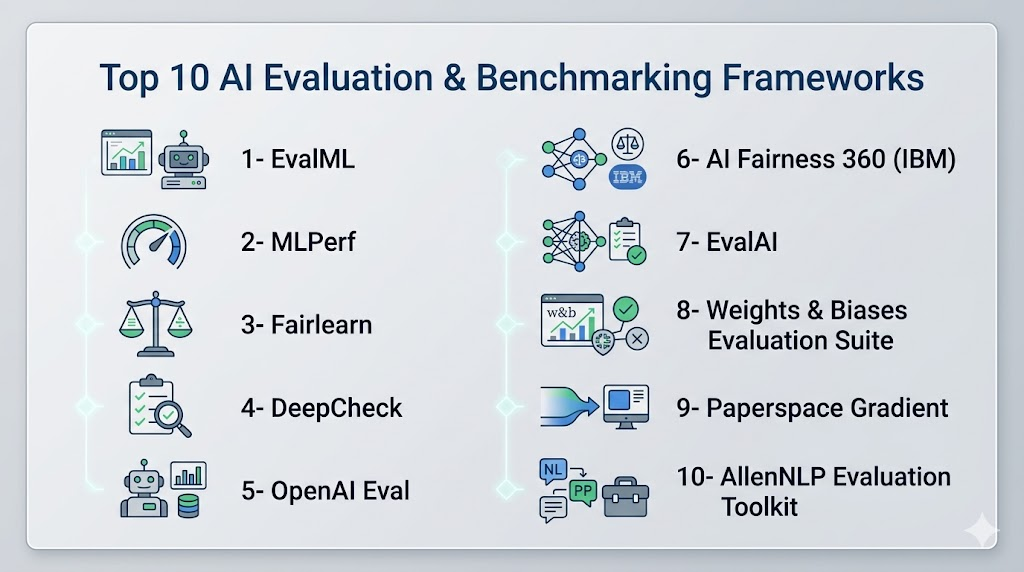
Top 10 AI Evaluation & Benchmarking Frameworks
1- EvalML
Short description: EvalML is an open-source framework for automated ML model evaluation, benchmarking, and monitoring. Best for Python-based ML workflows.
Key Features
- Automated model testing and scoring
- Support for regression, classification, and time-series models
- Customizable metrics and pipelines
- Data preprocessing and feature evaluation
- Integration with Python ML libraries
Pros
- Open-source and flexible
- Supports automated benchmarking
- Easy integration with Python workflows
Cons
- Limited support for large-scale LLMs
- Requires Python expertise
Platforms / Deployment
- Linux, macOS, Windows
- Cloud / Self-hosted / Hybrid
Security & Compliance
- Not publicly stated
Integrations & Ecosystem
Supports Pandas, scikit-learn, and TensorFlow pipelines.
- Python API
- Jupyter Notebook integration
- MLOps pipeline hooks
Support & Community
Open-source community, active GitHub repository, detailed docs.
2- MLPerf
Short description: MLPerf is a standardized benchmarking suite for AI models, widely used in research and enterprise to compare model performance across hardware.
Key Features
- Standardized datasets for image, NLP, and speech tasks
- Hardware and model-agnostic benchmarking
- Multi-framework support
- Comprehensive reporting and leaderboards
- End-to-end performance evaluation
Pros
- Industry-standard benchmark
- Supports multi-framework and multi-hardware evaluation
- Transparent and reproducible
Cons
- Focused on performance metrics only
- Less emphasis on fairness or bias
Platforms / Deployment
- Linux
- Cloud / Self-hosted
Security & Compliance
- Not publicly stated
Integrations & Ecosystem
- TensorFlow, PyTorch, ONNX support
- Hardware performance profiling
- Automated evaluation scripts
Support & Community
Industry-supported, large research community, extensive documentation.
3- Fairlearn
Short description: Open-source Python toolkit focused on fairness assessment and mitigation in AI models. Ideal for organizations prioritizing responsible AI.
Key Features
- Fairness metric computation
- Bias mitigation algorithms
- Integration with scikit-learn pipelines
- Visualization tools for fairness reports
- Supports multiple protected attributes
Pros
- Strong focus on fairness and ethics
- Easy to integrate with Python ML workflows
- Open-source and extensible
Cons
- Limited scalability for large datasets
- Does not provide performance benchmarking
Platforms / Deployment
- Linux, macOS, Windows
- Cloud / Self-hosted / Hybrid
Security & Compliance
- Not publicly stated
Integrations & Ecosystem
- Python libraries like scikit-learn, Pandas
- Jupyter Notebook reporting
- MLOps hooks
Support & Community
Active developer community, tutorials, GitHub support.
4- DeepCheck
Short description: DeepCheck is a framework for automated evaluation of ML models with a focus on data quality, robustness, and model performance.
Key Features
- Data integrity checks
- Model robustness tests
- Metric-based evaluation
- Customizable pipeline checks
- Visual dashboards
Pros
- Strong focus on model robustness
- Automated checks reduce human error
- Supports multiple model types
Cons
- Limited multi-model comparison
- Smaller community than EvalML
Platforms / Deployment
- Linux, macOS
- Cloud / Self-hosted / Hybrid
Security & Compliance
- Not publicly stated
Integrations & Ecosystem
- Python ML libraries
- Visualization tools
- CI/CD integration
Support & Community
Documentation available, community support moderate.
5- OpenAI Eval
Short description: Managed evaluation framework for large language models from OpenAI, focusing on scoring accuracy, robustness, and alignment.
Key Features
- Standardized LLM evaluation benchmarks
- Prompt-based scoring
- Human-in-the-loop evaluation
- Multi-metric scoring
- Scalable for large model deployments
Pros
- Direct integration with OpenAI models
- Scalable for LLM evaluation
- Supports human review in workflows
Cons
- Vendor-specific
- Cloud-only managed service
Platforms / Deployment
- Web, Cloud
- Cloud-only
Security & Compliance
- SOC 2, encryption in transit
Integrations & Ecosystem
- OpenAI API
- Python SDK
- Logging dashboards
Support & Community
Official OpenAI support and documentation.
6- AI Fairness 360 (IBM)
Short description: IBM’s open-source toolkit for bias detection, fairness assessment, and reporting across AI models.
Key Features
- Bias metrics and fairness metrics
- Mitigation algorithms
- Multi-framework support
- Reporting and visualization
- Supports multiple protected attributes
Pros
- Comprehensive fairness assessment
- Open-source with enterprise guidance
- Multi-model compatibility
Cons
- Limited benchmarking features
- Requires Python expertise
Platforms / Deployment
- Linux, Windows, macOS
- Cloud / Self-hosted / Hybrid
Security & Compliance
- Not publicly stated
Integrations & Ecosystem
- Python ML frameworks
- Jupyter Notebook visualization
- CI/CD pipeline integration
Support & Community
IBM documentation, active developer forums.
7- EvalAI
Short description: Open-source platform for running AI challenges, benchmarks, and competitions. Useful for benchmarking models against standardized datasets.
Key Features
- Supports multiple datasets and tasks
- Leaderboard creation
- Automated evaluation scripts
- User submissions tracking
- Metric-based scoring
Pros
- Ideal for benchmarking competitions
- Scales to multiple participants and models
- Open-source
Cons
- Focused on competition workflows
- Less suitable for production model evaluation
Platforms / Deployment
- Linux, Docker
- Cloud / Self-hosted
Security & Compliance
- Not publicly stated
Integrations & Ecosystem
- Python evaluation scripts
- APIs for submissions
- Visualization dashboards
Support & Community
Open-source community, GitHub support.
8- Weights & Biases Evaluation Suite
Short description: Provides experiment tracking, model evaluation, and benchmarking dashboards for enterprise ML workflows.
Key Features
- Experiment tracking and versioning
- Customizable metrics and evaluation pipelines
- Visual dashboards
- Multi-model comparison
- API integration with ML pipelines
Pros
- Enterprise-ready evaluation dashboards
- Tracks experiments for reproducibility
- Supports multi-model evaluation
Cons
- Paid subscription required for full features
- Learning curve for new users
Platforms / Deployment
- Web, Linux, macOS
- Cloud / Self-hosted / Hybrid
Security & Compliance
- SOC 2, encryption, RBAC
Integrations & Ecosystem
- Python and Java SDKs
- CI/CD pipeline integration
- MLOps dashboards
Support & Community
Official support and documentation, active forums.
9- Paperspace Gradient Evaluation
Short description: Cloud-based platform for benchmarking AI models on GPUs with reproducible results.
Key Features
- GPU-accelerated benchmarking
- Pre-built ML datasets
- Multi-framework support
- Logging and visualization
- Custom metric pipelines
Pros
- High-performance GPU evaluation
- Easy cloud access
- Scalable for large models
Cons
- Cloud-only
- Limited fairness/bias metrics
Platforms / Deployment
- Web, Cloud
- Cloud-only
Security & Compliance
- Not publicly stated
Integrations & Ecosystem
- TensorFlow, PyTorch, ONNX support
- Visualization tools
- CI/CD hooks
Support & Community
Official support and documentation.
10- AllenNLP Evaluation Toolkit
Short description: Open-source framework for evaluating NLP models on standardized datasets and metrics.
Key Features
- Supports multiple NLP tasks
- Standardized metric evaluation
- Dataset loaders and preprocessing
- Visualization of results
- Python API for custom evaluations
Pros
- NLP-focused evaluation
- Open-source and flexible
- Supports multiple metrics
Cons
- Limited non-NLP model support
- Smaller community than mainstream frameworks
Platforms / Deployment
- Linux, macOS, Windows
- Cloud / Self-hosted / Hybrid
Security & Compliance
- Not publicly stated
Integrations & Ecosystem
- Python ML frameworks
- Jupyter notebooks
- MLOps pipeline integration
Support & Community
Open-source community support, active GitHub repository.
Comparison Table (Top 10)
| Tool Name | Best For | Platform(s) Supported | Deployment | Standout Feature | Public Rating |
|---|---|---|---|---|---|
| EvalML | Automated ML evaluation | Linux, macOS, Windows | Cloud/Self-hosted/Hybrid | Auto scoring and pipelines | N/A |
| MLPerf | Performance benchmarking | Linux | Cloud/Self-hosted | Standardized multi-framework benchmarks | N/A |
| Fairlearn | Fairness evaluation | Linux, macOS, Windows | Cloud/Self-hosted/Hybrid | Bias detection and mitigation | N/A |
| DeepCheck | Robustness evaluation | Linux, macOS | Cloud/Self-hosted/Hybrid | Data integrity and model robustness | N/A |
| OpenAI Eval | LLM evaluation | Web, Cloud | Cloud-only | Human-in-the-loop scoring | N/A |
| AI Fairness 360 | Bias/fairness toolkit | Linux, macOS, Windows | Cloud/Self-hosted/Hybrid | Comprehensive fairness metrics | N/A |
| EvalAI | Benchmarking competitions | Linux, Docker | Cloud/Self-hosted | Leaderboards and automated evaluation | N/A |
| Weights & Biases | Enterprise evaluation | Web, Linux, macOS | Cloud/Self-hosted/Hybrid | Experiment tracking and dashboards | N/A |
| Paperspace Gradient | GPU benchmarking | Web, Cloud | Cloud-only | High-performance GPU evaluation | N/A |
| AllenNLP Toolkit | NLP evaluation | Linux, macOS, Windows | Cloud/Self-hosted/Hybrid | Standardized NLP metrics | N/A |
Evaluation & Scoring of AI Evaluation & Benchmarking Frameworks
| Tool Name | Core (25%) | Ease (15%) | Integrations (15%) | Security (10%) | Performance (10%) | Support (10%) | Value (15%) | Weighted Total |
|---|---|---|---|---|---|---|---|---|
| EvalML | 9 | 8 | 8 | 6 | 7 | 7 | 8 | 7.8 |
| MLPerf | 10 | 7 | 8 | 6 | 9 | 6 | 7 | 7.9 |
| Fairlearn | 8 | 8 | 7 | 7 | 6 | 7 | 8 | 7.4 |
| DeepCheck | 8 | 7 | 7 | 6 | 7 | 6 | 7 | 7.0 |
| OpenAI Eval | 9 | 8 | 8 | 7 | 9 | 8 | 7 | 8.2 |
| AI Fairness 360 | 8 | 7 | 7 | 7 | 6 | 7 | 7 | 7.1 |
| EvalAI | 8 | 8 | 7 | 6 | 7 | 7 | 7 | 7.2 |
| Weights & Biases | 9 | 8 | 8 | 7 | 8 | 8 | 7 | 8.0 |
| Paperspace Gradient | 8 | 7 | 7 | 6 | 9 | 6 | 7 | 7.3 |
| AllenNLP Toolkit | 8 | 8 | 7 | 6 | 7 | 7 | 7 | 7.2 |
Which AI Evaluation & Benchmarking Framework Tool Is Right for You?
Solo / Freelancer
- EvalML, AllenNLP Toolkit, and Fairlearn provide lightweight, Python-based evaluation workflows.
SMB
- DeepCheck, EvalAI, Paperspace Gradient for teams evaluating multiple models across domains.
Mid-Market
- Weights & Biases, OpenAI Eval, MLPerf for scalable benchmarking and monitoring of multiple AI pipelines.
Enterprise
- OpenAI Eval, MLPerf, Weights & Biases for robust evaluation, compliance-ready reporting, and hybrid cloud support.
Budget vs Premium
- Open-source tools (EvalML, Fairlearn, AllenNLP) reduce costs.
- Managed or enterprise-grade platforms (Weights & Biases, OpenAI Eval) provide ease of scaling and advanced reporting.
Feature Depth vs Ease of Use
- Open-source frameworks offer deeper customization.
- Managed platforms simplify dashboarding, monitoring, and enterprise deployment.
Integrations & Scalability
- Look for platforms that integrate with CI/CD, MLOps pipelines, and cloud infrastructure.
- Scalable evaluation ensures reliable benchmarking across multiple AI models.
Security & Compliance Needs
- SOC 2, RBAC, audit logs, and encryption are critical for regulated industries.
- Managed platforms often simplify compliance requirements.
Frequently Asked Questions (FAQs)
1- What is an AI evaluation and benchmarking framework?
It is a toolset to measure model performance, robustness, and fairness.
Frameworks provide standardized metrics, datasets, and reporting.
They help compare models across different tasks and environments.
Enterprises use them to validate models before production.
2- Why are evaluation frameworks important in 2026?
With LLMs and generative AI, model performance varies widely.
Frameworks ensure reliability, scalability, and compliance.
They help identify biases and optimize costs.
Evaluation is essential for high-stakes applications.
3- Can these frameworks evaluate multiple models at once?
Yes, most frameworks support multi-model comparisons.
Metrics and benchmarks can be applied across datasets.
Enables informed decisions when selecting the best model.
Some platforms provide automated ranking dashboards.
4- Do they support fairness and bias evaluation?
Many frameworks, like Fairlearn and AI Fairness 360, do.
They calculate metrics across protected attributes.
Bias mitigation strategies can be applied and monitored.
Fairness reports help with regulatory compliance.
5- Are these frameworks cloud or on-prem?
Some are cloud-native like Paperspace Gradient.
Open-source frameworks support self-hosting and hybrid setups.
Deployment choice depends on compliance and scale.
Cloud options simplify scalability for large models.
6- What metrics are typically tracked?
Accuracy, F1 score, precision, recall for classification.
ROUGE, BLEU, or perplexity for NLP models.
Throughput, latency, and resource utilization for benchmarking.
Fairness and robustness metrics for responsible AI.
7- Do these frameworks integrate with CI/CD pipelines?
Yes, integration allows automated evaluation during development.
Supports reproducible pipelines and versioned models.
Reduces manual evaluation effort and errors.
Most open-source and commercial tools provide APIs.
8- Can they handle LLMs and multimodal models?
OpenAI Eval, Weights & Biases, and MLPerf support LLMs.
Multimodal support varies by platform and framework.
Evaluation may include accuracy, alignment, or robustness metrics.
Scalability is key for large models.
9- What are common mistakes when using these frameworks?
Neglecting dataset selection or preprocessing steps.
Ignoring fairness, bias, or robustness checks.
Not integrating evaluation into CI/CD pipelines.
Failing to benchmark across multiple models for comparison.
10- What alternatives exist for small-scale model testing?
Manual evaluation scripts for individual models.
Lightweight SDKs like scikit-learn metrics for Python ML workflows.
Serverless evaluation endpoints for minimal infrastructure.
Full benchmarking frameworks are not always necessary.
Conclusion
AI Evaluation & Benchmarking Frameworks are critical for validating, comparing, and monitoring AI models in production.
They ensure accuracy, fairness, and reliability across applications and domains.
Open-source frameworks offer flexibility and customization.
Managed or enterprise-grade platforms provide scalability and reporting dashboards.
Selecting the right framework depends on model types, team size, and deployment scale.
Integration with CI/CD and MLOps pipelines ensures continuous evaluation.
Metrics for performance, robustness, and fairness are key to responsible AI deployment.
Frameworks supporting LLMs and multimodal models are increasingly important.

Find Trusted Cardiac Hospitals
Compare heart hospitals by city and services — all in one place.
Explore Hospitals
I wanted to explore AI evaluation and benchmarking frameworks, and this content helped me understand how different tools are used to measure and compare model performance.