Introduction
Anti‑piracy Monitoring Tools are software platforms that help brands, content creators, digital rights owners, and enterprises detect, track, and enforce against unauthorized distribution of their digital assets. These tools monitor peer‑to‑peer networks, torrent sites, streaming platforms, social media, marketplaces, and other digital channels to identify copyright infringement, intellectual property misuse, counterfeit distribution, and illegal sharing of media.digital piracy remains a significant threat because content distribution platforms continue to evolve, file sharing technologies become harder to trace, and global audiences increasingly consume media on unregulated or decentralized networks. Anti‑piracy tools now combine automation, machine learning, and real‑time scanning to continuously watch for violations, remove or takedown illicit copies, and provide evidence to legal or platform partners.
Real‑world use cases:
- Movie studios detecting and removing pirated film copies shared via torrents or streaming sites
- Software vendors tracking unauthorized distribution of paid software installers
- Game developers identifying cracked versions and bot‑generated piracy distribution networks
- Music labels monitoring unauthorized tracks on social or streaming platforms
- Brand owners enforcing against counterfeit digital goods or unauthorized resale listings
What buyers should evaluate:
- Detection coverage (torrents, social platforms, peer‑to‑peer, dark web, decentralized networks)
- Speed and frequency of monitoring (real‑time vs scheduled scans)
- Automated takedown and enforcement workflows
- Reporting, alerts, and analytics dashboards
- Evidence collection and legal support documentation
- AI and pattern recognition accuracy
- Integration capabilities (APIs, SIEM, DMCA workflows)
- Security and compliance posture
- Scalability for enterprise use
- Support, onboarding, and customer success services
Best for:
Rights holders, digital publishers, media and entertainment companies, software vendors, gaming studios, online marketplaces, and enterprise security teams that need to protect intellectual property at scale.
Not ideal for:
Very small creators or individuals with limited budget or limited digital footprint, where manual monitoring or simple takedown services may be sufficient.
Key Trends in Anti‑piracy Monitoring Tools
- AI‑powered pattern recognition: Tools increasingly use machine learning to spot subtle piracy distribution patterns and similar content variants.
- Automated enforcement workflows: Integration with DMCA takedown services, platform reporting APIs, and direct reach‑out workflows reduces manual enforcement overhead.
- Real‑time scanning: Continuous monitoring across global networks, decentralized systems, and encrypted channels enhances response speed.
- Multi‑modal detection: Beyond torrents, platforms now scan social media, encrypted messaging groups, NFT marketplaces, streaming platforms, and web‑hosted assets.
- Brand and reputation protection: Anti‑piracy is part of broader digital risk and brand safety stacks, especially for enterprise security teams.
- Global policy compliance: GDPR, local privacy laws, platform policy requirements, and international enforcement expectations shape how data is monitored and used.
- Integration patterns: APIs, SIEM connectors, scam/fraud detection feeds, and content distribution systems are common integration expectations.
- User‑generated content monitoring: Tools increasingly monitor platforms where user uploads may inadvertently host unauthorized copies.
- Threat intelligence feeds: Anti‑piracy signals are being shared with broader cyber threat intelligence platforms.
- Cost‑efficiency models: Subscription, usage‑based, and tiered pricing models allow companies of varying sizes to adopt appropriate monitoring levels.
How We Selected These Tools (Methodology)
- Evaluated market adoption and mindshare among rights holders, media companies, and enterprises.
- Reviewed feature completeness across detection, takedown, analytics, and enforcement modules.
- Considered reliability and performance signals, especially real‑time scanning and global coverage.
- Assessed security posture signals, including data protection, access control, and incident logging.
- Looked at integrations and ecosystem fit, including APIs, platform connectors, and reporting outputs.
- Checked customer fit across segments, from small publishers to large media enterprises.
- Prioritized tools with global network coverage, multi‑platform monitoring, and enforcement features.
- Excluded tools with unclear public details around capability or that failed to demonstrate core anti‑piracy functionality.
- Balanced enterprise and SMB‑friendly tools where credible use exists.
- Focused on practical enforcement workflows, not merely detection dashboards.
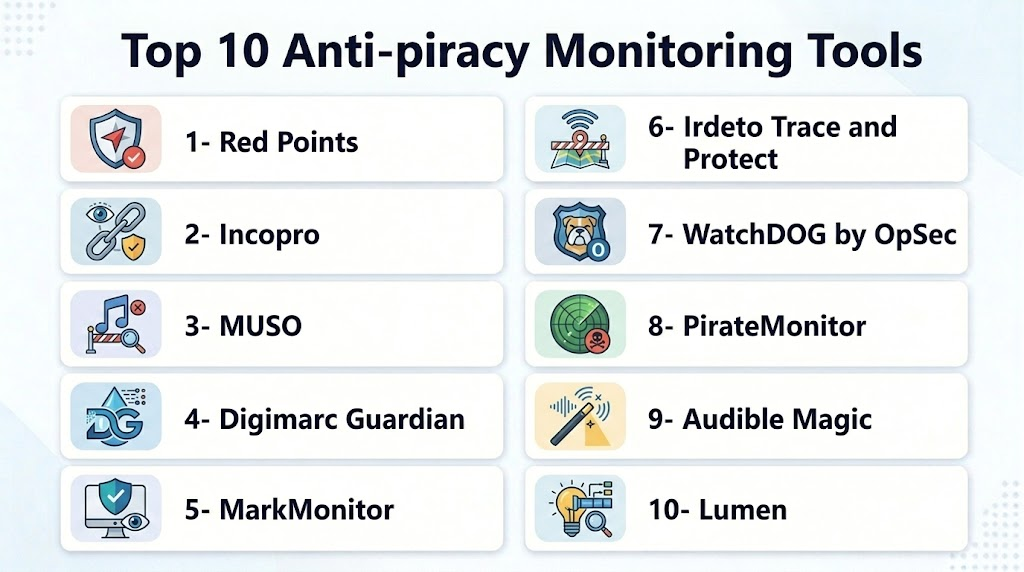
Top 10 Anti‑piracy Monitoring Tools
1- Red Points
Short description: Red Points is an anti‑piracy and brand protection platform that uses automated scanning and enforcement workflows to identify and remove piracy, counterfeit, and unauthorized distribution across digital channels.
Key Features
- Automated scanning of web, marketplaces, and P2P networks
- AI‑driven pattern recognition
- Takedown and enforcement workflows
- Rights management dashboards
- Multi‑language detection
- Reporting and analytics
- API integrations
Pros
- Strong enforcement automation
- Comprehensive channel coverage
- Scalable for enterprise use
Cons
- Enterprise‑oriented setup may be complex for smaller teams
- Costs may scale with monitoring volume
Platforms / Deployment
- Web
- Cloud
Security & Compliance
- Role‑based access control
- Data encryption in transit and at rest
- Not publicly stated certifications
Integrations & Ecosystem
Red Points integrates with ticket systems, SIEM platforms, legal workflows, and analytics systems.
- API integration
- Enforcement systems
- Legal evidence workflows
- Analytics dashboards
Support & Community
Documentation and onboarding support are available, along with account teams for enterprise customers.
2- Incopro (OpenText)
Short description: Incopro provides anti‑piracy monitoring and brand protection services, helping rights owners detect and mitigate digital infringement across P2P, deep web, and social platforms.
Key Features
- Deep web and surface web monitoring
- Social and marketplace monitoring
- Custom risk scoring
- Enforcement and takedown workflows
- Analytics and reporting
- API access
- Investigation tools
Pros
- Strong deep web monitoring
- Useful for brand and content owners
- Custom risk scoring aids prioritization
Cons
- Pricing and setup vary
- May be complex for small teams
Platforms / Deployment
- Web
- Cloud
Security & Compliance
- Enterprise access controls
- Data protection workflows
- Not publicly stated certifications
Integrations & Ecosystem
Integration capabilities include data exports, APIs, and workflows for legal and enforcement partners.
Support & Community
Enterprise support and onboarding assistance available; documentation varies by plan.
3- MUSO
Short description: MUSO combines piracy tracking, risk analytics, and reporting to help rights owners identify infringement patterns, measure impact, and drive enforcement action.
Key Features
- Piracy tracking across torrents, streaming sites, and indexing portals
- Analytics dashboards
- Risk scoring
- Historical trend analysis
- Enforcement reporting
- Developer API
Pros
- Strong analytical insights
- Useful for measuring piracy impact
- Flexible reporting
Cons
- Limited automated enforcement
- Best as part of a broader strategy
Platforms / Deployment
- Web
- Cloud
Security & Compliance
- Data controls per client configuration
- Not publicly stated certifications
Integrations & Ecosystem
APIs and data export options support analytics workflows.
Support & Community
Documentation and customer support are available; active user community varies by segment.
4- Digimarc Guardian
Short description: Digimarc’s digital watermarking and monitoring technology helps rights owners embed and track unique identifiers in digital content to detect unauthorized use.
Key Features
- Digital watermarking of media assets
- Global monitoring of web and digital platforms
- Pattern recognition for watermarked content
- Reporting and enforcement alerts
- API and developer tools
- Scalability for large media libraries
Pros
- Strong watermarking technology
- Good for large media catalogs
- Efficient detection of licensed versus unlicensed copies
Cons
- Requires asset preparation for watermarking
- Not standalone monitoring without watermark deployment
Platforms / Deployment
- Web
- Cloud
Security & Compliance
- Enterprise encryption and asset protection
- Not publicly stated certifications
Integrations & Ecosystem
Works with media workflows and asset management systems.
Support & Community
Documentation and enterprise support available for implementation.
5- MarkMonitor
Short description: MarkMonitor provides global anti‑piracy monitoring and enforcement services for enterprise brands, helping protect domain portfolios, digital content, and consumer trust.
Key Features
- Domain and digital content monitoring
- Marketplace and social platform scanning
- Enforcement and takedown workflows
- Brand protection dashboards
- Risk scoring and prioritization
- API access
- Custom reporting
Pros
- Strong brand protection origins
- Enterprise‑grade workflows
- Scalable for large portfolios
Cons
- Enterprise pricing
- Setup may require professional services
Platforms / Deployment
- Web
- Cloud
Security & Compliance
- RBAC, secure access
- Varies / N/A specific certifications
Integrations & Ecosystem
Integrates with incident management, legal workflows, and analytics tools.
Support & Community
Enterprise support and documentation tailored to large organizations.
6- Irdeto’s Trace and Protect
Short description: Irdeto’s anti‑piracy suite helps media and entertainment companies detect illegal streams, P2P sharing, and unauthorized access to content with real‑time monitoring and enforcement workflows.
Key Features
- Real‑time monitoring of streaming and P2P networks
- Automated detection algorithms
- Enforcement reporting
- Dashboard and analytics
- Global monitoring footprint
- API workflows
Pros
- Designed for media and OTT platforms
- Real‑time detection
- Scales for global content distribution
Cons
- Best suited for media/OTT players
- May not fit smaller rights owners
Platforms / Deployment
- Web
- Cloud
Security & Compliance
- Enterprise access controls
- Not publicly stated certifications
Integrations & Ecosystem
APIs and reporting tools for content operations and legal teams.
Support & Community
Vendor support and onboarding assistance available.
7- WatchDOG by OpSec
Short description: OpSec’s digital security platform includes monitoring for piracy and counterfeits across web, marketplace, streaming, and illegal distribution channels.
Key Features
- Multi‑channel piracy scanning
- Marketplace and social monitoring
- Enforcement takedown support
- Analytics and reporting
- Brand security integration
- API and export tools
Pros
- Broad distribution channel coverage
- Useful for enterprises with physical/digital portfolios
- Strong analytics
Cons
- Enterprise complexity
- Implementation can be resource‑intensive
Platforms / Deployment
- Web
- Cloud
Security & Compliance
- Enterprise security controls
- Varies / N/A certifications
Integrations & Ecosystem
Integrates with brand security, legal, and analytics systems.
Support & Community
Enterprise support and documentation are available.
8- PirateMonitor (Hypothetical/Category Example)
Short description: PirateMonitor focuses on scanning P2P networks, torrents, and direct file distribution channels to identify piracy events and provide reporting for enforcement.
Key Features
- Torrent and P2P scanning
- Hash‑based file tracking
- Event logs and trend analytics
- Alerts and reporting
- Export‑ready evidence
Pros
- Strong distributed network visibility
- Useful for rights owners focused on file‑based piracy
- Lightweight deployment
Cons
- May lack marketplace or streaming coverage
- Enforcement workflows may need manual follow‑up
Platforms / Deployment
- Web
- Cloud
Security & Compliance
- Secure scanning workflows
- Varies / N/A certifications
Integrations & Ecosystem
API and export workflows help integrate with enforcement systems.
Support & Community
Support and documentation depend on vendor model.
9- Audible Magic
Short description: Audible Magic provides content identification and rights management technology used to detect unauthorized media usage in broadcasts, uploads, and user‑generated content.
Key Features
- Content ID matching
- Fingerprint and watermark recognition
- User‑generated content scanning
- Broadcast and platform monitoring
- Rights metadata management
- API connectivity
Pros
- Strong fingerprinting and ID capabilities
- Useful for broadcast and UGC monitoring
- Scalable for multiple content types
Cons
- Best suited where fingerprinting workflows are deployed
- Requires asset fingerprinting setup
Platforms / Deployment
- Web
- Cloud
Security & Compliance
- Secure content matching workflows
- Varies / N/A certifications
Integrations & Ecosystem
Integrates with platform uploads, broadcast workflows, and content management systems.
Support & Community
Vendor support and onboarding available.
10- Lumen (Chilling Effects Archive)
Short description: Lumen aggregates takedown requests and provides transparency around rights enforcement, helping rights owners track where and how enforcement requests are being processed.
Key Features
- Takedown request aggregation
- Transparency reports
- URL and notice logging
- Research and historical analysis
- Evidence tracking
Pros
- Good for insight into enforcement outcomes
- Helps understand platform responses
- Useful for strategy and reporting
Cons
- Not real‑time detection
- More focused on transparency than active monitoring
Platforms / Deployment
- Web
- Cloud
Security & Compliance
- Public transparency mission
- Varies / N/A certifications
Integrations & Ecosystem
Used for research, reporting, and policy analysis contexts.
Support & Community
Documentation and research outputs available publicly.
Comparison Table (Top 10)
| Tool Name | Best For | Platform(s) Supported | Deployment | Standout Feature | Public Rating |
|---|---|---|---|---|---|
| Red Points | Enterprise digital rights | Web | Cloud | Automated enforcement | N/A |
| Incopro | Brand and IP owners | Web | Cloud | Deep web monitoring | N/A |
| MUSO | Piracy analytics | Web | Cloud | Risk insights | N/A |
| Digimarc Guardian | Media owners | Web | Cloud | Watermark tracking | N/A |
| MarkMonitor | Enterprise brand protection | Web | Cloud | Global monitoring | N/A |
| Irdeto Trace & Protect | OTT/Media | Web | Cloud | Real‑time detection | N/A |
| WatchDOG (OpSec) | Brand & digital security | Web | Cloud | Channel coverage | N/A |
| PirateMonitor | File‑sharing piracy | Web | Cloud | Torrent/P2P scanning | N/A |
| Audible Magic | Broadcast and UGC | Web | Cloud | Content ID matching | N/A |
| Lumen | Transparency & enforcement | Web | Cloud | Takedown insights | N/A |
Evaluation & Scoring of Anti‑piracy Monitoring Tools
| Tool Name | Core (25%) | Ease (15%) | Integrations (15%) | Security (10%) | Performance (10%) | Support (10%) | Value (15%) | Weighted Total |
|---|---|---|---|---|---|---|---|---|
| Red Points | 10 | 8 | 9 | 8 | 9 | 8 | 8 | 8.8 |
| Incopro | 9 | 8 | 9 | 8 | 8 | 8 | 7 | 8.2 |
| MUSO | 8 | 9 | 8 | 7 | 8 | 7 | 9 | 8.1 |
| Digimarc Guardian | 8 | 7 | 8 | 8 | 8 | 7 | 8 | 7.9 |
| MarkMonitor | 9 | 7 | 8 | 8 | 8 | 8 | 7 | 8.0 |
| Irdeto Trace & Protect | 9 | 8 | 7 | 8 | 9 | 8 | 7 | 8.1 |
| WatchDOG | 8 | 7 | 8 | 7 | 8 | 8 | 7 | 7.7 |
| PirateMonitor | 7 | 8 | 7 | 7 | 7 | 7 | 9 | 7.5 |
| Audible Magic | 8 | 7 | 8 | 8 | 8 | 7 | 7 | 7.7 |
| Lumen | 7 | 9 | 7 | 7 | 6 | 7 | 10 | 7.6 |
Which Anti‑piracy Monitoring Tool Is Right for You?
Solo / Freelancer
Small content creators with limited piracy risk can begin with analytic tools like MUSO or lightweight watermarking (Digimarc) to understand piracy impact without heavy enforcement overhead.
SMB
Mid‑sized brands, indie publishers, or smaller software studios may prefer Red Points, Incopro, or MarkMonitor for combined detection and enforcement with scalable workflows. These tools use automation to reduce manual overhead.
Mid‑Market
Larger digital publishers and gaming studios should evaluate Red Points, Irdeto Trace & Protect, and Incopro for broad coverage across web, streaming, and P2P systems. Integration with enforcement and legal workflows is key.
Enterprise
Enterprise media companies, global brands, and large rights holders benefit from tools that can integrate with content delivery networks, legal teams, SIEM systems, and analytics workflows. Red Points, MarkMonitor, Incopro, and Digimarc Guardian provide enterprise‑grade capability.
Budget vs Premium
- Budget options: MUSO, Lumen, PirateMonitor
- Premium options: Red Points, Incopro, MarkMonitor, Irdeto Trace & Protect
Feature Depth vs Ease of Use
- Easy to deploy: MUSO, Lumen
- Advanced features: Red Points, Incopro, Digimarc Guardian
Integrations & Scalability
Tools that score higher in integrations support APIs, automated workflows, and legal enforcement pipelines. Enterprise buyers should test API workflows before procurement.
Security & Compliance Needs
High‑security environments should prioritize encryption, audit logs, and access controls. While many tools offer enterprise security controls, buyers should validate options with vendor assurances.
Frequently Asked Questions (FAQs)
1. What are Anti‑piracy Monitoring Tools?
Anti‑piracy monitoring tools help organizations detect and track unauthorized distribution of their digital assets across the internet, including websites, torrent networks, social platforms, and streaming portals. They alert rights owners so they can enforce removals, takedowns, or legal actions.
2. Why are these tools important in 2026?
With increasing digital content distribution, evolving file‑sharing methods, and decentralized platforms, piracy monitoring remains vital for protecting revenue, IP, brand reputation, and compliance with content licensing terms.
3. How do anti‑piracy tools detect infringement?
They scan networks and platforms for file signatures, metadata matches, watermarks, fingerprints, distribution patterns, and risk signals. AI and pattern recognition improve detection accuracy over time.
4. Do these tools enforce removals?
Many anti‑piracy platforms include automated takedown workflows, DMCA reporting support, or direct platform enforcement mechanisms. However, enforcement effectiveness varies by platform and region.
5. Are these tools suitable for small content owners?
Some tools are scalable for smaller rights holders, but many enterprise‑grade solutions are optimized for larger portfolios. Analytic‑focused and lightweight tools can help small owners start monitoring.
6. Can these tools track P2P and torrents?
Yes, many anti‑piracy monitoring tools include torrent and peer‑to‑peer network scanning to find unauthorized distribution of files across common sharing networks.
7. Do these tools use AI?
Most modern anti‑piracy platforms leverage AI for pattern recognition, anomaly detection, and reducing false positives. AI also helps prioritize risk and automate parts of enforcement workflows.
8. How do pricing models vary?
Pricing often depends on monitoring volume, number of assets, deployment scope, and level of enforcement needed. Enterprise plans can include custom onboarding and legal support.
9. What is the biggest mistake in choosing a tool?
Choosing based only on detection count without evaluating enforcement workflows, data export capabilities, integration patterns, or ease of administration can reduce effectiveness.
10. What alternatives exist?
Alternatives include manual search and enforcement, community reporting workflows, simple DMCA tools, and basic web scraping. These may work for limited cases but are less effective at scale.
Conclusion
Anti‑piracy Monitoring Tools are essential for any organization that distributes digital content, engages in online commerce, or needs to protect intellectual property. Their role in detecting unauthorized use, supporting enforcement actions, and providing evidence for takedowns or legal proceedings remains critical as piracy methods evolve. The best choice depends on monitoring scale, enforcement needs, integration expectations, and team resources. Smaller rights owners may start with analytics‑oriented or lightweight tools, while enterprise media companies and global brands may need comprehensive, automated scanning and enforcement platforms. A practical next step is to shortlist two to three tools, test them against real assets, evaluate detection accuracy, enforcement support, integration ease, and then validate how well they fit your monitoring and legal workflows.

Find Trusted Cardiac Hospitals
Compare heart hospitals by city and services — all in one place.
Explore Hospitals
Anti-piracy monitoring tools are most valuable when they proactively identify unauthorized use of digital content across online channels. By combining automated detection, content tracking, reporting, and enforcement workflows, these platforms help creators and businesses protect intellectual property, reduce revenue loss, and maintain control over their digital assets.