Introduction
Social Commerce Platforms help brands sell products directly through social media channels, creator content, live shopping, shoppable videos, user-generated content, and community-driven buying journeys. Instead of forcing customers to move from a social post to a separate online store, social commerce connects product discovery, engagement, checkout, and post-purchase interaction in a smoother flow. In the current digital commerce environment, buyers often discover products through short videos, influencer recommendations, reviews, live streams, and community posts before visiting a traditional website. This makes social commerce important for e-commerce brands, D2C companies, retailers, creator-led businesses, and marketing teams that want to turn social engagement into measurable revenue.
Real-world use cases include:
- Selling products through Instagram, TikTok, Facebook, Pinterest, and YouTube.
- Turning user-generated content into shoppable galleries.
- Running creator-led and influencer-driven product campaigns.
- Hosting live shopping events with direct checkout options.
- Connecting social ads, product catalogs, and customer journeys.
Evaluation criteria buyers should consider:
- Social channel coverage
- Product catalog synchronization
- Shoppable content capabilities
- Creator and influencer commerce tools
- Live shopping support
- Analytics and attribution
- E-commerce platform integrations
- Checkout and payment experience
- Security and compliance controls
- Scalability for campaigns and global selling
Best for: E-commerce teams, D2C brands, retailers, marketplaces, growth marketers, creator-led businesses, and agencies that want to convert social engagement into sales.
Not ideal for: Businesses with no active social audience, highly regulated products with strict selling limitations, or companies that only need a basic website checkout without social discovery, creator campaigns, or content-led selling.
Key Trends in Social Commerce Platforms
- AI-powered product discovery: Platforms are increasingly using AI to recommend products, match content with shopper intent, and personalize social storefront experiences.
- Shoppable video growth: Short-form video, live streams, product demos, and creator content are becoming major sales drivers for fashion, beauty, lifestyle, gadgets, and home products.
- Creator-led commerce: Brands are moving beyond simple influencer posts and using creators as performance-based sellers, affiliate partners, and community builders.
- Unified social storefronts: Businesses want one place to manage product catalogs, content, campaigns, analytics, and social selling workflows across multiple channels.
- User-generated content commerce: Reviews, customer photos, testimonials, and creator videos are being reused as shoppable assets across websites, social feeds, ads, and email campaigns.
- Live shopping and real-time engagement: Livestream commerce continues to grow in categories where product education, urgency, and community trust influence buying decisions.
- Improved attribution models: Brands are demanding better tracking across social touchpoints, influencer links, paid ads, organic engagement, and final purchases.
- Privacy-aware targeting: As data privacy expectations rise, platforms are focusing on consent, first-party data, secure integrations, and compliant audience activation.
- Omnichannel integration: Social commerce is now connected with CRM, loyalty, email, SMS, inventory, fulfillment, customer support, and analytics tools.
- Embedded checkout and friction reduction: The strongest platforms reduce steps between product discovery and purchase, improving conversion from social engagement.
How We Selected These Tools
- We evaluated platforms with strong market adoption and visibility in social commerce, creator commerce, live shopping, social storefronts, and shoppable content.
- We prioritized tools that support real commerce workflows, not just social media scheduling or content posting.
- We considered feature completeness across product tagging, catalog syncing, analytics, creator management, UGC, live selling, and checkout support.
- We included a mix of marketplace-native platforms, e-commerce platforms, enterprise social commerce tools, and creator commerce solutions.
- We reviewed integration depth with e-commerce systems, CRM tools, advertising platforms, payment systems, and analytics environments.
- We considered usability for different segments, including solo sellers, SMB brands, mid-market retailers, and enterprise commerce teams.
- We evaluated scalability for product catalogs, social channels, creator programs, regional expansion, and campaign complexity.
- We considered security expectations such as access controls, platform permissions, payment handling, data protection, and compliance visibility.
- We avoided guessing public ratings, certifications, or pricing where information is not clearly known.
- We selected platforms that are relevant for modern social selling, content-led commerce, influencer-driven sales, and omnichannel digital commerce.
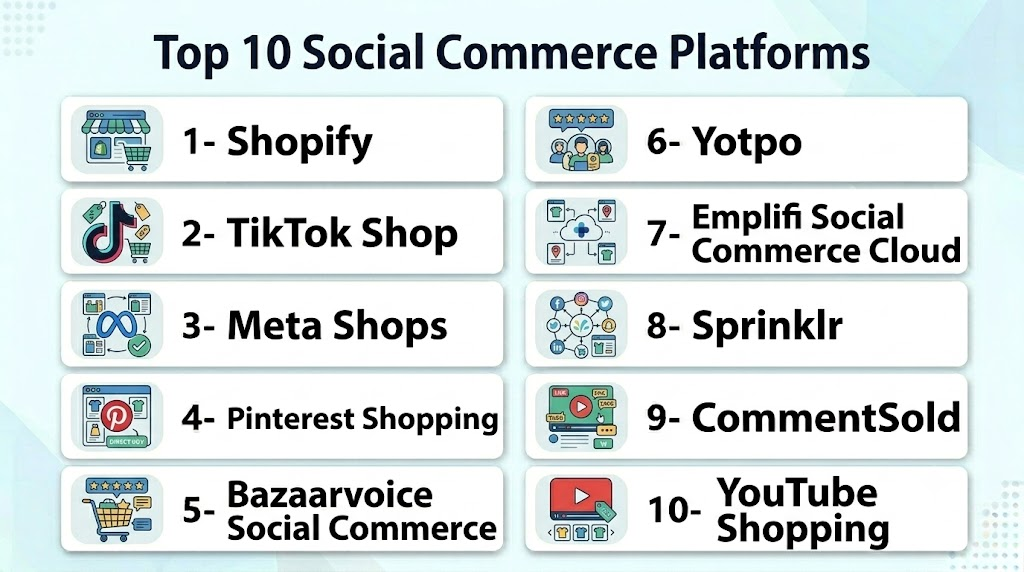
Top 10 Social Commerce Platforms Tools
1 — Shopify
Short description: Shopify is a leading e-commerce platform that supports social selling through integrations with social channels, marketplaces, product catalogs, and marketing tools. It is best for D2C brands, SMBs, and growing online retailers that want a central commerce system connected to social platforms.
Key Features
- Central product catalog and inventory management
- Social commerce sales channel integrations
- Support for product tagging and social storefront workflows
- App ecosystem for influencer, UGC, loyalty, reviews, and ads
- Checkout, payment, shipping, and tax management
- Analytics dashboard for sales and customer activity
- Scalable options for small stores and larger commerce teams
Pros
- Strong ecosystem for social commerce and e-commerce growth.
- Easy for SMBs to launch, manage, and scale online selling.
- Large app marketplace makes it flexible for different business models.
Cons
- Advanced social commerce workflows may require multiple apps.
- Costs can increase as brands add apps, themes, and premium features.
- Enterprise-level customization may require development support.
Platforms / Deployment
- Web / iOS / Android
- Cloud
Security & Compliance
Shopify provides commerce-grade security features, secure checkout, account access controls, and payment security support through its platform ecosystem. Specific compliance needs should be validated by plan, region, and implementation.
Integrations & Ecosystem
Shopify has one of the strongest ecosystems for social commerce because it connects product catalogs, checkout, marketing channels, advertising tools, and third-party apps.
- Facebook and Instagram selling
- TikTok Shop and social channel integrations
- Pinterest and marketplace integrations
- Email, SMS, reviews, loyalty, and UGC apps
- Payment, shipping, fulfillment, and analytics tools
- API and app marketplace support
Support & Community
Shopify offers documentation, help resources, partner agencies, app developer support, and a large merchant community. Support experience may vary by plan, region, and implementation complexity.
2 — TikTok Shop
Short description: TikTok Shop enables brands, creators, and sellers to sell products directly through TikTok videos, live streams, storefronts, and affiliate-style creator campaigns. It is especially useful for brands that rely on short-form video, creator trust, and impulse-friendly discovery.
Key Features
- Shoppable videos and product tagging
- Live shopping and livestream selling
- Creator affiliate and influencer selling tools
- In-app product discovery and storefront experience
- Seller dashboard for orders and product management
- Campaign and promotional tools
- Product content discovery through TikTok engagement
Pros
- Strong fit for viral product discovery and creator-led selling.
- Useful for beauty, fashion, lifestyle, gadgets, home, and impulse-buy categories.
- Reduces friction between content discovery and purchase.
Cons
- Performance depends heavily on content quality and creator strategy.
- Not suitable for every product category or regulated product type.
- Sellers must manage platform policies, fulfillment expectations, and customer service carefully.
Platforms / Deployment
- Web / iOS / Android
- Cloud
Security & Compliance
Platform security and seller policy controls are managed by TikTok. Specific seller compliance, payment handling, product eligibility, and regional rules should be verified before launch.
Integrations & Ecosystem
TikTok Shop works best when connected with commerce, creator, content, and fulfillment workflows.
- Creator affiliate workflows
- TikTok ads and campaign tools
- Seller center operations
- E-commerce catalog integrations where available
- Order and fulfillment workflows
- Analytics and performance reporting
Support & Community
TikTok provides seller resources, creator support content, and help materials. Support quality may vary by country, seller type, category, and account status.
3 — Meta Shops
Short description: Meta Shops allows businesses to create shopping experiences across Facebook and Instagram. It is best for brands that already have active communities, visual content, and paid social campaigns on Meta platforms.
Key Features
- Facebook and Instagram shop experiences
- Product catalog synchronization
- Product tagging in posts, stories, and reels
- Social advertising and retargeting support
- Messaging-based customer interaction
- Integration with commerce platforms
- Visual storefront and brand presentation tools
Pros
- Strong for visual discovery and social engagement.
- Useful for brands already investing in Facebook and Instagram marketing.
- Connects organic content, paid campaigns, and product catalogs.
Cons
- Requires strong content and community management.
- Checkout and feature availability can vary by region.
- Businesses may need external e-commerce platforms for deeper operations.
Platforms / Deployment
- Web / iOS / Android
- Cloud
Security & Compliance
Meta provides platform-level security, account controls, permissions, and business management settings. Specific compliance details depend on region, business setup, payment flow, and connected commerce tools.
Integrations & Ecosystem
Meta Shops connects with commerce platforms, catalog systems, advertising tools, and customer messaging workflows.
- Shopify and other e-commerce platform integrations
- Product catalog management
- Facebook and Instagram ads
- Messenger and Instagram messaging
- Pixel and conversion tracking
- Creator and branded content workflows
Support & Community
Meta provides business help resources, advertiser documentation, community support, and business account tools. Support experience may vary by account type and region.
4 — Pinterest Shopping
Short description: Pinterest Shopping helps brands turn visual inspiration into product discovery and purchase intent. It is useful for retail, fashion, home décor, beauty, lifestyle, wedding, food, and DIY categories where buyers plan purchases visually.
Key Features
- Product pins and shoppable visual discovery
- Catalog upload and product feed support
- Shopping ads and promoted product content
- Visual search and inspiration-led discovery
- Collections and curated shopping experiences
- Merchant tools for product visibility
- Analytics for product engagement
Pros
- Strong for intent-based product discovery.
- Works well for evergreen content and visually searchable products.
- Useful for brands with strong product photography and lifestyle content.
Cons
- Not ideal for all categories, especially low-visual or complex B2B products.
- Conversion may depend on product feed quality and content strategy.
- Requires consistent creative optimization.
Platforms / Deployment
- Web / iOS / Android
- Cloud
Security & Compliance
Pinterest provides platform-level account security, merchant policies, and ad account controls. Businesses should review product eligibility, data sharing, and regional commerce requirements.
Integrations & Ecosystem
Pinterest Shopping connects product feeds, e-commerce catalogs, advertising, and visual discovery workflows.
- Product catalog integrations
- Shopify and commerce platform support
- Shopping ads and conversion tracking
- Product pins and collections
- Analytics and campaign reporting
- Feed management tools
Support & Community
Pinterest provides business resources, merchant help materials, advertiser guidance, and creative best practices. Support varies by region, account type, and campaign setup.
5 — Bazaarvoice Social Commerce
Short description: Bazaarvoice Social Commerce helps brands collect, manage, and activate user-generated content, creator content, and social content across commerce channels. It is best for mid-market and enterprise brands that want to turn authentic content into shoppable experiences.
Key Features
- User-generated content collection and curation
- Shoppable galleries and social content activation
- Creator, influencer, and customer content workflows
- Product tagging and content rights management
- AI-assisted content moderation and organization
- Analytics for content performance
- Enterprise-focused governance and brand safety tools
Pros
- Strong fit for brands using UGC as a conversion asset.
- Helps connect social proof with product pages and campaigns.
- Useful for enterprise content governance and brand safety.
Cons
- May be more advanced than small teams need.
- Implementation can require content strategy and cross-team coordination.
- Pricing and packaging may not suit very small businesses.
Platforms / Deployment
- Web
- Cloud
Security & Compliance
Security and compliance details should be validated directly based on product package and enterprise requirements. Common enterprise expectations include role-based access, data protection, and governance workflows.
Integrations & Ecosystem
Bazaarvoice connects social content, reviews, product pages, creator campaigns, and commerce experiences.
- E-commerce platform integrations
- Social media content sourcing
- Product page and shoppable gallery integrations
- Content rights and permissions workflows
- Reviews and ratings ecosystem
- Analytics and reporting tools
Support & Community
Bazaarvoice provides enterprise support, documentation, onboarding resources, and customer success services. Support depth varies by package and account type.
6 — Yotpo
Short description: Yotpo is a commerce marketing platform that supports reviews, loyalty, SMS, email, and user-generated content workflows. It is useful for brands that want social proof, customer content, and retention tools connected to e-commerce growth.
Key Features
- Reviews and ratings management
- User-generated content collection
- Loyalty and referral program support
- SMS and email marketing workflows
- E-commerce integrations
- Customer engagement analytics
- Social proof and conversion optimization tools
Pros
- Strong for customer content and retention-led commerce.
- Good fit for Shopify and D2C brands.
- Combines multiple commerce marketing functions in one ecosystem.
Cons
- Full value may require multiple modules.
- Costs can grow as teams add more features.
- Advanced setup may need marketing operations support.
Platforms / Deployment
- Web
- Cloud
Security & Compliance
Not publicly stated for all modules in a single universal way. Buyers should validate encryption, access controls, data processing, and compliance expectations before implementation.
Integrations & Ecosystem
Yotpo integrates with e-commerce platforms and marketing tools to support conversion, retention, and social proof.
- Shopify and e-commerce platform integrations
- Reviews and UGC workflows
- Loyalty and referrals
- SMS and email marketing
- Analytics and campaign reporting
- Partner app ecosystem
Support & Community
Yotpo offers documentation, onboarding resources, support channels, and partner services. Support experience can vary by plan, module, and account tier.
7 — Emplifi Social Commerce Cloud
Short description: Emplifi Social Commerce Cloud supports social media management, customer engagement, and commerce experiences for brands that need to connect social content with sales and service. It is best for mid-market and enterprise teams managing multiple social channels.
Key Features
- Social content management and publishing
- Social commerce analytics
- Community and customer engagement tools
- Social care and messaging support
- Product and shop performance insights
- Campaign reporting
- Collaboration workflows for teams
Pros
- Good fit for brands managing social commerce and social care together.
- Useful for teams needing governance across multiple social accounts.
- Supports social analytics and customer engagement workflows.
Cons
- May be too broad for teams needing only basic product tagging.
- Enterprise-style workflows can require onboarding.
- Pricing and module availability may vary.
Platforms / Deployment
- Web
- Cloud
Security & Compliance
Not publicly stated for all modules. Buyers should validate SSO, audit logs, role-based access, data retention, and compliance requirements during procurement.
Integrations & Ecosystem
Emplifi connects social media operations, content, analytics, and customer engagement workflows.
- Social media platform integrations
- Social care and messaging integrations
- Commerce analytics workflows
- Team collaboration tools
- Reporting dashboards
- API and enterprise integration options may vary
Support & Community
Emplifi provides enterprise support, onboarding, training resources, and customer success guidance. Support availability depends on contract and package.
8 — Sprinklr
Short description: Sprinklr is an enterprise customer experience and social platform that supports social engagement, listening, customer care, marketing operations, and social commerce strategies. It is designed for large organizations managing complex customer interactions across many channels.
Key Features
- Social media management and engagement
- Customer care and messaging workflows
- Social listening and insights
- Campaign governance and collaboration
- AI-assisted analytics and workflow automation
- Enterprise reporting dashboards
- Integration with CRM and customer experience systems
Pros
- Strong for large enterprises with complex social operations.
- Combines social care, marketing, listening, and governance.
- Useful when social commerce is part of a wider customer experience strategy.
Cons
- More complex than SMB-focused social commerce tools.
- Implementation can require time, training, and change management.
- May be expensive for smaller teams.
Platforms / Deployment
- Web
- Cloud
Security & Compliance
Sprinklr commonly serves enterprise customers, but specific certifications and controls should be validated directly during procurement. Buyers should confirm SSO, access controls, audit logging, encryption, and regulatory needs.
Integrations & Ecosystem
Sprinklr integrates with social networks, CRM systems, customer care tools, analytics platforms, and enterprise workflows.
- Social media channel integrations
- CRM and customer service integrations
- AI and analytics workflows
- Content and campaign operations
- Customer care and messaging channels
- Enterprise API and workflow integrations
Support & Community
Sprinklr provides enterprise onboarding, training, documentation, support, and customer success services. Support model depends on contract, region, and implementation scope.
9 — CommentSold
Short description: CommentSold is a social commerce and live selling platform focused on helping retailers sell through live video, social comments, mobile apps, and online storefronts. It is especially useful for boutiques, fashion sellers, lifestyle brands, and live-shopping-driven retailers.
Key Features
- Live selling and livestream commerce
- Comment-based selling workflows
- Mobile app and web storefront support
- Inventory and order management
- Customer notifications and engagement tools
- Payment and checkout workflows
- Reporting for sales and customer activity
Pros
- Strong for live shopping and community-driven selling.
- Useful for retailers that sell through Facebook, Instagram, and live events.
- Helps turn engagement into immediate purchases.
Cons
- Best suited for specific retail categories.
- Requires consistent live content and community engagement.
- May not fit brands that do not use live selling.
Platforms / Deployment
- Web / iOS / Android
- Cloud
Security & Compliance
Not publicly stated in a universal way. Businesses should validate payment handling, access controls, customer data practices, and compliance needs before deployment.
Integrations & Ecosystem
CommentSold connects live commerce, social selling, customer engagement, and storefront operations.
- Social channel selling workflows
- Live video selling
- Mobile app commerce
- Inventory and order management
- Payment and checkout workflows
- Marketing and customer engagement tools
Support & Community
CommentSold provides onboarding, support resources, seller education, and customer success options. Support depth may vary by package and business size.
10 — CommentSold
Short description: CommentSold is a strong option for retailers that want to combine live commerce, social selling, and mobile-first shopping into one platform. It is particularly relevant for boutique commerce, fashion, apparel, and community-led selling models.
Key Features
- Livestream selling tools
- Comment-to-cart workflows
- Mobile app shopping experience
- Inventory syncing and order handling
- Customer engagement automation
- Checkout and payment support
- Seller analytics and performance tracking
Pros
- Excellent for live shopping and direct community selling.
- Supports mobile-first social commerce experiences.
- Helps sellers build repeat engagement through notifications and live events.
Cons
- Less suitable for B2B or complex enterprise product catalogs.
- Requires active content production and community selling.
- May overlap with existing e-commerce tools if live selling is not needed.
Platforms / Deployment
- Web / iOS / Android
- Cloud
Security & Compliance
Not publicly stated. Buyers should confirm payment security, permissions, access controls, data retention, and compliance requirements before implementation.
Integrations & Ecosystem
CommentSold fits into social selling, boutique retail, creator selling, and mobile commerce workflows.
- Social selling integrations
- Live shopping tools
- Mobile storefront experience
- Checkout and order workflows
- Customer engagement tools
- Reporting dashboards
Support & Community
CommentSold offers seller resources, onboarding support, and help documentation. Support availability may depend on the chosen plan and implementation requirements.
Comparison Table
| Tool Name | Best For | Platform(s) Supported | Deployment | Standout Feature | Public Rating |
|---|---|---|---|---|---|
| Shopify | SMBs and growing e-commerce brands | Web / iOS / Android | Cloud | Central commerce platform with social channel integrations | N/A |
| TikTok Shop | Creator-led and video-first selling | Web / iOS / Android | Cloud | Shoppable short videos and live shopping | N/A |
| Meta Shops | Facebook and Instagram selling | Web / iOS / Android | Cloud | Social storefronts across Meta platforms | N/A |
| Pinterest Shopping | Visual discovery and inspiration-led commerce | Web / iOS / Android | Cloud | Shoppable product pins and visual discovery | N/A |
| Bazaarvoice Social Commerce | Enterprise UGC and shoppable content | Web | Cloud | Social content activation and product tagging | N/A |
| Yotpo | D2C brands using reviews and UGC | Web | Cloud | Reviews, loyalty, and customer content ecosystem | N/A |
| Emplifi Social Commerce Cloud | Mid-market and enterprise social teams | Web | Cloud | Social commerce analytics and engagement workflows | N/A |
| Sprinklr | Enterprise customer experience and social commerce | Web | Cloud | Unified social engagement and customer care | N/A |
| CommentSold | Live shopping and boutique retail | Web / iOS / Android | Cloud | Comment selling and livestream commerce | N/A |
| YouTube Shopping | Video creators and product-led video commerce | Web / iOS / Android | Cloud | Product tagging inside video and creator content | N/A |
Evaluation & Scoring of Social Commerce Platforms
| Tool Name | Core (25%) | Ease (15%) | Integrations (15%) | Security (10%) | Performance (10%) | Support (10%) | Value (15%) | Weighted Total (0–10) |
|---|---|---|---|---|---|---|---|---|
| Shopify | 9 | 9 | 9 | 8 | 9 | 8 | 8 | 8.7 |
| TikTok Shop | 8 | 8 | 7 | 7 | 8 | 7 | 8 | 7.7 |
| Meta Shops | 8 | 8 | 8 | 7 | 8 | 7 | 8 | 7.8 |
| Pinterest Shopping | 7 | 8 | 7 | 7 | 8 | 7 | 8 | 7.4 |
| Bazaarvoice Social Commerce | 9 | 7 | 8 | 8 | 8 | 8 | 7 | 8.0 |
| Yotpo | 8 | 8 | 8 | 7 | 8 | 8 | 7 | 7.8 |
| Emplifi Social Commerce Cloud | 8 | 7 | 8 | 8 | 8 | 8 | 7 | 7.8 |
| Sprinklr | 9 | 6 | 9 | 8 | 9 | 8 | 6 | 8.0 |
| CommentSold | 8 | 8 | 7 | 7 | 8 | 7 | 8 | 7.7 |
| YouTube Shopping | 7 | 8 | 7 | 7 | 8 | 7 | 8 | 7.4 |
Which Social Commerce Platforms Tool Is Right for You?
Solo / Freelancer
Solo sellers, creators, and freelancers should prioritize platforms that are simple to launch and do not require heavy technical setup. TikTok Shop, Meta Shops, Pinterest Shopping, and YouTube Shopping can work well if the seller already creates content and has an engaged audience. Shopify is also a strong choice when the seller wants a central store connected to multiple social channels.
SMB
SMBs should focus on platforms that combine ease of use, catalog management, order handling, social channel selling, and affordable growth options. Shopify, Meta Shops, TikTok Shop, Yotpo, and CommentSold can be strong choices depending on the business model. For a small fashion or beauty brand, TikTok Shop and Instagram selling may be important, while a boutique retailer may benefit from CommentSold for live shopping.
Mid-Market
Mid-market brands need more control over campaigns, customer data, social content, and reporting. Shopify, Bazaarvoice, Yotpo, Emplifi, and Pinterest Shopping can support stronger content-to-commerce workflows. These businesses should evaluate whether they need UGC activation, product tagging, creator campaigns, loyalty, social proof, or multi-channel analytics.
Enterprise
Enterprise brands should prioritize governance, scalability, integrations, global support, permissions, analytics, and security controls. Sprinklr, Bazaarvoice, Emplifi, Shopify Plus-level commerce setups, and enterprise social commerce stacks are better suited for large teams. Enterprises should avoid choosing a tool only for social publishing and instead evaluate full commerce, attribution, compliance, and customer experience needs.
Budget vs Premium
Budget-conscious businesses should start with native selling tools such as TikTok Shop, Meta Shops, Pinterest Shopping, and YouTube Shopping, then connect them to a commerce backend like Shopify. Premium buyers may need Bazaarvoice, Sprinklr, Emplifi, or advanced Shopify ecosystems for governance, UGC management, large catalogs, analytics, and enterprise workflows.
Feature Depth vs Ease of Use
If ease of use matters most, Shopify, TikTok Shop, Meta Shops, and CommentSold are practical starting points. If feature depth matters more, Bazaarvoice, Sprinklr, and Emplifi offer stronger governance, analytics, social content management, and enterprise workflows. Buyers should decide whether they need a simple selling channel or a complete social commerce operating system.
Integrations & Scalability
Businesses planning to scale should evaluate product catalog syncing, CRM integrations, analytics, inventory systems, fulfillment workflows, and API availability. Shopify is strong as a commerce hub, while Bazaarvoice, Yotpo, Sprinklr, and Emplifi can extend social proof, UGC, social engagement, and enterprise workflows. Scalability depends on both the platform and the quality of your operational setup.
Security & Compliance Needs
Security-focused buyers should evaluate account permissions, SSO, audit logs, payment handling, data privacy, customer consent, and regional compliance. Enterprise teams should validate security documentation before purchase. Social commerce involves customer data, social permissions, product feeds, payments, and advertising pixels, so governance should be treated as a core buying criterion.
Frequently Asked Questions
1- What is a social commerce platform?
A social commerce platform helps businesses sell products through social media, creator content, live videos, shoppable posts, and social storefronts. It connects product discovery with buying actions so customers can move from engagement to purchase with less friction.
2- How is social commerce different from traditional e-commerce?
Traditional e-commerce usually starts with a website or marketplace search, while social commerce starts with social discovery, content, creators, and community interaction. Social commerce focuses on turning social engagement into direct product interest and sales.
3- What pricing models do social commerce platforms use?
Pricing varies by platform type. Native social selling platforms may have transaction, seller, or advertising-related costs, while enterprise platforms may use subscription, module-based, or custom pricing models. Buyers should review total cost, including apps, ads, integrations, and support.
4- How long does implementation take?
Basic social selling setup can take a few hours or days if the catalog, images, and policies are ready. Enterprise implementations involving UGC, CRM, analytics, permissions, and multiple regions may take longer because they require planning, testing, and governance.
5- What are common mistakes when choosing a social commerce platform?
A common mistake is choosing a platform only because it is popular, without checking audience fit, product category, content capability, and integration needs. Brands also fail when they ignore product feed quality, customer support workflows, fulfillment readiness, and attribution setup.
6- Are social commerce platforms secure?
Most major platforms provide standard platform security, but security depth varies by product, plan, and implementation. Buyers should validate permissions, payment handling, customer data protection, access controls, and compliance documentation before launching.
7- Can social commerce platforms integrate with Shopify, WooCommerce, or CRM tools?
Yes, many platforms integrate with e-commerce systems, CRM tools, analytics platforms, advertising accounts, and marketing automation tools. The depth of integration varies, so buyers should test catalog syncing, order flow, customer data transfer, and reporting accuracy.
8- Can small businesses use social commerce platforms?
Yes, small businesses can use tools like Shopify, TikTok Shop, Meta Shops, Pinterest Shopping, and CommentSold to start selling through social channels. The key is to begin with a manageable catalog, strong content, clear pricing, and reliable fulfillment.
9- Is live shopping necessary for social commerce?
Live shopping is useful for categories where product demonstration, urgency, and community engagement drive sales. However, it is not mandatory for every business. Many brands succeed with shoppable posts, product pins, creator content, social ads, and UGC galleries.
10- How do social commerce platforms support influencers and creators?
Some platforms provide creator storefronts, affiliate links, product tagging, campaign tracking, commission workflows, and creator performance analytics. These features help brands turn influencer content into measurable sales instead of only tracking likes or impressions.
11- What alternatives exist to social commerce platforms?
Alternatives include traditional e-commerce websites, marketplaces, affiliate platforms, influencer marketing tools, and manual social selling through messages or comments. These may work for small programs but can become difficult to manage as product catalogs, orders, and campaigns grow.
12- How should a business measure social commerce success?
Important metrics include conversion rate, revenue by channel, product views, add-to-cart rate, creator-driven sales, customer acquisition cost, repeat purchases, and return on ad spend. Brands should also track fulfillment quality and customer experience after purchase.
Conclusion
Social Commerce Platforms help businesses convert social engagement, creator content, user-generated content, live shopping, and visual discovery into measurable sales. The best platform depends on your audience, product category, content strategy, catalog size, integrations, security needs, and budget. Small businesses may start with Shopify, TikTok Shop, Meta Shops, Pinterest Shopping, or CommentSold, while mid-market and enterprise teams may need Bazaarvoice, Yotpo, Emplifi, or Sprinklr for deeper governance and analytics. No single platform is the best for every brand, because social commerce success depends on matching the tool to customer behavior and operational readiness. Before choosing, shortlist 2–3 platforms, test catalog syncing, product tagging, checkout experience, attribution, and customer support workflows. Run a pilot campaign with real products and real content before scaling across channels. A strong social commerce strategy should combine the right platform, consistent content, reliable fulfillment, and clear performance measurement.

Find Trusted Cardiac Hospitals
Compare heart hospitals by city and services — all in one place.
Explore Hospitals
Social commerce platforms are most effective when they combine product discovery, customer engagement, and seamless purchasing into a single experience. By integrating shopping features directly into social media channels, these platforms help businesses expand their reach, increase conversion rates, and create more interactive and personalized buying journeys.