Introduction
Energy Trading & Risk Management (ETRM) refers to specialized software solutions used by energy companies, utilities, commodity traders, and financial firms to manage the lifecycle of energy contracts, market risk, operational risk, logistics, pricing, accounting, and compliance. In plain English, ETRM platforms help organizations buy, sell, hedge, and settle energy products (like power, oil & gas, natural gas, renewables) while tracking associated financial, operational, and market risks. ETRM systems are mission‑critical because energy markets have become more complex and volatile, influenced by geopolitical shifts, renewable energy integration, decarbonization policies, and AI‑powered forecasting. Firms of all sizes need real‑time visibility into positions, risk exposures, pricing signals, and compliance obligations to stay competitive and avoid financial losses.
Real‑world use cases:
- Managing price risk for a utility’s power portfolio across futures, swaps, and spot markets.
- Tracking physical logistics and settlement of crude oil and refined products for an integrated energy company.
- Hedging natural gas exposure for a gas retailer using futures and options.
- Forecasting renewable generation and balancing supply/demand in a wind/solar portfolio.
- Ensuring audit‑ready compliance and reporting for regulators and auditors.
What buyers should evaluate:
- Market coverage and product support (power, gas, oil, emissions, renewables)
- Risk analytics (VaR, stress testing, scenario modeling)
- Real‑time data integration and pricing feeds
- Trading and contract lifecycle management (CLM)
- Scalability and performance
- Regulatory compliance and reporting capabilities
- Security and access controls
- Integration with accounting/ERP systems
- Ease of use and workflow automation
- Vendor support and community resources
Best for: Energy traders, risk managers, utility IT leaders, commodity portfolio analysts, mid‑market to enterprise energy firms, financial institutions with energy exposure, and integrated energy producers.
Not ideal for: Small businesses with limited trading activity, companies that only need basic spreadsheets for risk reporting, or organizations without exposure to energy markets (where general risk platforms or accounting systems suffice).
Key Trends in Energy Trading & Risk Management (ETRM)
- AI‑Driven Forecasting: Machine learning models for price prediction, demand forecasting, and volatility analysis are becoming baseline capabilities in modern ETRM systems.
- Cloud Native & Hybrid Deployment: SaaS/cloud options are increasing to support global teams, reduce infrastructure burden, and accelerate upgrades, while hybrid remains for firms with on‑premise constraints.
- Data Mesh & Interoperability: ETRM platforms are integrating with enterprise data lakes and analytics environments, enabling cross‑domain insights and AI workflows.
- Renewables & DER Integration: Support for intermittent generation, storage, and distributed energy resources (DERs) is now a requirement, not a niche feature.
- Regulatory & Compliance Automation: Automated audit trails, compliance workflows, and reporting for global regulations (e.g., REMIT, FERC, CFTC, EMIR) are more embedded.
- Real‑Time Position Management: Intraday exposure, T+0 settlement visibility, and real‑time dashboards are becoming expectations.
- Cybersecurity & Resilience: Increased focus on identity‑based security, SSO/MFA, encryption, and threat monitoring due to the critical nature of energy infrastructure.
- Blockchain for Settlement: Early adoption of distributed ledger tech for trade confirmation, settlement, and audit traceability in consortium environments.
- Advanced Risk Visualization: Interactive dashboards with scenario heatmaps, VaR analytics, and stress testing across multi‑commodity portfolios.
- API‑First Ecosystems: Vendors are exposing rich APIs to support third‑party analytics, fintech integrations, and custom dashboards.
How We Selected These Tools (Methodology)
- Evaluated market adoption and mindshare in global energy markets.
- Assessed feature completeness across trading, risk, analytics, and compliance.
- Reviewed performance and reliability signals through case evidence and user feedback themes.
- Considered security posture signals, including SSO, encryption, audit trails.
- Analyzed integration and ecosystem strength with data providers, ERP, accounting, pricing feeds, and analytics tools.
- Reviewed support and community resources, including onboarding and training.
- Balanced enterprise vs. mid‑market suitability, not strictly enterprise‑only.
- Included cloud and hybrid deployment options reflecting modern IT environments.
- Focused on risk analytics depth, not just contract management.
- Ensured breadth of market support (power, gas, oil, emissions, renewables).
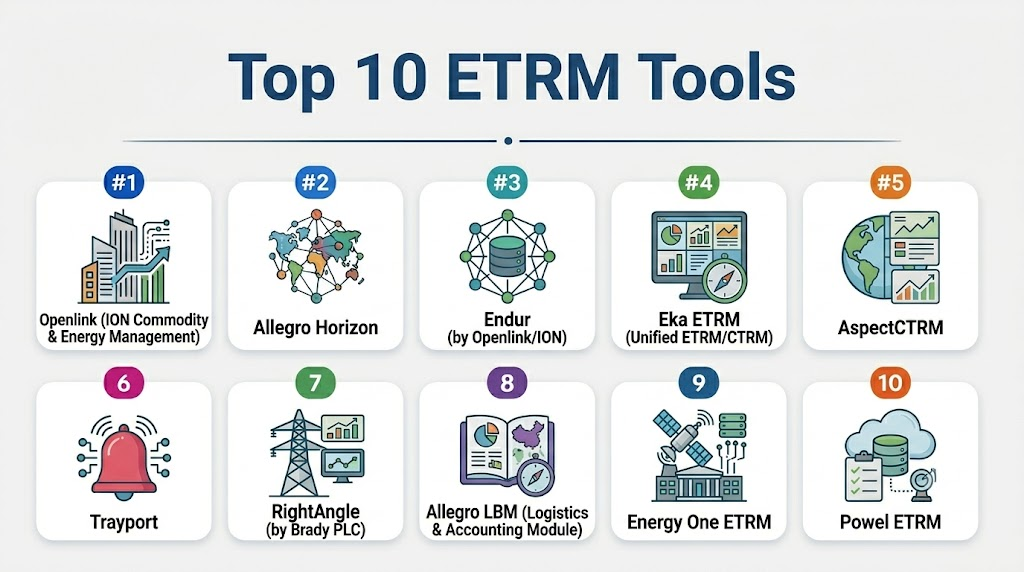
Top 10 Energy Trading & Risk Management (ETRM) Tools
1 — Openlink (ION Commodity & Energy Management)
Short description: A comprehensive ETRM/CTRM suite for enterprise energy organizations, supporting physical and financial trading, risk management, and treasury functions.
Key Features
- Integrated trading and risk modules
- Market data and pricing feed integration
- Real‑time VaR and PnL risk analytics
- Physical logistics and scheduling
- Terminals and settlement workflows
- Accounting and regulatory reporting
- Multi‑commodity support across energy markets
Pros
- Deep functionality for enterprise‑level complexity
- Broad commodity and product lifecycle coverage
Cons
- Implementation complexity can be high
- May be overkill for mid‑market users
Platforms / Deployment
- Windows / Web / Cloud / Hybrid
Security & Compliance
- Not publicly stated specific certifications; enterprise security controls, RBAC, encryption, audit logging generally supported.
Integrations & Ecosystem
Openlink typically integrates deeply with market data vendors, accounting systems, and risk analytics tools.
- Market price feeds
- ERP/accounting systems
- Exchange connectivity
- BI/analytics systems
Support & Community
Enterprise support model with dedicated services; documentation and user training available.
2 — Allegro Horizon
Short description: A full‑featured ETRM platform offering trading, risk, logistics, and analytics for power, gas, and commodities, designed for large and mid‑sized energy traders.
Key Features
- Real‑time position and PnL tracking
- Comprehensive risk analytics
- Clearing and settlement support
- Physical delivery and logistics management
- Automated reporting and alerts
- Pricing and curve modeling
- Regulatory compliance workflows
Pros
- Strong position management and risk features
- Scalable for global operations
Cons
- Customization may require professional services
- Moderate learning curve for new users
Platforms / Deployment
- Web / Windows / Cloud / Hybrid
Security & Compliance
- Not publicly stated specific certification details; supports encryption, RBAC, SSO options (varies by deployment).
Integrations & Ecosystem
Allegro supports a range of integrations with data providers and enterprise systems.
- Pricing data feeds
- Clearing houses and exchanges
- ERP/accounting systems
- Reporting and compliance systems
Support & Community
Vendor support tiers, professional services, and training programs available.
3 — Endur (by Openlink/ION)
Short description: A leading ETRM solution used by global energy and commodity trading firms for managing risk, trading, and financial reporting across multi‑commodity portfolios.
Key Features
- Comprehensive deal capture for financial/physical
- Real‑time risk and analytics
- Market data integration
- Exposure tracking and stress testing
- Multi‑currency and multi‑entity support
- Account reconciliation and P&L attribution
Pros
- Best‑in‑class risk analytics
- Trusted by global energy portfolios
Cons
- Enterprise footprint requires skilled resources
- Implementation timelines can be lengthy
Platforms / Deployment
- Web / Windows / Hybrid
Security & Compliance
- Not publicly stated details; enterprise grade security controls assumed.
Integrations & Ecosystem
- Exchange and clearing feeds
- ERP systems
- External analytics engines
- Data warehouses
Support & Community
Strong vendor support, community user groups, and expert training pathways.
4 — Eka (Unified ETRM/CTRM)
Short description: A cloud‑native ETRM platform focused on energy & commodity trading, risk analytics, logistics, and finance workflows with modern architecture.
Key Features
- Cloud‑native architecture
- Real‑time analytics and dashboards
- Physical and financial deal capture
- P&L and position reporting
- Workflow automation
- API‑first extensibility
- Integrated risk and compliance
Pros
- Modern UX and cloud scalability
- Faster deployment cycles
Cons
- May lack some deep features of legacy enterprise products
- Ecosystem integrations vary by region
Platforms / Deployment
- Web / Cloud
Security & Compliance
- SOC 2 (varies / N/A detailed statements), encryption, role‑based access.
Integrations & Ecosystem
- Market data feeds
- ERP/finance systems
- Exchange connectivity
- API extensibility
Support & Community
Cloud support tiers and onboarding programs; documentation portals available.
5 — AspectCTRM
Short description: Cloud‑based commodity and energy trading platform designed for mid‑sized trading firms with a focus on configuration flexibility and rapid deployment.
Key Features
- Deal capture and lifecycle
- Risk and position reporting
- Real‑time dashboards
- Contract and logistics management
- P&L attribution
- User‑configurable workflows
Pros
- Quick onboarding and flexible configuration
- Cost‑effective for mid‑market firms
Cons
- Not as deep in enterprise risk analytics
- Limited physical logistics features compared to larger suites
Platforms / Deployment
- Web / Cloud
Security & Compliance
- Not publicly stated specific certifications; includes common cloud security controls.
Integrations & Ecosystem
- Market feeds
- Accounting systems
- Custom API support
Support & Community
Documentation, professional services, and vendor support options.
6 — Trayport (Market Connectivity)
Short description: A connectivity and trading gateway used by energy traders to connect with multiple energy exchanges and brokers for real‑time trading.
Key Features
- Access to power and gas exchanges
- Multi‑broker connectivity
- Order routing and execution
- Market data streams
- Trade capture into backend systems
- Centralized trade repository
Pros
- Exceptional market access
- Reduces integration complexity to exchanges
Cons
- Not a full ETRM by itself; often paired with ETRM core systems
- Requires technical setup for new markets
Platforms / Deployment
- Windows / Web / Hybrid
Security & Compliance
- Not publicly stated specific certifications.
Integrations & Ecosystem
- Trading venues
- Brokers
- Backend ETRM systems
Support & Community
Vendor support and technical onboarding.
7 — RightAngle (by Brady PLC)
Short description: ETRM/CTRM product focused on mid‑market to enterprise energy/commodity traders, supporting deal capture, pricing, risk, and accounting.
Key Features
- Deal lifecycle management
- Risk analytics and reporting
- Multi‑product support
- Accounting interfaces
- Position and P&L dashboards
- Workflow automation
Pros
- Strong mid‑market fit
- Integrated accounting pipelines
Cons
- Interface seen as dated by some users
- Custom reports may require additional work
Platforms / Deployment
- Windows / Web / Hybrid
Security & Compliance
- Not publicly stated specific details.
Integrations & Ecosystem
- Accounting/ERP systems
- Market data connections
- Analytics tools
Support & Community
Vendor support contracts and professional services.
8 — Allegro LBM (Logistics & Accounting Module)
Short description: A module of the Allegro suite focused on logistics, scheduling, and accounting alignment for energy trading firms.
Key Features
- Physical logistics tracking
- Inventory valuation
- Freight and scheduling
- Accounting integration
- Cost allocation models
- Compliance checks
Pros
- Strong logistics coverage
- Tight integration with trading/risk modules
Cons
- Works best with full Allegro suite
- Limited standalone features
Platforms / Deployment
- Web / Hybrid
Security & Compliance
- Not publicly stated specific controls.
Integrations & Ecosystem
- ERP/accounting
- ETRM core modules
- Operational systems
Support & Community
Professional services and vendor support.
9 — Energy One (ETRM Module)
Short description: A component of the Energy One suite providing deal capture, pricing, risk, and reporting for energy and commodities.
Key Features
- Deal and position management
- Risk analytics
- Pricing tools
- Regulatory reporting
- Cashflow analysis
- Workflow automation
Pros
- Balanced feature set for mid‑market
- Localized support in some regions
Cons
- Smaller ecosystem than some global vendors
- Integration may require custom work
Platforms / Deployment
- Web / Hybrid
Security & Compliance
- Varies / N/A
Integrations & Ecosystem
- Market data
- ERP/finance
- Analytics platforms
Support & Community
Regional support teams and documentation.
10 — Powel ETRM
Short description: ETRM platform focused on energy companies with European market needs, blending trading, risk, and operational workflows.
Key Features
- Physical and financial deal management
- Risk analytics
- Position reporting
- Market data connectivity
- Compliance features
- Forecasting tools
Pros
- Strong fit for regional energy firms
- Integrated operational workflows
Cons
- Not as widely adopted globally
- Feature depth varies by product line
Platforms / Deployment
- Web / Hybrid
Security & Compliance
- Not publicly stated
Integrations & Ecosystem
- Exchange feeds
- ERP/accounting
- Forecasting tools
Support & Community
Vendor support and regional partners.
Comparison Table (Top 10)
| Tool Name | Best For | Platform(s) Supported | Deployment | Standout Feature | Public Rating |
|---|---|---|---|---|---|
| Openlink (ION CEM) | Enterprise energy portfolios | Web/Windows | Cloud/Hybrid | Deep risk analytics | N/A |
| Allegro Horizon | Large/mid‑market energy trading | Web/Windows | Cloud/Hybrid | Real‑time PnL & risk | N/A |
| Endur (ION) | Global trading firms | Web/Windows | Hybrid | Enterprise position management | N/A |
| Eka ETRM | Cloud native traders | Web | Cloud | Modern architecture | N/A |
| AspectCTRM | Mid‑market commodity traders | Web | Cloud | Rapid deployment | N/A |
| Trayport | Market connectivity | Web/Windows | Hybrid | Exchange access | N/A |
| RightAngle | Mid‑market energy/commodity firms | Web/Windows | Hybrid | Accounting integration | N/A |
| Allegro LBM | Logistics & accounting extension | Web | Hybrid | Logistics & scheduling | N/A |
| Energy One ETRM | Mid‑market/global | Web | Hybrid | Balanced ETRM | N/A |
| Powel ETRM | Regional energy firms | Web | Hybrid | Operational workflows | N/A |
Evaluation & Scoring of Energy Trading & Risk Management (ETRM)
| Tool Name | Core (25%) | Ease (15%) | Integrations (15%) | Security (10%) | Performance (10%) | Support (10%) | Value (15%) | Weighted Total |
|---|---|---|---|---|---|---|---|---|
| Openlink (ION CEM) | 9 | 6 | 9 | 8 | 9 | 7 | 7 | 8.3 |
| Allegro Horizon | 8 | 7 | 8 | 8 | 8 | 7 | 7 | 8.0 |
| Endur (ION) | 9 | 6 | 8 | 8 | 9 | 7 | 6 | 8.1 |
| Eka ETRM | 7 | 8 | 7 | 8 | 8 | 8 | 8 | 7.9 |
| AspectCTRM | 7 | 8 | 7 | 7 | 7 | 7 | 8 | 7.5 |
| Trayport | 6 | 7 | 9 | 7 | 7 | 7 | 7 | 7.4 |
| RightAngle | 7 | 7 | 7 | 7 | 7 | 7 | 7 | 7.3 |
| Allegro LBM | 6 | 6 | 7 | 7 | 7 | 7 | 6 | 6.6 |
| Energy One ETRM | 7 | 7 | 7 | 7 | 7 | 7 | 7 | 7.0 |
| Powel ETRM | 6 | 6 | 6 | 7 | 6 | 6 | 6 | 6.3 |
Which Energy Trading & Risk Management (ETRM) Tool Is Right for You?
Solo / Freelancer
Independent analysts or small commodity advisors may find AspectCTRM or Trayport useful for focused needs like deal capture and market access without heavy enterprise complexity.
SMB
Mid‑sized trading firms should explore Eka ETRM and AspectCTRM for cloud‑native ease and rapid deployment without sacrificing core functionality.
Mid‑Market
Firms with expanding portfolios and risk needs can lean toward Allegro Horizon or Energy One ETRM, balancing depth and manageability.
Enterprise
Large portfolios with complex risk exposures will benefit from Openlink (ION CEM) or Endur, which offer the deepest analytics, global coverage, and integration support.
Budget vs Premium
Budget‑conscious teams can evaluate cloud‑native options like Eka ETRM and AspectCTRM, while premium enterprise teams may prioritize Openlink or Allegro for end‑to‑end capabilities.
Feature Depth vs Ease of Use
Legacy players like Endur and Openlink provide deep features but higher operational overhead; cloud‑native offerings like Eka balance usability with essential ETRM functions.
Integrations & Scalability
Firms needing broad market data feeds, exchange connectivity, and ERP integration should focus on Openlink, Allegro, and Trayport.
Security & Compliance Needs
Select platforms with strong enterprise security controls and support for audit trails as default — especially for regulated markets and financial reporting.
Frequently Asked Questions (FAQs)
- What is an ETRM system?
An ETRM (Energy Trading & Risk Management) system is software that supports trading operations and risk analytics for energy commodities, covering deal capture, position management, pricing, logistics, and compliance. - How do ETRM systems handle risk?
They provide real‑time position risk analytics including VaR, stress testing, scenario modeling, exposures, and P&L attribution based on market data and deal positions. - Are ETRM tools suitable for renewables?
Modern ETRM systems increasingly support renewables, storage, and DERs, enabling forecasting and portfolio optimization for intermittent assets. - What deployment models are available?
ETRM platforms can be deployed on‑premise, in the cloud, or in hybrid environments, depending on security requirements and IT strategy. - How long does implementation take?
Implementation timelines vary widely — from weeks for lightweight cloud options to many months for enterprise deployments with customizations. - Do ETRM systems integrate with ERP?
Yes, most modern ETRM tools integrate with accounting, ERP, and financial systems to ensure reconciliation, settlement, and reporting alignment. - What role does AI play in ETRM?
AI enhances forecasting, anomaly detection, predictive risk analytics, and automated workflows, reducing manual effort and improving decisions. - How is security handled?
Enterprise ETRM solutions include RBAC, encryption, audit trails, and support for SSO/MFA, though specific certifications vary by vendor. - Can small traders benefit from ETRM?
Yes — some cloud‑native platforms are designed for smaller firms, offering essential deal capture and risk reporting without enterprise overhead. - What’s the difference between ETRM and CTRM?
ETRM focuses on energy commodities and their specific risk profiles, while CTRM can cover broader commodities (metals, agriculture) with similar lifecycle needs.
Conclusion
Selecting the right Energy Trading & Risk Management (ETRM) platform is a strategic decision shaped by market complexity, trading volume, risk tolerance, and integration needs. While enterprise players like Openlink and Endur dominate in deep analytics and global coverage, cloud‑native offerings like Eka ETRM and AspectCTRM are democratizing access with faster deployment and better user experiences. Mid‑market teams can find balance with tools like Allegro Horizon or Energy One ETRM.

Find Trusted Cardiac Hospitals
Compare heart hospitals by city and services — all in one place.
Explore Hospitals
Energy Trading Risk Management (ETRM) platforms are most valuable when they bring trading, risk analysis, scheduling, and settlement data into a single integrated system. By improving visibility into market exposure, price volatility, and operational risks, these tools help energy companies make faster, more informed trading decisions while reducing financial uncertainty.