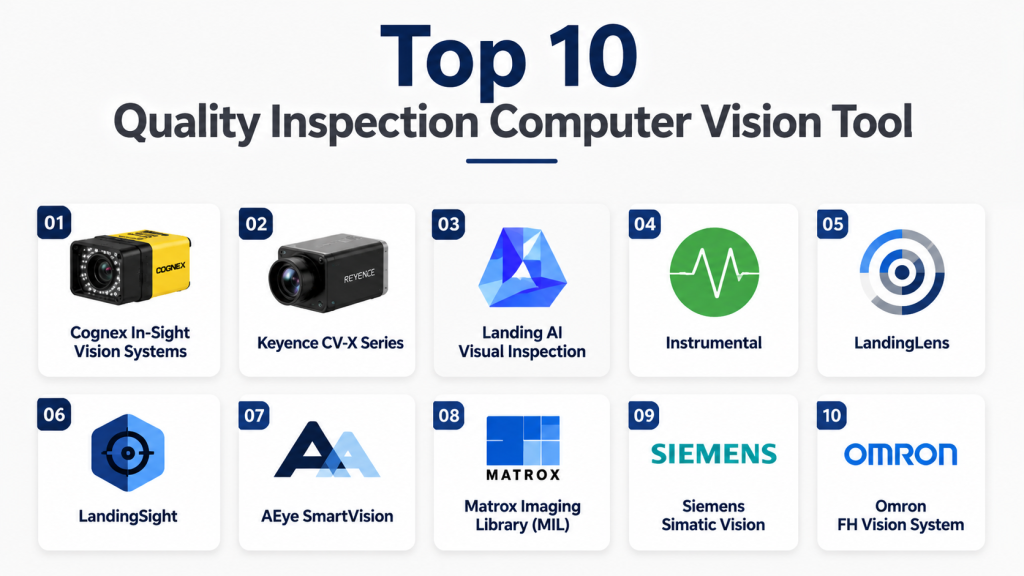
Introduction
Quality Inspection Computer Vision (CV) refers to the use of AI-powered visual analysis systems to automatically inspect products, components, or processes for defects, inconsistencies, or deviations from quality standards. Leveraging cameras, sensors, and machine learning models, these platforms can detect anomalies far faster and more accurately than traditional human inspections. manufacturing, food processing, electronics, and pharmaceuticals are increasingly relying on these tools to ensure compliance, reduce waste, and improve efficiency.
Why it matters now: With rising production speeds, tighter regulatory standards, and a global push toward Industry 4.0, automated visual quality inspection is no longer optional. Organizations need scalable, real-time, and precise solutions that integrate seamlessly into production lines while providing actionable insights.
Real-world use cases include:
- Detecting surface defects on automotive components.
- Inspecting packaging integrity in food and beverage plants.
- Identifying missing or misaligned parts in electronics assembly.
- Monitoring pharmaceutical pill coating consistency.
- Evaluating textile quality in high-volume apparel manufacturing.
Evaluation Criteria for Buyers:
- Accuracy and defect detection capability
- Real-time analysis and throughput
- Ease of integration with existing production systems
- Support for multiple camera types and lighting conditions
- AI/ML model training and customization capabilities
- Reporting and analytics functionality
- Compliance with industry standards (ISO, GMP, etc.)
- Security and access control
- Cost of deployment and scalability
- Vendor support and ecosystem
Best for: Manufacturing engineers, quality assurance managers, industrial automation teams, and medium to large enterprises across automotive, electronics, pharmaceuticals, and FMCG industries.
Not ideal for: Very low-volume production, highly artisanal products, or organizations where human visual inspection remains more cost-effective and adaptable.
Key Trends in Quality Inspection Computer Vision
- AI-Enhanced Defect Detection: Models now detect subtle surface defects, color deviations, and alignment issues with high accuracy.
- Edge Deployment: CV systems running on edge devices reduce latency, enabling real-time inspection without cloud dependence.
- Integration with IoT and MES: CV platforms increasingly connect with manufacturing execution systems for automated feedback loops.
- Hybrid Learning Models: Use of supervised and unsupervised learning improves detection of unknown defects.
- 3D Vision and Multi-Spectral Imaging: Enhances inspection capabilities for complex shapes and materials.
- Cloud Analytics and Reporting: Centralized dashboards provide enterprise-wide visibility and traceability.
- Regulatory Compliance Tracking: Systems generate audit-ready reports for ISO, GMP, and FDA requirements.
- Automation in Small and Medium Enterprises (SMEs): Affordable, modular CV solutions make AI inspection accessible to smaller production lines.
- Vendor-Neutral Integration: APIs and SDKs facilitate connectivity with robotics, PLCs, and ERP platforms.
- Sustainability and Waste Reduction: Automated quality inspection minimizes defective outputs, improving material efficiency.
How We Selected These Tools (Methodology)
- Market Adoption / Mindshare: Tools widely recognized and deployed in industrial environments.
- Feature Completeness: Comprehensive inspection, reporting, AI model customization, and integration capabilities.
- Reliability / Performance Signals: High throughput and minimal downtime in production-line testing.
- Security Posture Signals: Secure access controls, encryption, and audit trails.
- Integration / Ecosystem: Compatibility with MES, ERP, robotics, and IoT devices.
- Customer Fit Across Segments: Solutions suitable for SMEs, mid-market, and large enterprises.
- Innovation & AI Depth: Advanced machine learning, 3D imaging, and anomaly detection capabilities.
- Support & Community Strength: Vendor training, documentation, and active user communities.
- Compliance & Regulatory Support: Tools that facilitate ISO, GMP, and industry-specific standards.
Top 10 Quality Inspection Computer Vision Tools
1- Cognex In-Sight Vision Systems
Short description: Cognex In-Sight uses AI-based image analysis to inspect assembly, detect defects, and monitor product quality for manufacturing lines.
Key Features
- AI-powered defect detection and classification
- Vision sensors with deep learning capabilities
- Real-time production line monitoring
- Integration with PLCs and MES systems
- Extensive pre-trained models for common defects
- High-speed image acquisition and analysis
Pros
- Rapid deployment in industrial settings
- High accuracy with minimal false positives
- Scalable across multiple production lines
Cons
- Initial cost can be high for SMEs
- Requires trained personnel for complex setups
- Hardware-heavy compared to software-only solutions
Platforms / Deployment
- Windows / Linux / Embedded devices
- Hybrid (Edge + Cloud optional)
Security & Compliance
- Not publicly stated
Integrations & Ecosystem
Cognex integrates with major automation systems, PLCs, and cloud platforms:
- MES systems
- PLCs and robotics
- APIs for custom applications
Support & Community
Varies / Not publicly stated
2- Keyence CV-X Series
Short description: Keyence CV-X offers high-speed vision inspection with deep learning, suitable for detecting subtle defects in electronics, automotive, and food industries.
Key Features
- Deep learning-based visual inspection
- High-speed cameras for real-time defect detection
- Multi-camera synchronization for complex inspections
- Easy-to-use GUI for model training
- Automated reporting and logging
- Remote monitoring capabilities
Pros
- Fast deployment with intuitive interface
- Excellent for small and complex parts
- Robust industrial support
Cons
- Higher cost for multi-camera setups
- Limited flexibility in open-source integrations
Platforms / Deployment
- Windows / Embedded
- Hybrid (Edge with optional cloud connectivity)
Security & Compliance
- Not publicly stated
Integrations & Ecosystem
- PLCs and robotics integration
- MES systems
- SDK and API access for customization
Support & Community
Varies / Not publicly stated
3- Landing AI Visual Inspection
Short description: Landing AI provides an AI-first inspection platform that can be customized to detect specific product defects across manufacturing lines.
Key Features
- AI training with minimal labeled data
- Edge deployment with real-time alerts
- Supports multiple camera types and lighting conditions
- Detailed analytics and defect classification
- Cloud dashboard for monitoring production metrics
Pros
- Easy AI model customization
- Scalable from pilot to full production
- Strong cloud monitoring features
Cons
- Dependency on quality image data
- Subscription costs can be high for smaller lines
Platforms / Deployment
- Windows / Linux / Edge / Cloud
Security & Compliance
- Not publicly stated
Integrations & Ecosystem
- APIs for MES/ERP integration
- Compatible with industrial cameras
- SDKs for automation systems
Support & Community
- Online support and training modules
- Active user community
4- Instrumental
Short description: Instrumental offers cloud-based visual inspection software focused on electronics and high-volume assembly lines.
Key Features
- Cloud-hosted AI inspection and analytics
- Automated defect detection with historical analysis
- Integration with production management systems
- Supports multi-angle imaging and 3D inspection
- Detailed dashboards for QA teams
Pros
- Cloud-based deployment simplifies scaling
- Excellent analytics for defect trends
- Minimal on-site infrastructure needed
Cons
- Requires stable internet connectivity
- May have latency for high-speed production lines
Platforms / Deployment
- Cloud / Edge optional
Security & Compliance
- Not publicly stated
Integrations & Ecosystem
- APIs for MES/ERP
- Integration with industrial cameras
- Alerting and reporting systems
Support & Community
Varies / Not publicly stated
5- LandingLens
Short description: LandingLens delivers a visual inspection AI platform optimized for manufacturing industries needing fast and accurate defect detection.
Key Features
- Deep learning model training for custom defects
- Edge deployment for real-time line monitoring
- Multi-camera support and defect scoring
- Cloud dashboard for performance tracking
- Automated reporting and alerts
Pros
- Rapid deployment for pilot projects
- High accuracy in diverse environments
- Supports multiple product types
Cons
- Needs high-quality image capture
- Setup complexity for complex production lines
Platforms / Deployment
- Edge / Cloud
Security & Compliance
- Not publicly stated
Integrations & Ecosystem
- MES/ERP systems integration
- API access for custom workflows
- Compatible with industrial vision sensors
Support & Community
- Dedicated support channels and training resources
6- LandingSight
Short description: LandingSight leverages AI to identify product defects and process deviations, enhancing quality assurance in manufacturing lines.
Key Features
- AI-powered defect detection and classification
- Multi-camera synchronization
- Edge and cloud analytics
- Real-time alerts and dashboard reporting
- Customizable inspection rules
Pros
- Strong AI accuracy
- Flexible deployment models
- Good for both small and large production lines
Cons
- Requires initial AI model training
- Hardware integration may need technical expertise
Platforms / Deployment
- Edge / Cloud / Hybrid
Security & Compliance
- Not publicly stated
Integrations & Ecosystem
- MES and ERP APIs
- Robotics and PLC integration
- SDK for custom analytics
Support & Community
Varies / Not publicly stated
7- AEye SmartVision
Short description: AEye SmartVision focuses on high-speed visual inspection in automotive and electronics industries with AI-driven defect detection.
Key Features
- High-speed cameras and deep learning inspection
- Multi-angle and 3D defect detection
- Real-time alerts and analytics
- Easy model training interface
- Edge deployment for minimal latency
Pros
- High throughput suitable for automotive lines
- Accurate detection of subtle defects
- Scalable across multiple plants
Cons
- Hardware costs can be high
- Advanced setup requires technical staff
Platforms / Deployment
- Edge / Hybrid
Security & Compliance
- Not publicly stated
Integrations & Ecosystem
- PLC and robotics integration
- MES dashboards
- API for custom workflows
Support & Community
Varies / Not publicly stated
8- Matrox Imaging Library (MIL)
Short description: MIL is a developer-first CV library that enables custom inspection solutions across industrial applications.
Key Features
- Comprehensive image processing and AI functions
- Supports multi-camera setups and high-resolution images
- Real-time inspection capabilities
- SDK for Windows and Linux
- Extensive libraries for defect detection
Pros
- Highly flexible for custom applications
- Large developer ecosystem
- Reliable for high-speed inspection
Cons
- Requires developer expertise
- Not turnkey for non-technical teams
Platforms / Deployment
- Windows / Linux / Edge
Security & Compliance
- Not publicly stated
Integrations & Ecosystem
- APIs for robotics, PLCs, MES
- SDK for custom automation
- Compatible with industrial cameras
Support & Community
- Active developer community
- Extensive documentation
9- Siemens Simatic Vision
Short description: Simatic Vision provides integrated industrial inspection solutions with AI-enhanced image analysis for manufacturing quality control.
Key Features
- Deep learning-based defect detection
- Integration with Siemens automation stack
- Multi-camera inspection and 3D imaging
- Edge and cloud analytics
- Automated reporting and dashboard visualization
Pros
- Tight integration with Siemens industrial ecosystem
- High accuracy in industrial applications
- Scalable across production plants
Cons
- Best suited for Siemens-heavy environments
- Higher cost for small manufacturers
Platforms / Deployment
- Edge / Hybrid
Security & Compliance
- Not publicly stated
Integrations & Ecosystem
- Siemens PLCs and automation systems
- API for MES/ERP connectivity
- Robotics integration
Support & Community
- Siemens industrial support
- Community forums for users
10- Omron FH Vision System
Short description: Omron FH offers AI-enhanced inspection for high-speed assembly lines, including electronics, automotive, and precision manufacturing.
Key Features
- AI-powered defect detection
- Multi-camera and 3D inspection
- Real-time monitoring and alerts
- Easy-to-use training interface
- Edge deployment for minimal latency
Pros
- High-speed inspection suitable for mass production
- Flexible camera configurations
- Robust industrial performance
Cons
- Initial setup requires technical expertise
- Licensing costs may be high
Platforms / Deployment
- Edge / Hybrid
Security & Compliance
- Not publicly stated
Integrations & Ecosystem
- PLCs and robotics systems
- MES dashboards
- API for custom analytics
Support & Community
Varies / Not publicly stated
Comparison Table (Top 10)
| Tool Name | Best For | Platform(s) Supported | Deployment | Standout Feature | Public Rating |
|---|---|---|---|---|---|
| Cognex In-Sight | Industrial manufacturing | Windows / Linux / Embedded | Hybrid | Deep learning-based defect detection | N/A |
| Keyence CV-X Series | Electronics & automotive | Windows / Embedded | Hybrid | Multi-camera real-time inspection | N/A |
| Landing AI Visual Inspection | Manufacturing AI pilots | Windows / Linux / Edge / Cloud | Edge + Cloud | Easy AI model customization | N/A |
| Instrumental | Electronics assembly | Cloud | Cloud | Cloud-based analytics and reporting | N/A |
| LandingLens | Manufacturing lines | Edge / Cloud | Edge + Cloud | Multi-camera support and defect scoring | N/A |
| LandingSight | Production monitoring | Edge / Cloud / Hybrid | Hybrid | Real-time alerts and dashboard | N/A |
| AEye SmartVision | Automotive & electronics | Edge / Hybrid | Hybrid | High-speed multi-angle inspection | N/A |
| Matrox Imaging Library | Developer-focused inspection | Windows / Linux / Edge | Hybrid | SDK for custom applications | N/A |
| Siemens Simatic Vision | Industrial automation | Edge / Hybrid | Hybrid | Tight integration with Siemens stack | N/A |
| Omron FH Vision System | Mass production lines | Edge / Hybrid | Hybrid | Multi-camera 3D AI inspection | N/A |
Evaluation & Scoring of Quality Inspection Computer Vision
| Tool Name | Core (25%) | Ease (15%) | Integrations (15%) | Security (10%) | Performance (10%) | Support (10%) | Value (15%) | Weighted Total |
|---|---|---|---|---|---|---|---|---|
| Cognex In-Sight | 9 | 7 | 8 | 7 | 9 | 8 | 7 | 8.2 |
| Keyence CV-X Series | 8 | 8 | 7 | 7 | 9 | 8 | 7 | 8.0 |
| Landing AI Visual Inspection | 8 | 9 | 8 | 7 | 8 | 8 | 7 | 8.1 |
| Instrumental | 7 | 8 | 7 | 7 | 8 | 7 | 8 | 7.7 |
| LandingLens | 8 | 8 | 7 | 7 | 8 | 8 | 7 | 7.9 |
| LandingSight | 8 | 8 | 8 | 7 | 8 | 7 | 7 | 7.9 |
| AEye SmartVision | 8 | 7 | 7 | 7 | 9 | 7 | 7 | 7.8 |
| Matrox Imaging Library | 9 | 6 | 8 | 7 | 9 | 8 | 7 | 8.1 |
| Siemens Simatic Vision | 8 | 7 | 8 | 7 | 8 | 7 | 7 | 7.8 |
| Omron FH Vision System | 8 | 7 | 7 | 7 | 9 | 7 | 7 | 7.7 |
Which Quality Inspection Computer Vision Tool Is Right for You?
Solo / Freelancer
- Lightweight, edge-deployable solutions with minimal setup are ideal.
- Landing AI or Matrox Imaging Library may suit custom small-scale projects.
SMB
- Cloud or hybrid solutions with easy deployment and manageable costs.
- Instrumental or LandingLens offer quick ROI with moderate integration complexity.
Mid-Market
- Flexible, multi-camera inspection systems for growing production lines.
- Cognex In-Sight, Keyence CV-X, or LandingSight balance performance and scalability.
Enterprise
- High-speed, multi-site, and tightly integrated inspection systems.
- Siemens Simatic Vision or Omron FH excel in enterprise-scale automation.
Budget vs Premium
- Budget: Open-source SDKs or cloud-only solutions for low-volume or pilot projects.
- Premium: Enterprise-grade systems with advanced AI, edge processing, and deep integrations.
Feature Depth vs Ease of Use
- Feature-rich platforms may require technical setup (Matrox, Cognex).
- User-friendly platforms prioritize ease of use with slightly less flexibility (Landing AI, Instrumental).
Integrations & Scalability
- Evaluate compatibility with PLCs, robotics, MES, and ERP.
- Enterprise deployments demand systems that scale across multiple lines and plants.
Security & Compliance Needs
- Consider edge processing to minimize cloud exposure.
- Ensure audit trails, user access control, and compliance reporting are available.
Frequently Asked Questions (FAQs)
1- How do these tools handle complex or irregular defects?
AI-powered inspection systems use deep learning to identify both common and unusual defect patterns. Accuracy depends on the quality of training data and proper model tuning. Systems adapt over time to detect new anomalies. This reduces reliance on human inspection and improves consistency.
2- Can Quality Inspection CV integrate with existing MES/ERP systems?
Yes, most platforms offer APIs and SDKs for seamless integration. They allow automated feedback loops, real-time alerts, and production adjustments. Integration supports reporting and traceability. This ensures inspection data is actionable across enterprise systems.
3- What is the typical deployment model for these tools?
Deployment varies based on needs: edge-only for low-latency inspection, cloud-only for centralized analytics, or hybrid combining both. Edge deployment supports real-time production line monitoring. Cloud solutions offer centralized dashboards and historical analysis. Hybrid models balance speed, scalability, and visibility.
4- Are these systems suitable for SMEs?
Yes, many solutions are modular and cloud-based. They allow small and medium enterprises to adopt AI inspection without heavy upfront costs. Some platforms offer pay-as-you-go models. This enables SMEs to improve quality without large capital investment.
5- How accurate are these systems compared to human inspectors?
Modern CV systems often surpass human accuracy for repetitive or subtle defects. Consistency is higher and fatigue-related errors are eliminated. Training quality impacts performance significantly. Regular model updates further enhance accuracy over time.
6- What kind of cameras or sensors are required?
High-resolution industrial cameras are recommended for reliable defect detection. Lighting control and sometimes 3D or multi-spectral sensors improve inspection outcomes. Camera selection depends on product type and production speed. Proper setup ensures consistent image capture and analysis.
7- Is training data required for AI models?
Yes, custom defect detection requires labeled images from your production line. Pre-trained models may help, but optimal results need line-specific data. Quality and diversity of images affect model performance. Continuous feedback helps refine detection accuracy.
8- How scalable are these tools?
Enterprise-grade platforms support multi-camera setups across multiple lines and plants. Developer-focused SDKs are ideal for pilots or smaller deployments. Scalability depends on hardware, network, and platform architecture. Cloud and hybrid models facilitate expansion without disrupting operations.
9- What about security and compliance?
Most platforms provide standard encryption, access control, and user authentication. Compliance reporting for ISO, GMP, or FDA varies by vendor. Audit logs and role-based permissions help maintain security. Customers should verify compliance capabilities before deployment.
10- What are common mistakes when deploying CV inspection?
Common mistakes include insufficient lighting or low-quality cameras, inadequate training datasets, overlooking integration with MES/ERP systems, and ignoring edge vs cloud latency. Misalignment between production and inspection setup reduces accuracy. Proper planning and testing are essential.
Conclusion
Quality Inspection Computer Vision platforms are transforming manufacturing and production processes by providing faster, more accurate, and scalable inspection capabilities. Choosing the right system requires evaluating accuracy, integration, deployment model, scalability, and ease of use in the context of your specific production needs. For SMEs, cloud and modular solutions like Landing AI or Instrumental can deliver rapid ROI, while enterprises benefit from high-speed, multi-camera platforms like Siemens Simatic Vision or Omron

Find Trusted Cardiac Hospitals
Compare heart hospitals by city and services — all in one place.
Explore Hospitals
Computer vision for quality inspection delivers the greatest value when it complements human expertise rather than replacing it entirely. Combining automated defect detection with consistent quality standards and human verification can improve inspection accuracy, reduce waste, and increase production efficiency across manufacturing operations.