Introduction
Predictive Maintenance Platforms are software solutions designed to monitor equipment health, predict failures, and optimize maintenance schedules using data from sensors, IoT devices, and historical operational records. Unlike reactive maintenance, which fixes issues after they occur, predictive maintenance uses advanced analytics, AI, and machine learning to anticipate equipment malfunctions before they lead to costly downtime. predictive maintenance is critical due to the growing complexity of industrial machinery, higher uptime expectations, and increasing operational costs. Manufacturers, utilities, transportation operators, and energy companies are investing in these platforms to enhance efficiency, reduce unplanned downtime, and extend the lifespan of equipment.
Real-world use cases include:
- Monitoring turbine performance in power plants to schedule maintenance proactively.
- Predicting wear and tear on manufacturing robots and conveyors.
- Preventing failures in fleet vehicles through telematics and sensor data.
- Forecasting HVAC system breakdowns in commercial buildings.
- Managing condition-based maintenance for industrial pumps and compressors.
Evaluation Criteria for Buyers:
- Predictive analytics and AI capabilities.
- Sensor and IoT integration support.
- Real-time monitoring and alerting.
- Historical data management and trend analysis.
- Ease of dashboard use and reporting.
- Integration with ERP, CMMS, or MES systems.
- Scalability across facilities or fleets.
- Security, access control, and compliance.
- Deployment flexibility (cloud, edge, hybrid).
- Total cost of ownership and ROI.
Best for: Maintenance managers, industrial engineers, facility operators, fleet operators, and enterprises with high-value equipment or critical operations.
Not ideal for: Very small operations with minimal equipment, where manual or scheduled maintenance is sufficient, or where the cost of platform deployment outweighs the benefit.
Key Trends in Predictive Maintenance Platforms
- AI-driven anomaly detection: Platforms increasingly rely on machine learning to identify subtle patterns in sensor data that indicate potential failures.
- Edge computing for real-time monitoring: On-device analysis reduces latency and avoids bandwidth limitations in remote facilities.
- IoT-first architectures: Seamless integration with sensors, PLCs, and smart devices is standard for predictive analytics.
- Cloud-based analytics dashboards: Centralized visualization and remote access are growing trends, enabling multi-site operations monitoring.
- Hybrid deployment models: Combining cloud and edge computing ensures optimal balance of real-time alerts and historical analytics.
- Digital twins integration: Virtual replicas of assets are used for simulation and predictive modeling.
- Scalability for enterprise fleets: Multi-site and multi-asset monitoring is crucial for large industrial operations.
- Improved security and compliance: Platforms now prioritize encryption, RBAC, and audit-ready reporting for regulated industries.
- Predictive maintenance as a service: Subscription-based models are emerging to reduce upfront costs.
- Integration with enterprise systems: ERP, CMMS, and MES connectivity is essential for maintenance workflow automation.
How We Selected These Tools (Methodology)
- Market adoption and industry mindshare.
- Completeness of predictive maintenance features and AI capabilities.
- Reliability and performance in live operational environments.
- Security posture and regulatory compliance capabilities.
- Integration potential with ERP, CMMS, MES, and IoT ecosystems.
- Customer fit across SMEs, mid-market, and large enterprises.
- Ease of use, dashboard visualization, and reporting.
- Deployment flexibility and scalability.
- Vendor support, documentation, and training offerings.
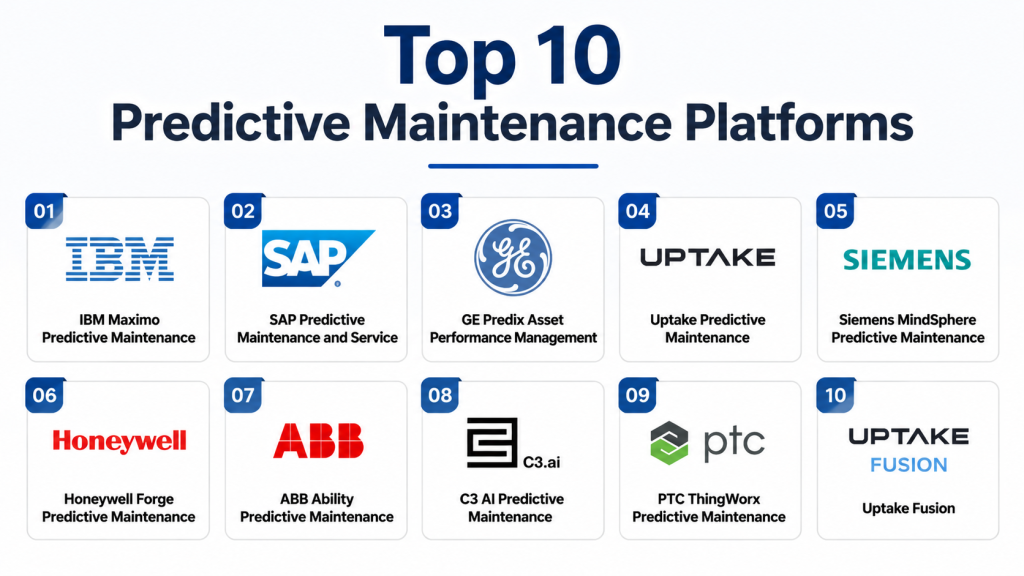
Top 10 Predictive Maintenance Platforms
1- IBM Maximo Predictive Maintenance
Short description: Provides AI-driven predictive maintenance for enterprises, focusing on asset health monitoring and failure prevention.
Key Features
- AI-based anomaly detection and failure prediction.
- IoT sensor integration for real-time monitoring.
- Analytics dashboards with historical trend analysis.
- Integration with ERP and CMMS systems.
- Workflow automation for maintenance scheduling.
- Digital twin capabilities for simulation.
Pros
- Enterprise-grade scalability and reliability.
- Strong analytics and reporting features.
- Extensive vendor support and industry adoption.
Cons
- Complex deployment for smaller operations.
- High upfront costs for licensing and setup.
- Requires trained personnel for AI model tuning.
Platforms / Deployment
- Windows / Linux / Cloud / Hybrid
Security & Compliance
- Not publicly stated
Integrations & Ecosystem
- ERP and CMMS connectivity
- IoT sensors and PLCs
- APIs for custom analytics and dashboards
Support & Community
- Dedicated enterprise support, training programs, and online community.
2- SAP Predictive Maintenance and Service
Short description: SAP PMS offers predictive analytics integrated with SAP ERP and IoT data for asset management and maintenance optimization.
Key Features
- AI-driven maintenance alerts and predictions.
- Integration with SAP ERP, MES, and IoT networks.
- Centralized dashboards with trend and performance analytics.
- Condition-based maintenance scheduling.
- Automated reporting for compliance and audits.
Pros
- Tight integration with SAP ecosystem.
- Enterprise-ready for global operations.
- Real-time monitoring with actionable insights.
Cons
- Primarily suited for SAP-heavy enterprises.
- Can be expensive for small-scale implementations.
- Complexity in configuring AI models.
Platforms / Deployment
- Cloud / Hybrid
Security & Compliance
- Not publicly stated
Integrations & Ecosystem
- SAP ERP and MES
- IoT devices
- Custom APIs
Support & Community
- Enterprise support with consulting services.
3- GE Predix Asset Performance Management
Short description: GE Predix uses IoT data and AI models to predict equipment failures, optimize maintenance, and reduce downtime.
Key Features
- Predictive analytics for asset health.
- IoT sensor integration across multiple assets.
- Failure mode analysis and risk scoring.
- Cloud-based dashboards with historical data visualization.
- Maintenance workflow automation.
Pros
- Industry-proven platform for industrial operations.
- Highly scalable for multi-site deployments.
- Strong analytics and visualization tools.
Cons
- Implementation complexity.
- Higher costs for smaller operators.
- Requires dedicated data integration resources.
Platforms / Deployment
- Cloud / Hybrid
Security & Compliance
- Not publicly stated
Integrations & Ecosystem
- IoT sensors and industrial gateways
- CMMS and ERP integration
- API-based extensibility
Support & Community
- Vendor support and community forums.
4- Uptake Predictive Maintenance
Short description: AI-driven predictive maintenance platform that provides actionable insights for industrial equipment and fleet management.
Key Features
- Real-time sensor monitoring and anomaly detection.
- Predictive algorithms for failure prevention.
- Dashboard visualization and trend analytics.
- Integration with ERP and CMMS.
- Mobile and remote access to asset health.
Pros
- Quick insights for actionable maintenance.
- Flexible deployment and SaaS model.
- Scalable across fleets and industrial plants.
Cons
- Requires high-quality sensor data for accuracy.
- May need customization for complex equipment.
- Cloud dependency can be a limitation in remote sites.
Platforms / Deployment
- Web / Cloud / Hybrid
Security & Compliance
- Not publicly stated
Integrations & Ecosystem
- IoT devices
- ERP and CMMS connectivity
- API access
Support & Community
- Support services and training available.
5- Siemens MindSphere Predictive Maintenance
Short description: Siemens MindSphere leverages IoT data and AI to anticipate equipment failures, optimize maintenance, and improve uptime.
Key Features
- AI-based predictive models for equipment health.
- Integration with industrial IoT devices and PLCs.
- Analytics dashboards and performance tracking.
- Maintenance scheduling and automation.
- Digital twin modeling.
Pros
- Strong industrial IoT ecosystem integration.
- Enterprise-grade analytics and reporting.
- Scalable for multi-plant operations.
Cons
- Best suited for Siemens-heavy environments.
- Setup and training can be complex.
- Licensing may be costly for small-scale operations.
Platforms / Deployment
- Cloud / Edge / Hybrid
Security & Compliance
- Not publicly stated
Integrations & Ecosystem
- PLCs, IoT sensors
- ERP and MES integration
- API access
Support & Community
- Siemens industrial support and training programs.
6- Honeywell Forge Predictive Maintenance
Short description: Honeywell Forge monitors industrial assets, predicts failures, and provides AI-driven maintenance insights.
Key Features
- Predictive failure detection with AI analytics.
- IoT sensor and equipment monitoring.
- Cloud-based dashboards with alerts.
- Maintenance workflow integration.
- Mobile access for remote monitoring.
Pros
- Real-time predictive insights.
- Scalable for large industrial fleets.
- Strong support and implementation expertise.
Cons
- Premium pricing.
- Complexity in setup and IoT integration.
- Best suited for large-scale deployments.
Platforms / Deployment
- Cloud / Hybrid
Security & Compliance
- Not publicly stated
Integrations & Ecosystem
- IoT sensors
- ERP, CMMS, MES integration
- API support
Support & Community
- Honeywell enterprise support and consulting.
7- ABB Ability Predictive Maintenance
Short description: ABB Ability monitors industrial machinery, predicts failures, and optimizes maintenance schedules for complex operations.
Key Features
- AI-driven predictive analytics.
- Real-time IoT data monitoring.
- Dashboard visualization and trend analysis.
- Integration with CMMS and ERP.
- Alerts and workflow automation.
Pros
- Strong industrial IoT platform.
- Scalable for multi-site operations.
- Provides actionable insights to reduce downtime.
Cons
- Higher complexity for small operators.
- Integration with legacy systems may require effort.
- Costly for smaller deployments.
Platforms / Deployment
- Cloud / Edge / Hybrid
Security & Compliance
- Not publicly stated
Integrations & Ecosystem
- IoT sensors
- ERP and CMMS systems
- API connectivity
Support & Community
- Enterprise-grade support.
8- C3 AI Predictive Maintenance
Short description: C3 AI platform offers enterprise-scale predictive maintenance with AI, analytics, and IoT integration.
Key Features
- Predictive algorithms for asset health.
- IoT and sensor data integration.
- Analytics dashboards with KPIs.
- Maintenance scheduling and alerts.
- Digital twin simulation.
Pros
- High scalability and customization.
- AI-driven insights reduce unplanned downtime.
- Flexible deployment options.
Cons
- Implementation requires expertise.
- Higher cost for SMEs.
- Complex setup for multi-site operations.
Platforms / Deployment
- Cloud / Hybrid
Security & Compliance
- Not publicly stated
Integrations & Ecosystem
- IoT devices
- ERP and CMMS integration
- API and SDK for extensibility
Support & Community
- Vendor support and consulting services.
9- PTC ThingWorx Predictive Maintenance
Short description: ThingWorx provides predictive maintenance using AI, IoT data, and analytics to optimize asset performance.
Key Features
- AI-based failure prediction.
- IoT sensor and data integration.
- Analytics dashboards and KPI tracking.
- Maintenance workflow automation.
- Digital twin support.
Pros
- Strong IoT and industrial integration.
- Scalable for enterprise deployments.
- Actionable insights for maintenance teams.
Cons
- Best for existing PTC ecosystem users.
- Implementation complexity.
- Licensing costs may be high for smaller organizations.
Platforms / Deployment
- Cloud / Edge / Hybrid
Security & Compliance
- Not publicly stated
Integrations & Ecosystem
- IoT devices and PLCs
- ERP and CMMS integration
- API and SDK access
Support & Community
- Vendor support and training.
10- Uptake Fusion
Short description: Uptake Fusion is an AI-driven predictive maintenance platform that delivers real-time insights and reduces unplanned downtime.
Key Features
- Predictive analytics for failure detection.
- Sensor and IoT integration.
- Dashboard visualization with alerts.
- Maintenance workflow automation.
- Mobile and remote access.
Pros
- Quick insights and actionable recommendations.
- Scalable across industrial operations.
- Flexible deployment options.
Cons
- Accuracy depends on quality of sensor data.
- Cloud dependency for full features.
- Customization may require professional services.
Platforms / Deployment
- Cloud / Hybrid
Security & Compliance
- Not publicly stated
Integrations & Ecosystem
- IoT sensors
- ERP and CMMS integration
- API and SDK support
Support & Community
- Vendor support and documentation.
Comparison Table (Top 10)
| Tool Name | Best For | Platform(s) Supported | Deployment | Standout Feature | Public Rating |
|---|---|---|---|---|---|
| IBM Maximo | Enterprise assets | Windows / Linux | Cloud / Hybrid | AI-based anomaly detection | N/A |
| SAP PMS | SAP customers | Cloud | Cloud / Hybrid | ERP-integrated predictive analytics | N/A |
| GE Predix | Industrial operations | Cloud | Cloud / Hybrid | Multi-asset failure prediction | N/A |
| Uptake | Industrial fleets | Web / Cloud | Cloud / Hybrid | Real-time insights | N/A |
| Siemens MindSphere | Industrial IoT | Cloud / Edge | Hybrid | Digital twin integration | N/A |
| Honeywell Forge | Industrial assets | Cloud | Cloud / Hybrid | AI-driven predictive alerts | N/A |
| ABB Ability | Manufacturing & energy | Cloud / Edge | Hybrid | Industrial IoT integration | N/A |
| C3 AI | Enterprise-scale assets | Cloud | Cloud / Hybrid | AI and analytics platform | N/A |
| PTC ThingWorx | IoT-heavy enterprises | Cloud / Edge | Hybrid | IoT sensor analytics | N/A |
| Uptake Fusion | Industrial operations | Cloud | Cloud / Hybrid | Predictive maintenance dashboard | N/A |
Evaluation & Scoring of Predictive Maintenance Platforms
| Tool Name | Core (25%) | Ease (15%) | Integrations (15%) | Security (10%) | Performance (10%) | Support (10%) | Value (15%) | Weighted Total |
|---|---|---|---|---|---|---|---|---|
| IBM Maximo | 9 | 7 | 8 | 7 | 9 | 8 | 7 | 8.2 |
| SAP PMS | 8 | 8 | 8 | 7 | 8 | 7 | 7 | 7.9 |
| GE Predix | 8 | 7 | 7 | 7 | 8 | 7 | 7 | 7.7 |
| Uptake | 8 | 8 | 7 | 7 | 8 | 7 | 7 | 7.8 |
| Siemens MindSphere | 8 | 7 | 8 | 7 | 8 | 7 | 7 | 7.8 |
| Honeywell Forge | 8 | 7 | 7 | 7 | 8 | 7 | 7 | 7.7 |
| ABB Ability | 8 | 7 | 7 | 7 | 8 | 7 | 7 | 7.7 |
| C3 AI | 9 | 7 | 8 | 7 | 8 | 7 | 7 | 7.9 |
| PTC ThingWorx | 8 | 7 | 8 | 7 | 8 | 7 | 7 | 7.8 |
| Uptake Fusion | 8 | 8 | 7 | 7 | 8 | 7 | 7 | 7.8 |
Which Predictive Maintenance Tool Is Right for You?
Solo / Freelancer
- Lightweight SaaS or cloud-only platforms.
- Uptake Fusion or C3 AI may suit smaller operations or pilots.
SMB
- Cloud-based solutions with easy setup and dashboards.
- IBM Maximo or Uptake offer mid-scale deployment flexibility.
Mid-Market
- Flexible multi-site monitoring, asset coverage.
- Siemens MindSphere or Honeywell Forge balance scalability and analytics.
Enterprise
- Large-scale deployments with IoT and ERP integration.
- SAP PMS, GE Predix, ABB Ability provide enterprise-grade performance.
Budget vs Premium
- Budget: Cloud-only or modular SaaS options.
- Premium: Full-scale platforms with AI, IoT integration, and digital twin support.
Feature Depth vs Ease of Use
- Feature-rich platforms (IBM Maximo, GE Predix) may require trained personnel.
- User-friendly dashboards (Uptake, Fusion) are easier to deploy quickly.
Integrations & Scalability
- Ensure compatibility with ERP, CMMS, MES, and IoT devices.
- Enterprise deployments benefit from multi-site and multi-asset scalability.
Security & Compliance Needs
- Look for encryption, RBAC, audit logs, and compliance reporting.
- Edge deployment can reduce exposure to cloud risks.
Frequently Asked Questions (FAQs)
1- How do predictive maintenance platforms forecast failures?
They analyze real-time sensor data and historical trends using AI and machine learning. Patterns indicate potential failures before downtime occurs. Alerts and maintenance schedules are generated. Accuracy improves with more operational data.
2- Can these platforms integrate with existing ERP or CMMS systems?
Yes, APIs and SDKs allow seamless integration. This enables automated work orders, reporting, and maintenance workflow alignment. Integration ensures predictive insights are actionable. Many platforms support multiple enterprise systems.
3- What deployment options exist for predictive maintenance?
Platforms can be cloud-only, edge-only, or hybrid. Edge deployment supports real-time local monitoring. Cloud solutions centralize analytics and reporting. Hybrid models combine low-latency detection with enterprise-scale dashboards.
4- Are these platforms suitable for small businesses?
Yes, modular and SaaS-based platforms reduce upfront costs. SMEs can start with limited assets and scale over time. Subscription-based pricing further reduces financial barriers. Cloud access simplifies deployment.
5- How accurate are these predictions compared to traditional maintenance?
AI-based predictive maintenance reduces unplanned downtime. Accuracy depends on sensor quality, data volume, and algorithm sophistication. Over time, models improve with feedback. Predictive insights surpass scheduled maintenance for many operations.
6- What types of equipment can be monitored?
Industrial machinery, fleet vehicles, HVAC systems, energy assets, pumps, and compressors. Platforms support multi-asset and multi-site deployments. IoT integration ensures comprehensive monitoring. Sensors may include vibration, temperature, or pressure.
7- Is historical data necessary?
Yes, historical performance improves AI prediction accuracy. More data enables better anomaly detection. Platforms often support continuous learning. Data integration with CMMS or ERP ensures consistency.
8- How scalable are these platforms?
Enterprise-grade platforms support thousands of assets across multiple sites. Cloud and hybrid architectures allow easy expansion. Edge-enabled deployments provide real-time monitoring without performance lag. Scalability ensures long-term growth and multi-facility management.
9- What security and compliance features are included?
Most platforms provide encryption, role-based access control, and audit logs. Compliance reporting varies by vendor and industry ISO, GDPR, etc. Edge computing can reduce cloud exposure. Always verify vendor certifications before deployment.
10- What common mistakes should be avoided during deployment?
Common errors include poor sensor quality, insufficient historical data, ignoring ERP/CMMS integration, and misaligning edge/cloud requirements. Incorrect thresholds or alerts can generate false positives. Proper planning and pilot testing prevent costly misconfigurations. Ongoing monitoring ensures system reliability.
Conclusion
Predictive Maintenance Platforms are essential for modern industrial operations, helping organizations reduce unplanned downtime, extend equipment life, and optimize maintenance costs. Selecting the right platform depends on asset complexity, scale, and integration needs with existing ERP or CMMS systems. Smaller businesses may benefit from modular, cloud-based solutions, while enterprises often require full-scale, AI-driven platforms with edge capabilities. Careful evaluation of predictive accuracy, scalability, and security ensures long-term ROI. Piloting 2–3 platforms before full deployment is recommended to validate features and integration. Ultimately, the best platform aligns with your operational requirements and growth strategy.

Find Trusted Cardiac Hospitals
Compare heart hospitals by city and services — all in one place.
Explore Hospitals
Predictive maintenance platforms create the greatest impact when they transform equipment data into timely maintenance actions rather than simply generating alerts. Combining sensor data, historical performance, and AI-driven analytics helps organizations reduce unexpected downtime, optimize maintenance schedules, and improve the overall reliability of critical assets.