Introduction
Operating Room Scheduling Software is specialized technology that allows hospitals and surgical centers to plan, optimize, and manage surgical procedures and operating room (OR) resources efficiently. These systems ensure that ORs are used optimally, reduce patient wait times, and help coordinate surgical teams, equipment, and post-operative care. healthcare facilities face increased surgical demand, complex procedures, and resource constraints, making OR scheduling software critical for operational efficiency and patient safety.
Real-world use cases include:
- Surgical scheduling: Aligning surgeries with available staff, ORs, and equipment.
- Emergency case management: Quickly reallocating ORs and staff for urgent procedures.
- Multi-specialty coordination: Managing resources across multiple surgical disciplines.
- Post-operative resource planning: Ensuring ICU or recovery beds are available.
- Reporting and analytics: Tracking OR utilization, turnover, and staff productivity.
Evaluation criteria for buyers:
- Real-time OR scheduling and tracking
- Integration with EHR and HIS systems
- Automated conflict detection and alerts
- Mobile access for surgical staff
- Predictive analytics for resource utilization
- Ease of use and intuitive dashboards
- Regulatory compliance (HIPAA, SOC 2)
- Workflow automation and AI-assisted scheduling
- Scalability for multi-OR or multi-facility hospitals
- Vendor support and training resources
Best for: Hospital administrators, surgical coordinators, perioperative managers, and large hospital networks.
Not ideal for: Small clinics or ambulatory surgical centers with limited OR complexity or manual scheduling processes.
Key Trends in Operating Room Scheduling Software
- AI-driven predictive OR utilization and surgical case prioritization
- Mobile dashboards for surgical teams to view and adjust schedules
- Cloud-native platforms for multi-hospital networks
- Integration with EHR/HIS, PACS, and perioperative systems
- Real-time alerts for delays, conflicts, or emergencies
- Analytics for OR utilization, turnover, and cost management
- Automated compliance with labor, safety, and regulatory standards
- Workflow automation for pre-op and post-op coordination
- IoT-enabled tracking of surgical instruments and OR equipment
- Subscription and API-first pricing models for flexibility and scalability
How We Selected These Tools (Methodology)
- Evaluated market adoption and usage across hospitals and surgical centers
- Reviewed feature completeness, including automation, analytics, and mobile access
- Assessed performance and reliability signals, including uptime and system responsiveness
- Verified security posture, including HIPAA/SOC 2 compliance, encryption, and RBAC
- Checked integration capabilities with EHR/HIS, PACS, and perioperative systems
- Considered customer fit for SMB, mid-market, and enterprise hospitals
- Reviewed support and documentation for onboarding and training
- Examined scalability across multiple ORs and facilities
- Compared vendor reputation and long-term viability
- Analyzed pricing transparency and deployment options
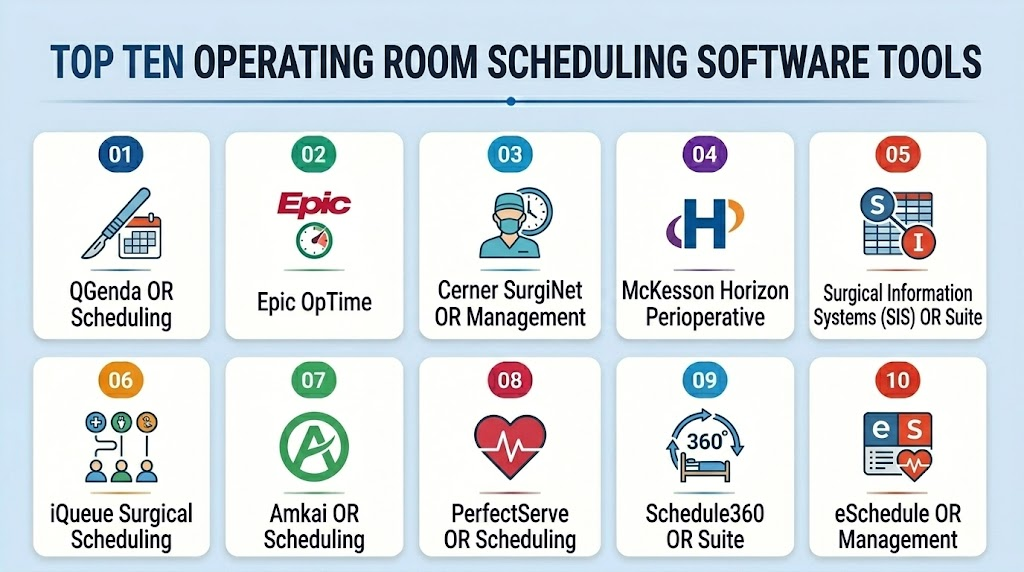
Top 10 Operating Room Scheduling Software Tools
1- QGenda OR Scheduling
Short description: Enterprise-grade OR scheduling software that optimizes surgical assignments, staff coordination, and room utilization.
Key Features:
- Automated OR scheduling and conflict resolution
- Predictive analytics for surgical cases
- Integration with EHR and perioperative systems
- Mobile access for staff and coordinators
- Reporting dashboards for OR efficiency
- Alerts for schedule changes or emergencies
Pros:
- Excellent analytics and predictive scheduling
- Scalable for large hospital networks
Cons:
- Higher cost for smaller facilities
- Implementation requires IT support
Platforms / Deployment: Web, iOS, Android / Cloud
Security & Compliance: HIPAA, SOC 2, encryption, audit logs
Integrations & Ecosystem:
- EHR/HIS integration
- PACS and imaging systems
- Mobile communication apps
Support & Community: Enterprise support, training programs, responsive helpdesk
2- Epic OpTime
Short description: Integrated within Epic’s EHR suite, enabling hospitals to schedule, manage, and analyze surgical cases efficiently.
Key Features:
- Real-time OR dashboards
- Case prioritization and scheduling rules
- Mobile staff access
- Automated conflict alerts
- Reporting for OR utilization and turnaround times
Pros:
- Direct integration with Epic EHR
- Streamlines multi-specialty surgical workflows
Cons:
- Limited flexibility outside Epic ecosystem
- Requires Epic-certified training
Platforms / Deployment: Web / Cloud / Hybrid
Security & Compliance: HIPAA, SOC 2, encryption, RBAC
Integrations & Ecosystem:
- Epic EHR modules
- Perioperative systems
- Analytics platforms
Support & Community: Vendor support, enterprise training, moderate external developer resources
3- Cerner SurgiNet OR Management
Short description: Real-time OR scheduling and management system designed for Cerner hospitals and integrated surgical facilities.
Key Features:
- Real-time OR tracking and scheduling
- Alerts for conflicts and emergencies
- Multi-specialty support
- Reporting dashboards
- Mobile notifications
- Analytics on OR utilization
Pros:
- Strong Cerner EHR integration
- Supports complex multi-OR environments
Cons:
- Limited to Cerner ecosystem
- Custom integration may be needed
Platforms / Deployment: Web / Cloud / Hybrid
Security & Compliance: HIPAA, SOC 2, encryption
Integrations & Ecosystem:
- Cerner EHR
- PACS and imaging systems
- Analytics tools
Support & Community: Documentation, vendor support, training
4- McKesson Horizon Perioperative
Short description: Comprehensive OR and perioperative management solution for hospital networks, focusing on workflow optimization and case efficiency.
Key Features:
- Automated OR scheduling
- Staff and resource management
- Predictive analytics for case flow
- Alerts and notifications
- Multi-unit coordination
- Reporting and dashboards
Pros:
- Enterprise-grade analytics
- Strong workflow automation
Cons:
- Higher implementation costs
- Learning curve for smaller hospitals
Platforms / Deployment: Web / Cloud / Hybrid
Security & Compliance: HIPAA, encryption, SOC 2
Integrations & Ecosystem:
- EHR and HIS integration
- Telehealth platforms
- Analytics tools
Support & Community: Enterprise support, training resources
5- Surgical Information Systems (SIS) OR Suite
Short description: OR scheduling and surgical management software designed for hospitals and surgical centers, emphasizing workflow efficiency.
Key Features:
- OR and staff scheduling
- Case prioritization
- Mobile access for surgical teams
- Alerts for conflicts and emergencies
- Reporting dashboards
- Analytics for utilization
Pros:
- Flexible scheduling options
- Good mobile accessibility
Cons:
- Limited predictive analytics
- Integration may require IT support
Platforms / Deployment: Web, iOS / Cloud / Hybrid
Security & Compliance: HIPAA, encryption
Integrations & Ecosystem:
- EHR systems
- Perioperative tracking tools
- Mobile communication
Support & Community: Documentation, vendor support
6- iQueue Surgical Scheduling
Short description: Cloud-based OR scheduling software focused on predictive analytics and real-time staff coordination.
Key Features:
- Predictive OR utilization
- Automated schedule generation
- Alerts for delays or conflicts
- Multi-OR coordination
- Reporting dashboards
- Mobile access
Pros:
- Strong predictive analytics
- Good for high-volume hospitals
Cons:
- Requires IT expertise for full setup
- Premium pricing
Platforms / Deployment: Web, iOS, Android / Cloud
Security & Compliance: HIPAA, SOC 2, encryption
Integrations & Ecosystem:
- EHR/HIS
- Analytics and reporting tools
- Mobile dashboards
Support & Community: Documentation, enterprise support
7- Amkai OR Scheduling
Short description: Web-based software for managing OR schedules, staff assignments, and surgical workflow.
Key Features:
- Automated scheduling
- Staff assignment and preferences
- Conflict resolution
- Alerts for emergencies
- Reporting and analytics
- Mobile dashboards
Pros:
- Easy to adopt for mid-sized hospitals
- Supports multiple ORs
Cons:
- Limited enterprise-grade analytics
- Fewer integrations
Platforms / Deployment: Web, iOS / Cloud
Security & Compliance: HIPAA, encryption
Integrations & Ecosystem:
- HR and payroll systems
- EHR platforms
- Mobile apps
Support & Community: Documentation, email support
8- PerfectServe OR Scheduling
Short description: Cloud-based platform offering OR scheduling, team coordination, and real-time case management.
Key Features:
- OR and staff scheduling
- Alerts for conflicts or emergencies
- Mobile dashboards
- Reporting and analytics
- Predictive case flow
- Multi-department support
Pros:
- Strong mobile accessibility
- Good for hospitals with multiple specialties
Cons:
- Limited integration options
- Premium pricing for enterprise features
Platforms / Deployment: Web, iOS, Android / Cloud
Security & Compliance: HIPAA, encryption
Integrations & Ecosystem:
- EHR/HIS
- Mobile apps
- Analytics platforms
Support & Community: Vendor support, documentation
9- Schedule360 OR Suite
Short description: Scheduling software for operating rooms focusing on labor compliance, staff coordination, and analytics.
Key Features:
- Automated scheduling
- Conflict detection
- Compliance tracking
- Mobile staff access
- Reporting dashboards
- Predictive analytics
Pros:
- Affordable for mid-sized hospitals
- Easy to use
Cons:
- Limited enterprise features
- Integration options are moderate
Platforms / Deployment: Web, iOS, Android / Cloud
Security & Compliance: HIPAA, encryption
Integrations & Ecosystem:
- EHR/HIS
- Staff management systems
- Analytics tools
Support & Community: Documentation, email support
10- eSchedule OR Management
Short description: Enterprise OR scheduling software with focus on resource optimization, predictive analytics, and workflow management.
Key Features:
- Real-time OR tracking
- Automated schedule generation
- Staff notifications
- Multi-OR coordination
- Analytics and reporting
- Mobile access
Pros:
- Enterprise-grade analytics
- Optimizes OR utilization
Cons:
- High cost for smaller hospitals
- Setup may require IT support
Platforms / Deployment: Web, iOS, Android / Cloud
Security & Compliance: HIPAA, SOC 2, encryption
Integrations & Ecosystem:
- EHR/HIS
- Analytics platforms
- Mobile dashboards
Support & Community: Enterprise support, vendor training
Comparison Table (Top 10)
| Tool Name | Best For | Platform(s) Supported | Deployment | Standout Feature | Public Rating |
|---|---|---|---|---|---|
| QGenda OR Scheduling | Enterprise hospitals | Web, iOS, Android | Cloud | Predictive analytics | N/A |
| Epic OpTime | Epic hospitals | Web | Cloud / Hybrid | EHR-integrated scheduling | N/A |
| Cerner SurgiNet | Cerner hospitals | Web | Cloud / Hybrid | Multi-OR support | N/A |
| McKesson Horizon Perioperative | Multi-hospital networks | Web | Cloud / Hybrid | Workflow optimization | N/A |
| Surgical Information Systems (SIS) | Hospitals & surgical centers | Web, iOS | Cloud / Hybrid | Workflow efficiency | N/A |
| iQueue Surgical Scheduling | High-volume hospitals | Web, iOS, Android | Cloud | Predictive OR utilization | N/A |
| Amkai OR Scheduling | Mid-sized hospitals | Web, iOS | Cloud | Staff assignment | N/A |
| PerfectServe OR Scheduling | Multi-specialty hospitals | Web, iOS, Android | Cloud | Team coordination | N/A |
| Schedule360 OR Suite | Mid-sized hospitals | Web, iOS, Android | Cloud | Labor compliance | N/A |
| eSchedule OR Management | Enterprise hospitals | Web, iOS, Android | Cloud | Resource optimization | N/A |
Evaluation & Scoring of Operating Room Scheduling Software
| Tool Name | Core (25%) | Ease (15%) | Integrations (15%) | Security (10%) | Performance (10%) | Support (10%) | Value (15%) | Weighted Total |
|---|---|---|---|---|---|---|---|---|
| QGenda OR Scheduling | 9 | 8 | 9 | 9 | 8 | 8 | 7 | 8.5 |
| Epic OpTime | 9 | 7 | 8 | 9 | 9 | 7 | 7 | 8.1 |
| Cerner SurgiNet | 8 | 7 | 8 | 9 | 8 | 7 | 7 | 7.8 |
| McKesson Horizon | 8 | 7 | 8 | 9 | 8 | 7 | 6 | 7.7 |
| SIS | 8 | 7 | 7 | 8 | 7 | 7 | 7 | 7.3 |
| iQueue | 9 | 7 | 8 | 9 | 8 | 7 | 6 | 7.8 |
| Amkai | 7 | 8 | 7 | 8 | 7 | 7 | 7 | 7.2 |
| PerfectServe | 8 | 8 | 7 | 8 | 8 | 7 | 7 | 7.6 |
| Schedule360 | 7 | 8 | 7 | 8 | 7 | 6 | 7 | 7.0 |
| eSchedule | 9 | 7 | 8 | 9 | 8 | 7 | 6 | 7.8 |
Which Operating Room Scheduling Software Is Right for You?
Solo / Freelancer: Smaller surgical centers may use SIS or Amkai OR Scheduling for simplicity and mobile support.
SMB Hospitals: Schedule360 or PerfectServe OR Scheduling provide mid-sized hospitals with automation and compliance tracking.
Mid-Market: iQueue or McKesson Horizon supports complex scheduling and predictive analytics for multiple ORs.
Enterprise: Large hospital networks benefit from QGenda OR Scheduling, Epic OpTime, or Cerner SurgiNet with enterprise-grade reporting and multi-specialty coordination.
Budget vs Premium: Smaller hospitals can use affordable solutions with essential features; enterprise hospitals require premium software for analytics, predictive scheduling, and multi-OR coordination.
Feature Depth vs Ease of Use: Enterprise tools provide deep analytics and complex scheduling; SMB tools focus on usability and mobile dashboards.
Integrations & Scalability: Cloud-native platforms like QGenda, Epic OpTime, and Cerner SurgiNet offer seamless integration with EHR/HIS and scale across multiple facilities.
Security & Compliance Needs: HIPAA and SOC 2-certified software is essential for large hospitals; smaller clinics may balance simplicity with regulatory needs.
Frequently Asked Questions (FAQs)
1- What pricing models are available?
Subscription-based, per-OR, or enterprise licensing; some vendors offer tiered pricing for SMB vs enterprise hospitals.
2- How long does implementation take?
Small surgical centers can onboard in weeks; large multi-OR networks may require several months.
3- Do these systems integrate with EHRs?
Yes, most top systems provide deep integration with EHR/HIS platforms for scheduling and case management.
4- Are predictive analytics available?
Yes, enterprise tools like QGenda and iQueue forecast OR utilization and staffing needs.
5- Do these systems support mobile dashboards?
Most offer iOS and Android apps for staff to view schedules, swap cases, and receive alerts.
6- Can these tools manage multiple ORs?
Yes, enterprise-grade solutions support multi-OR and multi-specialty coordination.
7- Are these systems secure and compliant?
Top vendors comply with HIPAA, SOC 2, encryption, and audit logging.
8- Are small surgical centers supported?
Yes, mobile-friendly and affordable tools like Amkai or SIS suit smaller OR facilities.
9- Do these platforms automate conflict resolution?
Yes, they detect scheduling conflicts, prioritize emergency cases, and optimize resource allocation.
10- Can these systems integrate with perioperative devices?
Yes, some tools support IoT-enabled tracking for instruments, equipment, and room availability.
Conclusion
Operating Room Scheduling Software is vital for efficient OR management, staff coordination, and surgical workflow optimization. Smaller facilities can benefit from SIS or Amkai OR Scheduling, while mid-market hospitals should consider Schedule360 or PerfectServe. Enterprise hospitals will benefit most from QGenda OR Scheduling, Epic OpTime, or Cerner SurgiNet for predictive analytics and multi-OR coordination. The key to success is shortlisting 2–3 solutions, piloting scheduling workflows, and validating integration, compliance, and usability for your hospital network.

Find Trusted Cardiac Hospitals
Compare heart hospitals by city and services — all in one place.
Explore Hospitals
Operating room efficiency depends on far more than filling available time slots. Scheduling platforms that account for surgeon availability, equipment readiness, staffing levels, and procedure duration can help reduce delays while improving both resource utilization and patient flow.