Introduction
Hospital Asset Tracking Tools are specialized software platforms designed to monitor, locate, and manage medical equipment, devices, and supplies across hospitals and healthcare networks. They enable real-time visibility of assets, reduce loss or theft, optimize utilization, and ensure regulatory compliance. With the increasing complexity of healthcare facilities the rising cost of medical equipment, these tools are essential for efficient operations, cost management, and patient safety.
Real-world use cases include:
- Tracking critical equipment: Ventilators, infusion pumps, and diagnostic machines.
- Inventory management: Monitoring consumables and medical supplies in real-time.
- Preventive maintenance scheduling: Ensuring devices are serviced on time to reduce downtime.
- Multi-department coordination: Tracking assets shared across wards, ICU, ER, and ORs.
- Compliance reporting: Maintaining audit logs for regulatory and accreditation purposes.
Evaluation criteria for buyers:
- Real-time asset location and status tracking
- Integration with hospital EHR/HIS systems
- Mobile access and IoT device support
- Predictive maintenance alerts
- Inventory and lifecycle management
- Ease of use and dashboard visualization
- Security and regulatory compliance (HIPAA, GDPR)
- Analytics and reporting capabilities
- Scalability across multiple facilities
- Vendor support and training resources
Best for: Hospital administrators, biomedical engineers, operations managers, and IT teams in multi-ward or multi-hospital facilities.
Not ideal for: Small clinics with minimal equipment or facilities managing assets manually without complex workflows.
Key Trends in Hospital Asset Tracking Tools
- AI-driven predictive maintenance and utilization analytics
- IoT-enabled real-time tracking with RFID, BLE, and GPS
- Mobile-first dashboards for biomedical and nursing staff
- Cloud-native platforms supporting multi-hospital networks
- Integration with EHR, HIS, and procurement systems
- Automated alerts for misplaced, expired, or underutilized assets
- Analytics for cost optimization and ROI reporting
- Compliance with HIPAA, SOC 2, and ISO 13485
- Subscription and API-first pricing models for extensibility
- Enhanced patient safety through timely availability of critical devices
How We Selected These Tools (Methodology)
- Evaluated market adoption across hospitals and healthcare networks
- Reviewed feature completeness, including tracking, maintenance, and reporting
- Assessed performance and reliability signals, including uptime and real-time updates
- Verified security posture, including encryption, access control, and audit logs
- Checked integration capabilities with EHR/HIS, mobile apps, and IoT devices
- Considered customer fit across small, mid-sized, and enterprise hospitals
- Reviewed support resources, onboarding, and training quality
- Examined scalability across wards, departments, and multi-hospital networks
- Analyzed vendor reputation and technology roadmap
- Compared pricing transparency and deployment flexibility
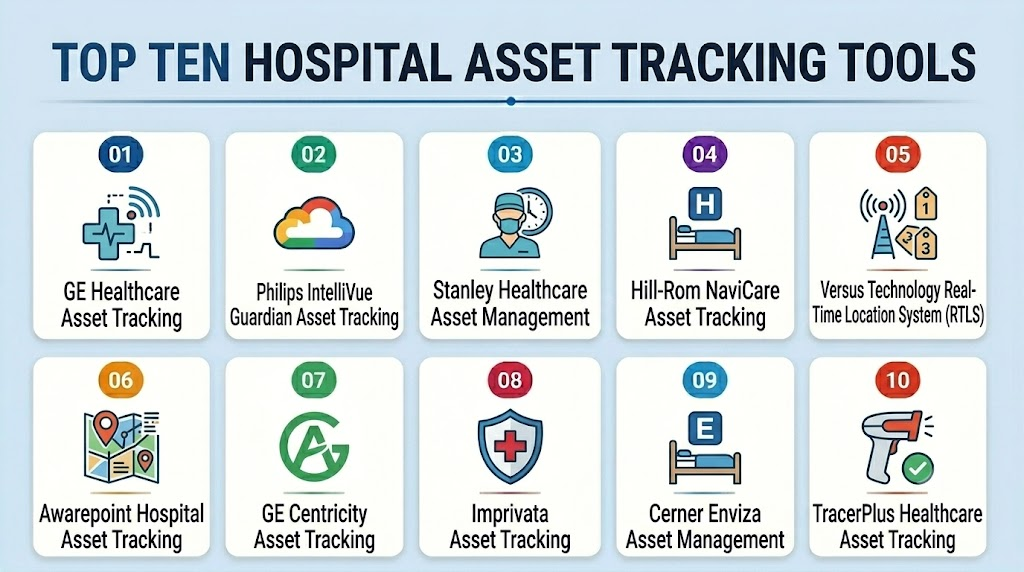
Top 10 Hospital Asset Tracking Tools
1- GE Healthcare Asset Tracking
Short description: Provides hospitals with real-time location and status of medical equipment, ensuring optimal utilization and timely maintenance.
Key Features:
- Real-time asset tracking via RFID and IoT sensors
- Predictive maintenance alerts
- Integration with EHR/HIS systems
- Mobile dashboards for staff
- Analytics on utilization and ROI
- Inventory management and lifecycle tracking
Pros:
- Robust analytics and reporting
- Enterprise-grade scalability
Cons:
- Higher cost for smaller hospitals
- Integration complexity with legacy systems
Platforms / Deployment: Web, iOS, Android / Cloud
Security & Compliance: HIPAA, SOC 2, encryption, audit logs
Integrations & Ecosystem:
- EHR/HIS systems
- IoT-enabled medical devices
- Procurement and inventory platforms
Support & Community: Vendor training, enterprise support, user community
2- Philips IntelliVue Guardian Asset Tracking
Short description: Tracks critical devices in hospitals and provides predictive maintenance insights to reduce downtime.
Key Features:
- Real-time device location tracking
- Alerts for misplaced or underutilized equipment
- Maintenance scheduling
- Mobile access for biomedical staff
- Analytics dashboards
- Integration with EHR systems
Pros:
- Excellent for critical care equipment
- Mobile-friendly interface
Cons:
- Limited for smaller facilities
- May require hardware upgrades for tracking
Platforms / Deployment: Web, iOS, Android / Cloud
Security & Compliance: HIPAA, encryption
Integrations & Ecosystem:
- EHR/HIS integration
- Mobile dashboards
- IoT-enabled sensors
Support & Community: Documentation, vendor support
3- Stanley Healthcare Asset Management
Short description: Provides hospitals with real-time visibility of equipment, assets, and staff workflow coordination.
Key Features:
- RFID and Wi-Fi tracking
- Inventory and asset lifecycle management
- Real-time location dashboards
- Mobile notifications
- Predictive maintenance
- Reporting and analytics
Pros:
- Strong mobile and real-time tracking
- Scalable for enterprise hospitals
Cons:
- Premium pricing
- Implementation may require IT support
Platforms / Deployment: Web, iOS, Android / Cloud
Security & Compliance: HIPAA, SOC 2
Integrations & Ecosystem:
- EHR/HIS
- IoT devices and sensors
- Inventory management systems
Support & Community: Vendor training, documentation, support desk
4- Hill-Rom NaviCare Asset Tracking
Short description: Tracks critical medical devices and hospital assets to optimize utilization and compliance.
Key Features:
- Real-time asset location and status
- Alerts for missing or underutilized equipment
- Mobile dashboards
- Maintenance scheduling
- Analytics and reporting
- Multi-department tracking
Pros:
- Integrated with hospital workflow
- User-friendly dashboards
Cons:
- Hardware dependencies
- May require additional licensing for IoT tracking
Platforms / Deployment: Web, iOS, Android / Cloud / Hybrid
Security & Compliance: HIPAA, encryption
Integrations & Ecosystem:
- EHR/HIS integration
- IoT medical devices
- Maintenance and procurement systems
Support & Community: Documentation, vendor support, training
5- Versus Technology Real-Time Location System (RTLS)
Short description: Uses RTLS to track hospital assets, staff, and patients, optimizing efficiency and safety.
Key Features:
- RTLS tracking via badges and tags
- Asset and patient workflow management
- Alerts for misplaced equipment
- Mobile dashboards
- Analytics on utilization
- Compliance reporting
Pros:
- Supports asset, staff, and patient tracking
- Real-time insights improve efficiency
Cons:
- Hardware setup required
- High initial investment
Platforms / Deployment: Web, iOS, Android / Cloud
Security & Compliance: HIPAA, SOC 2, encryption
Integrations & Ecosystem:
- EHR/HIS
- Mobile apps
- IoT-enabled devices
Support & Community: Vendor support, documentation
6- Awarepoint Hospital Asset Tracking
Short description: Provides hospitals with real-time asset visibility, maintenance scheduling, and utilization analytics.
Key Features:
- RFID and Wi-Fi asset tracking
- Predictive maintenance alerts
- Mobile dashboards
- Integration with EHR
- Analytics and utilization reports
- Multi-department asset management
Pros:
- Strong predictive analytics
- Mobile access for staff
Cons:
- Enterprise pricing
- Integration may require IT support
Platforms / Deployment: Web, iOS, Android / Cloud
Security & Compliance: HIPAA, SOC 2
Integrations & Ecosystem:
- EHR/HIS
- IoT devices
- Inventory management systems
Support & Community: Vendor support, documentation
7- GE Centricity Asset Tracking
Short description: Helps hospitals manage medical devices, assets, and equipment utilization across multiple facilities.
Key Features:
- Real-time location tracking
- Maintenance scheduling
- Alerts for low utilization or missing devices
- Analytics dashboards
- Integration with hospital IT systems
- Mobile access
Pros:
- Enterprise-grade features
- Scalable for multi-hospital networks
Cons:
- Costly for small hospitals
- Setup requires IT support
Platforms / Deployment: Web, iOS, Android / Cloud
Security & Compliance: HIPAA, encryption
Integrations & Ecosystem:
- EHR/HIS
- IoT-enabled devices
- Mobile dashboards
Support & Community: Vendor support, documentation
8- Imprivata Asset Tracking
Short description: Tracks critical hospital assets and ensures compliance with regulatory standards while improving utilization.
Key Features:
- Real-time asset tracking via RFID
- Mobile dashboard for staff
- Alerts for missing or overdue maintenance
- Reporting and analytics
- Integration with EHR and inventory systems
- Multi-site asset management
Pros:
- Mobile-friendly
- Strong compliance tracking
Cons:
- Limited for small clinics
- Hardware required for full capabilities
Platforms / Deployment: Web, iOS, Android / Cloud
Security & Compliance: HIPAA, encryption, SOC 2
Integrations & Ecosystem:
- EHR/HIS
- IoT medical devices
- Inventory management systems
Support & Community: Vendor support, documentation
9- Cerner Enviza Asset Management
Short description: Provides hospitals with asset visibility, predictive maintenance, and utilization analytics.
Key Features:
- Real-time asset tracking
- Maintenance and lifecycle management
- Mobile access for staff
- Alerts for missing equipment
- Analytics dashboards
- Multi-department tracking
Pros:
- Integration with Cerner EHR
- Strong predictive analytics
Cons:
- Limited outside Cerner ecosystem
- Enterprise pricing
Platforms / Deployment: Web, iOS, Android / Cloud
Security & Compliance: HIPAA, SOC 2, encryption
Integrations & Ecosystem:
- Cerner EHR
- IoT devices
- Inventory and procurement systems
Support & Community: Vendor support, documentation
10- TracerPlus Healthcare Asset Tracking
Short description: Affordable hospital asset tracking solution for small to medium healthcare facilities, focusing on inventory and equipment tracking.
Key Features:
- Real-time asset location
- Maintenance scheduling
- Mobile dashboards
- Alerts for missing or underutilized devices
- Analytics and reporting
- Multi-department support
Pros:
- Affordable for SMB hospitals
- Easy to deploy and use
Cons:
- Limited predictive analytics
- Fewer integrations than enterprise tools
Platforms / Deployment: Web, iOS, Android / Cloud
Security & Compliance: HIPAA, encryption
Integrations & Ecosystem:
- EHR/HIS
- Inventory management
- Mobile dashboards
Support & Community: Documentation, email support
Comparison Table (Top 10)
| Tool Name | Best For | Platform(s) Supported | Deployment | Standout Feature | Public Rating |
|---|---|---|---|---|---|
| GE Healthcare | Enterprise hospitals | Web, iOS, Android | Cloud | Real-time asset tracking | N/A |
| Philips IntelliVue | Critical care assets | Web, iOS, Android | Cloud | Predictive maintenance | N/A |
| Stanley Healthcare | Multi-ward hospitals | Web, iOS, Android | Cloud | Staff and asset workflow | N/A |
| Hill-Rom NaviCare | Hospital wards | Web, iOS, Android | Cloud / Hybrid | Mobile dashboards | N/A |
| Versus RTLS | Hospitals & patient tracking | Web, iOS, Android | Cloud | RTLS tracking | N/A |
| Awarepoint | Enterprise hospitals | Web, iOS, Android | Cloud | Predictive maintenance alerts | N/A |
| GE Centricity | Multi-hospital networks | Web, iOS, Android | Cloud | Multi-facility asset tracking | N/A |
| Imprivata | Hospital compliance tracking | Web, iOS, Android | Cloud | Regulatory compliance | N/A |
| Cerner Enviza | Cerner hospitals | Web, iOS, Android | Cloud | Predictive analytics | N/A |
| TracerPlus | SMB hospitals | Web, iOS, Android | Cloud | Affordable mobile tracking | N/A |
Evaluation & Scoring of Hospital Asset Tracking Tools
| Tool Name | Core (25%) | Ease (15%) | Integrations (15%) | Security (10%) | Performance (10%) | Support (10%) | Value (15%) | Weighted Total |
|---|---|---|---|---|---|---|---|---|
| GE Healthcare | 9 | 8 | 9 | 9 | 8 | 8 | 7 | 8.5 |
| Philips IntelliVue | 8 | 8 | 8 | 9 | 8 | 7 | 7 | 7.9 |
| Stanley Healthcare | 8 | 7 | 8 | 9 | 8 | 7 | 7 | 7.8 |
| Hill-Rom NaviCare | 8 | 8 | 7 | 8 | 8 | 7 | 7 | 7.8 |
| Versus RTLS | 9 | 7 | 8 | 9 | 8 | 7 | 6 | 7.8 |
| Awarepoint | 8 | 7 | 8 | 9 | 8 | 7 | 7 | 7.7 |
| GE Centricity | 9 | 7 | 8 | 9 | 8 | 7 | 6 | 7.7 |
| Imprivata | 7 | 8 | 7 | 8 | 7 | 7 | 7 | 7.2 |
| Cerner Enviza | 8 | 7 | 8 | 9 | 8 | 7 | 6 | 7.6 |
| TracerPlus | 7 | 8 | 6 | 8 | 7 | 6 | 7 | 7.0 |
Which Hospital Asset Tracking Tool Is Right for You?
Solo / Freelancer: Small clinics or mobile health units may use TracerPlus for simple, mobile-friendly tracking.
SMB Hospitals: Mid-sized facilities benefit from Hill-Rom NaviCare, Awarepoint, or Imprivata for multi-ward tracking and compliance alerts.
Mid-Market: Hospitals with multiple departments can adopt Stanley Healthcare, Versus RTLS, or Philips IntelliVue for predictive maintenance and IoT integration.
Enterprise: Large hospital networks should consider GE Healthcare, GE Centricity, or Cerner Enviza for multi-facility asset visibility, analytics, and regulatory compliance.
Budget vs Premium: SMB hospitals may choose affordable tools like TracerPlus or Hill-Rom NaviCare, while enterprise hospitals need premium platforms with full analytics, predictive alerts, and multi-site scalability.
Feature Depth vs Ease of Use: Enterprise solutions offer extensive analytics and predictive features, whereas SMB tools prioritize mobile usability and rapid deployment.
Integrations & Scalability: Cloud-native platforms like GE Healthcare and Philips IntelliVue provide seamless integration with EHR/HIS and scale across multiple hospitals.
Security & Compliance Needs: HIPAA/SOC 2-compliant platforms are essential for large networks; smaller clinics may focus on operational simplicity.
Frequently Asked Questions (FAQs)
1- What pricing models are available?
Subscription-based, per-device, or enterprise licensing; some offer tiered pricing for SMB vs large hospitals.
2- How long does implementation take?
Small facilities can onboard in weeks; enterprise hospitals may require months.
3- Can these tools integrate with EHRs?
Yes, most top platforms integrate with hospital EHR/HIS for asset status and inventory management.
4- Are predictive maintenance features available?
Yes, AI-driven predictive alerts help reduce downtime and optimize equipment usage.
5- Do these systems offer mobile dashboards?
Most platforms support iOS and Android for staff to view asset location and status in real-time.
6- Can multi-facility hospitals use these tools?
Enterprise-grade platforms like GE Healthcare, GE Centricity, and Cerner Enviza scale across multiple sites.
7- Is data secure and compliant?
Top vendors follow HIPAA, SOC 2, encryption standards, and audit logging.
8- Are these tools suitable for small clinics?
Yes, mobile-friendly and affordable options like TracerPlus or Hill-Rom NaviCare are ideal.
9- Can these tools reduce asset loss?
Yes, real-time tracking and alerts prevent misplaced or stolen equipment.
10- Do they integrate with IoT devices?
Yes, most enterprise systems support RFID, BLE, and GPS-enabled medical devices for continuous monitoring.
Conclusion
Hospital Asset Tracking Tools are critical for real-time visibility, efficient utilization, and cost management of medical equipment and devices. Smaller clinics may adopt TracerPlus for simplicity, mid-sized hospitals can benefit from Hill-Rom NaviCare or Awarepoint, and enterprise hospitals should consider GE Healthcare, GE Centricity, or Cerner Enviza for predictive maintenance, analytics, and multi-facility coordination. To implement successfully, shortlist 2–3 platforms, pilot asset workflows, and validate compliance, integrations, and usability.

Find Trusted Cardiac Hospitals
Compare heart hospitals by city and services — all in one place.
Explore Hospitals
Hospital asset tracking is about much more than locating equipment—it helps ensure critical devices are available exactly when clinicians need them. Better utilization insights can reduce unnecessary purchases, minimize equipment downtime, and ultimately support more efficient patient care.