Introduction
Order-to-Cash (O2C) platforms are end-to-end solutions that manage the entire order lifecycle from customer order creation to payment collection. These platforms streamline sales, invoicing, revenue recognition, and cash collection processes, ensuring that businesses can efficiently convert orders into cash. the emphasis on automation, AI-driven analytics, and integrated workflows has made O2C platforms critical for organizations seeking operational efficiency and revenue growth.
Real-world use cases include:
- Automating invoice generation and payment reminders to reduce DSO (Days Sales Outstanding).
- Integrating with ERP systems to streamline order fulfillment and accounting.
- Providing visibility into order and payment status for both finance and sales teams.
- Supporting complex pricing and discount models for global operations.
- Reducing revenue leakage through automated compliance and audit controls.
Buyers should evaluate: workflow automation, ease of integration, scalability, AI-enabled forecasting, compliance & security, multi-currency support, reporting & analytics, customer experience management, and cost-to-implement.
Best for: Finance leaders, sales operations teams, medium to large enterprises, and companies with complex billing or global sales operations.
Not ideal for: Small businesses with straightforward invoicing needs, or companies with minimal order volumes where simpler accounting software may suffice.
Key Trends in Order-to-Cash Platforms
- AI-powered cash forecasting and predictive analytics for optimized collections.
- Increased adoption of cloud-native O2C platforms for scalability and flexibility.
- Workflow automation to reduce manual intervention in invoicing and approvals.
- Embedded compliance features, including audit logs and automated revenue recognition.
- Integration with CRM and ERP systems for end-to-end visibility.
- Real-time dashboards for sales, finance, and operations teams.
- Support for multi-currency and global tax compliance.
- Enhanced self-service portals for customers to track orders and payments.
- Subscription-based and usage-based billing automation for SaaS companies.
- Modular platforms allowing companies to adopt O2C in phases.
How We Selected These Tools (Methodology)
- Evaluated market adoption and industry mindshare.
- Reviewed feature completeness including invoicing, collections, and revenue recognition.
- Analyzed reliability, uptime, and performance metrics.
- Considered security posture and compliance with standards like SOC 2, GDPR, ISO 27001.
- Assessed integration capabilities with ERP, CRM, and other enterprise systems.
- Reviewed customer segment fit from SMB to enterprise-scale.
- Looked at AI and automation features to improve efficiency.
- Factored in scalability for global operations.
- Considered flexibility and customization options.
- Evaluated vendor support and community resources.
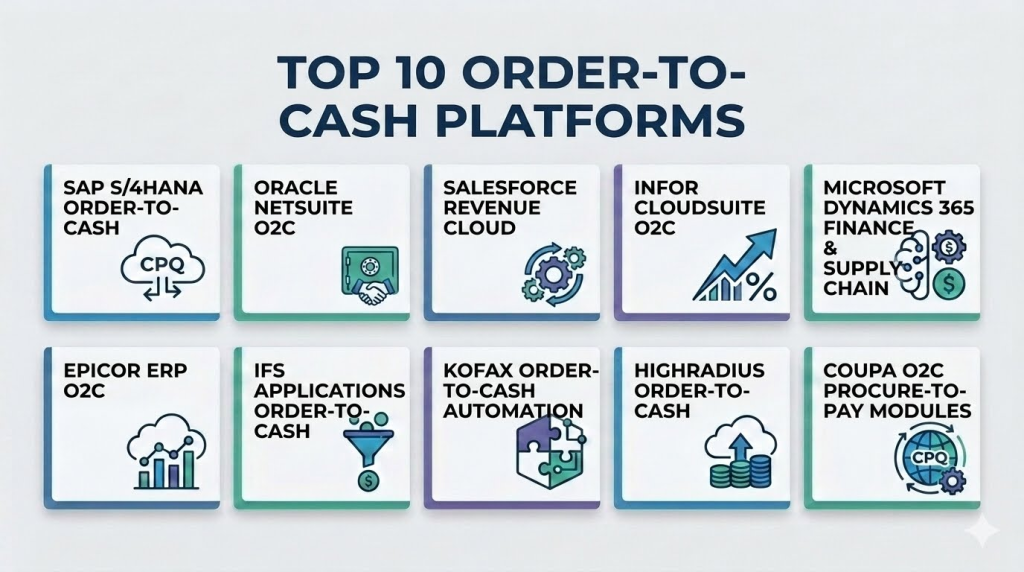
Top 10 Order-to-Cash Platforms
1 — SAP S/4HANA Order-to-Cash
Short description: Comprehensive enterprise platform managing orders, invoicing, and payments with robust analytics. Ideal for global operations.
Key Features
- End-to-end O2C workflow automation.
- Integrated with SAP ERP and finance modules.
- Advanced reporting and real-time dashboards.
- AI-driven predictive cash flow analytics.
- Multi-currency and global tax compliance.
Pros
- Enterprise-grade scalability and reliability.
- Deep integration with SAP ecosystem.
Cons
- Complex implementation for smaller teams.
- Higher total cost of ownership.
Platforms / Deployment
- Web / Cloud / Hybrid
Security & Compliance
- SOC 2, ISO 27001, GDPR
Integrations & Ecosystem
Supports ERP, CRM, and payment gateways:
- SAP Ariba, SAP Concur
- Salesforce CRM
- Banking and payment APIs
Support & Community
Comprehensive documentation, training programs, and global support.
2 — Oracle NetSuite O2C
Short description: Cloud-based O2C solution for automating order management, invoicing, and collections with native ERP integration.
Key Features
- Real-time order tracking and fulfillment.
- Automated invoice generation and payment reminders.
- Integrated revenue recognition.
- Role-based dashboards for finance teams.
- Multi-language and multi-currency support.
Pros
- Strong automation reduces manual errors.
- Flexible cloud deployment.
Cons
- May require customization for complex workflows.
- Licensing cost can be high for SMBs.
Platforms / Deployment
- Web / Cloud
Security & Compliance
- Not publicly stated
Integrations & Ecosystem
- NetSuite ERP modules
- Payment gateways and tax engines
- API for third-party integrations
Support & Community
Varies / Not publicly stated
3 — Salesforce Revenue Cloud
Short description: Combines CPQ and billing to streamline the quote-to-cash process for B2B and B2C sales.
Key Features
- Configure-price-quote (CPQ) automation.
- Subscription and usage-based billing.
- Integrated revenue recognition.
- Customer self-service portals.
- Analytics dashboards for sales forecasting.
Pros
- Seamless integration with Salesforce CRM.
- AI-driven revenue insights.
Cons
- Best suited for Salesforce users.
- Complexity can increase with customization.
Platforms / Deployment
- Web / Cloud
Security & Compliance
- SSO/SAML, MFA, audit logs
Integrations & Ecosystem
- Salesforce ecosystem modules
- Payment gateways
- ERP and accounting APIs
Support & Community
Extensive Salesforce support, community forums, training.
4 — Infor CloudSuite O2C
Short description: Cloud-native O2C platform designed for manufacturing and distribution industries.
Key Features
- End-to-end order management.
- Automated invoice and payment collection.
- Inventory and fulfillment tracking.
- Analytics for revenue and cash flow.
- Integration with supply chain modules.
Pros
- Industry-specific templates and workflows.
- Scalable cloud architecture.
Cons
- Learning curve for new users.
- Limited third-party integrations outside Infor ecosystem.
Platforms / Deployment
- Web / Cloud
Security & Compliance
- Not publicly stated
Integrations & Ecosystem
- ERP and supply chain systems
- Payment gateways
- Analytics tools
Support & Community
Varies / Not publicly stated
5 — Microsoft Dynamics 365 Finance & Supply Chain
Short description: O2C module within Dynamics 365, offering integrated financial and supply chain management.
Key Features
- Invoice automation and cash application.
- Credit management and collections tracking.
- Revenue recognition automation.
- Integrated supply chain visibility.
- AI-based insights for DSO optimization.
Pros
- Deep ERP integration for finance and supply chain.
- Microsoft ecosystem compatibility.
Cons
- May require customization for complex O2C workflows.
- Training required for non-Microsoft users.
Platforms / Deployment
- Web / Cloud / Hybrid
Security & Compliance
- ISO 27001, GDPR
Integrations & Ecosystem
- Microsoft 365 suite
- Power BI for analytics
- Payment gateways and ERP APIs
Support & Community
Strong Microsoft support and partner network.
6 — Epicor ERP O2C
Short description: ERP-focused O2C platform for manufacturing and distribution companies.
Key Features
- Order management and invoicing automation.
- Credit and collections management.
- Inventory and fulfillment integration.
- Analytics dashboards for sales and finance.
- Configurable workflows.
Pros
- Industry-tailored O2C workflows.
- Flexibility for global operations.
Cons
- Limited cloud deployment features compared to competitors.
- Complex pricing and licensing.
Platforms / Deployment
- Web / Cloud / Hybrid
Security & Compliance
- Not publicly stated
Integrations & Ecosystem
- ERP modules, shipping carriers, payment gateways
Support & Community
Varies / Not publicly stated
7 — IFS Applications Order-to-Cash
Short description: O2C solution within IFS Applications ERP suite for project and asset-centric businesses.
Key Features
- Integrated project billing and invoicing.
- Automated revenue recognition.
- Credit management.
- Customer portal for order tracking.
- Analytics dashboards.
Pros
- Project-focused O2C workflows.
- Global multi-currency support.
Cons
- Best for IFS ERP users.
- Complex configuration for small teams.
Platforms / Deployment
- Web / Cloud / Hybrid
Security & Compliance
- Not publicly stated
Integrations & Ecosystem
- ERP, CRM, payment APIs, analytics platforms
Support & Community
Varies / Not publicly stated
8 — Kofax Order-to-Cash Automation
Short description: Focused on automating invoice processing, cash application, and collections.
Key Features
- Intelligent invoice capture and validation.
- Automated cash application.
- Collections workflow automation.
- Integration with ERP systems.
- Analytics for DSO and revenue trends.
Pros
- Reduces manual data entry.
- Optimizes collections processes.
Cons
- Limited end-to-end order management.
- Requires ERP integration for full functionality.
Platforms / Deployment
- Web / Cloud
Security & Compliance
- Not publicly stated
Integrations & Ecosystem
- ERP connectors
- Payment gateways
- Analytics and BI tools
Support & Community
Varies / Not publicly stated
9 — HighRadius Order-to-Cash
Short description: AI-driven O2C automation platform for collections, credit, and cash application.
Key Features
- Predictive analytics for collections prioritization.
- Automated credit risk assessment.
- Cash application automation.
- Real-time dashboards for finance teams.
- Integration with ERP systems.
Pros
- AI-powered insights for revenue optimization.
- Reduces DSO and improves cash flow.
Cons
- Focused mainly on finance, not full order management.
- Requires ERP connectivity for full value.
Platforms / Deployment
- Web / Cloud
Security & Compliance
- Not publicly stated
Integrations & Ecosystem
- ERP systems, payment gateways, BI tools
Support & Community
Varies / Not publicly stated
10 — Coupa O2C / Procure-to-Pay with O2C Modules
Short description: Cloud platform primarily for P2P but includes O2C modules for invoicing and cash collection.
Key Features
- Invoice management and validation.
- Automated approval workflows.
- Payment processing and reconciliation.
- Analytics dashboards.
- ERP system integration.
Pros
- Combines P2P and O2C for end-to-end financial workflow.
- Cloud-native deployment with scalability.
Cons
- Limited end-to-end order management compared to full ERP suites.
- May require customization for complex sales models.
Platforms / Deployment
- Web / Cloud
Security & Compliance
- Not publicly stated
Integrations & Ecosystem
- ERP and accounting systems
- Payment gateways
- BI and analytics tools
Support & Community
Varies / Not publicly stated
Comparison Table (Top 10)
| Tool Name | Best For | Platform(s) Supported | Deployment | Standout Feature | Public Rating |
|---|---|---|---|---|---|
| SAP S/4HANA O2C | Large enterprises | Web | Cloud/Hybrid | End-to-end workflow automation | N/A |
| Oracle NetSuite O2C | SMBs & mid-market | Web | Cloud | Integrated ERP O2C | N/A |
| Salesforce Revenue Cloud | SaaS & B2B | Web | Cloud | CPQ + Billing | N/A |
| Infor CloudSuite O2C | Manufacturing & distribution | Web | Cloud | Industry-specific templates | N/A |
| Dynamics 365 Finance | Finance & operations | Web | Cloud/Hybrid | Integrated finance + supply chain | N/A |
| Epicor ERP O2C | Manufacturing | Web | Cloud/Hybrid | Configurable workflows | N/A |
| IFS Applications O2C | Project/asset-centric | Web | Cloud/Hybrid | Project billing | N/A |
| Kofax O2C Automation | Finance teams | Web | Cloud | Invoice/cash automation | N/A |
| HighRadius O2C | Finance & collections | Web | Cloud | AI-driven cash collection | N/A |
| Coupa O2C | P2P + O2C | Web | Cloud | Combined P2P + O2C | N/A |
Evaluation & Scoring of Order-to-Cash Platforms
| Tool Name | Core (25%) | Ease (15%) | Integrations (15%) | Security (10%) | Performance (10%) | Support (10%) | Value (15%) | Weighted Total (0–10) |
|---|---|---|---|---|---|---|---|---|
| SAP S/4HANA O2C | 10 | 7 | 9 | 10 | 10 | 8 | 7 | 9.0 |
| Oracle NetSuite O2C | 9 | 8 | 8 | 9 | 9 | 8 | 8 | 8.5 |
| Salesforce Revenue Cloud | 9 | 8 | 9 | 8 | 9 | 9 | 8 | 8.5 |
| Infor CloudSuite O2C | 8 | 7 | 7 | 8 | 8 | 7 | 7 | 7.5 |
| Dynamics 365 Finance | 9 | 7 | 8 | 9 | 9 | 8 | 8 | 8.5 |
| Epicor ERP O2C | 8 | 7 | 7 | 8 | 8 | 7 | 7 | 7.5 |
| IFS Applications O2C | 8 | 7 | 7 | 8 | 8 | 7 | 7 | 7.5 |
| Kofax O2C | 7 | 8 | 7 | 7 | 8 | 7 | 7 | 7.5 |
| HighRadius O2C | 8 | 8 | 7 | 7 | 8 | 7 | 7 | 7.5 |
| Coupa O2C | 7 | 8 | 7 | 7 | 8 | 7 | 7 | 7.5 |
Which Order-to-Cash Platform Is Right for You?
Solo / Freelancer
- Lightweight O2C solutions like NetSuite or Kofax are suitable if handling few invoices and basic collections.
SMB
- Cloud-native platforms like Oracle NetSuite, Salesforce Revenue Cloud, or Coupa O2C provide scalability and automation.
Mid-Market
- SAP S/4HANA, Dynamics 365 Finance, and HighRadius support integrated finance and supply chain operations.
Enterprise
- Full ERP-integrated solutions such as SAP S/4HANA, IFS Applications, or Epicor ERP offer global scalability and compliance features.
Budget vs Premium
- Budget: Kofax, Coupa O2C for focused automation.
- Premium: SAP, Oracle, Salesforce Revenue Cloud for enterprise-grade capabilities.
Feature Depth vs Ease of Use
- Complex features may reduce ease of use (SAP, IFS), whereas cloud-native solutions (Coupa, NetSuite) offer simpler adoption.
Integrations & Scalability
- ERP-integrated solutions scale well across global operations. API support is critical for adding third-party tools.
Security & Compliance Needs
- High-security and regulated industries benefit from SAP S/4HANA, Dynamics 365, and Salesforce Revenue Cloud with SOC 2/ISO 27001 compliance.
Frequently Asked Questions (FAQs)
1- What is the typical pricing model for O2C platforms?
Pricing varies: most are subscription-based, sometimes with tiered modules for enterprise functionality. Costs depend on user seats, transaction volume, and feature modules.
2- How long does implementation usually take?
Implementation ranges from a few weeks for cloud-native platforms to 6–12 months for complex ERP-integrated solutions.
3- Can these platforms integrate with existing ERP systems?
Yes, integration is standard, with APIs and native connectors for SAP, Oracle, Dynamics, and other ERP systems.
4- Do O2C platforms include AI features?
Many modern platforms include AI for cash forecasting, collections prioritization, and revenue analytics.
5- What are common mistakes when adopting O2C platforms?
Typical mistakes include underestimating implementation complexity, not aligning workflows, and skipping staff training.
6- How secure are these platforms?
Most platforms offer standard security controls like SSO, MFA, encryption, and audit logs. Compliance varies per platform.
7- Can they handle multi-currency and global tax rules?
Yes, leading platforms like SAP S/4HANA, NetSuite, and Dynamics 365 offer multi-currency, multi-tax, and compliance automation.
8- How scalable are these solutions?
Cloud-native platforms scale easily; ERP-integrated platforms are designed for enterprise-wide global operations.
9- Can small businesses benefit from these tools?
Yes, but simpler solutions like Kofax or Coupa may be more cost-effective than full ERP O2C suites.
10- How do I switch from one O2C platform to another?
Switching involves data migration, workflow reconfiguration, and staff retraining. Planning and phased rollout minimize disruption.
Conclusion
Order-to-Cash platforms streamline the entire revenue lifecycle, from order management to payment collection, while improving visibility, compliance, and efficiency. Selecting the right O2C solution depends on company size, industry requirements, integration needs, and budget. Cloud-native platforms suit SMBs seeking quick deployment, while ERP-integrated solutions serve enterprises with complex global operations. The best approach is to shortlist 2–3 platforms, run pilots to validate workflows and integrations, and ensure compliance standards are met before scaling across the organization.

Find Trusted Cardiac Hospitals
Compare heart hospitals by city and services — all in one place.
Explore Hospitals
Order-to-cash performance is often determined by how well different business functions work together. Platforms that connect order processing, fulfillment, billing, and payment status in a unified workflow can reduce delays, improve accuracy, and create a better customer experience from purchase to payment.