Introduction
Vector search tooling is a modern approach to information retrieval that uses vector embeddings to represent complex data in high-dimensional space. Unlike traditional keyword search, vector search can understand semantic meaning, context, and similarity between documents, images, and other data types. This technology has gained prominence in AI-driven applications, recommendation engines, semantic search engines, and NLP platforms. vector search is critical as organizations manage massive amounts of unstructured data from multiple sources. Companies increasingly rely on vector search to provide precise results, enhance customer experiences, and support AI models for predictive analytics.
Real-world use cases include:
- Semantic search in enterprise knowledge bases
- AI-driven recommendations in e-commerce platforms
- Natural language query support for chatbots
- Image and video similarity search in media libraries
- Fraud detection and anomaly detection using embeddings
Buyer evaluation criteria:
- Performance and scalability
- Accuracy of vector similarity search
- Support for multiple embedding types (text, image, audio)
- Integration with AI/ML pipelines
- Ease of deployment and management
- Security, compliance, and access control
- Pricing model and cost efficiency
- Customization and extensibility
Best for: Enterprises, AI/ML teams, data-driven companies, SaaS platforms needing advanced search capabilities.
Not ideal for: Small organizations with minimal unstructured data or projects where simple keyword search suffices.
Key Trends in Vector Search Tooling
- Increasing integration with AI embeddings and LLMs for semantic understanding
- Multi-modal vector search supporting text, images, and audio
- Real-time vector indexing for dynamic data streams
- Hybrid search combining vector and keyword-based retrieval
- Cloud-native, serverless deployment for elastic scaling
- Enhanced privacy, encryption, and compliance with GDPR/HIPAA
- Optimized storage using approximate nearest neighbor (ANN) techniques
- Unified APIs for search across heterogeneous data sources
- Lower latency and higher throughput through GPU acceleration
- Integration with analytics and recommendation pipelines
How We Selected These Tools (Methodology)
- Market adoption and visibility among enterprises
- Feature richness and ability to handle diverse embedding types
- Scalability and performance under high query load
- Security and compliance capabilities
- Ecosystem and ease of integration with ML workflows
- Support quality and community activity
- Flexibility for on-premises or cloud deployments
- Innovation in AI and embedding compatibility
- Reliability, uptime, and operational maturity
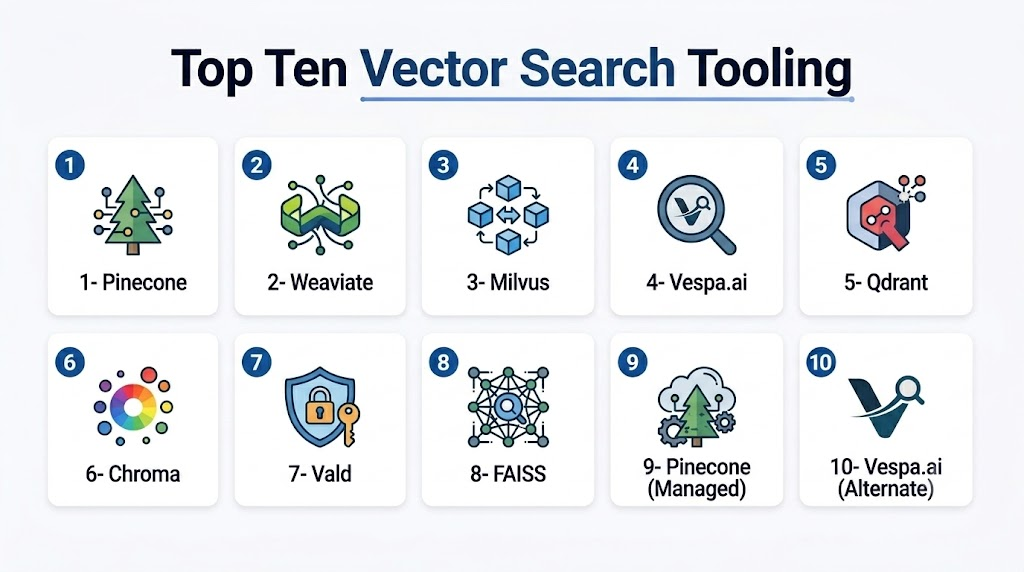
Top 10 Vector Search Tooling
1- Pinecone
Short description: A managed vector database optimized for real-time similarity search and recommendation systems. Suited for AI developers and ML teams.
Key Features
- Fully managed vector database
- High-dimensional vector support
- Real-time indexing and retrieval
- Scalable API for production workloads
- Multi-cloud deployment support
Pros
- Easy setup and deployment
- Handles millions of vectors efficiently
- Strong developer-friendly API
Cons
- Cloud-only, limited on-prem options
- Pricing may be high for large-scale projects
Platforms / Deployment
- Web / Cloud
Security & Compliance
- Not publicly stated
Integrations & Ecosystem
Supports integration with Python, Node.js, and ML frameworks such as TensorFlow and PyTorch.
- REST and gRPC APIs
- SDKs for major languages
- Supports vector embeddings from LLMs and NLP models
Support & Community
Comprehensive docs, active developer forum, managed support tiers.
2- Weaviate
Short description: Open-source vector search engine with semantic search and graph database features. Ideal for enterprises needing hybrid search.
Key Features
- Hybrid vector + keyword search
- Graph relationships for contextual querying
- Modular architecture for plugins
- Real-time indexing and scalable clustering
Pros
- Open-source with strong community
- Flexible for hybrid deployments
- Supports multiple data types
Cons
- Requires self-management for large clusters
- Some advanced features need commercial licenses
Platforms / Deployment
- Web / Linux / Cloud / Self-hosted
Security & Compliance
- Not publicly stated
Integrations & Ecosystem
Supports REST, GraphQL, Python SDK, and embedding from Hugging Face or OpenAI models.
- Multi-modal vector handling
- Cloud connectors for AWS, GCP
- Integration with ML pipelines
Support & Community
Active open-source community, tutorials, commercial support available.
3- Milvus
Short description: Open-source high-performance vector database designed for similarity search in enterprise AI applications.
Key Features
- GPU-accelerated vector indexing
- Approximate Nearest Neighbor (ANN) support
- Multi-modal search (text, image, audio)
- Horizontal scaling for big data
Pros
- Free and open-source
- High throughput and low latency
- Large-scale vector handling
Cons
- Requires infrastructure management
- Complex setup for beginners
Platforms / Deployment
- Linux / Cloud / Hybrid
Security & Compliance
- Not publicly stated
Integrations & Ecosystem
- Python, Java, Go SDKs
- ML integration with TensorFlow, PyTorch
- Connector support for various data stores
Support & Community
Large community, active forums, commercial enterprise support.
4- Vespa.ai
Short description: Engine for vector search and recommendation applications, combining structured data with embeddings.
Key Features
- Real-time ANN search
- Combining structured + vector data
- Scalability for millions of queries
- Machine-learned ranking support
Pros
- Powerful hybrid search
- Handles large-scale production workloads
- Open-source with enterprise options
Cons
- Steeper learning curve
- Self-hosted deployment complexity
Platforms / Deployment
- Linux / Cloud / Self-hosted
Security & Compliance
- Not publicly stated
Integrations & Ecosystem
- REST APIs, Java SDK
- Compatible with ML models for embedding
- Supports advanced ranking features
Support & Community
Active open-source community, professional support plans.
5- Qdrant
Short description: Cloud-native vector search engine for semantic search, recommendation, and AI applications.
Key Features
- High-performance ANN search
- Filterable vector queries
- Multi-tenancy and cloud deployment
- Real-time updates
Pros
- Easy to integrate and deploy
- Fast similarity searches
- Managed and self-hosted options
Cons
- Fewer enterprise-grade features than larger platforms
- Limited historical analytics
Platforms / Deployment
- Web / Cloud / Self-hosted
Security & Compliance
- Not publicly stated
Integrations & Ecosystem
- Python, REST, gRPC SDKs
- Embedding support from popular AI models
- Extensible through plugins
Support & Community
Active docs, community forum, optional commercial support.
6- Chroma
Short description: Open-source vector database for AI-native applications, designed for embedding storage and retrieval.
Key Features
- Efficient vector indexing
- Python-native SDK
- Flexible deployment
- Supports multi-modal data
Pros
- Open-source and lightweight
- Simple integration with AI pipelines
- Fast retrieval
Cons
- Smaller community
- Lacks some enterprise features
Platforms / Deployment
- Linux / Cloud / Self-hosted
Security & Compliance
- Not publicly stated
Integrations & Ecosystem
- Python SDK, REST API
- Embedding support from LLMs
- Works with ML model outputs
Support & Community
Open-source community, basic docs, limited enterprise support.
7- Vald
Short description: Distributed vector search engine with focus on cloud-native scalability and AI search applications.
Key Features
- ANN search
- Kubernetes native
- Multi-cloud support
- Highly scalable and fault-tolerant
Pros
- Designed for cloud-native deployment
- Supports large-scale vector searches
- High resilience and uptime
Cons
- Complex setup for small teams
- Limited pre-built ML integrations
Platforms / Deployment
- Cloud / Linux / Kubernetes
Security & Compliance
- Not publicly stated
Integrations & Ecosystem
- REST API, Go SDK, Python SDK
- Works with AI embedding models
- Kubernetes deployment patterns
Support & Community
Open-source support, active development community.
8- FAISS (Facebook AI Similarity Search)
Short description: Open-source library for vector similarity search, optimized for large datasets and high-dimensional embeddings.
Key Features
- GPU-accelerated vector search
- ANN indexing
- Scalable for billions of vectors
- Supports multiple distance metrics
Pros
- Extremely fast for high-dimensional data
- Open-source and widely used
- Integrates with AI frameworks
Cons
- Requires programming knowledge
- No managed service
Platforms / Deployment
- Linux / Windows / macOS
Security & Compliance
- Not publicly stated
Integrations & Ecosystem
- Python, C++ APIs
- Integrates with TensorFlow, PyTorch
- Works as backend engine for search services
Support & Community
Strong open-source community, active contributions.
9- Pinecone (Vector Database)
Short description: Fully managed vector database for similarity search, embeddings, and semantic retrieval.
Key Features
- Real-time vector indexing
- High throughput
- Managed cloud service
- Scalable and multi-tenant
Pros
- Easy to deploy and manage
- Optimized for production workloads
- Strong API support
Cons
- Cloud-only
- Cost scales with usage
Platforms / Deployment
- Web / Cloud
Security & Compliance
- Not publicly stated
Integrations & Ecosystem
- Python, Node.js SDK
- Compatible with AI embedding pipelines
- REST API
Support & Community
Managed support, active developer community.
10- Vespa.ai (Alternate)
Short description: Engine for large-scale vector and structured search, semantic ranking, and recommendation systems.
Key Features
- ANN search
- Hybrid vector + structured search
- Scalable clustering
- Supports machine-learned ranking
Pros
- Robust for enterprise-scale
- Combines structured + semantic search
- Open-source with professional support
Cons
- Steep learning curve
- Self-hosted management needed
Platforms / Deployment
- Linux / Cloud / Self-hosted
Security & Compliance
- Not publicly stated
Integrations & Ecosystem
- Java SDK, REST API
- Supports embeddings from LLMs
- Integration with ML pipelines
Support & Community
Active open-source community and enterprise support.
Comparison Table (Top 10)
| Tool Name | Best For | Platform(s) Supported | Deployment | Standout Feature | Public Rating |
|---|---|---|---|---|---|
| 1- Pinecone | Real-time semantic search | Web | Cloud | Fully managed vector DB | N/A |
| 2- Weaviate | Hybrid vector + keyword | Web, Linux | Cloud/Self-hosted | Graph-based semantic queries | N/A |
| 3- Milvus | High-performance AI search | Linux | Cloud/Self-hosted | GPU-accelerated ANN | N/A |
| 4- Vespa.ai | Enterprise-scale vector search | Linux | Cloud/Self-hosted | Hybrid search + ranking | N/A |
| 5- Qdrant | AI embedding search | Web | Cloud/Self-hosted | Filterable vector queries | N/A |
| 6- Chroma | AI-native vector DB | Linux | Cloud/Self-hosted | Python-native SDK | N/A |
| 7- Vald | Cloud-native distributed search | Cloud, Linux | Cloud | Kubernetes-native scaling | N/A |
| 8- FAISS | High-dimensional vector search | Linux, macOS, Windows | Self-hosted | GPU acceleration | N/A |
| 9- Pinecone | Managed vector DB | Web | Cloud | Multi-tenant vector indexing | N/A |
| 10- Vespa.ai | Semantic ranking & search | Linux | Cloud/Self-hosted | Hybrid vector + structured | N/A |
Evaluation & Scoring of Vector Search Tooling
| Tool Name | Core (25%) | Ease (15%) | Integrations (15%) | Security (10%) | Performance (10%) | Support (10%) | Value (15%) | Weighted Total (0–10) |
|---|---|---|---|---|---|---|---|---|
| 1- Pinecone | 9 | 9 | 8 | 7 | 9 | 8 | 7 | 8.4 |
| 2- Weaviate | 8 | 7 | 8 | 7 | 8 | 7 | 8 | 7.7 |
| 3- Milvus | 9 | 6 | 7 | 7 | 9 | 7 | 8 | 7.9 |
| 4- Vespa.ai | 9 | 6 | 8 | 7 | 8 | 7 | 8 | 7.8 |
| 5- Qdrant | 8 | 8 | 7 | 7 | 8 | 7 | 7 | 7.5 |
| 6- Chroma | 7 | 8 | 7 | 6 | 7 | 6 | 7 | 7.0 |
| 7- Vald | 8 | 7 | 7 | 7 | 8 | 7 | 7 | 7.4 |
| 8- FAISS | 9 | 5 | 6 | 6 | 9 | 6 | 8 | 7.0 |
| 9- Pinecone | 9 | 9 | 8 | 7 | 9 | 8 | 7 | 8.4 |
| 10- Vespa.ai | 9 | 6 | 8 | 7 | 8 | 7 | 8 | 7.8 |
Which Vector Search Tool Is Right for You?
Solo / Freelancer
- Lightweight open-source options like Chroma or FAISS.
- Easy to integrate with Python AI pipelines.
SMB
- Qdrant or Weaviate for managed or hybrid deployments.
- Balanced cost and performance.
Mid-Market
- Pinecone or Milvus for high performance with manageable scaling.
Enterprise
- Vespa.ai or Pinecone managed service for large-scale, multi-tenant production systems.
Budget vs Premium
- FAISS, Chroma for free/open-source options
- Pinecone, Vespa.ai for enterprise-grade premium solutions
Feature Depth vs Ease of Use
- FAISS has deep features but steeper learning curve
- Pinecone is simpler with managed operations
Integrations & Scalability
- All tools integrate with AI embedding pipelines; scale depends on cloud or GPU support
Security & Compliance Needs
- Enterprise deployments (Pinecone, Vespa) preferred for regulated data
Frequently Asked Questions (FAQs)
1- What is vector search?
Vector search uses mathematical embeddings to find semantically similar items across text, images, and structured data. It outperforms keyword search in AI and NLP scenarios.
2- How does vector search differ from keyword search?
Unlike keyword search, vector search understands context and meaning, returning results based on semantic similarity rather than exact matches.
3- Which programming languages are supported?
Most vector platforms provide SDKs for Python, Java, Node.js, and REST APIs, making them compatible with AI and ML pipelines.
4- Can vector search handle multi-modal data?
Yes, platforms like Milvus, Vespa.ai, and Weaviate support text, image, and audio embeddings for hybrid searches.
5- Are these tools cloud-native or self-hosted?
Options vary: Pinecone is cloud-managed, FAISS is self-hosted, Weaviate and Milvus can be deployed either way.
6- How scalable are these solutions?
Scalability depends on architecture: GPU acceleration, distributed clusters, and cloud elasticity allow handling millions to billions of vectors.
7- What are common use cases?
Semantic search, recommendation systems, chatbots, image similarity, anomaly detection, and AI content retrieval.
8- How do I ensure data security?
Implement SSO, RBAC, encryption at rest/in transit, and choose platforms compliant with enterprise regulations (SOC 2, GDPR, HIPAA).
9- Are these tools suitable for startups?
Yes, lightweight open-source options (Chroma, FAISS) are ideal for early-stage AI-driven applications.
10- Can I integrate these with existing ML pipelines?
Yes, all top tools provide APIs, SDKs, and connectors to integrate with embeddings from LLMs, TensorFlow, and PyTorch.
Conclusion
Vector search tooling is reshaping semantic search, AI-driven recommendations, and multi-modal data retrieval. Selecting the right platform depends on scale, team expertise, and deployment preferences. Enterprises benefit from managed services for reliability, while open-source options are ideal for experimentation. Evaluating features, performance, and integrations ensures alignment with business needs. Consider GPU acceleration, hybrid search support, and security compliance. Start with a pilot, measure relevance and latency, then scale to production. The best tool is context-dependent and should fit the organization’s long-term AI strategy.

Find Trusted Cardiac Hospitals
Compare heart hospitals by city and services — all in one place.
Explore Hospitals
One key challenge often overlooked in vector search tooling is how high-dimensional indexing structures behave under frequent data updates. As embeddings evolve and datasets grow, maintaining both search accuracy and low-latency performance becomes a continuous tuning problem rather than a one-time setup.