Introduction
Responsible AI tooling refers to platforms and software solutions that help organizations ensure their AI and machine learning models operate ethically, fairly, and transparently. These tools focus on detecting bias, explaining model decisions, monitoring model behavior, and ensuring compliance with regulations or internal policies. as AI adoption expands across industries, responsible AI tooling is becoming a critical part of any AI strategy to maintain trust, reduce risks, and comply with growing governance standards.
Real-world use cases include:
- Detecting and mitigating bias in hiring algorithms or credit scoring models.
- Ensuring explainability and transparency in medical AI diagnostics.
- Monitoring predictive models in finance to prevent unfair discrimination.
- Auditing AI models in regulated industries like healthcare, insurance, and government.
- Implementing human-in-the-loop checks for high-stakes decision-making.
Evaluation criteria for buyers:
- Bias detection and fairness assessment capabilities.
- Model explainability and transparency features.
- Continuous monitoring and drift detection.
- Regulatory compliance support and audit logging.
- Integration with existing ML pipelines.
- Security and access control.
- Reporting and visualization capabilities.
- Support and community resources.
- Scalability and multi-model support.
Best for: AI ethics teams, data scientists, ML engineers, compliance officers, and organizations deploying AI at scale in regulated or high-risk sectors.
Not ideal for: Teams running low-stakes AI experiments, or projects where standard ML monitoring suffices without formal governance or explainability requirements.
Key Trends in Responsible AI Tooling
- Growth of explainable AI (XAI) features for model transparency across industries.
- Integration of bias detection and fairness auditing directly into MLOps pipelines.
- Increased use of human-in-the-loop review to validate high-risk predictions.
- Support for multi-modal and large language models with explainability dashboards.
- Cloud-native deployment with enterprise security and governance controls.
- Automated model monitoring and drift detection to maintain compliance.
- Enhanced regulatory support for GDPR, CCPA, and emerging AI regulations.
- API-first architectures for easy integration into existing workflows.
- AI performance auditing and reporting for board-level governance.
- Pricing models shifting toward subscription-based, usage-scalable SaaS.
How We Selected These Tools (Methodology)
- Evaluated market adoption and mindshare among enterprise and developer users.
- Assessed feature completeness: bias detection, explainability, monitoring.
- Reviewed reliability and performance in real-world AI deployments.
- Considered security posture: access control, encryption, audit logs.
- Examined integration capability with ML pipelines and MLOps tools.
- Determined customer fit for solo developers, SMBs, mid-market, and enterprise.
- Evaluated support and community strength.
- Considered scalability and cloud deployment options.
- Checked AI-specific compliance capabilities.
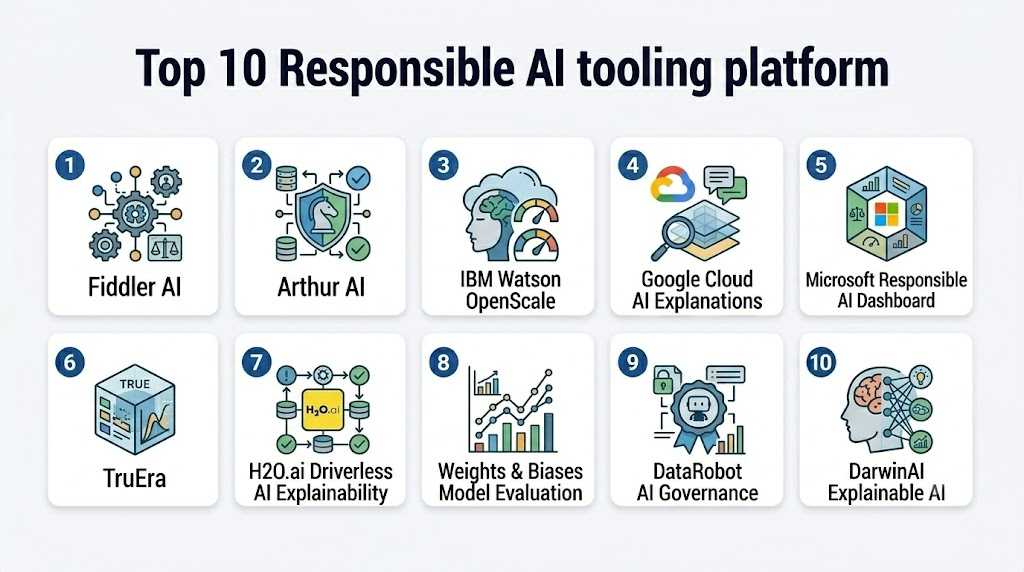
Top 10 Responsible AI Tooling Tools
1- Fiddler AI
Short description: Fiddler AI provides enterprise-grade explainability, monitoring, and bias detection for machine learning models, focusing on real-time model transparency.
Key Features
- Explainable AI dashboards and model insights.
- Bias detection and fairness auditing.
- Model monitoring and drift alerts.
- Integration with major ML frameworks.
- Collaboration tools for teams and stakeholders.
Pros
- Real-time insights into model behavior.
- Strong focus on compliance and auditability.
Cons
- May require technical expertise for full deployment.
- Subscription pricing can be high for smaller teams.
Platforms / Deployment
- Web
- Cloud
Security & Compliance
Not publicly stated
Integrations & Ecosystem
Supports Python SDKs and REST APIs.
- TensorFlow, PyTorch
- MLOps platforms
- BI tools for reporting
Support & Community
Documentation and onboarding support available; enterprise support tiers.
2- Arthur AI
Short description: Arthur AI helps organizations monitor, explain, and detect bias in ML models with real-time dashboards and automated alerts.
Key Features
- Continuous model monitoring for performance and fairness.
- Explainability metrics for individual predictions.
- Bias and drift detection across multiple models.
- Automated reporting for audits.
- Multi-team collaboration dashboards.
Pros
- Strong monitoring for production models.
- Useful for compliance reporting.
Cons
- Limited offline or self-hosted options.
- Steeper learning curve for smaller teams.
Platforms / Deployment
- Web
- Cloud
Security & Compliance
Not publicly stated
Integrations & Ecosystem
- Python SDK
- MLflow integration
- APIs for MLOps pipelines
Support & Community
Enterprise support available; documentation comprehensive.
3- IBM Watson OpenScale
Short description: IBM Watson OpenScale provides AI governance with explainability, fairness, and continuous monitoring across AI deployments.
Key Features
- Bias detection and fairness scoring.
- Explainability for AI decisions.
- Model drift and performance monitoring.
- Integration with Watson and non-Watson AI models.
- Audit logs and compliance reporting.
Pros
- Enterprise-grade governance.
- Supports hybrid and multi-cloud environments.
Cons
- Best suited for IBM ecosystem users.
- Complexity may challenge small teams.
Platforms / Deployment
- Web
- Cloud / Hybrid
Security & Compliance
SOC 2, ISO 27001
Integrations & Ecosystem
- IBM Cloud and Watson ML
- Python and Java SDKs
- APIs for enterprise pipelines
Support & Community
Strong enterprise support and extensive documentation.
4- Google Cloud AI Explanations
Short description: Provides model transparency and explainability for AI deployments on Google Cloud, including feature attribution and fairness metrics.
Key Features
- Local and global model explainability.
- Bias detection metrics.
- Integration with Vertex AI pipelines.
- Visualization dashboards for predictions.
- Automated reporting tools.
Pros
- Tight integration with Google Cloud AI ecosystem.
- Scalable and cloud-native.
Cons
- Limited to Google Cloud users.
- May require technical expertise to configure.
Platforms / Deployment
- Web
- Cloud
Security & Compliance
Not publicly stated
Integrations & Ecosystem
- Vertex AI
- TensorFlow, PyTorch
- BigQuery for data storage
Support & Community
Google Cloud support tiers; extensive documentation.
5- Microsoft Responsible AI Dashboard
Short description: A platform to evaluate and monitor AI models for fairness, interpretability, and responsible deployment practices.
Key Features
- Model interpretability and feature attribution.
- Bias and fairness assessments.
- Audit and compliance reporting.
- Integration with Azure AI services.
- Collaboration tools for governance teams.
Pros
- Strong integration with Azure ecosystem.
- Enterprise-ready monitoring dashboards.
Cons
- Cloud-dependent on Azure.
- Less flexible outside Microsoft stack.
Platforms / Deployment
- Web
- Cloud
Security & Compliance
Not publicly stated
Integrations & Ecosystem
- Azure AI and ML frameworks
- REST APIs for automation
- Power BI for reporting
Support & Community
Enterprise support via Microsoft; documentation extensive.
6- TruEra
Short description: TruEra offers explainability, model performance analysis, and bias detection for deployed AI models with actionable insights.
Key Features
- Real-time monitoring for accuracy and fairness.
- Explainability dashboards and model comparison.
- Bias detection and remediation tools.
- Alerts for performance drift.
- Multi-framework support.
Pros
- Focused on model health and ethical AI.
- Supports multiple model frameworks.
Cons
- Subscription pricing may be high.
- Implementation requires ML expertise.
Platforms / Deployment
- Web
- Cloud
Security & Compliance
Not publicly stated
Integrations & Ecosystem
- Python SDK
- TensorFlow, PyTorch
- MLOps pipelines
Support & Community
Documentation and enterprise support available.
7- H2O.ai Driverless AI Explainability
Short description: Provides responsible AI features including explainability, bias detection, and model interpretability for automated ML workflows.
Key Features
- Feature importance and SHAP analysis.
- Bias detection and fairness scoring.
- Automated explanations for model predictions.
- Integration with H2O.ai AutoML pipelines.
- Reporting dashboards.
Pros
- Strong integration with AutoML workflows.
- Supports enterprise-scale datasets.
Cons
- Primarily focused on H2O AutoML users.
- Learning curve for beginners.
Platforms / Deployment
- Web / Windows / Linux
- Cloud / Hybrid
Security & Compliance
Not publicly stated
Integrations & Ecosystem
- H2O.ai ecosystem
- Python SDK
- BI and visualization tools
Support & Community
Professional support available; strong documentation.
8- Weights & Biases Model Evaluation
Short description: Platform for monitoring AI model fairness, explainability, and performance metrics with reporting capabilities.
Key Features
- Model version tracking and evaluation.
- Fairness and bias detection.
- Explainability dashboards.
- Integration with training pipelines.
- Team collaboration features.
Pros
- Strong tracking and collaboration.
- Supports multiple ML frameworks.
Cons
- Primarily cloud-based; limited self-hosted options.
- Focus on evaluation, less on remediation.
Platforms / Deployment
- Web
- Cloud
Security & Compliance
Not publicly stated
Integrations & Ecosystem
- TensorFlow, PyTorch, scikit-learn
- Python SDK
- APIs for CI/CD pipelines
Support & Community
Documentation available; active community.
9- DataRobot AI Governance
Short description: Enterprise platform for AI governance, model transparency, and regulatory compliance.
Key Features
- Explainability and fairness scoring.
- Compliance dashboards.
- Automated reporting and auditing.
- Integration with ML pipelines.
- Collaboration tools.
Pros
- Enterprise-grade governance features.
- Comprehensive auditing and compliance support.
Cons
- Best suited for enterprise customers.
- Less flexible for individual developers.
Platforms / Deployment
- Web
- Cloud
Security & Compliance
SOC 2, ISO 27001
Integrations & Ecosystem
- DataRobot AutoML
- Python API
- Cloud ML pipelines
Support & Community
Enterprise support; documentation robust.
10- DarwinAI Explainable AI
Short description: Provides explainability, transparency, and AI model auditing for enterprise-grade neural networks.
Key Features
- Neural network explainability.
- Bias detection and fairness metrics.
- Model audit logs and transparency reports.
- Integration with deep learning frameworks.
- Deployment monitoring tools.
Pros
- Strong focus on deep learning transparency.
- Enterprise-grade reporting features.
Cons
- Primarily for advanced neural networks.
- Pricing may be prohibitive for SMBs.
Platforms / Deployment
- Web
- Cloud
Security & Compliance
Not publicly stated
Integrations & Ecosystem
- TensorFlow, PyTorch
- Python SDK
- Enterprise MLOps pipelines
Support & Community
Enterprise support; documentation available.
Comparison Table (Top 10)
| Tool Name | Best For | Platform(s) Supported | Deployment | Standout Feature | Public Rating |
|---|---|---|---|---|---|
| Fiddler AI | Enterprise explainability | Web | Cloud | Real-time model insights | N/A |
| Arthur AI | Model monitoring | Web | Cloud | Real-time fairness and drift | N/A |
| IBM Watson OpenScale | Enterprise AI governance | Web | Cloud/Hybrid | Bias detection & audit | N/A |
| Google Cloud AI Explanations | Google Cloud AI users | Web | Cloud | Feature attribution & explainability | N/A |
| Microsoft Responsible AI Dashboard | Azure AI deployments | Web | Cloud | Compliance & interpretability | N/A |
| TruEra | Model evaluation | Web | Cloud | Bias & performance monitoring | N/A |
| H2O.ai Driverless AI Explainability | AutoML pipelines | Web/Windows/Linux | Cloud/Hybrid | Automated explanations | N/A |
| Weights & Biases Model Evaluation | ML pipeline tracking | Web | Cloud | Model version & fairness tracking | N/A |
| DataRobot AI Governance | Enterprise compliance | Web | Cloud | Comprehensive governance dashboard | N/A |
| DarwinAI Explainable AI | Neural network transparency | Web | Cloud | Deep learning model explainability | N/A |
Evaluation & Scoring of Responsible AI Tooling
| Tool Name | Core (25%) | Ease (15%) | Integrations (15%) | Security (10%) | Performance (10%) | Support (10%) | Value (15%) | Weighted Total (0–10) |
|---|---|---|---|---|---|---|---|---|
| Fiddler AI | 9 | 7 | 8 | 6 | 8 | 7 | 7 | 7.85 |
| Arthur AI | 8 | 7 | 7 | 6 | 7 | 7 | 7 | 7.25 |
| IBM Watson OpenScale | 9 | 6 | 7 | 8 | 8 | 7 | 6 | 7.5 |
| Google Cloud AI Explanations | 8 | 7 | 7 | 7 | 7 | 6 | 7 | 7.2 |
| Microsoft Responsible AI Dashboard | 8 | 7 | 6 | 7 | 7 | 6 | 6 | 6.85 |
| TruEra | 8 | 7 | 7 | 6 | 7 | 6 | 6 | 6.85 |
| H2O.ai Driverless AI Explainability | 8 | 6 | 7 | 6 | 7 | 6 | 6 | 6.75 |
| Weights & Biases Model Evaluation | 7 | 7 | 7 | 6 | 6 | 6 | 6 | 6.55 |
| DataRobot AI Governance | 9 | 6 | 7 | 8 | 8 | 7 | 6 | 7.5 |
| DarwinAI Explainable AI | 8 | 6 | 7 | 6 | 7 | 6 | 6 | 6.75 |
Which Responsible AI Tool Is Right for You?
Solo / Freelancer
Weights & Biases, Fiddler AI, or TruEra are suitable for individual model evaluation and small-scale explainability needs.
SMB
Arthur AI, Fiddler AI, or H2O.ai Driverless AI Explainability provide accessible dashboards and operational insights with manageable costs.
Mid-Market
TruEra, Microsoft Responsible AI Dashboard, and Google Cloud AI Explanations offer collaborative monitoring, bias detection, and governance features.
Enterprise
IBM Watson OpenScale, DataRobot AI Governance, and DarwinAI support large-scale deployments, regulatory compliance, and enterprise governance workflows.
Budget vs Premium
Open-source or developer-friendly tools like Weights & Biases and Fiddler AI are cost-efficient. Enterprise-focused platforms offer full governance but at higher subscription pricing.
Feature Depth vs Ease of Use
Tools like IBM Watson OpenScale and DataRobot provide deep governance features but require technical knowledge. Fiddler AI and Arthur AI balance usability with advanced monitoring.
Integrations & Scalability
Cloud-native platforms integrate with existing MLOps pipelines and scale for multiple models and datasets.
Security & Compliance Needs
Organizations in regulated sectors should prioritize SOC 2, ISO 27001, and audit-ready platforms for model governance.
Frequently Asked Questions (FAQs)
1- What is responsible AI tooling?
Tools that help monitor, explain, and govern AI models for fairness, transparency, and compliance.
2- Do these platforms detect bias automatically?
Most provide automated bias metrics, fairness scoring, and alerts, but human validation is recommended.
3- Can responsible AI tools explain model predictions?
Yes, explainability dashboards and feature attribution methods help stakeholders understand predictions.
4- Are these tools cloud-only?
Some are cloud-native, while others offer hybrid or self-hosted options.
5- How do I integrate them with my ML workflow?
Platforms provide APIs, SDKs, or built-in integrations with common ML frameworks like TensorFlow and PyTorch.
6- Are these tools suitable for small teams?
Yes, several tools like Fiddler AI and Weights & Biases cater to small-scale deployments.
7- Do they support multi-modal AI models?
Many platforms support structured, text, image, and video-based models.
8- How do they help with regulatory compliance?
By maintaining audit logs, fairness reports, and explainability dashboards aligned with governance standards.
9- What are the costs like?
Costs vary: open-source or developer-focused tools are affordable; enterprise platforms have subscription-based pricing.
10- Can these tools prevent AI failures?
They reduce risk by monitoring drift, bias, and model behavior but do not replace robust development and testing.
Conclusion
Responsible AI tooling is becoming a critical component for organizations that deploy AI at scale, helping ensure fairness, transparency, and accountability. These platforms enable teams to detect bias, explain model decisions, monitor performance, and maintain compliance with evolving regulations. Selecting the right tool depends on your team size, AI model types, deployment scale, and governance requirements. Small teams may prioritize usability and integration, while enterprises may need robust audit and compliance features. Piloting 2–3 tools on real-world models helps assess fit, usability, and workflow compatibility. Cloud-native and hybrid options provide flexibility and scalability as your AI initiatives grow. By adopting responsible AI tooling, organizations can reduce risk, improve stakeholder trust, and support ethical AI adoption. The next step is to shortlist tools, run pilots, validate integrations and security, and scale with confidence.

Find Trusted Cardiac Hospitals
Compare heart hospitals by city and services — all in one place.
Explore Hospitals
One aspect that often receives less attention is organizational culture and accountability. Even with strong Responsible AI tools, clear ownership and cross-functional collaboration are essential to ensure ethical practices are consistently followed.