Introduction
Bias & Fairness Testing Tools are specialized platforms that help organizations identify, measure, and mitigate biases in AI and machine learning models. They provide actionable insights into how algorithms behave across different demographic groups, ensuring that predictions, recommendations, or decisions are equitable and ethically sound. as AI adoption grows in sensitive domains such as healthcare, finance, hiring, and criminal justice, these tools have become essential for responsible AI deployment.
Real-world use cases include:
- Evaluating loan approval algorithms to ensure fair credit access.
- Testing recruitment AI for demographic neutrality.
- Auditing healthcare predictive models to prevent unequal treatment recommendations.
- Monitoring content recommendation engines to reduce algorithmic bias.
- Ensuring fairness in autonomous decision-making systems like insurance claims or criminal risk assessments.
Key evaluation criteria for buyers:
- Coverage of protected attributes and demographic fairness
- Depth of bias detection metrics and explainability
- Support for multiple model types and ML frameworks
- Ease of integration into existing pipelines
- Automation of fairness testing and reporting
- Security and compliance capabilities
- Visualization and interpretability tools
- Scalability for enterprise-grade deployments
- Regulatory alignment (GDPR, CCPA, EU AI Act)
- Support and community engagement
Best for: AI ethics teams, data scientists, ML engineers, compliance officers, enterprise organizations, fintech, healthcare, and HR technology companies.
Not ideal for: Organizations with minimal AI deployment or those only running simple models without sensitive decision-making requirements.
Key Trends in Bias & Fairness Testing Tools
- Integration of AI-driven bias detection with continuous model monitoring pipelines.
- Automated counterfactual testing and scenario-based fairness evaluation.
- Real-time dashboards for bias and fairness metrics across multiple model versions.
- Expansion of fairness definitions beyond statistical parity to outcome-based fairness.
- Adoption of explainable AI techniques to complement fairness audits.
- Cross-industry compliance frameworks aligning with global AI regulations.
- Cloud-native deployment with hybrid support for enterprise ML stacks.
- Increasing focus on model retraining recommendations for fairness improvement.
- Integration with MLOps platforms for continuous evaluation and governance.
- Incorporation of ethical scoring and risk assessment metrics for decision-makers.
How We Selected These Tools (Methodology)
- Evaluated market adoption, mindshare, and enterprise traction.
- Analyzed feature completeness for bias detection, metrics, and reporting.
- Assessed reliability, performance, and scalability signals in real-world deployments.
- Reviewed security posture, including access controls, encryption, and compliance.
- Checked integrations with popular ML frameworks (TensorFlow, PyTorch, scikit-learn).
- Evaluated applicability across multiple industries and model types.
- Considered automation and workflow orchestration capabilities.
- Reviewed documentation quality, onboarding ease, and community engagement.
- Focused on tools supporting explainability and transparency in model decisions.
- Prioritized platforms actively updating to align with emerging AI regulations.
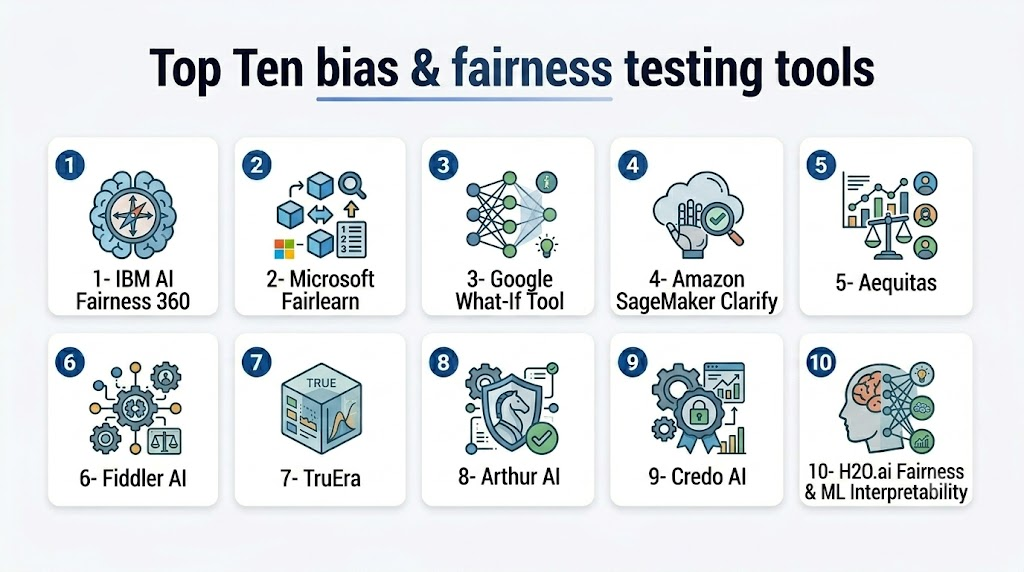
Top 10 Bias & Fairness Testing Tools
1- IBM AI Fairness 360
Short description: Open-source toolkit for detecting and mitigating bias in AI models, suitable for developers and data scientists in enterprise and academic settings.
Key Features
- Preprocessing, in-processing, and post-processing bias mitigation algorithms
- Support for structured and unstructured data
- Metrics for disparate impact, statistical parity, and fairness over time
- Integration with Python ML frameworks
- Extensible API for custom fairness tests
Pros
- Extensive library of fairness metrics and algorithms
- Open-source with active community contributions
Cons
- Requires Python expertise
- Visualization features are limited
Platforms / Deployment
- Web / Windows / macOS / Linux
- Cloud / Self-hosted
Security & Compliance
Not publicly stated
Integrations & Ecosystem
Integrates easily with scikit-learn, TensorFlow, PyTorch
- Jupyter notebooks
- ML pipelines
- Custom Python scripts
Support & Community
Active GitHub community; extensive tutorials and sample datasets
2- Microsoft Fairlearn
Short description: Toolkit designed to assess and mitigate fairness issues in machine learning models for enterprise and research teams.
Key Features
- Fairness assessment dashboard
- Mitigation algorithms for constrained optimization
- Supports multiple model types
- Visualizations for demographic disparities
- Python SDK for integration
Pros
- Clear fairness metrics visualization
- Supports integration with ML pipelines
Cons
- Limited to Python ecosystem
- Advanced mitigation requires expertise
Platforms / Deployment
- Web / Windows / macOS / Linux
- Cloud / Self-hosted
Security & Compliance
Not publicly stated
Integrations & Ecosystem
- Python ML frameworks
- Azure ML pipelines
- API extensibility
Support & Community
Documentation comprehensive; active GitHub repository
3- Google What-If Tool
Short description: Visualization-based tool for analyzing AI models for fairness, performance, and robustness without extensive coding.
Key Features
- Interactive feature slicing and counterfactual analysis
- Integration with TensorFlow models
- Visual impact analysis on demographics
- Scenario simulation for fairness testing
- Easy-to-use notebook interface
Pros
- Intuitive visualization interface
- Minimal coding needed for basic tests
Cons
- TensorFlow-centric
- Limited mitigation capabilities
Platforms / Deployment
- Web / Linux / macOS / Windows
- Cloud / Self-hosted
Security & Compliance
Not publicly stated
Integrations & Ecosystem
- TensorFlow
- Jupyter notebooks
- ML experimentation platforms
Support & Community
Strong community support; Google AI documentation
4- Aequitas
Short description: Open-source bias auditing toolkit focused on fairness assessment for structured data, designed for data science teams.
Key Features
- Pre-built fairness metrics dashboards
- Statistical analysis of disparities across groups
- Supports multiple fairness definitions
- Command-line interface and Python API
- Reports exportable for compliance documentation
Pros
- Lightweight and easy to integrate
- Flexible fairness metrics for multiple scenarios
Cons
- No built-in mitigation algorithms
- Focused on structured datasets
Platforms / Deployment
- Web / Windows / macOS / Linux
- Cloud / Self-hosted
Security & Compliance
Not publicly stated
Integrations & Ecosystem
- Python data pipelines
- Pandas, scikit-learn
- CSV / JSON report generation
Support & Community
Community-driven; active GitHub and documentation
5- Fiddler AI Fairness
Short description: Enterprise-grade ML monitoring platform with built-in bias detection and fairness reporting for complex production models.
Key Features
- Real-time fairness monitoring
- Predefined and customizable fairness metrics
- Multi-model and multi-environment support
- Explainability dashboards
- Automated alerts for bias drift
Pros
- Enterprise-ready with scalable deployment
- Continuous monitoring of models
Cons
- Licensing required
- Can be complex to configure
Platforms / Deployment
- Web / Windows / macOS / Linux
- Cloud / Hybrid
Security & Compliance
- SOC 2, GDPR
- SSO / MFA
Integrations & Ecosystem
- ML frameworks: scikit-learn, TensorFlow, PyTorch
- APIs for alerting
- Data warehouse integration
Support & Community
Dedicated enterprise support; documentation and onboarding resources
6- TruEra
Short description: AI observability platform offering fairness and bias testing alongside model performance monitoring for production ML.
Key Features
- Bias detection across sensitive attributes
- Root cause analysis for unfair model decisions
- Pre- and post-deployment fairness checks
- Model performance benchmarking
- Customizable dashboards for stakeholders
Pros
- Integrated with model monitoring workflows
- Supports enterprise governance needs
Cons
- Higher cost for small teams
- Setup requires technical expertise
Platforms / Deployment
- Web / Linux / Windows
- Cloud / Hybrid
Security & Compliance
Not publicly stated
Integrations & Ecosystem
- Python ML frameworks
- API support
- Cloud data warehouses
Support & Community
Professional support available; community limited to enterprise clients
7- H2O.ai Driverless AI
Short description: Automated machine learning platform with fairness and bias auditing as part of model interpretability suite.
Key Features
- Built-in bias metrics and reporting
- Automatic feature engineering with fairness awareness
- Model explainability via SHAP and LIME
- Supports tabular, text, and image data
- Deployment-ready model packaging
Pros
- Fully automated ML with bias insights
- Enterprise scalability
Cons
- Premium pricing
- Complexity for beginners
Platforms / Deployment
- Web / Windows / Linux
- Cloud / Self-hosted
Security & Compliance
Not publicly stated
Integrations & Ecosystem
- Python, R
- Cloud deployment pipelines
- MLflow integration
Support & Community
Strong enterprise support; active user forums
8- DataRobot AI Fairness
Short description: Enterprise AutoML platform with integrated bias detection and fairness reporting for model transparency and governance.
Key Features
- Multi-metric fairness evaluation
- Pre-built dashboards for demographic parity
- Bias mitigation recommendations
- Supports tabular and time series data
- Explainable AI outputs for stakeholders
Pros
- Integrates bias checks into AutoML workflow
- Supports regulated industries
Cons
- Enterprise pricing may limit smaller teams
- Less flexible for custom algorithms
Platforms / Deployment
- Web / Windows / Linux
- Cloud / Hybrid
Security & Compliance
Not publicly stated
Integrations & Ecosystem
- Python SDK
- Cloud ML pipelines
- APIs for alerts and reporting
Support & Community
Enterprise-grade support; extensive documentation
9- Fairness Indicators (TensorFlow)
Short description: Open-source toolkit for TensorFlow models that evaluates fairness across user-defined metrics and sensitive groups.
Key Features
- Metrics for classification fairness
- Visual dashboards for bias assessment
- TensorFlow integration for model pipelines
- Batch and streaming evaluation modes
- Counterfactual testing support
Pros
- Free and open-source
- Simple integration with TensorFlow models
Cons
- Limited to TensorFlow
- Mitigation requires external implementation
Platforms / Deployment
- Web / Linux / Windows / macOS
- Cloud / Self-hosted
Security & Compliance
Not publicly stated
Integrations & Ecosystem
- TensorFlow
- Jupyter notebooks
- Data visualization libraries
Support & Community
Strong TensorFlow community support; open-source contributions
10- Pymetrics Bias Auditing
Short description: Bias detection and fairness auditing tool for HR and talent assessment models using psychometric data and AI predictions.
Key Features
- Analyzes pre-employment assessment models
- Fairness metrics across demographic groups
- Detailed reporting for HR compliance
- Supports multiple AI assessment models
- Integration with HRIS systems
Pros
- Focused on recruitment fairness
- Generates regulatory-friendly reports
Cons
- Niche use-case focus
- Limited outside HR applications
Platforms / Deployment
- Web
- Cloud
Security & Compliance
Not publicly stated
Integrations & Ecosystem
- HRIS systems
- APIs for assessment platforms
- Dashboard export for stakeholders
Support & Community
Customer support focused on enterprise HR; limited developer community
Comparison Table (Top 10)
| Tool Name | Best For | Platform(s) Supported | Deployment | Standout Feature | Public Rating |
|---|---|---|---|---|---|
| IBM AI Fairness 360 | Developers / Data Scientists | Web, Windows, macOS, Linux | Cloud / Self-hosted | Pre-, in-, post-processing mitigation | N/A |
| Microsoft Fairlearn | Enterprise AI | Web, Windows, macOS, Linux | Cloud / Self-hosted | Dashboard for fairness metrics | N/A |
| Google What-If Tool | TensorFlow users | Web, Linux, macOS, Windows | Cloud / Self-hosted | Interactive visual analysis | N/A |
| Aequitas | Structured data fairness | Web, Windows, macOS, Linux | Cloud / Self-hosted | Statistical disparity analysis | N/A |
| Fiddler AI Fairness | Enterprise ML monitoring | Web, Windows, macOS, Linux | Cloud / Hybrid | Real-time bias monitoring | N/A |
| TruEra | Production ML monitoring | Web, Linux, Windows | Cloud / Hybrid | Root cause bias analysis | N/A |
| H2O.ai Driverless AI | AutoML fairness | Web, Windows, Linux | Cloud / Self-hosted | Automated bias detection | N/A |
| DataRobot AI Fairness | Enterprise AutoML | Web, Windows, Linux | Cloud / Hybrid | Bias mitigation recommendations | N/A |
| Fairness Indicators | TensorFlow models | Web, Linux, Windows, macOS | Cloud / Self-hosted | Visual dashboards | N/A |
| Pymetrics Bias Auditing | HR assessments | Web | Cloud | HR-focused fairness reporting | N/A |
Evaluation & Scoring of Bias & Fairness Testing Tools
| Tool Name | Core (25%) | Ease (15%) | Integrations (15%) | Security (10%) | Performance (10%) | Support (10%) | Value (15%) | Weighted Total (0–10) |
|---|---|---|---|---|---|---|---|---|
| IBM AI Fairness 360 | 9 | 7 | 8 | 7 | 8 | 7 | 9 | 8.1 |
| Microsoft Fairlearn | 8 | 8 | 7 | 7 | 8 | 7 | 8 | 7.8 |
| Google What-If Tool | 7 | 9 | 6 | 6 | 7 | 7 | 9 | 7.5 |
| Aequitas | 7 | 8 | 6 | 6 | 7 | 6 | 9 | 7.2 |
| Fiddler AI Fairness | 9 | 7 | 8 | 8 | 9 | 8 | 7 | 8.1 |
| TruEra | 8 | 7 | 8 | 7 | 8 | 7 | 7 | 7.5 |
| H2O.ai Driverless AI | 9 | 7 | 8 | 7 | 9 | 7 | 6 | 7.8 |
| DataRobot AI Fairness | 9 | 7 | 7 | 7 | 8 | 7 | 6 | 7.6 |
| Fairness Indicators | 7 | 8 | 6 | 6 | 7 | 6 | 9 | 7.3 |
| Pymetrics Bias Auditing | 7 | 8 | 6 | 6 | 7 | 6 | 7 | 7.0 |
Which Bias & Fairness Testing Tool Is Right for You?
Solo / Freelancer
Open-source tools like IBM AI Fairness 360, Microsoft Fairlearn, and Google What-If Tool are ideal due to low cost and flexibility.
SMB
Aequitas and Fairness Indicators provide lightweight integration and visual dashboards for smaller teams without heavy enterprise overhead.
Mid-Market
Fiddler AI Fairness and TruEra offer scalable monitoring and automated fairness reporting, suitable for organizations with multiple ML models.
Enterprise
H2O.ai Driverless AI, DataRobot AI Fairness, and Fiddler AI Fairness provide comprehensive bias detection, mitigation recommendations, and governance for large-scale deployment.
Budget vs Premium
Open-source tools (IBM AI Fairness 360, Fairlearn, What-If Tool) are budget-friendly; enterprise platforms (Fiddler, DataRobot, TruEra) offer advanced features at a premium.
Feature Depth vs Ease of Use
Enterprise platforms excel in depth and automation; visualization-focused tools provide higher usability for analysts and smaller teams.
Integrations & Scalability
Choose tools with APIs and pipeline support if integrating into complex ML workflows. Cloud and hybrid deployment improves scalability and enterprise compliance.
Security & Compliance Needs
For regulated industries, prioritize platforms with explicit SOC 2, GDPR, or MFA capabilities. Open-source tools require external processes for compliance alignment.
Frequently Asked Questions (FAQs)
1- What types of bias can these tools detect?
They detect demographic, statistical, and outcome-based bias across protected attributes such as race, gender, age, and socio-economic status.
2- Can bias mitigation be automated?
Some tools offer automated mitigation algorithms; others provide analysis to guide manual intervention.
3- Are these tools suitable for all AI model types?
Most support structured and tabular data; TensorFlow or PyTorch-specific tools are better for deep learning or unstructured data.
4- How easy is integration with existing ML pipelines?
Integration varies; Python SDKs and APIs facilitate embedding into CI/CD and MLOps workflows.
5- Do these tools handle continuous monitoring?
Enterprise platforms like Fiddler AI and TruEra offer real-time monitoring and alerts for bias drift.
6- Are there compliance benefits?
Tools help generate fairness reports for internal audits and regulatory compliance, though explicit certifications are often not provided.
7- Is visualization available?
Many provide dashboards or visualizations to analyze fairness metrics, counterfactuals, and demographic impacts.
8- What is the cost range?
Open-source tools are free; enterprise platforms require licensing, with pricing varying by model count and deployment.
9- How do I choose between open-source and enterprise tools?
Consider team size, model complexity, regulatory needs, and available resources for setup and monitoring.
10- Can these tools replace human oversight?
No, they assist human review. Fairness evaluation requires human judgment alongside automated metrics.
Conclusion
Bias & Fairness Testing Tools are essential for ensuring ethical and equitable AI.
Choosing the right tool depends on your model complexity, team size, regulatory requirements, and budget.
Open-source tools like IBM AI Fairness 360 and Fairlearn suit developers and small teams.
Enterprise platforms such as Fiddler AI and DataRobot provide scalability, automation, and governance for large deployments.
Start by shortlisting 2–3 tools that align with your use case and run pilot tests on critical models.
Validate fairness metrics, monitor bias continuously, and ensure compliance with industry regulations.
This structured approach helps organizations deploy AI responsibly while minimizing risk and improving trust.

Find Trusted Cardiac Hospitals
Compare heart hospitals by city and services — all in one place.
Explore Hospitals
One area worth exploring further is how fairness metrics are maintained over time as datasets and user behavior evolve. Continuous evaluation is essential because a model that starts fair may gradually develop unintended biases after repeated updates.