Introduction
Homomorphic Encryption Toolkits allow computations on encrypted data without revealing the underlying information. Unlike traditional encryption, which protects data at rest or in transit, homomorphic encryption ensures data privacy even while it is actively processed. this technology is becoming essential as organizations process sensitive data for AI, analytics, healthcare, finance, and multi-party collaborations while complying with GDPR, HIPAA, and other privacy regulations.
Real-world use cases include:
- Secure AI/ML model training on encrypted datasets without exposing sensitive information.
- Privacy-preserving analytics for healthcare patient data.
- Financial risk assessment on client portfolios without sharing raw data.
- Collaborative research between enterprises or academic institutions without sharing confidential data.
- Enabling cloud-based services to process sensitive information without breaching privacy laws.
Key evaluation criteria for buyers:
- Supported homomorphic encryption schemes (BFV, CKKS, BGV)
- Performance and scalability for large datasets
- Ease of integration with AI/ML frameworks and analytics tools
- Security and compliance support
- Multi-language and platform support
- Developer documentation and community support
- Licensing and deployment flexibility
- Extensibility for custom applications
- Availability of encrypted operations (add, multiply, etc.)
- GPU/TPU acceleration support for high-performance workloads
Best for: Enterprises, AI/ML developers, cryptography teams, and organizations handling sensitive datasets in healthcare, finance, and government sectors.
Not ideal for: Teams working with non-sensitive data or requiring only standard encryption for storage or transit, as homomorphic encryption introduces performance overhead and complexity.
Key Trends in Homomorphic Encryption Toolkits
- Hybrid HE frameworks: Toolkits now support mixed schemes, allowing both approximate and exact encrypted computations.
- AI/ML integration: Frameworks optimized for TensorFlow, PyTorch, and scikit-learn pipelines.
- Hardware acceleration: GPU/TPU support for homomorphic computations to reduce latency.
- Cloud-deployable HE: Toolkits packaged for cloud and containerized environments.
- Federated learning and privacy-preserving AI: Enabling multi-party model training without sharing raw data.
- Standardization of APIs: Uniform APIs across toolkits for encrypted computation operations.
- Performance optimization: Faster bootstrapping, batching, and parallel processing for large datasets.
- Enterprise-ready security features: Key management, access controls, and audit logging included.
- Open-source collaboration: Community-driven HE libraries improve transparency and adoption.
- Simplified deployment: Prebuilt Docker containers and SDKs for rapid integration.
How We Selected These Tools (Methodology)
- Reviewed market adoption and community traction.
- Assessed encryption scheme coverage and computation capabilities.
- Evaluated performance benchmarks for large-scale operations.
- Verified security and compliance readiness for enterprise and regulated use cases.
- Analyzed integration with AI/ML pipelines and programming languages.
- Examined support for hardware acceleration and cloud deployments.
- Considered documentation, tutorials, and community strength.
- Reviewed licensing and cost-effectiveness for different organizations.
- Compared developer productivity and usability across toolkits.
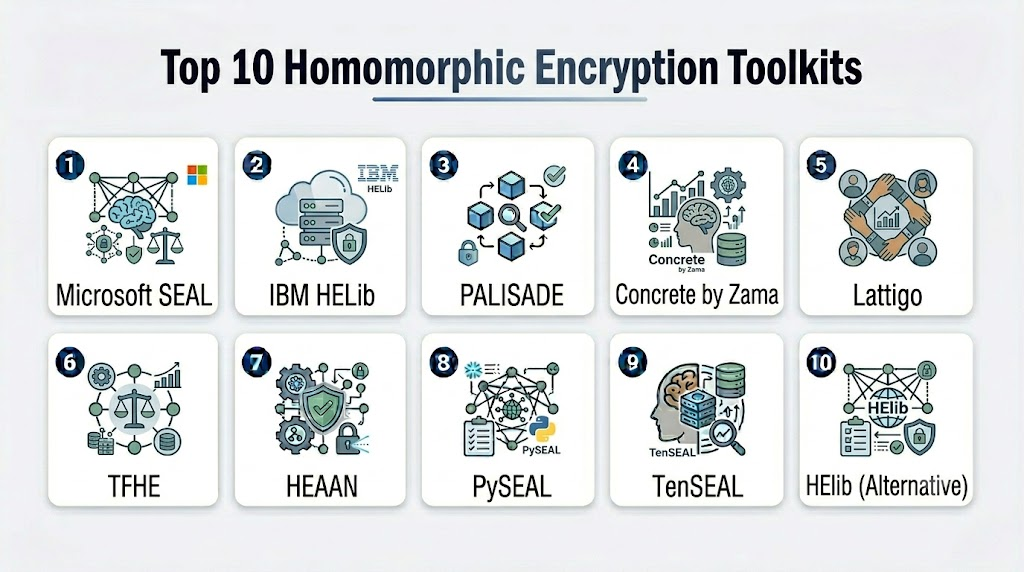
Top 10 Homomorphic Encryption Toolkits
1- Microsoft SEAL
Short description: A widely used, open-source library for homomorphic encryption, supporting secure computation for developers and enterprises.
Key Features
- Supports BFV and CKKS encryption schemes
- Efficient integer and real-number operations
- Multi-threaded performance optimizations
- .NET, C++, and Python bindings
- Active documentation and tutorials
Pros
- High-performance for research and production
- Strong community and Microsoft support
Cons
- No built-in GPU acceleration
- Steeper learning curve for beginners
Platforms / Deployment
- Windows / Linux / macOS
- Cloud / Self-hosted
Security & Compliance
- RBAC for key management
- Not publicly stated: SOC 2, ISO 27001
Integrations & Ecosystem
- Compatible with TensorFlow, PyTorch
- SDKs for Python and C++
- APIs for encrypted computations
Support & Community
- Active GitHub repository
- Detailed tutorials and sample projects
2- IBM HELib
Short description: Open-source homomorphic encryption library optimized for large integer computations, popular in research and enterprise solutions.
Key Features
- Supports BGV scheme
- Batch processing for vectors
- Optimized for multi-threaded operations
- Extensive documentation and examples
- C++ native support
Pros
- Mature library with strong cryptography foundation
- Scales well for enterprise workloads
Cons
- Complex setup for beginners
- Limited Python bindings
Platforms / Deployment
- Linux / Windows / macOS
- Self-hosted / Hybrid
Security & Compliance
- Not publicly stated
Integrations & Ecosystem
- Integrates with AI/ML frameworks through C++ APIs
- Can be wrapped for Python ML pipelines
Support & Community
- Research-focused community
- Active development and documentation
3- PALISADE
Short description: A high-performance HE library supporting multiple encryption schemes for research and commercial applications.
Key Features
- BFV, BGV, CKKS support
- Efficient bootstrapping and batching
- GPU acceleration support
- Multi-language SDKs
- Sample applications for analytics
Pros
- Flexible for AI/ML workloads
- Open-source with active community
Cons
- Requires understanding of HE math
- Deployment complexity for large datasets
Platforms / Deployment
- Linux / Windows / macOS
- Cloud / Self-hosted / Hybrid
Security & Compliance
- Not publicly stated
Integrations & Ecosystem
- TensorFlow, PyTorch
- Docker and containerized support
Support & Community
- GitHub community
- Tutorials and academic support
4- Concrete by Zama
Short description: Developer-first HE library focusing on privacy-preserving ML on encrypted data.
Key Features
- CKKS and TFHE support
- Encrypted neural network computation
- Python SDK with high-level API
- Cloud-ready deployment
- GPU acceleration
Pros
- Simplifies privacy-preserving AI
- Modern and active development
Cons
- Still maturing for large-scale production
- Limited enterprise certifications
Platforms / Deployment
- Linux / macOS
- Cloud / Self-hosted
Security & Compliance
- Not publicly stated
Integrations & Ecosystem
- PyTorch integration
- API for encrypted ML pipelines
Support & Community
- Active open-source community
- Tutorials and sample notebooks
5- Lattigo
Short description: Go-based HE library for developers building privacy-preserving applications in cloud and distributed environments.
Key Features
- BFV and CKKS support
- Golang-native APIs
- Lightweight and portable
- Encrypted ML computation support
- Multi-threading
Pros
- Developer-friendly for Go projects
- Efficient for cloud-native microservices
Cons
- Limited documentation compared to SEAL
- Smaller community
Platforms / Deployment
- Linux / macOS
- Cloud / Self-hosted
Security & Compliance
- Not publicly stated
Integrations & Ecosystem
- APIs for ML and analytics
- Docker deployment
Support & Community
- Community support
- Examples and tutorials on GitHub
6- TFHE
Short description: Fast Fully Homomorphic Encryption library specialized for Boolean circuits and binary data.
Key Features
- Supports fast gate-by-gate computation
- Ideal for encrypted decision trees and classifiers
- High-performance CPU optimizations
- C++ API
Pros
- Best for bitwise encrypted computation
- Efficient for binary ML models
Cons
- Limited floating-point operations
- Complex setup
Platforms / Deployment
- Linux / Windows / macOS
- Self-hosted / Cloud
Security & Compliance
- Not publicly stated
Integrations & Ecosystem
- C++ ML libraries
- API for encrypted algorithms
Support & Community
- Academic community
- GitHub examples
7- HEAAN
Short description: HE library optimized for approximate arithmetic on real numbers, supporting privacy-preserving analytics.
Key Features
- CKKS scheme
- Efficient approximate operations
- Vectorized batch operations
- Sample ML pipelines included
Pros
- High performance for real-number computations
- Well-suited for ML pipelines
Cons
- Approximate results may affect precision
- Requires cryptography knowledge
Platforms / Deployment
- Linux / Windows / macOS
- Self-hosted / Cloud
Security & Compliance
- Not publicly stated
Integrations & Ecosystem
- TensorFlow, PyTorch via Python wrappers
- APIs for analytics pipelines
Support & Community
- Open-source community
- Tutorials and research papers
8- PySEAL
Short description: Python bindings for Microsoft SEAL, simplifying HE integration for Python developers and data scientists.
Key Features
- Access to SEAL encryption schemes via Python
- Easy integration with AI frameworks
- Supports batching and vectorized operations
- Documentation and tutorials
Pros
- Python-friendly for AI developers
- Simplifies SEAL usage
Cons
- Performance slightly lower than native SEAL
- Limited advanced features
Platforms / Deployment
- Linux / Windows / macOS
- Cloud / Self-hosted
Security & Compliance
- Not publicly stated
Integrations & Ecosystem
- TensorFlow, PyTorch, NumPy
- Python SDK
Support & Community
- Open-source community
- Tutorials available
9- TenSEAL
Short description: Python library for homomorphic encryption integrated with machine learning workflows.
Key Features
- CKKS and BFV support
- Tensor computations on encrypted data
- PyTorch and NumPy integration
- GPU acceleration
- Cloud-friendly
Pros
- Simplifies encrypted ML pipelines
- Python-first approach
Cons
- Limited enterprise support
- Learning curve for advanced operations
Platforms / Deployment
- Linux / macOS
- Cloud / Self-hosted
Security & Compliance
- Not publicly stated
Integrations & Ecosystem
- PyTorch, NumPy
- API for ML workflows
Support & Community
- GitHub community
- Tutorials and examples
10- HElib (Alternative)
Short description: Mature C++ library supporting BGV scheme for integer-based homomorphic encryption computations.
Key Features
- BGV scheme support
- Batch processing
- Optimized for CPU multi-threading
- Academic and enterprise use
- Sample apps
Pros
- Robust and well-tested
- Suitable for large integer computations
Cons
- Limited floating-point operations
- Complex setup
Platforms / Deployment
- Linux / Windows / macOS
- Self-hosted / Cloud
Security & Compliance
- Not publicly stated
Integrations & Ecosystem
- APIs for C++ ML and analytics
- Academic research integration
Support & Community
- Research-focused support
- GitHub tutorials
Comparison Table (Top 10)
| Tool Name | Best For | Platform(s) Supported | Deployment | Standout Feature | Public Rating |
|---|---|---|---|---|---|
| Microsoft SEAL | Enterprise & developers | Windows, Linux, macOS | Cloud / Self-hosted | BFV/CKKS schemes | N/A |
| IBM HELib | Research & enterprise | Windows, Linux, macOS | Self-hosted / Hybrid | BGV optimized | N/A |
| PALISADE | AI/ML & analytics | Windows, Linux, macOS | Cloud / Hybrid | Multi-scheme support | N/A |
| Concrete by Zama | ML developers | Linux, macOS | Cloud / Self-hosted | Encrypted neural networks | N/A |
| Lattigo | Go developers | Linux, macOS | Cloud / Self-hosted | Go-native API | N/A |
| TFHE | Boolean/binary computation | Linux, Windows, macOS | Cloud / Self-hosted | Fast bitwise operations | N/A |
| HEAAN | Real-number ML | Linux, Windows, macOS | Cloud / Self-hosted | Approximate arithmetic | N/A |
| PySEAL | Python developers | Windows, Linux, macOS | Cloud / Self-hosted | Python-friendly SEAL | N/A |
| TenSEAL | Python & ML pipelines | Linux, macOS | Cloud / Self-hosted | Encrypted tensor computation | N/A |
| HElib | Integer computation | Windows, Linux, macOS | Self-hosted / Cloud | BGV batching | N/A |
Evaluation & Scoring of Homomorphic Encryption Toolkits
| Tool Name | Core (25%) | Ease (15%) | Integrations (15%) | Security (10%) | Performance (10%) | Support (10%) | Value (15%) | Weighted Total |
|---|---|---|---|---|---|---|---|---|
| Microsoft SEAL | 9 | 8 | 9 | 8 | 8 | 8 | 7 | 8.3 |
| IBM HELib | 8 | 7 | 7 | 8 | 8 | 7 | 7 | 7.6 |
| PALISADE | 8 | 7 | 8 | 8 | 8 | 7 | 7 | 7.8 |
| Concrete by Zama | 7 | 8 | 7 | 8 | 7 | 7 | 7 | 7.5 |
| Lattigo | 7 | 7 | 6 | 8 | 7 | 6 | 7 | 7.0 |
| TFHE | 8 | 6 | 6 | 8 | 7 | 6 | 7 | 7.1 |
| HEAAN | 8 | 6 | 7 | 8 | 7 | 6 | 7 | 7.2 |
| PySEAL | 7 | 8 | 7 | 8 | 7 | 6 | 7 | 7.2 |
| TenSEAL | 7 | 7 | 7 | 8 | 7 | 6 | 7 | 7.1 |
| HElib | 8 | 6 | 6 | 8 | 7 | 6 | 7 | 7.1 |
Which Homomorphic Encryption Tool Is Right for You?
Solo / Freelancer
- PySEAL or TenSEAL for Python ML prototypes, lightweight development, and learning HE.
SMB
- Microsoft SEAL or PALISADE for practical AI/analytics integration with moderate learning curve.
Mid-Market
- PALISADE, Concrete, or HEAAN for enterprise ML pipelines with cloud deployment support.
Enterprise
- SEAL, HELib, or TFHE for large-scale, multi-party, or regulated datasets with performance and security requirements.
Budget vs Premium
- Budget: PySEAL, TenSEAL for experimentation
- Premium: SEAL, PALISADE, Concrete for production workloads
Feature Depth vs Ease of Use
- Deep features: TFHE, PALISADE, HEAAN
- Easier integration: PySEAL, TenSEAL
Integrations & Scalability
- AI/ML pipelines: Concrete, PALISADE, SEAL
- GPU acceleration: HEAAN, Concrete
Security & Compliance Needs
- Sensitive data processing and regulatory compliance: SEAL, HELib, PALISADE
Frequently Asked Questions (FAQs)
1- What is homomorphic encryption?
A cryptographic technique that allows computation on encrypted data without decrypting it, ensuring privacy.
2- How is HE used in AI?
It allows AI models to train or infer on encrypted datasets, preserving confidentiality.
3- Which schemes are most common?
BFV, CKKS, BGV are widely supported depending on integer or approximate computations.
4- Are these libraries open-source?
Most toolkits like SEAL, HELib, PALISADE, and TenSEAL are open-source.
5- How scalable are HE toolkits?
Modern libraries support batching, GPU acceleration, and multi-threading for large datasets.
6- Can I integrate HE with Python ML frameworks?
Yes, PySEAL, TenSEAL, and Concrete provide Python APIs compatible with TensorFlow and PyTorch.
7- Is performance a concern?
HE introduces computation overhead; modern toolkits optimize with batching and hardware acceleration.
8- Are there enterprise-ready certifications?
Most libraries are research-focused; enterprise deployments require additional compliance validation.
9- Can HE be used in cloud environments?
Yes, toolkits support cloud and hybrid deployments, containerization, and multi-party computations.
10- What are common pitfalls?
High computation latency, complexity in key management, and understanding encryption schemes.
Conclusion
Homomorphic encryption toolkits enable secure, privacy-preserving computation across AI, analytics, and collaborative applications. Selection depends on deployment environment, integration needs, and dataset sensitivity. Developers can start with Python-friendly libraries like PySEAL or TenSEAL, while enterprises may adopt SEAL, HELib, or PALISADE for production-scale encrypted ML workloads. Buyers should shortlist 2–3 tools, run pilots, and verify performance and integration before full adoption. Proper evaluation ensures secure computation without compromising privacy or scalability.

Find Trusted Cardiac Hospitals
Compare heart hospitals by city and services — all in one place.
Explore Hospitals
One aspect that deserves more attention is the computational overhead associated with homomorphic encryption in production environments. As adoption grows, teams should evaluate performance trade-offs, scalability requirements, and monitoring strategies to ensure secure yet practical deployments.