Introduction
In vitro fertilization (IVF) is a fertility treatment that brings eggs and sperm together in a laboratory. If an egg is fertilized, it may develop into an embryo. A specialist may then place the embryo into the uterus, where a pregnancy may begin. IVF can offer a treatment option for people who have trouble getting pregnant.
The cost of IVF is an important part of planning care. Treatment may involve doctor visits, blood tests, ultrasound scans, medicines, laboratory work, and one or more procedures. These services can add up, so it helps to understand the full cost before treatment starts.
IVF hospital packages can make costs easier to plan. However, each package may cover different tests, medicines, procedures, and follow-up visits. The final bill also depends on the hospital’s location, the treatment plan, and each patient’s medical needs.
MyHospitalNow helps readers learn about hospital services and treatment options. Before choosing a fertility hospital, compare written cost estimates rather than relying only on advertised starting prices. A clear estimate can help you plan your budget and ask the right questions without adding more stress to an already personal journey.
What Is IVF and Why Does Treatment Cost Vary?
IVF stands for in vitro fertilization. The words mean that fertilization takes place outside the body, in a laboratory. The treatment plan depends on the person’s health, test results, and fertility needs.
Main stages of IVF treatment
IVF usually involves several steps:
- Fertility assessment: The specialist reviews medical history and may request blood tests, scans, and a semen test.
- Ovarian stimulation: Medicines help the ovaries develop eggs. Blood tests and ultrasound scans may be used to track their growth.
- Egg retrieval: A doctor collects the eggs through a planned procedure. Sedation or anaesthesia may be used.
- Laboratory fertilization: Eggs and sperm are brought together. In some cases, a specialist may inject a single sperm into an egg using a method called ICSI.
- Embryo development: The laboratory checks whether fertilization occurs and whether embryos continue to develop.
- Embryo transfer: When suitable, an embryo is placed into the uterus. Other suitable embryos may sometimes be frozen for later use.
Not every treatment plan follows the same path. A cycle may be delayed or cancelled, and a fresh transfer may not be suitable. These changes can affect the final bill.
Why do IVF costs differ?
The cost of IVF depends on the services a patient needs. One person may need fewer tests or a lower medicine dose than another. Some patients may need extra laboratory services or treatment for a specific medical issue.
Hospital charges also vary by city, staff, laboratory facilities, and the type of care offered. A package is a set of services sold for a quoted price. It does not always cover every cost that may arise during treatment.
What Is the Typical IVF Cost and Hospital Packages Price in India?
The IVF treatment cost in India varies by city, hospital, and treatment plan. There is no single price that applies to every patient or fertility centre.
Published hospital price pages reviewed in October 2026 show different starting prices. For example, one provider lists basic IVF in Jharkhand from ₹1,00,000 per cycle, while another lists IVF in Prayagraj from ₹1,71,100 per cycle. These are provider-specific advertised starting prices, not a national average or a guarantee of the final bill.
The two prices may cover different services, so they should not be treated as directly comparable. Always check the latest local price and ask the hospital for a written estimate based on your test results.
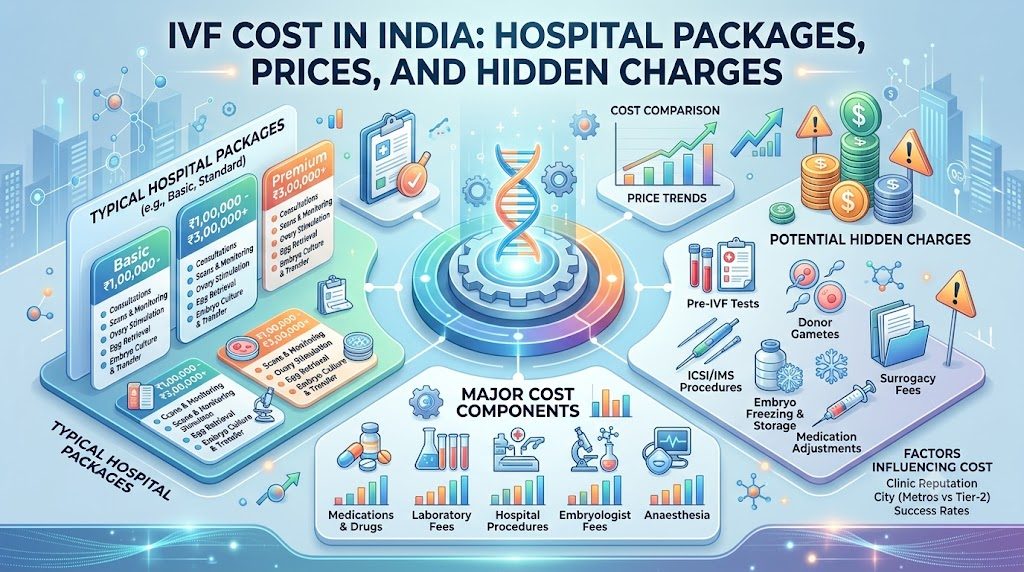
A basic IVF package may look affordable at first. However, medicines, initial tests, freezing, storage, or other services may be billed separately. The amount you pay for one cycle can therefore differ from the advertised IVF package price.
Your total spending may also rise if treatment is cancelled, a frozen embryo transfer is needed, or another cycle is recommended. Ask for estimates of these possible costs before you agree to treatment.
Main factors that affect the price
- City and location: Staff costs, rent, and hospital fees differ across places.
- Specialist fees: Consultation and procedure charges vary between providers.
- Laboratory services: The type of fertilization and embryo culture can affect costs.
- Medicines: Drug type, dose, and treatment length affect the IVF medicines cost.
- Additional procedures: ICSI and other services may add to the bill.
- Embryo storage: Freezing and keeping embryos for future use can involve separate fees.
- Number of cycles: More than one cycle may be needed, increasing total spending.
The best estimate is one that reflects your medical needs and clearly lists what you may have to pay.
What Do IVF Hospital Packages Usually Include?
IVF hospital package inclusions depend on the provider and the plan you choose. Some packages cover several stages of treatment, while others cover only selected procedures.
Services that may be included are:
- Consultation: An initial visit with a fertility specialist, if stated.
- Fertility tests: Selected blood tests, semen tests, or ultrasound scans.
- Treatment monitoring: Scans and blood tests during ovarian stimulation.
- Egg retrieval: The procedure to collect eggs, sometimes with related theatre charges.
- Laboratory services: Fertilization and embryo culture.
- Embryo transfer: Transfer of an embryo when included in the plan.
- Clinical team fees: Charges for the doctors and other staff involved.
- Day-care services: Basic recovery space or care after a procedure, where offered.
- Follow-up visits: A set number of reviews after treatment.
These are possible inclusions, not a list of services every hospital must provide in one package. Some hospitals include medicines and ICSI, while others charge for them separately.
Ask for an itemized estimate. This is a written list of each service and its cost. It should show what is included, what is excluded, and when extra fees may apply.
Common IVF Costs and Package Inclusions
| Cost component | What it may cover | What patients should check |
|---|---|---|
| Consultation and assessment | Specialist visits and selected fertility tests | Are the first consultation and all required tests included? |
| Medicines | Drugs used to stimulate the ovaries and support treatment | Are all medicines included, or is there a separate pharmacy bill? |
| Egg retrieval | The procedure used to collect eggs | Are theatre, sedation, anaesthesia, and recovery charges included? |
| Laboratory services | Fertilization and embryo culture | Is ICSI included, or is it charged separately when needed? |
| Embryo transfer | Placement of an embryo into the uterus | Is one transfer included, and what happens if a frozen transfer is needed? |
| Embryo freezing and storage | Freezing suitable embryos and keeping them in storage | Are freezing fees, storage duration, and renewal fees stated clearly? |
| Follow-up care | Reviews and checks after the procedure | How many visits are included, and what costs extra? |
Note: Package inclusions differ by hospital. This table is a checklist, not a price list.
Costs That May Be Charged Separately
Extra charges can increase the total IVF treatment expenses. Knowing about them early can help you avoid unexpected bills.
Tests and medicines
Initial consultations, fertility investigations, blood tests, and ultrasound scans may not all be included. Some hospitals include only the tests needed during stimulation, while others bill each test separately.
Medicines can also form a large part of the bill. The IVF medicines cost depends on the type of drugs, the dose, and how long they are needed. Ask whether injections, hormone medicines, and other prescribed drugs are covered.
Procedures and laboratory services
Some patients may need additional services based on their medical assessment.
- ICSI: Intracytoplasmic sperm injection is a laboratory method in which one sperm is injected into an egg. It may be recommended for certain sperm-related problems or other clinical reasons. The ICSI treatment cost may be separate from the basic IVF price.
- Embryo freezing: Suitable embryos may be frozen for possible future use. The freezing fee and storage cost may be separate.
- Frozen embryo transfer: A later transfer may require medicines, scans, consultations, and procedure fees.
- Embryo genetic testing: Testing may be considered in selected situations. It can add to the cost and is not needed by every patient.
- Donor services: Donor eggs or sperm may involve additional charges and must follow applicable laws and medical rules.
- Other procedures: A specialist may recommend another procedure for a specific medical reason.
- Complication care: Extra treatment may be needed if a medical problem occurs.
Do not assume that every add-on improves the chance of pregnancy. Ask why a service is recommended, whether it is suitable for your situation, and what it costs. You can ask for time to consider non-urgent options before agreeing.
Travel and daily expenses
The hospital bill is only one part of the total cost. You may also need to pay for travel, accommodation, meals, childcare, or time away from work.
IVF may require several visits over a period of weeks. If the hospital is far from home, include these costs in your budget.
How to Compare IVF Hospital Packages
A fair comparison looks at both medical care and total expected spending. A low starting price may not be the cheapest option once separate fees are added. A higher price does not automatically mean better care.
Use these points when comparing hospitals.
1. Compare the full estimated cost. Ask each hospital to price a similar treatment plan. Include tests, medicines, procedures, freezing, storage, and possible future transfers where relevant.
2. Check the specialist’s qualifications. Ask about the fertility specialist’s training and experience with your type of fertility concern. You should feel comfortable asking questions and discussing your choices.
3. Review laboratory services and safety. Ask how the clinic monitors laboratory quality, maintains equipment, and protects eggs and embryos. The clinic should be able to explain its safety practices in clear terms.
4. Check the package terms. Read the list of included services, exclusions, extra fees, and the time limit for using the package. Find out what happens if treatment is delayed or cancelled.
5. Consider counselling and support. Fertility treatment can be stressful. Ask whether the hospital offers counselling, clear communication, and help with treatment planning.
6. Plan for travel and follow-up. Think about the distance, number of visits, travel costs, and access to care after a procedure.
7. Check registration. In India, assisted reproductive technology clinics are regulated under the Assisted Reproductive Technology (Regulation) Act, 2021. Check the clinic’s registration through the relevant official registry or authority and ask about applicable standards.
When learning how to compare IVF hospitals, remember that price is only one part of the decision. Choose a provider that explains your options, gives clear cost information, and recommends treatment based on your medical needs.
Questions to Ask Before Choosing an IVF Package
| Question | Why it matters |
|---|---|
| What is the full estimated cost of my treatment plan? | Helps patients plan for the likely total expense |
| Which tests and medicines are included? | Reduces the risk of unexpected bills |
| Is ICSI included if the specialist recommends it? | Clarifies the cost of a potentially relevant laboratory procedure |
| Are embryo freezing and storage included? | Helps patients understand future costs |
| What happens if the cycle is cancelled? | Clarifies charges if treatment cannot proceed as planned |
| What would another cycle or frozen transfer cost? | Supports realistic financial planning |
| Are payment plans available, and are there extra fees? | Helps patients understand the full payment commitment |
| What are the package’s refund or cancellation terms? | Makes the conditions clear before signing |
Request written answers and keep a copy of the final estimate and package terms. If a promise is made during a consultation, ask for it to be included in writing.
IVF Success Rates and Package Claims
The cost of IVF and the chance of success are two different things. Paying more does not guarantee pregnancy or a live birth.
IVF outcomes can vary with age, the cause of infertility, ovarian reserve, sperm factors, embryo development, medical history, and other personal factors. A specialist can explain which factors may affect your treatment.
Hospitals may report pregnancy rates per cycle, pregnancy rates per embryo transfer, or live births per treatment cycle. These measures are not the same. Compare results only when the measure, patient group, and reporting period are clear.
Be careful with claims such as “guaranteed baby,” “100% success,” or “risk-free IVF.” No package can promise a particular outcome.
Multi-cycle and refund packages also need careful review. They may have strict eligibility rules, time limits, exclusions, and conditions for refunds. Ask what counts as a completed cycle, which fees cannot be refunded, and what happens if you do not meet the package rules.
Discuss realistic expectations with a qualified fertility specialist. Ask for information that applies to your age, diagnosis, and planned treatment rather than relying only on general success figures.
Payment Plans, Insurance, and Financial Planning
Hospitals may offer installments or other IVF payment plans. Before signing, check whether the plan includes interest, processing fees, late fees, or other charges. Ask for the full amount you will pay and the dates when payments are due.
IVF insurance coverage in India depends on the policy, employer benefits, insurer, and treatment details. Some policies may cover certain investigations or related care but exclude IVF itself. Waiting periods, spending limits, pre-approval rules, and other conditions may apply.
Do not assume that your health insurance will pay for IVF. Contact your insurer and request written confirmation of the benefits, exclusions, and documents required. If your employer provides health benefits, ask whether fertility care is covered.
Government schemes and assistance programs may also have specific eligibility rules. Confirm directly with the relevant program whether IVF is included. Do not rely on a general claim that a scheme covers fertility care.
When planning your budget, include:
- The expected hospital and pharmacy bills.
- Travel, accommodation, meals, and time away from work.
- Embryo freezing and future storage fees, if needed.
- The possible cost of a frozen transfer or another cycle.
- A reasonable allowance for costs not included in the estimate.
You can also ask whether the hospital offers financial counselling. Take time to review all terms before making a payment or agreeing to a treatment plan.
How to Prepare for an IVF Cost Consultation
A little preparation can help you understand your options and make better financial decisions. You do not need to know every medical term before meeting your specialist.
Use this checklist before your appointment:
- Collect your medical records and previous fertility test results.
- Prepare a list of your current medicines and supplements.
- Ask which tests are needed before treatment begins.
- Request a written, itemized estimate for your planned treatment.
- Ask which services are essential and which are optional.
- Check the cost of medicines, embryo freezing, storage, and future transfers.
- Ask what you may need to pay if a cycle is delayed or cancelled.
- Discuss realistic treatment expectations and follow-up care.
- Read the package terms carefully before making a decision.
If something is unclear, ask the hospital to explain it in simple words. You can also seek a second medical opinion if you are unsure about a proposed treatment or its cost.
Frequently Asked Questions (FAQs)
1. How much does IVF treatment usually cost in India?
IVF treatment costs vary by city, hospital, and medical needs. Published starting prices may cover only selected services, while medicines, tests, and extra procedures may cost more. Ask your chosen hospital for a written estimate based on your test results and planned treatment.
2. What is usually included in an IVF hospital package?
An IVF hospital package may include selected consultations, monitoring scans, egg retrieval, laboratory fertilization, embryo culture, and embryo transfer. Some packages also cover medicines and freezing. Inclusions differ between hospitals, so review the itemized estimate and confirm which services will require separate payment.
3. Are IVF medicines included in the package price?
Not always. Some packages include stimulation injections and selected medicines, while others charge for them separately. The final medicine bill depends on the drugs prescribed, their doses, and the length of treatment. Ask for an estimate of medicine costs before starting your cycle.
4. Can the cost of IVF increase during treatment?
Yes. The cost may increase if additional tests, medicines, or procedures are needed. A cancelled cycle or a later frozen embryo transfer may also involve extra charges. Ask your hospital which costs are fixed, which may change, and what you might pay in different situations.
5. Is ICSI included in a standard IVF package?
ICSI is not included in every standard IVF package. It is a laboratory method in which one sperm is injected into an egg. Your specialist may recommend it for specific medical reasons. Ask whether the procedure is included and why it may be suitable for your treatment plan.
6. Do IVF packages include embryo freezing and storage?
Some packages include embryo freezing and storage for a set period, while others charge separately for each service. Storage renewal and a future frozen embryo transfer may also cost extra. Confirm the storage period, renewal fees, and transfer charges before choosing a package.
7. Does health insurance cover IVF treatment in India?
Coverage depends on your policy, employer benefits, and insurer. Some plans may cover certain fertility investigations or related care, while IVF may be excluded or subject to limits. Check waiting periods, exclusions, and approval rules directly with your insurer, and request written confirmation before treatment.
8. Are multi-cycle IVF packages worth considering?
Multi-cycle packages may help some patients plan their spending, but their value depends on the terms and expected treatment needs. Check the number of cycles or transfers covered, time limits, exclusions, and refund rules. Discuss whether the plan suits your medical situation before making a financial commitment.
9. Does a more expensive IVF package mean a higher success rate?
No. A higher price does not guarantee a better outcome. IVF success depends on factors such as age, diagnosis, egg and sperm health, embryo development, and medical history. Ask the specialist to explain realistic expectations for your situation and how the hospital measures its treatment outcomes.
10. What should I ask a hospital before choosing an IVF package?
Ask for the full estimated cost, a list of included services, medicine charges, and fees for ICSI, freezing, storage, and future transfers. Also ask about cancellation rules, refunds, payment plans, and follow-up care. Keep written answers and compare similar treatment plans before deciding.
Conclusion
Understanding IVF cost and hospital packages can help you plan treatment with greater confidence. Look beyond the advertised price and compare the full cost of consultations, tests, medicines, laboratory services, and future care. Check all exclusions, cancellation terms, and refund conditions before making a payment. Ask your fertility specialist which options are medically appropriate for you and what each option may cost. Take time to review your choices and seek clarification whenever needed. A clear plan can support better financial decisions without creating false expectations about treatment outcomes.

Find Trusted Cardiac Hospitals
Compare heart hospitals by city and services — all in one place.
Explore Hospitals