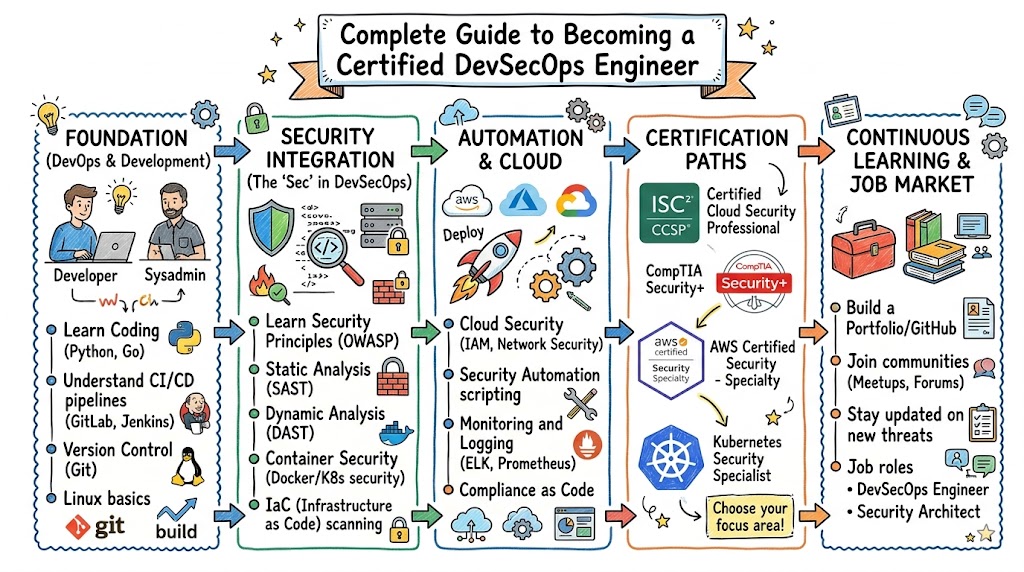
Introduction
Modern software moves fast. Features are released weekly or even daily. But if security is weak, one bad change can cause data leaks, downtime, or huge business loss.Certified DevSecOps Engineer is a certification that helps you learn how to build software that is both fast and secure, from code to production. It teaches you how to add security into every step of DevOps, without slowing teams down.In this guide, I will explain this certification in simple language, with a clear roadmap you can follow as an engineer, manager, or technical leader.
What is DevSecOps and why it matters now
DevSecOps means “Development + Security + Operations”. It is a way of working where security is built into the software lifecycle from the start, not added at the end.
Instead of one security team checking everything manually at the last moment, DevSecOps:
- Brings security checks into CI/CD pipelines
- Uses tools to scan code, images, and infrastructure automatically
- Makes developers, security engineers, and ops teams share responsibility
For companies, DevSecOps reduces risk, speeds up releases, and improves trust with customers and regulators. For you as a professional, DevSecOps skills make you more valuable, because every modern product needs secure delivery.
What Certified DevSecOps Engineer covers
The Certified DevSecOps Engineer program focuses on the full DevSecOps lifecycle.
You learn topics like:
- DevOps and DevSecOps culture and principles
- Secure coding and static analysis (SAST)
- Dynamic application security testing (DAST) and API testing
- Securing CI/CD pipelines (Jenkins, GitLab CI, GitHub Actions, etc.)
- Secrets management and configuration security
- Container and Kubernetes security
- Infrastructure as Code (IaC) security and scanning
- Threat modeling and risk assessment
- Logging, monitoring, and incident response from a security view
The goal is to make you comfortable with both security concepts and DevOps tools, so you can bridge the gap between developers, security team, and operations.
Certified DevSecOps Engineer
What it is
Certified DevSecOps Engineer is a practical certification that teaches you how to design, build, and operate secure DevOps pipelines. It focuses on bringing security into every stage of software delivery, using automation, tools, and best practices.
Who should take it
This certification is ideal for:
- DevOps Engineers who want strong security skills
- Security Engineers who want to work closely with DevOps and cloud teams
- SRE and Platform Engineers responsible for production systems
- Cloud and Infrastructure Engineers managing Kubernetes and cloud platforms
- Developers who want to write secure code and integrate security into their pipelines
- Engineering Managers who want to lead secure delivery practices
Skills you will gain
After completing this certification, you should have skills in:
- Understanding DevOps and DevSecOps culture and principles
- Designing secure CI/CD pipelines end to end
- Using SAST and DAST tools to find vulnerabilities early
- Securing containers, images, and Kubernetes workloads
- Managing secrets safely (tokens, keys, passwords)
- Scanning Infrastructure as Code (Terraform, CloudFormation, etc.)
- Doing threat modeling for applications and systems
- Setting up logging, monitoring, and alerts for security events
- Automating security checks to run on every build and deploy
Real-world projects you should be able to do after it
After this certification, you should be able to:
- Design and implement a secure CI/CD pipeline with automated security checks
- Integrate SAST, DAST, and dependency scanning tools into builds
- Build a secure container image pipeline with image signing and scanning
- Secure a Kubernetes cluster with proper RBAC, policies, and network controls
- Implement secrets management using vaults or cloud-native secrets
- Set up Infrastructure as Code scanning and policy-as-code checks
- Build dashboards and alerts for security events using logs and metrics
- Prepare security reports and recommendations for product teams
Preparation plan (7–14 / 30 / 60 days)
Your preparation time will depend on your background. Here is a simple plan structure you can adapt.
7–14 day fast-track plan
- Day 1–2: Review DevOps and DevSecOps fundamentals, CI/CD basics, and cloud-native security concepts
- Day 3–4: Deep dive into SAST, DAST, and dependency scanning tools and workflows
- Day 5–7: Practice securing CI/CD pipelines, container and Kubernetes security labs
- Day 8–10: Focus on IaC security, threat modeling, and policy-as-code
- Day 11–14: Mock projects and practice questions, revise notes and lab exercises
30-day balanced plan
- Week 1: DevOps, DevSecOps culture, SDLC, and security basics
- Week 2: Pipeline security, SAST/DAST, secure coding, and secrets management
- Week 3: Containers, Kubernetes, IaC security, and cloud platform security basics
- Week 4: Threat modeling, monitoring, incident response, revision, and mock projects
60-day deep plan
- Weeks 1–2: Linux, Git, CI/CD basics, DevOps culture
- Weeks 3–4: Security fundamentals, app security, SAST/DAST, secure coding
- Weeks 5–6: Cloud basics, containers, Kubernetes, and IaC
- Weeks 7–8: DevSecOps pipelines, tools integration, and hands-on labs
- Weeks 9–10: Threat modeling, monitoring, compliance, and governance
- Weeks 11–12: Practice projects, notes consolidation, and exam-oriented revision
Common mistakes to avoid
- Trying to “cram tools” without understanding the DevSecOps mindset and culture
- Ignoring basic Linux, Git, and CI/CD skills before jumping into security tools
- Focusing only on application security but ignoring infrastructure and cloud layers
- Doing theory only and skipping hands-on labs and pipeline practice
- Not documenting findings, runbooks, and security recommendations
- Treating DevSecOps as a “security team job” instead of a shared responsibility
Best next certification after this
After Certified DevSecOps Engineer, strong next options are:
- Same track (DevSecOps / Security track): Advanced or specialized DevSecOps, cloud security, or security architecture certifications
- Cross-track (SRE / DevOps / Cloud): SRE-focused certifications or Master in DevOps Engineering (MDE) style programs that deepen reliability and platform skills
- Leadership: Architecture, governance, or FinOps-oriented certifications focused on risk, cost, and technology leadership
Certification mapping table
Below is a sample mapping inspired by DevOpsSchool’s master DevOps certification structure, adapted for a DevSecOps-focused roadmap.
DevOps and related certifications table
| Track | Level | Who it’s for | Prerequisites | Skills covered | Recommended order |
|---|---|---|---|---|---|
| DevOps Core | Professional/Master | DevOps & Cloud Engineers, SREs | Basic Linux, Git, scripting | CI/CD, containers, cloud basics, monitoring | 1st – foundation |
| DevSecOps | Professional | Security, DevOps, Cloud, SRE Engineers | DevOps basics, CI/CD knowledge | SAST/DAST, pipeline security, containers, IaC, threat modeling | 2nd – security specialization |
| SRE | Professional | SREs, Reliability & Platform leads | Linux, networking, monitoring | SLOs, error budgets, observability, incident response | 2nd – reliability focus |
| AIOps/MLOps | Professional | Automation & ML-focused engineers | Python, data basics, monitoring | ML in Ops, anomaly detection, intelligent alerting | 3rd – advanced analytics |
| DataOps | Professional | Data & Platform engineers | Data pipeline experience | Data CI/CD, orchestration, quality, governance | 3rd – data specialization |
| FinOps | Professional | Cloud architects, FinOps, managers | Cloud architecture basics | Cost governance, unit economics, budgeting | 3rd – leadership/business |
You can adjust names and details depending on your internal program mapping, but this table gives your readers a clear structure.
Choose your path: six learning paths
When you think about your long-term career, you should not look at only one certification. Instead, build a path that grows your skills step by step.
Here are six major learning paths and where Certified DevSecOps Engineer fits in.
1. DevOps path
This path is for engineers who want to build and run delivery pipelines and platforms.
Typical order:
- Start: Core DevOps / MDE-style foundation (Linux, Git, CI/CD, cloud, containers)
- Next: Certified DevSecOps Engineer to secure pipelines and deployments
- Then: SRE or Platform-focused certifications for reliability and scale
2. DevSecOps path
This is the main path for security-focused engineers and DevOps teams who want to specialize in security.
Typical order:
- Start: DevOps fundamentals and basic cloud skills
- Next: Certified DevSecOps Engineer for full DevSecOps lifecycle skills
- Then: Cloud security certifications or advanced DevSecOps programs
3. SRE path
For SREs and reliability engineers who keep systems fast, stable, and safe.
Typical order:
- Start: DevOps / MDE foundational certification
- Next: SRE-focused certification (SLOs, error budgets, incident response)
- Then: Certified DevSecOps Engineer to add strong security to your reliability toolkit
4. AIOps/MLOps path
For engineers who want to use data and machine learning to improve operations.
Typical order:
- Start: DevOps and Observability basics
- Next: SRE or DevSecOps (so you understand reliability and security)
- Then: AIOps/MLOps certification for intelligent automation and advanced analytics
5. DataOps path
For Data Engineers and Platform Engineers working on data pipelines.
Typical order:
- Start: Data engineering and DevOps fundamentals
- Next: Certified DevSecOps Engineer to secure pipelines, clusters, and data platforms
- Then: DataOps-focused certification for orchestration, quality, and governance
6. FinOps path
For people who manage cloud costs and want to align tech with business.
Typical order:
- Start: Cloud and DevOps basics
- Next: FinOps certification for cost optimization and governance
- Then: Certified DevSecOps Engineer to ensure secure and compliant cloud usage that supports cost goals
Role → Recommended certifications
Here is a simple mapping of job roles to recommended certifications across DevOps, DevSecOps, SRE, AIOps/MLOps, DataOps, and FinOps, using Certified DevSecOps Engineer as a key element.
Top institutions that help with Certified DevSecOps Engineer
The following institutions and platforms support training and certification paths related to DevSecOps and modern engineering. You can position them in your blog as trusted options for learners.
DevOpsSchool
DevOpsSchool is known for its end-to-end DevOps, SRE, DevSecOps, and cloud training programs. It offers structured learning paths, hands-on labs, and project-based learning for working professionals. Their programs are aligned with real industry use cases, helping you prepare for certifications like Certified DevSecOps Engineer and broader master programs such as Master in DevOps Engineering.
Cotocus
Cotocus focuses on career transformation for engineers and managers through specialized DevOps and DevSecOps programs. It works closely with trainers and industry experts to design practical courses that help you use tools and techniques in real projects. Cotocus often supports corporate teams who want to adopt DevSecOps and secure their delivery pipelines at scale.
Scmgalaxy
Scmgalaxy started with source control, build, and release management training and has grown into a platform offering DevOps, DevSecOps, SRE, and related courses. Its focus is on tools, automation, and real-world implementation. For Certified DevSecOps Engineer, their ecosystem can help you gain confidence with CI/CD, version control, and security tool integrations.
BestDevOps
BestDevOps is a content and learning hub focused on DevOps, automation, and cloud-native practices. It aggregates knowledge, tutorials, and structured learning information for busy professionals. For learners interested in DevSecOps, it helps them stay updated on trends, tools, and best practices that complement formal certifications like Certified DevSecOps Engineer.
devsecopsschool
DevSecOpsSchool is dedicated to DevSecOps-specific training and certifications. Its goal is to bring practical, industry-ready DevSecOps skills to engineers and security professionals. It focuses on secure CI/CD, cloud-native security, and integrated security practices, making it directly relevant to Certified DevSecOps Engineer aspirants.
sreschool
SRESchool is focused on Site Reliability Engineering, availability, and performance. It offers training on SLOs, error budgets, incident response, and observability. For DevSecOps learners, SRESchool complements security skills with strong reliability practices, helping you design systems that are both secure and highly available.
aiopsschool
AIOpsSchool is designed for engineers who want to use data and machine learning in operations. It teaches how to use metrics, logs, and traces to detect anomalies and automate operational decisions. For Certified DevSecOps Engineer holders, AIOpsSchool gives a path to apply intelligent automation to security and reliability workflows.
dataopsschool
DataOpsSchool focuses on applying DevOps principles to data pipelines, analytics platforms, and data products. It covers topics like data CI/CD, orchestration, quality, and governance. Combined with DevSecOps skills, DataOpsSchool prepares you to build secure, reliable, and compliant data platforms.
finopsschool
FinOpsSchool trains engineers and managers in cloud cost management and financial operations. It teaches how to align engineering decisions with business cost goals. When you combine FinOps knowledge with Certified DevSecOps Engineer skills, you can design systems that are secure, reliable, and cost-effective.
Next certifications to take after Certified DevSecOps Engineer
After you complete Certified DevSecOps Engineer, you should plan your next steps based on your career goals. Using the style of master DevOps roadmaps, we can think of three main directions.
1. Same track
If you want to go deeper into security:
- Advanced DevSecOps programs focused on cloud-native and container security
- Cloud security certifications (for example, security track from major cloud providers)
- Threat modeling, security architecture, or red-team/blue-team style programs
This route is good if you want to become a Security Architect, DevSecOps Lead, or Principal Security Engineer.
2. Cross-track
If you want a broader engineering profile:
- Master in DevOps Engineering (MDE) style master certification to cover end-to-end DevOps and platform skills
- SRE certifications focusing on reliability, scalability, and incident response
- AIOps/MLOps or DataOps certifications to bring data and ML into operations
This route suits future SRE Leads, Platform Engineers, or Engineering Generalists who design and run full platforms.
3. Leadership
If you want to move into leadership and architecture roles:
- FinOps certifications for cost and financial governance in cloud
- Architecture or governance programs that focus on risk, compliance, and technical strategy
- Management programs for leading DevOps/DevSecOps/SRE teams
This route is ideal if you want to become an Architect, Head of Engineering, or Director-level leader.
FAQs about the DevSecOps career path
These FAQs cover DevSecOps and broader questions around difficulty, time, prerequisites, sequence, value, and career outcomes.
- Is DevSecOps only for security people?
No. DevSecOps is for developers, DevOps engineers, SREs, security engineers, and managers. Anyone involved in building or running software can benefit from DevSecOps skills. - How difficult is it to move into DevSecOps from DevOps?
If you already know CI/CD, cloud, and containers, DevSecOps is a moderate step up. You mainly need to learn security basics, tools, and risk thinking. - How much time does it take to become job-ready in DevSecOps?
For an active engineer with DevOps background, 2–3 months of focused study and hands-on practice is usually enough to be useful in a DevSecOps role. Beginners may need 4–6 months. - Do I need to be a security expert before learning DevSecOps?
No. DevSecOps is designed to bring security closer to developers and operations. You need basic security awareness, and then you can grow deeper while working with security teams. - What is the right sequence: DevOps first or DevSecOps first?
In most cases, DevOps or cloud fundamentals should come first. Then DevSecOps builds on those skills, because you will be securing pipelines, infrastructure, and deployments. - What is the career value of DevSecOps skills?
DevSecOps skills are in high demand because companies want secure and fast delivery. These skills make you suitable for high-impact roles and often better salary bands. - Which roles benefit the most from DevSecOps?
DevOps engineers, SREs, Platform/Cloud engineers, Security engineers, and Engineering Managers see strong value from DevSecOps. - How does DevSecOps relate to SRE and AIOps?
DevSecOps focuses on security in the pipeline and runtime, SRE focuses on reliability, and AIOps uses data and ML to automate operations. Together they form a complete modern operations toolkit. - Can DevSecOps help in regulated industries (finance, healthcare, etc.)?
Yes. DevSecOps helps automate compliance checks, logging, and audit evidence, which is important for regulated environments. - Is DevSecOps only for cloud-native systems?
No. While cloud-native environments benefit a lot, DevSecOps principles apply to on-premise, hybrid, and legacy environments too. - What tools are commonly used in DevSecOps?
Common categories include SAST/DAST tools, dependency scanners, secret scanners, container and IaC security tools, policy-as-code, and SIEM systems. - Can I move into management after working in DevSecOps?
Yes. DevSecOps experience is valuable for technical leadership roles like Security Architect, Platform Lead, Head of DevOps, or Engineering Manager with a strong security focus.
FAQs on Certified DevSecOps Engineer
These questions focus specifically on the Certified DevSecOps Engineer program.
- What is the main goal of Certified DevSecOps Engineer?
The main goal is to train professionals who can integrate security into every stage of the DevOps lifecycle using automation and modern tools. - Who is the Certified DevSecOps Engineer program designed for?
It is designed for DevOps engineers, security professionals, cloud architects, SREs, and developers who want to build secure pipelines and cloud-native systems. - What are the prerequisites for this certification?
You should be comfortable with basic Linux, Git, CI/CD, and at least one cloud or container platform. Basic security understanding is helpful but not required. - How long should I prepare for Certified DevSecOps Engineer?
If you already work in DevOps or security, 4–6 weeks of focused study and hands-on labs is usually enough. Beginners may need 2–3 months. - What topics does the certification cover?
It covers DevOps and DevSecOps culture, secure coding, SAST/DAST, pipeline security, container and Kubernetes security, IaC scanning, threat modeling, and monitoring. - What kind of projects should I build while preparing?
You should build at least one CI/CD pipeline with integrated security scans, a secure container/Kubernetes deployment, and an IaC-based environment with security checks. - What roles can I target after getting this certification?
You can aim for roles like DevSecOps Engineer, Secure DevOps Engineer, Cloud Security Engineer, Security-focused SRE, or Platform Engineer with security responsibility. - How does Certified DevSecOps Engineer fit with other master programs like MDE?
Certified DevSecOps Engineer can be taken after or alongside a DevOps master program like MDE, adding a strong security layer to your existing DevOps, SRE, and cloud skills.
Conclusion
DevSecOps is no longer “optional security work.” It is a core part of how modern teams build and run software. Certified DevSecOps Engineer helps you learn how to bring security into your daily workflows in a practical, tool-driven way.If you are a DevOps Engineer, SRE, Platform Engineer, Security Engineer, Data Engineer, FinOps Practitioner, or Engineering Manager, this certification can significantly increase your impact and value. With a clear study plan, hands-on projects, and support from training platforms like DevOpsSchool and its ecosystem, you can move into high-demand DevSecOps roles and build a future-ready career.

Find Trusted Cardiac Hospitals
Compare heart hospitals by city and services — all in one place.
Explore Hospitals
A very useful and motivating blog that explains the path to becoming a Certified DevSecOps Engineer in simple words and makes the career journey easier to understand. I liked that the article clearly shows the skills needed, the learning roadmap, and the practical value of combining security with DevOps in modern software delivery. It is a valuable read for engineers, security professionals, and learners who want clear and practical knowledge about building a strong career in DevSecOps.
This blog explains the Certified DevSecOps Engineer path in a clear and simple way. I like that it shows how security, automation, and DevOps practices work together, which makes it very useful for professionals who want to build safer and stronger software delivery systems.