Introduction
Stream Processing Frameworks are specialized platforms that allow organizations to ingest, process, and analyze continuous streams of data in real time. Unlike traditional batch processing, these frameworks enable immediate insight into operational metrics, system behavior, and user activity as data is generated. Businesses increasingly rely on these frameworks to power real-time analytics, decision-making, and automation workflows.
Real-world use cases include monitoring financial transactions for fraud, analyzing IoT sensor data for predictive maintenance, providing instant recommendations in e-commerce, tracking user engagement on web and mobile apps, and supporting automated responses in operational systems.
When evaluating stream processing frameworks, buyers should consider:
- Low-latency data ingestion and processing capabilities
- Scalability to handle high-volume data streams
- Fault tolerance and reliability
- Integration with existing data infrastructure
- Real-time analytics and AI/ML support
- Ease of deployment and management
- Security and compliance certifications
- Support for multiple data formats and protocols
- Monitoring and observability capabilities
- Total cost of ownership and licensing models
Best for: Data engineers, DevOps teams, analytics and operations managers, and product teams in SMBs, mid-market, and enterprise organizations needing rapid, actionable insights.
Not ideal for: Companies with only batch processing needs or minimal real-time data requirements.
Key Trends in Stream Processing Frameworks
- Integration of AI/ML for anomaly detection and predictive analytics
- Cloud-native and serverless architectures for scalable deployments
- Multi-cloud and hybrid capabilities for data portability
- Adoption of event-driven microservices and architectures
- Advanced monitoring, observability, and alerting capabilities
- Increased focus on compliance, privacy, and data governance
- Automated orchestration and pipeline management
- Enhanced support for IoT and edge data processing
- Pay-per-use and consumption-based pricing models
- Simplified developer experience with low-code or visual interfaces
How We Selected These Tools (Methodology)
- Market adoption and industry recognition
- Feature completeness including ingestion, processing, and analytics
- Performance and low-latency benchmarks
- Security and compliance capabilities
- Integration with data pipelines, storage, and BI tools
- Support for SMB, mid-market, and enterprise requirements
- Ease of use and deployment flexibility
- AI/ML and advanced analytics support
- Observability and operational monitoring features
- Cost-effectiveness relative to features and scale
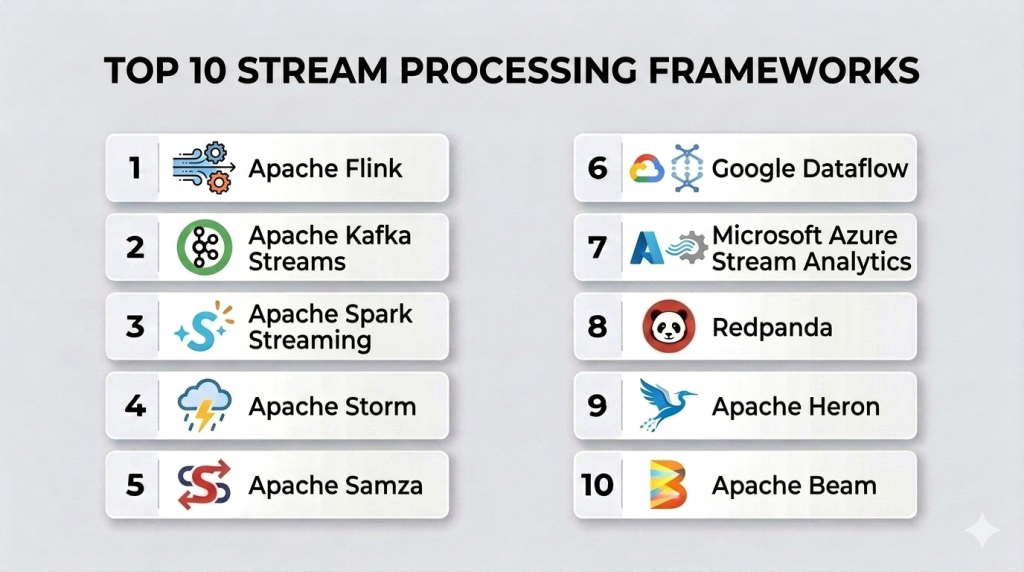
Top 10 Stream Processing Frameworks
#1 — Apache Flink
Short description: Apache Flink is an open-source framework for stateful stream processing. It allows real-time event-driven analytics and complex event processing, supporting high-throughput, low-latency applications.
Key Features
- Stateful stream processing with event-time semantics
- High-throughput and low-latency analytics
- Windowed computations and aggregations
- Fault-tolerant checkpointing
- Integration with Kafka, Hadoop, and cloud services
- Scalable cluster deployment
- Rich API support for Java and Scala
Pros
- Robust for complex event processing
- Scales efficiently for large workloads
Cons
- Steeper learning curve for new users
- Monitoring requires additional tooling
Platforms / Deployment
- Linux, macOS, Windows
- Self-hosted / Hybrid
Security & Compliance
- SSL/TLS encryption support
- Not publicly stated for certifications
Integrations & Ecosystem
- Kafka, Hadoop, S3, cloud storage
- API support for custom connectors
Support & Community
- Strong open-source community and vendor support options
#2 — Apache Kafka Streams
Short description: Kafka Streams is a lightweight Java library for building stream processing applications directly on Apache Kafka. It simplifies real-time analytics on event streams without the need for a separate cluster.
Key Features
- Fully integrates with Apache Kafka topics
- Stateful and stateless processing
- Windowing, joins, and aggregations
- Fault-tolerant and scalable
- Embedded library, no separate cluster needed
Pros
- Simple deployment as part of Kafka ecosystem
- Handles high-throughput streaming effectively
Cons
- Limited to Kafka ecosystems
- Advanced analytics require integration with other frameworks
Platforms / Deployment
- Linux, macOS, Windows
- Cloud / Self-hosted
Security & Compliance
- Supports SSL/TLS and SASL authentication
- Not publicly stated for certifications
Integrations & Ecosystem
- Kafka topics, Connect, Schema Registry
- APIs for custom processing
Support & Community
- Active Kafka community and Confluent support
#3 — Apache Spark Streaming
Short description: Spark Streaming extends Apache Spark to support scalable, high-throughput, fault-tolerant stream processing. It integrates seamlessly with batch analytics to enable unified data processing.
Key Features
- Micro-batch processing for real-time streams
- Integration with Spark MLlib for machine learning
- Fault tolerance and checkpointing
- Supports Kafka, Flume, Kinesis
- SQL-like queries for stream analytics
Pros
- Unified batch and stream processing
- Large-scale analytics capabilities
Cons
- Higher latency than true event-driven frameworks
- Resource-intensive for large deployments
Platforms / Deployment
- Linux, macOS, Windows
- Cloud / Self-hosted / Hybrid
Security & Compliance
- Kerberos and SSL support
- Not publicly stated for certifications
Integrations & Ecosystem
- Hadoop ecosystem, Kafka, cloud storage
- APIs for custom transformations
Support & Community
- Active open-source community and enterprise support
#4 — Apache Storm
Short description: Apache Storm is a distributed real-time computation system for processing large streams of data reliably. It is suitable for low-latency, high-velocity event processing.
Key Features
- True real-time stream processing
- Fault-tolerant and scalable
- Integration with Kafka, RabbitMQ, and databases
- Topology-based processing model
- Supports multiple programming languages
Pros
- Very low-latency event processing
- Mature ecosystem
Cons
- Complex setup and monitoring
- Limited advanced analytics support
Platforms / Deployment
- Linux, macOS, Windows
- Cloud / Self-hosted / Hybrid
Security & Compliance
- SSL and authentication support
- Not publicly stated for certifications
Integrations & Ecosystem
- Kafka, RabbitMQ, Hadoop
- APIs for custom processors
Support & Community
- Active community and commercial support available
#5 — Apache Samza
Short description: Apache Samza is a distributed stream processing framework designed for low-latency analytics with tight Kafka integration. It focuses on stateful computations for event-driven applications.
Key Features
- Stateful stream processing
- Fault-tolerant architecture
- Kafka integration
- Horizontal scalability
- Lightweight deployment
Pros
- Efficient low-latency processing
- Developer-friendly API
Cons
- Smaller ecosystem compared to Spark or Flink
- Requires Kafka expertise
Platforms / Deployment
- Linux, macOS, Windows
- Self-hosted / Hybrid
Security & Compliance
- SSL support
- Not publicly stated for certifications
Integrations & Ecosystem
- Kafka, Hadoop, cloud connectors
- API and SDK support
Support & Community
- Open-source community and vendor support
#6 — Google Dataflow
Short description: Google Dataflow is a fully managed, serverless stream and batch data processing service based on Apache Beam. It offers scalable real-time analytics on cloud infrastructure.
Key Features
- Unified batch and stream processing
- Autoscaling and serverless
- Integration with GCP ecosystem
- Event-time processing and windowing
- SDK support for Java and Python
Pros
- Fully managed, no cluster maintenance
- Scales automatically with workload
Cons
- Limited to Google Cloud ecosystem
- Learning curve for Apache Beam
Platforms / Deployment
- Web
- Cloud
Security & Compliance
- IAM, encryption, audit logging
- SOC 2, GDPR
Integrations & Ecosystem
- BigQuery, Pub/Sub, Cloud Storage
- APIs and SDKs for pipeline management
Support & Community
- Google Cloud support and developer forums
#7 — Microsoft Azure Stream Analytics
Short description: Azure Stream Analytics is a fully managed real-time analytics service for processing high-throughput streams in the Azure cloud.
Key Features
- Real-time event processing
- Integration with IoT Hub, Event Hubs
- SQL-like query language for streams
- Serverless and auto-scaling
- Built-in monitoring and alerting
Pros
- Fully managed with minimal operational overhead
- Deep integration with Azure services
Cons
- Cloud lock-in to Azure ecosystem
- Limited open-source extensibility
Platforms / Deployment
- Web
- Cloud
Security & Compliance
- SSO, encryption, and RBAC
- ISO 27001, SOC 2, GDPR
Integrations & Ecosystem
- Azure SQL, Data Lake, IoT Hub
- REST API and SDKs
Support & Community
- Azure enterprise support and documentation
#8 — Redpanda
Short description: Redpanda is a Kafka-compatible, high-performance streaming platform optimized for low-latency event processing.
Key Features
- Kafka API compatibility
- In-memory processing option
- Horizontal scaling
- Low-latency stream handling
- Simplified operational model
Pros
- High performance and Kafka-compatible
- Easier to deploy than Kafka
Cons
- Smaller ecosystem
- Limited third-party tooling
Platforms / Deployment
- Linux, macOS, Windows
- Cloud / Self-hosted
Security & Compliance
- TLS encryption and RBAC
- Not publicly stated
Integrations & Ecosystem
- Kafka connectors, cloud storage
- APIs for custom pipelines
Support & Community
- Vendor support and forums
#9 — Apache Heron
Short description: Apache Heron is a real-time, distributed stream processing engine originally developed by Twitter to replace Storm, offering improved performance and scalability.
Key Features
- Low-latency processing
- Stateful and stateless processing
- Fault-tolerant and scalable
- Compatible with Storm topologies
- Metrics and monitoring built-in
Pros
- Improved throughput over Storm
- Compatible with existing Storm deployments
Cons
- Smaller community than Storm or Flink
- Less feature-rich than Flink
Platforms / Deployment
- Linux, macOS, Windows
- Self-hosted / Hybrid
Security & Compliance
- SSL/TLS support
- Not publicly stated
Integrations & Ecosystem
- Kafka, databases, cloud storage
- APIs for custom topologies
Support & Community
- Open-source community support
#10 — Apache Beam
Short description: Apache Beam is a unified programming model for batch and stream processing, supporting multiple runners including Dataflow, Flink, and Spark.
Key Features
- Unified batch and stream model
- Multi-runner support
- Event-time processing
- Windowing and triggers
- SDK support for Java, Python, and Go
Pros
- Flexibility across multiple execution engines
- Unified API simplifies development
Cons
- Learning curve for complex pipelines
- Dependent on runner capabilities
Platforms / Deployment
- Linux, macOS, Windows
- Cloud / Self-hosted / Hybrid
Security & Compliance
- Varies by runner
- Not publicly stated
Integrations & Ecosystem
- Kafka, cloud storage, big data systems
- SDKs for custom transformations
Support & Community
- Active Apache community and documentation
Comparison Table (Top 10)
| Tool Name | Best For | Platform(s) Supported | Deployment | Standout Feature | Public Rating |
|---|---|---|---|---|---|
| Apache Flink | Stateful stream processing | Linux, macOS, Windows | Self-hosted / Hybrid | Low-latency analytics | N/A |
| Kafka Streams | Kafka-native stream apps | Linux, macOS, Windows | Cloud / Self-hosted | Embedded processing library | N/A |
| Spark Streaming | Unified batch & stream | Linux, macOS, Windows | Cloud / Self-hosted | Micro-batch processing | N/A |
| Apache Storm | Low-latency real-time | Linux, macOS, Windows | Cloud / Self-hosted | Event topology processing | N/A |
| Apache Samza | Kafka-integrated stream processing | Linux, macOS, Windows | Self-hosted / Hybrid | Low-latency analytics | N/A |
| Google Dataflow | Managed cloud streams | Web | Cloud | Serverless stream processing | N/A |
| Azure Stream Analytics | Cloud-native real-time | Web | Cloud | SQL-like query on streams | N/A |
| Redpanda | High-performance Kafka alternative | Linux, macOS, Windows | Cloud / Self-hosted | Low-latency streaming | N/A |
| Apache Heron | Storm-compatible stream engine | Linux, macOS, Windows | Self-hosted / Hybrid | High throughput | N/A |
| Apache Beam | Unified batch & stream API | Linux, macOS, Windows | Cloud / Self-hosted / Hybrid | Multi-runner support | N/A |
Evaluation & Scoring of Stream Processing Frameworks
| Tool Name | Core (25%) | Ease (15%) | Integrations (15%) | Security (10%) | Performance (10%) | Support (10%) | Value (15%) | Weighted Total |
|---|---|---|---|---|---|---|---|---|
| Apache Flink | 9 | 7 | 8 | 8 | 9 | 7 | 8 | 8.2 |
| Kafka Streams | 8.5 | 8 | 7.5 | 8 | 8 | 7 | 7.5 | 7.9 |
| Spark Streaming | 8 | 7 | 7.5 | 7.5 | 8 | 7 | 7.5 | 7.65 |
| Apache Storm | 8 | 7 | 7 | 7 | 8 | 7 | 7 | 7.2 |
| Apache Samza | 7.5 | 7 | 7 | 7 | 7.5 | 7 | 7 | 7.1 |
| Google Dataflow | 8 | 8 | 7.5 | 8 | 8 | 7 | 7.5 | 7.8 |
| Azure Stream Analytics | 7.5 | 8 | 7 | 8 | 7.5 | 7 | 7.5 | 7.5 |
| Redpanda | 7.5 | 7 | 7 | 7 | 8 | 7 | 7 | 7.2 |
| Apache Heron | 7 | 7 | 7 | 7 | 7.5 | 7 | 7 | 7.1 |
| Apache Beam | 8 | 7 | 7.5 | 7 | 8 | 7 | 7.5 | 7.6 |
Which Stream Processing Frameworks Tool Is Right for You?
Solo / Freelancer
Tools like Redpanda or Azure Stream Analytics offer quick deployment with minimal maintenance for small teams.
SMB
Google Dataflow and Spark Streaming provide scalable, managed services with advanced analytics features.
Mid-Market
Apache Flink and Kafka Streams offer robust stateful stream processing suitable for mid-sized enterprises.
Enterprise
Apache Flink, Apache Storm, and Confluent Cloud support large-scale, low-latency, mission-critical event processing.
Budget vs Premium
Open-source frameworks like Flink, Storm, and Samza reduce licensing costs, while cloud-managed services provide convenience at higher price points.
Feature Depth vs Ease of Use
Flink and Spark offer powerful processing capabilities; Redpanda and Stream Analytics simplify setup and operations.
Integrations & Scalability
Ensure compatibility with Kafka, cloud storage, ETL tools, and BI dashboards for a future-proof setup.
Security & Compliance Needs
Choose frameworks supporting encryption, RBAC, SSO, SOC 2, and GDPR compliance as per organizational policies.
Frequently Asked Questions (FAQs)
1. What are Stream Processing Frameworks?
They are platforms that process continuous streams of data in real time to enable immediate analytics and actions.
2. Can small teams use these frameworks?
Yes, managed cloud services like Dataflow or Stream Analytics reduce operational complexity for small teams.
3. Are these frameworks suitable for IoT?
Absolutely, they are designed to handle high-velocity IoT sensor data.
4. Do they support AI or ML?
Several frameworks integrate with ML models for anomaly detection and predictive analytics.
5. How complex is deployment?
Open-source frameworks require setup and monitoring; cloud-managed services simplify deployment.
6. Can they visualize data in dashboards?
Yes, most integrate with BI tools for real-time dashboards.
7. Are they scalable?
Frameworks like Flink, Kafka, and Dataflow can scale to millions of events per second.
8. Do they offer security features?
Yes, most support encryption, authentication, RBAC, and compliance certifications.
9. Can they integrate with existing data pipelines?
Yes, they support connections to ETL tools, databases, messaging systems, and cloud services.
10. Which deployment model should I choose?
Cloud for managed ease and scalability, self-hosted for regulatory compliance or low-latency requirements.
Conclusion
Stream Processing Frameworks empower organizations to analyze and respond to data in real time. Selecting the right tool depends on workload scale, operational expertise, integration needs, and latency requirements. Open-source options like Apache Flink and Kafka provide robust capabilities for complex event processing, while cloud-managed services such as Google Dataflow and Azure Stream Analytics simplify adoption and scaling. Companies should pilot frameworks based on their real-time use cases, validate security and compliance, and ensure integration with analytics and monitoring pipelines to achieve reliable, actionable insights.

Find Trusted Cardiac Hospitals
Compare heart hospitals by city and services — all in one place.
Explore Hospitals
In real systems, network delays or temporary failures can cause events to arrive later than expected. Teams should have clear rules for how these events are handled so they do not create incorrect totals or missed alerts. This can make real-time processing more reliable when data does not arrive perfectly.