Introduction
Storage management tools are software solutions designed to help organizations efficiently allocate, monitor, and optimize storage resources across on-premises, cloud, and hybrid IT environments. These tools allow IT teams to manage disk space, track usage trends, optimize performance, and ensure data availability while reducing costs associated with over-provisioning and underutilized storage.
In businesses are dealing with exponentially growing data volumes from cloud applications, virtualized environments, IoT devices, and remote work setups. Effective storage management ensures performance, compliance, and business continuity. Real-world use cases include:
- Monitoring storage utilization across servers and cloud instances.
- Automating storage provisioning for virtual machines and databases.
- Identifying and reclaiming unused or redundant data.
- Ensuring compliance with data retention and regulatory policies.
- Integrating with backup, disaster recovery, and cloud migration workflows.
Key evaluation criteria buyers should consider:
- Platform coverage (Windows, Linux, macOS, cloud storage)
- Deployment type (cloud, on-premises, hybrid)
- Monitoring and analytics capabilities
- Automation and policy-based management
- Scalability for growing storage requirements
- Integration with backup, disaster recovery, and cloud services
- Reporting and alerting functionalities
- Performance optimization and tiering support
- Security and compliance adherence
- Pricing flexibility
Best for: IT administrators, system architects, and storage managers in mid-market to enterprise organizations with large-scale or complex storage environments. Industries such as finance, healthcare, media, and technology benefit most.
Not ideal for: Small organizations with minimal storage infrastructure may rely on native OS or cloud provider management tools instead.
Key Trends in Storage Management Tools
- AI-assisted storage optimization: Predicts data growth and recommends storage allocation.
- Hybrid and multi-cloud support: Ensures visibility and management across on-premises and cloud storage.
- Automation and orchestration: Policy-driven provisioning, tiering, and lifecycle management.
- Data deduplication and compression: Reduces storage costs and optimizes performance.
- Real-time monitoring and predictive analytics: Identifies potential bottlenecks before they impact performance.
- Integration with backup and disaster recovery: Streamlines data protection and replication.
- Compliance-driven storage management: Facilitates GDPR, HIPAA, SOC 2, and ISO compliance.
- Support for virtualized and containerized workloads: Optimizes storage in VMware, Hyper-V, and Kubernetes environments.
- Flexible pricing models: Subscription, capacity-based, and pay-as-you-go options for SMBs and enterprises.
- Enhanced security and access control: Encryption, MFA, RBAC, and audit trails.
How We Selected These Tools (Methodology)
- Evaluated market adoption and mindshare across enterprise and mid-market segments.
- Assessed feature completeness for storage monitoring, provisioning, and optimization.
- Reviewed performance and reliability signals from case studies and vendor documentation.
- Considered security posture including encryption, RBAC, MFA, and audit capabilities.
- Checked integration and ecosystem support with cloud platforms, backup, and monitoring tools.
- Assessed scalability and multi-site support.
- Evaluated automation and orchestration capabilities.
- Reviewed reporting, analytics, and alerting functionalities.
- Considered ease of deployment and onboarding.
- Analyzed support tiers and community engagement.
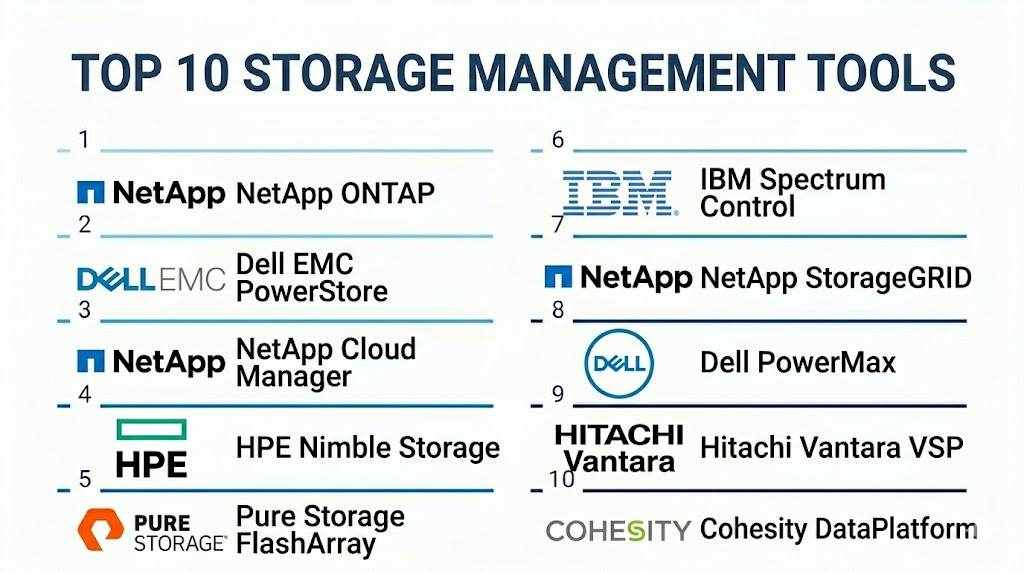
Top 10 Storage Management Tools
#1 — NetApp ONTAP
Short description: Enterprise-grade storage management and data services platform for managing on-premises and cloud storage. Ideal for large enterprises with complex storage needs.
Key Features
- Unified file and block storage management
- Cloud integration and tiering
- Data deduplication and compression
- Snapshots and replication for disaster recovery
- Predictive analytics for capacity planning
- Automated storage provisioning
- Security and compliance reporting
Pros
- Robust enterprise features
- Scalable for multi-site deployments
Cons
- High complexity
- Premium licensing costs
Platforms / Deployment
- Windows, Linux, VMware, cloud
- Cloud / On-premises / Hybrid
Security & Compliance
- Encryption, RBAC, audit logs
- Not publicly stated
Integrations & Ecosystem
Integrates with VMware, AWS, Azure, backup solutions, and monitoring tools.
- Cloud connectors for tiering
- APIs for automation
- ITSM integration
Support & Community
Vendor support available; strong enterprise community.
#2 — Dell EMC PowerStore
Short description: Modern storage management platform combining performance, scalability, and automation for enterprise workloads, including virtualized and containerized environments.
Key Features
- Unified block and file storage
- Automation and policy-driven provisioning
- Performance analytics dashboards
- Snapshots and replication
- Integration with VMware, Kubernetes, and cloud platforms
- Data efficiency features (compression, deduplication)
Pros
- High performance and scalable
- Supports modern workloads
Cons
- Complexity for SMB deployment
- Premium pricing
Platforms / Deployment
- Windows, Linux, VMware, cloud
- Cloud / On-premises / Hybrid
Security & Compliance
- Encryption, RBAC
- Not publicly stated
Integrations & Ecosystem
Integrates with VMware, cloud platforms, backup solutions.
- APIs for automation
- Monitoring and alerting
- IT workflow integration
Support & Community
Vendor support; active enterprise community.
#3 — NetApp Cloud Manager
Short description: Provides centralized management of hybrid and multi-cloud storage environments. Ideal for enterprises using both on-premises and cloud storage.
Key Features
- Hybrid and multi-cloud visibility
- Policy-driven storage automation
- Tiering and capacity optimization
- Backup and disaster recovery integration
- Reporting and analytics
- Security and compliance dashboards
Pros
- Centralized management for hybrid storage
- Optimizes cost and capacity
Cons
- Focused on NetApp ecosystem
- Requires training for complex features
Platforms / Deployment
- Web, Windows, Linux, cloud
- Cloud / Hybrid
Security & Compliance
- Encryption, RBAC, audit logs
- Not publicly stated
Integrations & Ecosystem
Integrates with AWS, Azure, VMware, and backup systems.
- APIs for automation
- Cloud tiering connectors
Support & Community
Vendor support; active NetApp community.
#4 — HPE Nimble Storage
Short description: Intelligent storage management platform offering predictive analytics, automated management, and hybrid cloud support for mid-market and enterprise.
Key Features
- Predictive analytics for performance and capacity
- Policy-driven storage provisioning
- Automated backups and replication
- Cloud integration
- Data deduplication and compression
- Multi-protocol support
Pros
- AI-driven insights
- Simplified management
Cons
- Premium cost
- Complex deployment
Platforms / Deployment
- Windows, Linux, VMware, cloud
- Cloud / On-premises / Hybrid
Security & Compliance
- Encryption, RBAC
- Not publicly stated
Integrations & Ecosystem
Integrates with VMware, cloud platforms, and backup solutions.
- API support
- Monitoring integration
- IT workflow connectors
Support & Community
Vendor support available; growing enterprise community.
#5 — Pure Storage FlashArray
Short description: High-performance storage management solution for enterprises requiring scalable, low-latency storage with automation and cloud integration.
Key Features
- All-flash storage arrays
- Cloud integration and replication
- Automation and orchestration
- Data reduction and compression
- Real-time monitoring and analytics
Pros
- Exceptional performance
- Simplified management with AI insights
Cons
- High investment cost
- Primarily for enterprise environments
Platforms / Deployment
- Windows, Linux, VMware, cloud
- Cloud / On-premises / Hybrid
Security & Compliance
- Encryption, audit logs
- Not publicly stated
Integrations & Ecosystem
Integrates with VMware, cloud providers, and monitoring platforms.
- APIs for automation
- Cloud replication connectors
Support & Community
Vendor support; active user community.
#6 — IBM Spectrum Control
Short description: Enterprise storage management platform for monitoring, optimizing, and automating storage across on-premises and cloud infrastructure.
Key Features
- Capacity and performance monitoring
- Automated provisioning and tiering
- Multi-vendor support
- Predictive analytics
- Integration with backup and disaster recovery
- Reporting dashboards
Pros
- Supports heterogeneous storage environments
- Strong analytics and monitoring
Cons
- Complex configuration
- Enterprise pricing
Platforms / Deployment
- Windows, Linux, VMware, cloud
- Cloud / On-premises / Hybrid
Security & Compliance
- Encryption, RBAC
- Not publicly stated
Integrations & Ecosystem
Integrates with multiple storage vendors, cloud platforms, and ITSM tools.
- APIs for workflow automation
- Monitoring integration
Support & Community
Vendor support; enterprise community active.
#7 — NetApp StorageGRID
Short description: Object storage management for large-scale, cloud-integrated deployments, supporting unstructured data and long-term retention.
Key Features
- Object storage management
- Multi-cloud integration
- Automated tiering
- Lifecycle and retention policies
- Compliance and auditing
- Analytics dashboards
Pros
- Scalable for petabyte-level storage
- Strong cloud integration
Cons
- Specialized for object storage
- Learning curve for hybrid deployments
Platforms / Deployment
- Windows, Linux, Cloud
- Cloud / On-premises / Hybrid
Security & Compliance
- Encryption, audit logs
- GDPR, SOC 2
Integrations & Ecosystem
Integrates with backup solutions, cloud providers, and monitoring systems.
- API automation
- Workflow connectors
Support & Community
Vendor support; active NetApp community.
#8 — Dell PowerMax
Short description: Enterprise storage management with AI-driven optimization, high availability, and hybrid cloud integration for performance-critical workloads.
Key Features
- AI-driven performance optimization
- Multi-cloud integration
- Automated provisioning and replication
- Data deduplication and compression
- Predictive analytics
- High availability
Pros
- High reliability and performance
- Advanced AI-driven insights
Cons
- Enterprise cost
- Complexity for SMBs
Platforms / Deployment
- Windows, Linux, VMware, Cloud
- Cloud / On-premises / Hybrid
Security & Compliance
- Encryption, RBAC
- Not publicly stated
Integrations & Ecosystem
Integrates with cloud, backup, and ITSM tools.
- API support
- Monitoring connectors
- Automation workflows
Support & Community
Vendor support; enterprise community active.
#9 — Hitachi Vantara VSP
Short description: High-performance enterprise storage management platform with automation, analytics, and cloud integration for hybrid environments.
Key Features
- AI-driven storage analytics
- Automated provisioning
- Cloud integration and tiering
- High availability and disaster recovery
- Deduplication and compression
- Multi-protocol support
Pros
- Enterprise scalability
- AI-assisted management
Cons
- High investment cost
- Requires skilled administration
Platforms / Deployment
- Windows, Linux, VMware, Cloud
- Cloud / On-premises / Hybrid
Security & Compliance
- Encryption, RBAC
- Not publicly stated
Integrations & Ecosystem
Integrates with VMware, cloud providers, and backup solutions.
- API automation
- Monitoring and reporting integration
Support & Community
Vendor support; active enterprise forums.
#10 — Cohesity DataPlatform
Short description: Hyperconverged storage management platform providing backup, archiving, and cloud integration for enterprise-scale deployments.
Key Features
- Hyperconverged storage
- Cloud and on-prem backup
- Data deduplication and compression
- Policy-driven automation
- Multi-cloud integration
- Reporting and analytics
Pros
- Unified platform for backup and storage
- Scalable for hybrid deployments
Cons
- Premium cost
- Complexity in initial deployment
Platforms / Deployment
- Windows, Linux, VMware, Cloud
- Cloud / On-premises / Hybrid
Security & Compliance
- Encryption, RBAC, MFA
- Not publicly stated
Integrations & Ecosystem
Integrates with VMware, cloud platforms, ITSM, and backup tools.
- API for automation
- Cloud tiering connectors
Support & Community
Vendor support; active enterprise community.
Comparison Table (Top 10)
| Tool Name | Best For | Platform(s) Supported | Deployment | Standout Feature | Public Rating |
|---|---|---|---|---|---|
| NetApp ONTAP | Enterprise | Windows, Linux, VMware, Cloud | Cloud/On-prem/Hybrid | Unified storage management | N/A |
| Dell EMC PowerStore | Enterprise | Windows, Linux, VMware, Cloud | Cloud/On-prem/Hybrid | Automation and analytics | N/A |
| NetApp Cloud Manager | Enterprise | Windows, Linux, Cloud | Cloud/Hybrid | Hybrid cloud visibility | N/A |
| HPE Nimble Storage | Mid-Market/Enterprise | Windows, Linux, VMware, Cloud | Cloud/On-prem/Hybrid | AI-driven insights | N/A |
| Pure Storage FlashArray | Enterprise | Windows, Linux, VMware, Cloud | Cloud/On-prem/Hybrid | High performance | N/A |
| IBM Spectrum Control | Enterprise | Windows, Linux, VMware, Cloud | Cloud/On-prem/Hybrid | Multi-vendor support | N/A |
| NetApp StorageGRID | Enterprise | Windows, Linux, Cloud | Cloud/On-prem/Hybrid | Object storage management | N/A |
| Dell PowerMax | Enterprise | Windows, Linux, VMware, Cloud | Cloud/On-prem/Hybrid | AI optimization | N/A |
| Hitachi Vantara VSP | Enterprise | Windows, Linux, VMware, Cloud | Cloud/On-prem/Hybrid | High availability | N/A |
| Cohesity DataPlatform | Enterprise | Windows, Linux, VMware, Cloud | Cloud/On-prem/Hybrid | Hyperconverged storage | N/A |
Evaluation & Scoring of Storage Management Tools
| Tool Name | Core (25%) | Ease (15%) | Integrations (15%) | Security (10%) | Performance (10%) | Support (10%) | Value (15%) | Weighted Total (0–10) |
|---|---|---|---|---|---|---|---|---|
| NetApp ONTAP | 9 | 7 | 8 | 8 | 9 | 7 | 8 | 8.2 |
| Dell EMC PowerStore | 9 | 7 | 8 | 8 | 9 | 7 | 7 | 7.9 |
| NetApp Cloud Manager | 8 | 7 | 7 | 8 | 8 | 7 | 7 | 7.5 |
| HPE Nimble Storage | 8 | 7 | 7 | 8 | 8 | 7 | 7 | 7.5 |
| Pure Storage FlashArray | 9 | 7 | 7 | 8 | 9 | 7 | 7 | 7.8 |
| IBM Spectrum Control | 8 | 6 | 7 | 8 | 8 | 7 | 7 | 7.3 |
| NetApp StorageGRID | 8 | 7 | 7 | 8 | 8 | 7 | 7 | 7.5 |
| Dell PowerMax | 9 | 7 | 8 | 8 | 9 | 7 | 7 | 7.9 |
| Hitachi Vantara VSP | 8 | 7 | 7 | 8 | 8 | 7 | 7 | 7.5 |
| Cohesity DataPlatform | 9 | 7 | 8 | 8 | 9 | 7 | 7 | 7.9 |
Interpretation: Weighted totals reflect the relative strengths of each solution in core features, usability, integrations, security, performance, support, and value. Higher totals indicate better suitability for complex, hybrid, and multi-cloud storage environments. Buyers should prioritize based on organizational size, storage complexity, and budget.
Which Storage Management Tools Tool Is Right for You?
Solo / Freelancer
- Entry-level tools or cloud-native solutions may suffice. NetApp Cloud Manager or Cohesity can offer cloud integration without heavy on-prem investment.
SMB
- HPE Nimble Storage or Pure Storage FlashArray provide scalable, automated management for growing data requirements.
Mid-Market
- IBM Spectrum Control, Dell EMC PowerStore, or NetApp ONTAP offer strong analytics, automation, and multi-site management.
Enterprise
- NetApp ONTAP, Dell PowerMax, Hitachi Vantara VSP, and Cohesity DataPlatform deliver enterprise-grade performance, AI-assisted management, and hybrid cloud optimization.
Budget vs Premium
- Budget-friendly: HPE Nimble Storage, NetApp Cloud Manager
- Premium enterprise: NetApp ONTAP, Dell PowerMax, Cohesity
Feature Depth vs Ease of Use
- Feature-rich: NetApp ONTAP, Dell PowerMax, Pure Storage
- Ease-of-use: HPE Nimble Storage, NetApp Cloud Manager
Integrations & Scalability
- NetApp, Cohesity, and Dell platforms offer strong cloud, backup, and ITSM integrations for scaling.
Security & Compliance Needs
- Enterprises with strict regulatory requirements should prioritize encryption, RBAC, MFA, and audit logging supported by NetApp, Dell PowerMax, and Cohesity solutions.
Frequently Asked Questions (FAQs)
1. How much do storage management tools cost?
Pricing varies with deployment type, capacity, and enterprise features. Cloud-first solutions often use subscription models, while enterprise-grade tools require licensing per array or node.
2. How long does deployment take?
Cloud solutions can deploy within days; enterprise on-prem deployments may take weeks for configuration, testing, and migration.
3. Can these tools optimize storage automatically?
Yes. Modern tools include AI-driven analytics and policy-driven automation to optimize capacity and performance.
4. Do they support hybrid cloud environments?
Yes. Most enterprise tools provide multi-cloud visibility and tiering, enabling seamless management across on-premises and cloud storage.
5. Can storage be provisioned for virtualized workloads?
Yes. Tools support VMware, Hyper-V, and containerized workloads with automated provisioning and replication.
6. How secure is storage management data?
Top solutions provide encryption, RBAC, MFA, and audit logs to maintain compliance and protect data.
7. Are these tools scalable for large organizations?
Yes. Platforms like NetApp ONTAP, Cohesity, and Dell PowerMax scale to petabyte-level storage across multiple sites.
8. Can storage be monitored in real time?
Yes. Dashboards and alerts provide real-time monitoring of capacity, performance, and health.
9. Can these tools integrate with backup and disaster recovery?
Yes. Integration with backup, disaster recovery, and ITSM solutions is standard to ensure continuity.
10. Are open-source storage management tools viable?
Open-source options exist but typically lack enterprise-grade automation, monitoring, security, and multi-cloud integration.
Conclusion
Storage management tools are essential for organizations to manage growing data volumes, optimize storage performance, ensure business continuity, and maintain compliance. Modern solutions offer AI-assisted analytics, automation, hybrid cloud visibility, and integration with IT workflows, providing scalable and efficient storage management. Choosing the right tool depends on company size, infrastructure complexity, compliance needs, and budget. IT teams should pilot solutions, validate automation and reporting capabilities, and ensure seamless integration for effective storage optimization and protection.

Find Trusted Cardiac Hospitals
Compare heart hospitals by city and services — all in one place.
Explore Hospitals
Storage management is not only about tracking available space. It is also important to know which data is growing fastest and why. Regular reviews of storage usage can help teams find old backups, duplicate data, or unused files before they become a bigger cost or performance problem.