Introduction
Distributed Tracing Tools are specialized platforms that allow organizations to monitor and visualize the flow of requests across complex, distributed systems. They provide deep insights into how different microservices, APIs, and components interact, helping teams identify performance bottlenecks, latency issues, and operational inefficiencies. As enterprises increasingly adopt cloud-native architectures, containerized deployments, and serverless computing, distributed tracing has become essential for maintaining application reliability and performance.
These tools are critical for real-world scenarios such as debugging latency in e-commerce platforms, monitoring API performance in SaaS applications, analyzing microservices dependencies in financial systems, or ensuring uptime for global web services. Additionally, distributed tracing supports DevOps practices by providing end-to-end visibility into service calls, enabling faster root cause analysis and efficient troubleshooting.
Best for: DevOps engineers, site reliability engineers (SREs), cloud architects, mid-market to enterprise organizations, technology-driven companies using microservices, and SaaS providers.
Not ideal for: Organizations with monolithic applications, minimal distributed services, or those relying on simpler logging and monitoring tools where full tracing may not be cost-effective.
Key evaluation criteria include:
- Real-time trace collection and visualization
- Ease of instrumenting applications and microservices
- Integration with observability stacks (logs, metrics, alerts)
- Support for multiple programming languages and frameworks
- Scalability and storage efficiency
- AI or automated anomaly detection features
- Security and compliance standards
- Deployment flexibility (cloud, self-hosted, hybrid)
- Community and vendor support
- Pricing and total cost of ownership
Key Trends in Distributed Tracing Tools
- AI-powered root cause analysis to automatically identify anomalies and performance issues.
- Unified observability with integration of metrics, logs, and traces into single dashboards.
- Serverless and microservices-focused tracing for cloud-native architectures.
- OpenTelemetry adoption as an emerging standard for distributed instrumentation.
- Cloud-first and SaaS delivery models with scalable storage and global access.
- Enhanced visualization and trace analytics for multi-service dependencies.
- Automated alerting and anomaly detection based on trace patterns.
- Integration with CI/CD pipelines for continuous monitoring of deployments.
- Flexible pricing models including usage-based and subscription tiers.
- Security and compliance capabilities for sensitive data tracing.
How We Selected These Tools (Methodology)
- Analyzed market adoption and mindshare among enterprises and developers.
- Assessed feature completeness, including instrumentation, visualization, and AI-driven insights.
- Evaluated performance and reliability under high traffic and distributed loads.
- Reviewed security posture, including encryption, RBAC, and compliance capabilities.
- Examined integration capabilities with metrics, logging, and alerting systems.
- Considered developer friendliness and multi-language support.
- Balanced cloud-native and self-hosted options for deployment flexibility.
- Measured scalability and storage efficiency for enterprise-grade environments.
- Assessed community engagement and vendor support levels.
- Considered cost-effectiveness relative to features and scale.
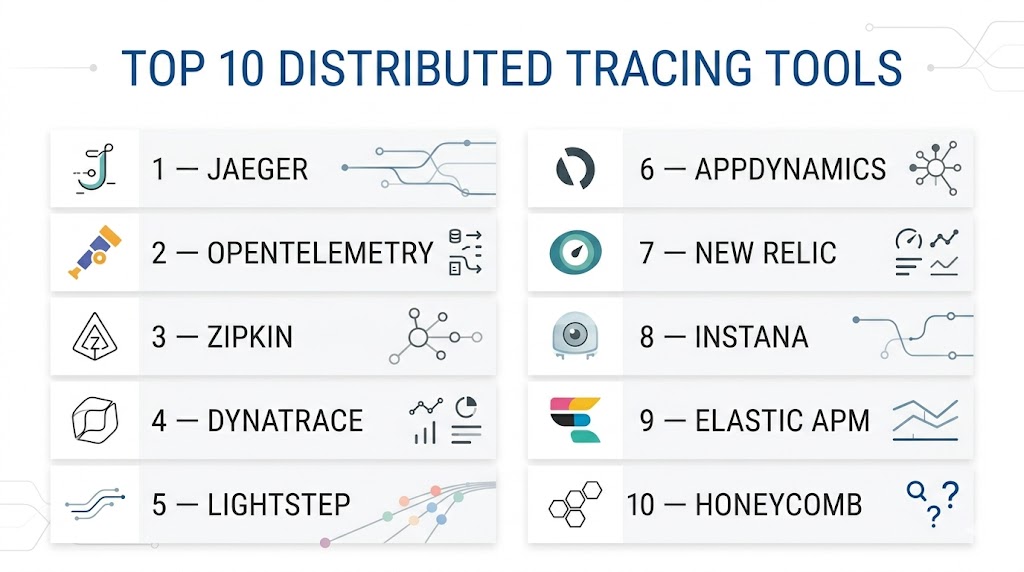
Top 10 Distributed Tracing Tools
#1 — Jaeger
Short description : Jaeger is an open-source, end-to-end distributed tracing system for monitoring and troubleshooting microservices-based applications. It is widely used by developers and DevOps teams to analyze latency and optimize performance.
Key Features
- End-to-end distributed tracing
- Root cause analysis and latency monitoring
- Integration with OpenTelemetry
- Scalable storage backend (Elasticsearch, Cassandra)
- Adaptive sampling and trace filtering
- Customizable dashboards and visualizations
Pros
- Open-source with no licensing cost
- Strong community and ecosystem
- Flexible storage and scalability options
Cons
- UI may be less polished than commercial solutions
- Advanced analytics features require additional configuration
- Support primarily community-driven
Platforms / Deployment
- Web, Linux
- Cloud / Self-hosted
Security & Compliance
- Not publicly stated
Integrations & Ecosystem
Integrates with OpenTelemetry SDKs and popular logging/monitoring stacks.
- Kubernetes, Prometheus, Grafana
- Elasticsearch, Cassandra backends
- CI/CD pipeline hooks
- Alerting tools via APIs
Support & Community
Strong open-source community; documentation available; enterprise support via third-party providers.
#2 — OpenTelemetry
Short description : OpenTelemetry is an open-source observability framework that provides standardized APIs and SDKs for collecting distributed traces, metrics, and logs. It is developer-focused and widely adopted for cloud-native monitoring.
Key Features
- Unified telemetry collection (traces, metrics, logs)
- Vendor-neutral instrumentation
- Multi-language support
- Integration with Jaeger, Zipkin, and commercial backends
- Sampling and batching for performance
Pros
- Open standard promotes interoperability
- Vendor-neutral and flexible
- Active community and adoption
Cons
- Requires backend to visualize traces
- Configuration complexity for large-scale setups
- Limited out-of-the-box dashboards
Platforms / Deployment
- Web, Linux, Windows, macOS
- Cloud / Self-hosted
Security & Compliance
- Not publicly stated
Integrations & Ecosystem
Works with tracing backends and observability platforms.
- Supports Prometheus, Grafana, Elasticsearch
- Cloud-native platforms: AWS, Azure, GCP
- APIs for custom integrations
Support & Community
Active open-source community; official documentation and guides.
#3 — Zipkin
Short description : Zipkin is an open-source distributed tracing system for collecting and visualizing latency data across microservices. Ideal for developers and small to mid-market organizations.
Key Features
- Trace collection and visualization
- Sampling and rate control
- Multi-storage backend support
- Dependency graph analysis
- Simple UI for trace exploration
Pros
- Lightweight and easy to deploy
- Open-source and free
- Supports multiple storage options
Cons
- Limited advanced analytics
- UI and reporting are basic
- Scaling to enterprise workloads can be challenging
Platforms / Deployment
- Web, Linux
- Cloud / Self-hosted
Security & Compliance
- Not publicly stated
Integrations & Ecosystem
Integrates with OpenTelemetry and other observability tools.
- Logging systems
- Metrics platforms
- Kubernetes and cloud-native environments
Support & Community
Community-driven support; documentation and tutorials available.
#4 — Dynatrace
Short description : Dynatrace provides AI-powered distributed tracing as part of its full-stack observability platform. Suitable for enterprise DevOps, SREs, and cloud-native applications.
Key Features
- AI-assisted root cause analysis
- End-to-end distributed tracing
- Automatic instrumentation
- Real-time monitoring and alerting
- Multi-cloud support and dashboards
- Integration with CI/CD pipelines
Pros
- Advanced AI insights
- Fully managed cloud option
- Comprehensive enterprise observability
Cons
- Subscription cost can be high
- Some features may be overkill for small teams
- Cloud-dependent for full functionality
Platforms / Deployment
- Web, Linux, Windows
- Cloud / Hybrid
Security & Compliance
- SOC 2, ISO 27001, GDPR
- Encryption, SSO, MFA
Integrations & Ecosystem
Integrates with Kubernetes, AWS, Azure, GitHub, and Jira.
- APIs for custom workflows
- CI/CD pipelines integration
- Collaboration tools for DevOps teams
Support & Community
Enterprise support with SLAs; documentation and training resources.
#5 — Lightstep
Short description : Lightstep delivers distributed tracing with advanced analytics and performance monitoring for large-scale cloud-native applications, focusing on observability for enterprise microservices.
Key Features
- High-resolution distributed tracing
- Service dependency visualization
- Anomaly detection with AI
- Cloud-native multi-service support
- Dashboards and alerts
- Integrations with observability stacks
Pros
- Powerful analytics for large-scale environments
- AI-driven insights
- Strong cloud-native focus
Cons
- Cost may be prohibitive for smaller teams
- Learning curve for advanced features
- Dependent on cloud infrastructure
Platforms / Deployment
- Web
- Cloud
Security & Compliance
- SOC 2, ISO 27001, GDPR
- Encryption, SSO
Integrations & Ecosystem
- Integrates with Prometheus, Grafana, Kubernetes
- CI/CD pipeline support
- APIs for automation and analytics
Support & Community
Enterprise-grade support; documentation and professional services.
#6 — AppDynamics
Short description : AppDynamics offers distributed tracing as part of its application performance monitoring suite. Ideal for enterprises seeking deep visibility across applications and business transactions.
Key Features
- End-to-end transaction tracing
- Business transaction monitoring
- Automated root cause analysis
- Multi-cloud and hybrid deployment
- Dashboards and alerting
- AI-based performance insights
Pros
- Strong enterprise adoption
- Comprehensive monitoring suite
- Business-oriented analytics
Cons
- Expensive for smaller teams
- Complexity in setup and configuration
- Cloud vs on-prem licensing considerations
Platforms / Deployment
- Web, Windows, Linux
- Cloud / Self-hosted / Hybrid
Security & Compliance
- SOC 2, ISO 27001
- Encryption, RBAC, MFA
Integrations & Ecosystem
- Integrates with cloud platforms, CI/CD, logging, and alerting systems
- APIs for custom dashboards
- Supports Kubernetes and microservices observability
Support & Community
Enterprise support with documentation and training programs.
#7 — New Relic
Short description : New Relic provides distributed tracing as part of its observability platform, targeting DevOps and SRE teams for performance monitoring in cloud and microservices environments.
Key Features
- Real-time distributed tracing
- Service dependency maps
- Integrated observability (logs, metrics, traces)
- AI-assisted anomaly detection
- Custom dashboards and alerts
Pros
- Unified observability platform
- Cloud-native friendly
- Strong analytics and visualization
Cons
- Cost scales with usage
- May require configuration for full visibility
- Cloud-focused deployment
Platforms / Deployment
- Web, Linux, Windows
- Cloud / Hybrid
Security & Compliance
- SOC 2, ISO 27001
- Encryption, SSO, MFA
Integrations & Ecosystem
- Cloud services (AWS, Azure, GCP)
- CI/CD pipelines
- APIs for custom integrations
- Logging and monitoring tools
Support & Community
Enterprise support with documentation, webinars, and community forums.
#8 — Instana
Short description : Instana provides automated distributed tracing and application performance monitoring with AI-powered insights, focusing on microservices and cloud-native deployments.
Key Features
- Automated tracing without manual instrumentation
- Service and dependency visualization
- AI-driven anomaly detection
- Real-time dashboards
- CI/CD integration
- Multi-cloud support
Pros
- Quick setup and automated instrumentation
- Strong AI-powered root cause analysis
- Cloud-native focus
Cons
- Subscription pricing may be high
- Limited on-prem deployment
- Feature depth may be excessive for small teams
Platforms / Deployment
- Web
- Cloud / Hybrid
Security & Compliance
- SOC 2, ISO 27001
- Encryption, SSO
Integrations & Ecosystem
- Kubernetes, Docker, cloud platforms
- Logging, metrics, and alerting integration
- APIs for custom automation
Support & Community
Enterprise support with professional services and documentation.
#9 — Elastic APM
Short description : Elastic APM (Application Performance Monitoring) offers distributed tracing as part of the Elastic Stack, suitable for developers and enterprises leveraging open-source observability solutions.
Key Features
- Trace collection and visualization
- Integration with Elasticsearch and Kibana
- Service performance analytics
- Multi-language agent support
- Custom dashboards and alerting
Pros
- Open-source flexibility
- Strong analytics with Elasticsearch
- Cost-effective for open-source users
Cons
- Requires Elastic Stack setup
- Scaling requires infrastructure knowledge
- Advanced AI features limited
Platforms / Deployment
- Web, Linux, Windows
- Cloud / Self-hosted / Hybrid
Security & Compliance
- Encryption, SSO
- Not publicly stated
Integrations & Ecosystem
- Works with Elasticsearch, Logstash, Kibana
- CI/CD and monitoring integrations
- APIs for automation and dashboards
Support & Community
Community-driven support; commercial subscriptions available.
#10 — Honeycomb
Short description : Honeycomb provides observability and distributed tracing for developers and SREs, emphasizing high-resolution data analytics and performance insights for complex systems.
Key Features
- High-cardinality data analysis
- Distributed tracing with event-level visibility
- Real-time dashboards
- Anomaly detection and alerting
- Cloud-native deployment
- Integrations with observability stack
Pros
- Excellent for debugging complex microservices
- High-resolution performance insights
- Developer-focused and flexible
Cons
- Pricing can be high for large datasets
- Learning curve for advanced analytics
- Primarily cloud-based
Platforms / Deployment
- Web
- Cloud
Security & Compliance
- Not publicly stated
Integrations & Ecosystem
- Supports Kubernetes, AWS, GCP, and Azure
- APIs for custom dashboards and pipelines
- Integration with logs and metrics platforms
Support & Community
Documentation, onboarding guides, and enterprise support available.
Comparison Table (Top 10)
| Tool Name | Best For | Platform(s) Supported | Deployment | Standout Feature | Public Rating |
|---|---|---|---|---|---|
| Jaeger | DevOps & Developers | Web, Linux | Cloud / Self-hosted | Open-source full tracing | N/A |
| OpenTelemetry | Developers & Cloud Teams | Web, Linux, Windows, macOS | Cloud / Self-hosted | Vendor-neutral instrumentation | N/A |
| Zipkin | SMB & Developers | Web, Linux | Cloud / Self-hosted | Lightweight trace collection | N/A |
| Dynatrace | Enterprise DevOps | Web, Linux, Windows | Cloud / Hybrid | AI-assisted root cause analysis | N/A |
| Lightstep | Cloud-native Enterprises | Web | Cloud | High-resolution trace analytics | N/A |
| AppDynamics | Enterprise IT & Business Transactions | Web, Windows, Linux | Cloud / Self-hosted / Hybrid | Business transaction tracing | N/A |
| New Relic | DevOps & SRE | Web, Linux, Windows | Cloud / Hybrid | Unified observability | N/A |
| Instana | Microservices Teams | Web | Cloud / Hybrid | Automated instrumentation | N/A |
| Elastic APM | Developers & Enterprises | Web, Linux, Windows | Cloud / Self-hosted / Hybrid | Open-source analytics | N/A |
| Honeycomb | Developers & SREs | Web | Cloud | High-resolution event analytics | N/A |
Evaluation & Scoring of Distributed Tracing Tools
| Tool Name | Core (25%) | Ease (15%) | Integrations (15%) | Security (10%) | Performance (10%) | Support (10%) | Value (15%) | Weighted Total (0–10) |
|---|---|---|---|---|---|---|---|---|
| Jaeger | 8 | 7 | 7 | 7 | 8 | 6 | 9 | 7.5 |
| OpenTelemetry | 7 | 6 | 8 | 7 | 7 | 6 | 9 | 7.2 |
| Zipkin | 6 | 8 | 6 | 6 | 6 | 6 | 9 | 6.6 |
| Dynatrace | 9 | 8 | 8 | 9 | 9 | 8 | 6 | 8.5 |
| Lightstep | 9 | 7 | 8 | 8 | 9 | 7 | 6 | 8.3 |
| AppDynamics | 9 | 7 | 8 | 8 | 8 | 7 | 6 | 8.1 |
| New Relic | 8 | 8 | 8 | 8 | 8 | 7 | 6 | 8.0 |
| Instana | 8 | 8 | 8 | 8 | 8 | 7 | 6 | 8.0 |
| Elastic APM | 7 | 7 | 7 | 7 | 7 | 6 | 8 | 7.1 |
| Honeycomb | 8 | 7 | 7 | 7 | 8 | 6 | 6 | 7.4 |
Interpretation: Weighted totals reflect comparative strengths in features, usability, integration, and enterprise readiness. Scores are relative to the top ten tools evaluated here.
Which Distributed Tracing Tool Is Right for You?
Solo / Freelancer
Jaeger, Zipkin, or OpenTelemetry offer lightweight, open-source solutions with low cost and minimal setup.
SMB
Zipkin, Elastic APM, or Honeycomb provide cost-effective distributed tracing with essential features.
Mid-Market
New Relic or Instana provide cloud-native tracing with AI-assisted insights and integration with observability stacks.
Enterprise
Dynatrace, Lightstep, AppDynamics deliver enterprise-grade AI analytics, scalability, and multi-cloud tracing.
Budget vs Premium
Open-source tools like Jaeger and OpenTelemetry suit limited budgets; Dynatrace and Lightstep are premium solutions with advanced features.
Feature Depth vs Ease of Use
Elastic APM and OpenTelemetry offer depth but require configuration; Instana and Dynatrace balance automation and feature-rich monitoring.
Integrations & Scalability
Dynatrace, Lightstep, and AppDynamics are best for complex, multi-cloud, or large-scale environments requiring broad integrations.
Security & Compliance Needs
Enterprises with strict compliance should prioritize Dynatrace or AppDynamics for robust enterprise security features.
Frequently Asked Questions (FAQs)
1. What pricing models are available for distributed tracing tools?
Pricing varies widely: open-source tools are free, while enterprise platforms use subscription or usage-based models.
2. How long does onboarding typically take?
Open-source setups like Jaeger can be implemented in hours; enterprise platforms may require weeks for full instrumentation and dashboards.
3. Can these tools scale to large distributed systems?
Yes, enterprise solutions like Dynatrace, Lightstep, and New Relic are built to handle complex microservices and cloud-native deployments.
4. Are AI or automation features standard?
Some platforms, like Dynatrace, Instana, and Lightstep, include AI-assisted root cause analysis; others rely on manual trace inspection.
5. What platforms are supported?
Most tools support Linux, Windows, and cloud environments. Web-based dashboards are standard for visualization.
6. How secure is distributed tracing?
Enterprise tools offer encryption, SSO, RBAC, and compliance certifications such as SOC 2, ISO 27001, and GDPR.
7. How do integrations work?
Tools often integrate with CI/CD pipelines, logging systems, metrics platforms, Kubernetes, and cloud providers through APIs and SDKs.
8. Can distributed tracing replace logging or monitoring?
Tracing complements logs and metrics but does not replace them; combined observability provides full system insights.
9. What are common implementation challenges?
Challenges include instrumenting all services, managing trace data volume, configuring sampling, and ensuring consistent monitoring across environments.
10. Are open-source options viable for enterprises?
Yes, with proper scaling and support, tools like Jaeger and OpenTelemetry can serve enterprise needs while providing flexibility and cost savings.
Conclusion
Distributed tracing is a critical component of modern observability strategies, enabling organizations to monitor microservices, identify performance bottlenecks, and maintain system reliability. Choosing the right tool depends on application complexity, scale, budget, and team expertise. Open-source options like Jaeger, Zipkin, and OpenTelemetry provide flexibility and cost-effectiveness, while enterprise platforms such as Dynatrace, Lightstep, and AppDynamics offer advanced analytics, AI-assisted root cause analysis, and multi-cloud support. Teams should assess their architecture, integration needs, and compliance requirements, shortlist suitable tools, and run pilot implementations to validate performance and observability effectiveness before full deployment.

Find Trusted Cardiac Hospitals
Compare heart hospitals by city and services — all in one place.
Explore Hospitals
Distributed tracing can become expensive when every request is recorded in a busy production system. Using smart sampling can help teams keep the traces that are most useful for finding problems while reducing unnecessary data. This also makes it easier to store and review tracing data over time.