Introduction
Data Clean Rooms are secure environments that allow organizations to collaborate, analyze, and activate data without directly exposing personally identifiable information or raw customer records. These platforms enable multiple parties such as advertisers, publishers, retailers, media companies, and brands to combine datasets for analytics, audience insights, measurement, and attribution while maintaining privacy and compliance requirements. As privacy regulations continue to evolve and third-party cookies become less effective, Data Clean Rooms have become a strategic component of modern data and marketing infrastructure. Organizations increasingly rely on clean rooms to enable privacy-safe data sharing, audience analysis, advertising measurement, and AI-driven insights without compromising sensitive customer information.
Real-World Use Cases Include
- Privacy-safe advertising measurement.
- Customer audience matching across organizations.
- Marketing attribution and campaign analysis.
- Retail media network analytics.
- Secure data collaboration between partners.
Evaluation Criteria for Buyers
- Privacy and security controls
- Data governance capabilities
- Query and analytics flexibility
- Integration ecosystem
- Scalability and performance
- AI and machine learning support
- Regulatory compliance readiness
- Ease of deployment
- Collaboration capabilities
- Cost and operational efficiency
Best for: Enterprises, advertisers, retailers, publishers, media companies, financial institutions, healthcare organizations, and businesses with significant data collaboration requirements.
Not ideal for: Small organizations with limited data-sharing needs, businesses without sensitive datasets, or teams requiring only basic analytics functionality.
Key Trends in Data Clean Rooms
- AI-powered privacy-preserving analytics are becoming mainstream.
- Retail media networks continue driving clean room adoption.
- First-party data strategies are replacing third-party cookie dependence.
- Differential privacy technologies are becoming more common.
- Multi-cloud deployments are increasing.
- Real-time data collaboration capabilities are expanding.
- Privacy-enhancing technologies are evolving rapidly.
- Secure machine learning within clean rooms is gaining traction.
- Cross-company data collaboration frameworks are improving.
- Regulatory compliance automation is becoming a key differentiator.
How We Selected These Tools
The platforms in this list were selected based on:
- Industry adoption and market presence.
- Security and privacy architecture.
- Data collaboration capabilities.
- Analytics and query flexibility.
- Integration ecosystem maturity.
- Scalability across enterprise workloads.
- Governance and compliance support.
- Innovation in privacy-enhancing technologies.
- Customer support and implementation resources.
- Suitability across industries and use cases.
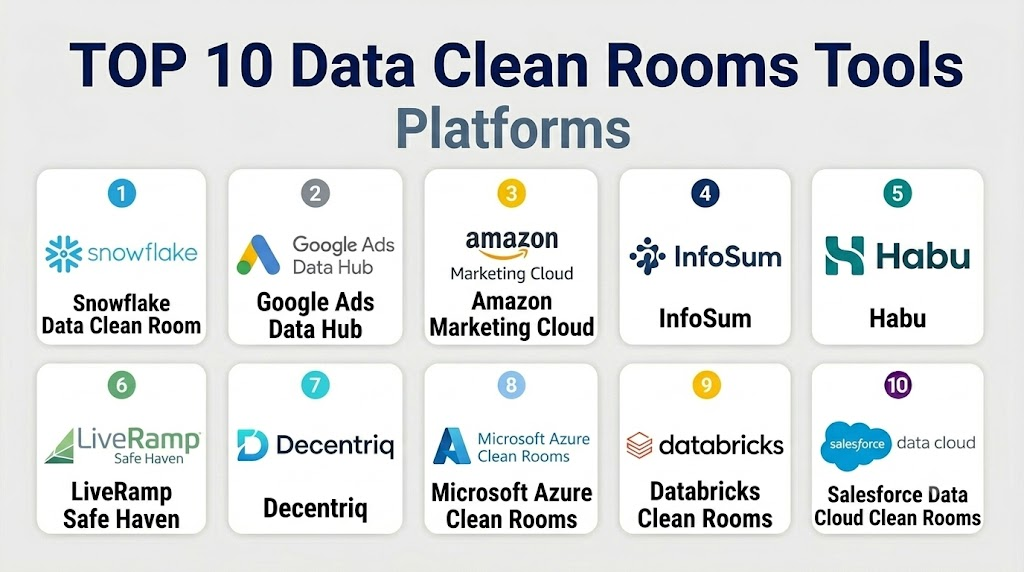
Top 10 Data Clean Rooms Tools
1- Snowflake Data Clean Room
Short Description: Snowflake Data Clean Room enables secure data collaboration and analytics directly within the Snowflake ecosystem while maintaining privacy and governance controls.
Key Features
- Secure data sharing
- Privacy-preserving analytics
- Cross-company collaboration
- Role-based access controls
- Data governance tools
- SQL-based analytics
- Multi-party collaboration
Pros
- Deep Snowflake integration
- Strong scalability
- Flexible analytics capabilities
Cons
- Best suited for Snowflake users
- Enterprise-oriented pricing
- Requires data expertise
Platforms / Deployment
- Cloud
Security & Compliance
- Encryption
- RBAC
- Audit logging
- Enterprise security controls
Integrations & Ecosystem
Snowflake supports broad integration across cloud data ecosystems.
- Data warehouses
- BI platforms
- Machine learning tools
- APIs
- Cloud platforms
Support & Community
Strong enterprise support and extensive documentation.
2- Google Ads Data Hub
Short Description: Google Ads Data Hub enables privacy-safe analysis of advertising performance using Google’s advertising datasets.
Key Features
- Advertising measurement
- Audience analysis
- Attribution reporting
- Privacy controls
- Campaign analytics
- BigQuery integration
- Query-based analysis
Pros
- Strong Google ecosystem integration
- Privacy-focused design
- Robust advertising analytics
Cons
- Google-centric environment
- Specialized use cases
- Learning curve
Platforms / Deployment
- Cloud
Security & Compliance
- Access controls
- Privacy protection mechanisms
Integrations & Ecosystem
- BigQuery
- Google Marketing Platform
- Google Ads
- APIs
Support & Community
Comprehensive Google documentation and support.
3- Amazon Marketing Cloud
Short Description: Amazon Marketing Cloud provides advertisers with privacy-safe analytics and audience insights within Amazon’s advertising ecosystem.
Key Features
- Advertising analytics
- Audience insights
- Attribution reporting
- Campaign measurement
- SQL query access
- Secure collaboration
- Retail analytics
Pros
- Rich Amazon advertising data
- Strong measurement capabilities
- Scalable architecture
Cons
- Amazon-focused ecosystem
- Technical expertise required
- Limited outside Amazon data access
Platforms / Deployment
- Cloud
Security & Compliance
- Enterprise-grade controls
- Privacy-preserving analytics
Integrations & Ecosystem
- Amazon Ads
- AWS services
- Analytics tools
- APIs
Support & Community
Enterprise support and partner ecosystem.
4- InfoSum
Short Description: InfoSum specializes in privacy-first data collaboration without moving or exposing underlying customer data.
Key Features
- Data collaboration
- Audience matching
- Privacy-first architecture
- Identity resolution
- Data federation
- Partner connectivity
- Analytics support
Pros
- Strong privacy model
- No centralized data storage
- Flexible collaboration
Cons
- Specialized implementation
- Enterprise pricing
- Learning curve
Platforms / Deployment
- Cloud
Security & Compliance
- Privacy-enhancing technologies
- Access controls
Integrations & Ecosystem
- Advertising platforms
- Data platforms
- APIs
- Partner networks
Support & Community
Strong enterprise onboarding and support.
5- Habu
Short Description: Habu provides a data clean room platform focused on secure data collaboration, audience analytics, and marketing measurement.
Key Features
- Data clean room framework
- Audience collaboration
- Marketing analytics
- Secure computation
- Governance controls
- Multi-cloud support
- Measurement capabilities
Pros
- Strong collaboration features
- Flexible deployment
- Enterprise-focused controls
Cons
- Enterprise-oriented
- Complex implementation
- Premium pricing
Platforms / Deployment
- Cloud
- Hybrid
Security & Compliance
- Governance controls
- Access management
Integrations & Ecosystem
- Cloud providers
- Data warehouses
- Advertising platforms
- APIs
Support & Community
Professional services and customer support.
6- LiveRamp Safe Haven
Short Description: LiveRamp Safe Haven enables privacy-safe data collaboration, identity resolution, and measurement across business ecosystems.
Key Features
- Identity resolution
- Data collaboration
- Audience insights
- Secure measurement
- Data activation
- Partner connectivity
- Governance controls
Pros
- Strong identity capabilities
- Broad ecosystem
- Proven enterprise adoption
Cons
- Enterprise pricing
- Complex onboarding
- Specialized expertise needed
Platforms / Deployment
- Cloud
Security & Compliance
- Enterprise security controls
- Privacy-focused architecture
Integrations & Ecosystem
- Advertising platforms
- Retail networks
- Data warehouses
- APIs
Support & Community
Strong customer success and implementation services.
7- Decentriq
Short Description: Decentriq focuses on confidential data collaboration using privacy-enhancing technologies and secure computing.
Key Features
- Confidential computing
- Data collaboration
- Secure analytics
- Privacy-preserving queries
- Access governance
- Data clean room environment
- Regulatory support
Pros
- Strong privacy architecture
- Modern security approach
- Flexible analytics
Cons
- Smaller ecosystem
- Enterprise focus
- Specialized implementation
Platforms / Deployment
- Cloud
Security & Compliance
- Confidential computing
- Encryption
- Access controls
Integrations & Ecosystem
- Data platforms
- Analytics tools
- APIs
- Cloud environments
Support & Community
Growing support ecosystem and documentation.
8- Microsoft Azure Clean Rooms
Short Description: Microsoft Azure Clean Rooms provides secure data collaboration capabilities within the Azure ecosystem.
Key Features
- Secure collaboration
- Data sharing controls
- Analytics support
- Governance capabilities
- Identity management
- Cloud-native deployment
- Access control policies
Pros
- Strong Azure integration
- Enterprise scalability
- Broad Microsoft ecosystem
Cons
- Azure-centric
- Technical complexity
- Enterprise-focused pricing
Platforms / Deployment
- Cloud
Security & Compliance
- Azure security controls
- Identity management
- Governance tools
Integrations & Ecosystem
- Azure services
- Microsoft Fabric
- Power BI
- APIs
Support & Community
Strong enterprise support and partner network.
9- Databricks Clean Rooms
Short Description: Databricks Clean Rooms enables secure collaboration and analytics across organizations using the Databricks Lakehouse platform.
Key Features
- Secure collaboration
- Lakehouse integration
- Data sharing
- Privacy controls
- AI and machine learning support
- Governance tools
- Cross-organization analytics
Pros
- Strong analytics capabilities
- AI-ready architecture
- Scalable platform
Cons
- Technical expertise required
- Enterprise complexity
- Premium pricing
Platforms / Deployment
- Cloud
Security & Compliance
- Access controls
- Governance framework
- Enterprise security
Integrations & Ecosystem
- Databricks ecosystem
- Data lakes
- ML platforms
- APIs
Support & Community
Large community and enterprise support resources.
10- Salesforce Data Cloud Clean Rooms
Short Description: Salesforce Data Cloud Clean Rooms help organizations securely collaborate and activate customer data within the Salesforce ecosystem.
Key Features
- Customer data collaboration
- Audience analysis
- Privacy controls
- Identity management
- Marketing measurement
- Data activation
- Governance tools
Pros
- Strong Salesforce integration
- Customer data focus
- Marketing use cases
Cons
- Salesforce-centric
- Enterprise pricing
- Advanced setup requirements
Platforms / Deployment
- Cloud
Security & Compliance
- Enterprise security controls
- Access management
Integrations & Ecosystem
- Salesforce ecosystem
- Marketing platforms
- CRM systems
- APIs
Support & Community
Comprehensive Salesforce support ecosystem.
Comparison Table
| Tool Name | Best For | Platform Supported | Deployment | Standout Feature | Public Rating |
|---|---|---|---|---|---|
| Snowflake Data Clean Room | Data collaboration | Web | Cloud | Native Snowflake sharing | N/A |
| Google Ads Data Hub | Advertising analytics | Web | Cloud | Google campaign measurement | N/A |
| Amazon Marketing Cloud | Retail media analytics | Web | Cloud | Amazon advertising insights | N/A |
| InfoSum | Privacy-first collaboration | Web | Cloud | Data federation model | N/A |
| Habu | Enterprise collaboration | Web | Cloud/Hybrid | Multi-cloud support | N/A |
| LiveRamp Safe Haven | Identity collaboration | Web | Cloud | Identity resolution | N/A |
| Decentriq | Confidential computing | Web | Cloud | Privacy-enhancing technology | N/A |
| Microsoft Azure Clean Rooms | Azure environments | Web | Cloud | Azure-native collaboration | N/A |
| Databricks Clean Rooms | Analytics teams | Web | Cloud | Lakehouse integration | N/A |
| Salesforce Data Cloud Clean Rooms | Customer data collaboration | Web | Cloud | Salesforce integration | N/A |
Evaluation & Scoring of Data Clean Rooms
| Tool Name | Core | Ease | Integrations | Security | Performance | Support | Value | Weighted Total |
|---|---|---|---|---|---|---|---|---|
| Snowflake Data Clean Room | 10 | 8 | 10 | 9 | 10 | 9 | 8 | 9.15 |
| Google Ads Data Hub | 9 | 8 | 8 | 9 | 9 | 8 | 8 | 8.45 |
| Amazon Marketing Cloud | 9 | 8 | 8 | 9 | 9 | 8 | 8 | 8.45 |
| InfoSum | 9 | 7 | 8 | 10 | 8 | 8 | 7 | 8.30 |
| Habu | 9 | 7 | 9 | 9 | 8 | 8 | 7 | 8.25 |
| LiveRamp Safe Haven | 9 | 7 | 9 | 9 | 9 | 9 | 7 | 8.50 |
| Decentriq | 8 | 7 | 7 | 10 | 8 | 7 | 8 | 8.00 |
| Microsoft Azure Clean Rooms | 9 | 8 | 9 | 9 | 9 | 9 | 8 | 8.75 |
| Databricks Clean Rooms | 9 | 7 | 9 | 9 | 10 | 8 | 8 | 8.60 |
| Salesforce Data Cloud Clean Rooms | 8 | 8 | 9 | 8 | 8 | 9 | 8 | 8.25 |
Which Data Clean Rooms Tool Is Right for You?
Solo / Freelancer
Most clean room platforms are enterprise-focused. Individual users typically do not require dedicated clean room solutions.
SMB
Smaller organizations with growing collaboration needs may consider Salesforce Data Cloud Clean Rooms if already invested in the Salesforce ecosystem.
Mid-Market
InfoSum, Decentriq, and Habu offer flexible collaboration capabilities without requiring the scale of the largest enterprise deployments.
Enterprise
Snowflake Data Clean Room, LiveRamp Safe Haven, Databricks Clean Rooms, and Microsoft Azure Clean Rooms are strong enterprise choices.
Budget vs Premium
Organizations seeking maximum flexibility from existing cloud investments should evaluate native clean room offerings. Premium buyers often prefer LiveRamp, InfoSum, or Habu.
Feature Depth vs Ease of Use
Snowflake and Databricks provide extensive analytical capabilities. Salesforce and Azure solutions may be easier for existing ecosystem users.
Integrations & Scalability
Snowflake, Azure, Databricks, and Salesforce offer extensive ecosystems and large-scale deployment options.
Security & Compliance Needs
Organizations prioritizing privacy and governance should evaluate InfoSum, Decentriq, LiveRamp Safe Haven, and Snowflake.
Frequently Asked Questions
1- What is a data clean room?
A data clean room is a secure environment that allows multiple parties to analyze and collaborate on data without exposing raw customer information.
2- Why are data clean rooms becoming important?
Privacy regulations and declining third-party cookie effectiveness are driving demand for secure data collaboration solutions.
3- Who typically uses data clean rooms?
Advertisers, retailers, publishers, media companies, financial institutions, and healthcare organizations commonly use clean rooms.
4- How do clean rooms protect privacy?
Most platforms use access controls, aggregation techniques, privacy-enhancing technologies, and governance policies to prevent exposure of sensitive data.
5- Can clean rooms support machine learning?
Yes. Many modern platforms support secure analytics and machine learning workloads within controlled environments.
6- How difficult is implementation?
Implementation complexity depends on data architecture, governance requirements, and integration needs.
7- What industries benefit the most?
Retail, advertising, media, finance, healthcare, telecommunications, and enterprise technology sectors often see the greatest benefits.
8- Are clean rooms cloud-based?
Most modern clean rooms are cloud-native, although some platforms support hybrid deployment models.
9- What are common implementation mistakes?
Common mistakes include poor governance planning, unclear collaboration objectives, weak identity management, and insufficient data quality controls.
10- What alternatives exist to data clean rooms?
Alternatives include direct data sharing, data exchanges, secure multiparty computation frameworks, and traditional analytics environments, though they may offer less privacy protection.
Conclusion
Data Clean Rooms have become a foundational technology for privacy-safe collaboration, measurement, and analytics in a world increasingly defined by first-party data strategies and regulatory requirements. Organizations can now collaborate with partners, analyze audiences, measure campaigns, and generate insights without exposing sensitive customer information. Snowflake Data Clean Room, LiveRamp Safe Haven, Databricks Clean Rooms, Azure Clean Rooms, and InfoSum represent some of the strongest options available, while specialized providers continue to innovate in privacy-enhancing technologies and secure analytics. The right solution depends on your existing data ecosystem, compliance requirements, collaboration goals, and technical capabilities. Before making a decision, shortlist several platforms, conduct a proof of concept, validate governance requirements, and ensure alignment with long-term data strategy objectives.

Find Trusted Cardiac Hospitals
Compare heart hospitals by city and services — all in one place.
Explore Hospitals
I wasn’t very familiar with data clean rooms, and this post helped me understand how they enable secure data collaboration while maintaining privacy.