Introduction
On-call Scheduling Tools are software solutions designed to streamline and automate the management of on-call rotations for IT, DevOps, and support teams. They enable organizations to ensure continuous coverage, reduce manual scheduling errors, and maintain clear accountability during critical incidents. By providing centralized scheduling, alerting, and escalation workflows, these tools help teams respond efficiently to operational events and maintain service reliability.
In , with increasingly complex IT infrastructures, cloud-native applications, and distributed teams, effective on-call management is more important than ever. Real-world use cases include managing DevOps rotation schedules for global teams, handling IT support shifts across multiple time zones, coordinating incident response during critical outages, maintaining 24/7 customer support coverage, and optimizing staff utilization while preventing burnout.
Best for: IT operations, DevOps teams, SRE teams, support managers, SMBs to enterprise organizations, and teams with 24/7 operational requirements.
Not ideal for: Small teams with minimal incidents, organizations that rely solely on ad-hoc or manual scheduling, or teams with infrequent on-call duties.
Key evaluation criteria include:
- Automated on-call scheduling and rotations
- Multi-channel alert notifications (SMS, email, push)
- Escalation policies and rules
- Calendar integration and synchronization
- Integration with incident management and monitoring tools
- Analytics and reporting on incidents and response times
- Mobile access and notifications
- Compliance and audit features
- Ease of use and setup
- Pricing and scalability
Key Trends in On-call Scheduling Tools
- AI-driven optimization of on-call schedules to reduce burnout and improve coverage
- Integration with incident management and alerting systems
- Cross-platform notifications via email, SMS, mobile apps, and chat platforms
- Predictive analytics for anticipating staffing requirements
- Cloud-native deployment with hybrid options for global teams
- Self-service scheduling for individual team members
- Compliance and audit-ready reporting
- Collaboration and escalation automation across multi-team environments
- Flexible subscription and usage-based pricing
- Integration with workforce management and HR systems
How We Selected These Tools (Methodology)
- Evaluated market adoption and industry recognition
- Assessed feature completeness, including alerting, scheduling, and escalation capabilities
- Measured performance and reliability under heavy on-call workloads
- Reviewed security posture, including encryption, SSO, and RBAC
- Examined integration capabilities with monitoring, ITSM, and collaboration platforms
- Considered fit for different team sizes and industry segments
- Evaluated AI and automation capabilities for schedule optimization
- Assessed mobile access and usability
- Checked vendor support, documentation, and community engagement
- Balanced pricing against features and scalability
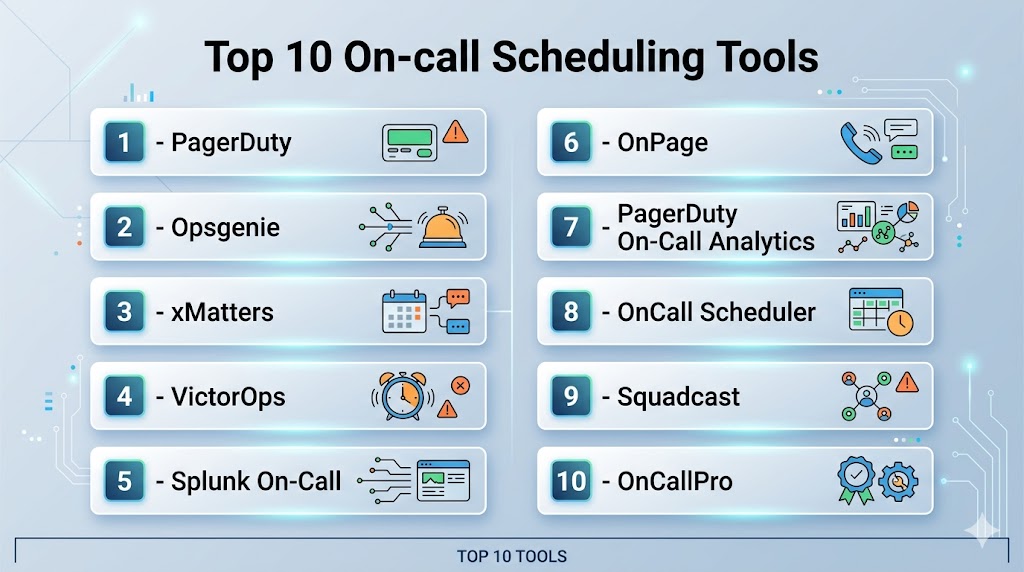
Top 10 On-call Scheduling Tools
#1 — PagerDuty
Short description : PagerDuty provides automated on-call scheduling, incident alerting, and escalation workflows for IT and DevOps teams. It ensures 24/7 coverage and reduces response times for critical incidents.
Key Features
- Automated on-call rotations and schedule generation
- Multi-channel notifications (SMS, email, push)
- Escalation policies and rules
- Incident integration with monitoring tools
- Analytics and reporting on response metrics
- Mobile app for real-time access
Pros
- Reduces manual scheduling errors
- AI-assisted alert prioritization
- Extensive integrations with IT and DevOps tools
Cons
- Higher subscription costs for small teams
- Cloud-only deployment
- Complexity in configuring advanced workflows
Platforms / Deployment
- Web, iOS, Android
- Cloud
Security & Compliance
- SOC 2, ISO 27001
- SSO, MFA, encryption
Integrations & Ecosystem
- Integration with monitoring tools like Datadog, New Relic
- Slack, Teams, Jira
- APIs for custom alerts and workflows
Support & Community
Enterprise-grade support with documentation, training, and community forums.
#2 — Opsgenie
Short description : Opsgenie is an on-call scheduling and incident management tool designed for DevOps and IT teams. It automates rotations, escalations, and notifications to ensure prompt incident response.
Key Features
- Multi-source alert aggregation
- On-call scheduling and rotations
- Escalation policies and automated reminders
- Analytics on incident response
- Integration with monitoring and ITSM tools
Pros
- Flexible alert routing and on-call management
- Real-time notifications across channels
- Seamless integrations with observability platforms
Cons
- Cost may scale with team size
- Learning curve for workflow customization
- Cloud-focused deployment
Platforms / Deployment
- Web, iOS, Android
- Cloud
Security & Compliance
- SOC 2
- Encryption, SSO
Integrations & Ecosystem
- Slack, Teams, Jira
- Monitoring tools: Datadog, Nagios
- APIs for automation
Support & Community
Documentation, online tutorials, and enterprise support.
#3 — xMatters
Short description : xMatters provides automated scheduling, alerts, and incident response workflows for IT and DevOps teams, ensuring teams are notified and coordinated during incidents.
Key Features
- Automated scheduling and on-call management
- Multi-channel notifications
- Escalation and handoff workflows
- Integration with incident management and monitoring tools
- Analytics and reporting dashboards
Pros
- Strong automation for alerting and scheduling
- Multi-channel notifications
- Customizable escalation rules
Cons
- Requires configuration expertise
- Cloud-focused for full functionality
- Enterprise pricing
Platforms / Deployment
- Web, iOS, Android
- Cloud
Security & Compliance
- SOC 2
- Encryption, SSO
Integrations & Ecosystem
- Jira, Slack, Teams
- Monitoring tools like Datadog, Prometheus
- APIs for custom workflows
Support & Community
Enterprise support and documentation available.
#4 — VictorOps
Short description : VictorOps, part of Splunk, delivers on-call scheduling, alerting, and incident collaboration for DevOps teams. It centralizes notifications and provides dashboards for real-time incident management.
Key Features
- On-call schedule management
- Real-time alerts and escalation
- Collaboration tools (chat, video)
- Analytics on incident metrics
- Integration with monitoring and ITSM
Pros
- Unified alerting and communication
- Streamlined DevOps workflow
- Real-time dashboards for incident tracking
Cons
- Cloud-only deployment
- Best suited for DevOps-centric teams
- Subscription cost
Platforms / Deployment
- Web, iOS, Android
- Cloud
Security & Compliance
- SOC 2
- Encryption, SSO, MFA
Integrations & Ecosystem
- Monitoring tools: Datadog, New Relic
- Slack, Teams, Jira
- APIs for automation
Support & Community
Enterprise support with documentation and forums.
#5 — Splunk On-Call
Short description : Splunk On-Call provides incident alerting and on-call scheduling, integrating seamlessly with Splunk observability for faster response and collaboration.
Key Features
- Automated on-call schedules and escalations
- Multi-channel notifications
- Incident dashboards and analytics
- Integration with monitoring and ITSM tools
- Post-incident review and metrics
Pros
- Strong integration with Splunk ecosystem
- Real-time alerting
- Supports DevOps and IT teams
Cons
- Cloud-based
- Enterprise pricing
- Best for teams already using Splunk
Platforms / Deployment
- Web, iOS, Android
- Cloud
Security & Compliance
- SOC 2, ISO 27001
- Encryption, SSO, MFA
Integrations & Ecosystem
- Splunk APM, Datadog, New Relic
- Slack, Teams, Jira
- APIs for workflow automation
Support & Community
Enterprise support and online documentation.
#6 — OnPage
Short description : OnPage provides secure incident alerts and on-call scheduling for IT, DevOps, and healthcare teams, focusing on reliability and compliance.
Key Features
- Priority-based alerting and escalation
- On-call schedule management
- Multi-channel notifications
- Compliance reporting
- Incident dashboards
Pros
- Reliable and secure alerts
- HIPAA-compliant for healthcare use
- Customizable escalation policies
Cons
- Pricing may be high for SMBs
- Cloud deployment only
- Limited advanced analytics
Platforms / Deployment
- Web, iOS, Android
- Cloud
Security & Compliance
- SOC 2, HIPAA
- Encryption, MFA
Integrations & Ecosystem
- PagerDuty, Jira, Slack
- APIs for alert customization
- ITSM and monitoring integration
Support & Community
Documentation, email support, and professional services.
#7 — PagerDuty On-Call Analytics
Short description : This PagerDuty module adds analytics and reporting for on-call schedules, providing insights on workload, response times, and team efficiency.
Key Features
- Reporting on schedule adherence
- On-call workload analysis
- SLA and incident metrics
- Integration with PagerDuty incident data
Pros
- Data-driven scheduling insights
- Helps balance team workload
- Enhances incident response management
Cons
- Requires PagerDuty subscription
- Cloud-only
- Advanced analytics may need configuration
Platforms / Deployment
- Web
- Cloud
Security & Compliance
- SOC 2
- Encryption, SSO
Integrations & Ecosystem
- PagerDuty core system
- Slack, Teams
- APIs for custom reports
Support & Community
Enterprise support, documentation, and training.
#8 — OnCall Scheduler
Short description : OnCall Scheduler is a lightweight, web-based tool for creating and managing on-call rotations, suitable for small IT and DevOps teams.
Key Features
- Simple rotation scheduling
- Email and SMS notifications
- Calendar integration
- Shift swap and coverage management
Pros
- Easy to set up
- Affordable for small teams
- Simple interface
Cons
- Limited automation
- No advanced analytics
- Cloud-only
Platforms / Deployment
- Web
- Cloud
Security & Compliance
- Encryption
- Not publicly stated
Integrations & Ecosystem
- Google Calendar, Outlook
- Email/SMS alerts
- APIs for basic automation
Support & Community
Documentation and email support.
#9 — Squadcast
Short description : Squadcast provides on-call scheduling and incident response for DevOps teams, integrating with monitoring tools to streamline alerting and collaboration.
Key Features
- On-call rotations and schedule management
- Alerting and escalation policies
- Integration with observability tools
- Post-incident reports
- Collaboration dashboards
Pros
- Cloud-native and easy to use
- Supports multi-team incident management
- Strong integrations
Cons
- Cloud-only
- Subscription pricing
- Some features limited for small teams
Platforms / Deployment
- Web, iOS, Android
- Cloud
Security & Compliance
- SOC 2
- Encryption, SSO
Integrations & Ecosystem
- Datadog, Prometheus, New Relic
- Slack, Teams, Jira
- APIs for automation
Support & Community
Documentation, online support, and enterprise services.
#10 — OnCallPro
Short description : OnCallPro provides scheduling, alerting, and incident management for IT teams, focusing on simplicity and usability for small to mid-sized teams.
Key Features
- Rotation management and alerts
- SMS and email notifications
- Shift swap and coverage tracking
- Simple reporting dashboards
Pros
- User-friendly interface
- Quick setup for small teams
- Cost-effective
Cons
- Limited advanced automation
- No mobile app for iOS/Android
- Cloud-only
Platforms / Deployment
- Web
- Cloud
Security & Compliance
- Encryption
- Not publicly stated
Integrations & Ecosystem
- Email/SMS systems
- Calendar integration
- APIs for basic automation
Support & Community
Documentation and email support.
Comparison Table (Top 10)
| Tool Name | Best For | Platform(s) Supported | Deployment | Standout Feature | Public Rating |
|---|---|---|---|---|---|
| PagerDuty | Enterprise IT & DevOps | Web, iOS, Android | Cloud | AI-assisted automation | N/A |
| Opsgenie | DevOps & IT | Web, iOS, Android | Cloud | Flexible escalation policies | N/A |
| xMatters | IT & DevOps | Web, iOS, Android | Cloud | Workflow orchestration | N/A |
| VictorOps | DevOps teams | Web, iOS, Android | Cloud | Collaboration dashboards | N/A |
| Splunk On-Call | DevOps & IT | Web, iOS, Android | Cloud | Integration with Splunk | N/A |
| OnPage | IT & Healthcare | Web, iOS, Android | Cloud | HIPAA-compliant alerts | N/A |
| PagerDuty Analytics | Enterprise IT | Web | Cloud | On-call workload insights | N/A |
| OnCall Scheduler | Small IT teams | Web | Cloud | Simple scheduling interface | N/A |
| Squadcast | DevOps & IT | Web, iOS, Android | Cloud | Incident + on-call integration | N/A |
| OnCallPro | SMB IT teams | Web | Cloud | Simple usability | N/A |
Evaluation & Scoring of On-call Scheduling Tools
| Tool Name | Core (25%) | Ease (15%) | Integrations (15%) | Security (10%) | Performance (10%) | Support (10%) | Value (15%) | Weighted Total (0–10) |
|---|---|---|---|---|---|---|---|---|
| PagerDuty | 9 | 8 | 9 | 9 | 9 | 8 | 6 | 8.5 |
| Opsgenie | 8 | 8 | 8 | 8 | 8 | 7 | 7 | 7.9 |
| xMatters | 8 | 7 | 8 | 8 | 8 | 7 | 6 | 7.7 |
| VictorOps | 8 | 7 | 8 | 8 | 8 | 7 | 6 | 7.7 |
| Splunk On-Call | 8 | 7 | 8 | 8 | 8 | 7 | 6 | 7.7 |
| OnPage | 7 | 7 | 7 | 8 | 7 | 6 | 6 | 7.0 |
| PagerDuty Analytics | 8 | 7 | 8 | 8 | 8 | 7 | 6 | 7.7 |
| OnCall Scheduler | 6 | 8 | 6 | 7 | 6 | 6 | 7 | 6.7 |
| Squadcast | 8 | 7 | 8 | 8 | 8 | 7 | 6 | 7.7 |
| OnCallPro | 6 | 8 | 6 | 7 | 6 | 6 | 7 | 6.7 |
Interpretation: Weighted totals show comparative effectiveness, balancing core features, usability, integration, security, and value. High scores suggest robust enterprise capabilities, but selection should reflect team size and complexity.
Which On-call Scheduling Tool Is Right for You?
Solo / Freelancer
OnCallPro or OnCall Scheduler for lightweight, simple scheduling without extensive costs.
SMB
Opsgenie, OnPage, or PagerDuty Analytics for structured alerts, escalation, and schedule management.
Mid-Market
VictorOps, Splunk On-Call, or Squadcast for robust integration with incident management and monitoring tools.
Enterprise
PagerDuty, xMatters, and Splunk On-Call for AI-driven workflows, global coverage, and advanced reporting.
Budget vs Premium
Lightweight tools suit small teams; premium options provide automation, analytics, and multi-team orchestration.
Feature Depth vs Ease of Use
PagerDuty and VictorOps offer depth and AI automation; OnCallPro and OnCall Scheduler are simple and quick to deploy.
Integrations & Scalability
Enterprises with complex monitoring stacks benefit from PagerDuty, xMatters, and Splunk On-Call for scalable and integrated operations.
Security & Compliance Needs
Healthcare and regulated industries should prioritize OnPage and PagerDuty for HIPAA and SOC 2 compliance.
Frequently Asked Questions (FAQs)
1. What pricing models exist?
Most tools use subscription-based or usage-based pricing. Open-source or lightweight tools may offer free tiers.
2. How long does onboarding take?
Small teams can onboard in hours; enterprise deployments may require weeks for configuration and integrations.
3. Can these tools scale for global teams?
Yes, enterprise solutions like PagerDuty, xMatters, and Splunk On-Call support multiple regions and high-volume schedules.
4. Are AI features standard?
Premium tools often include AI-driven schedule optimization and alert noise reduction; basic tools do not.
5. What platforms are supported?
Web dashboards are standard; iOS and Android apps provide mobile access for on-call staff.
6. How secure are these tools?
Enterprise-grade tools provide encryption, RBAC, SSO, MFA, and adherence to SOC 2, ISO 27001, and HIPAA standards where publicly stated.
7. Can these tools integrate with monitoring and incident systems?
Yes, integrations with APM, ITSM, and monitoring platforms are common.
8. Do these tools replace ITSM?
No, they complement ITSM by focusing on scheduling, alerts, and escalations.
9. What are common mistakes in implementing on-call scheduling?
Ignoring workload balancing, failing to define escalation policies, and underutilizing mobile notifications.
10. Are there open-source options?
Yes, some tools offer open-source or lightweight solutions, but enterprise-grade features typically require subscription plans.
Conclusion
On-call Scheduling Tools are essential for maintaining continuous coverage, reducing response times, and ensuring service reliability in modern IT and DevOps environments. Enterprise solutions like PagerDuty, xMatters, and VictorOps offer advanced automation, analytics, and global coverage, while SMBs and smaller teams can benefit from lightweight tools like OnCallPro, OnCall Scheduler, and OnPage. Selecting the right tool depends on team size, complexity, integrations, and compliance requirements. Organizations should evaluate these factors, pilot suitable tools, and implement workflows to optimize on-call efficiency and improve operational resilience.

Find Trusted Cardiac Hospitals
Compare heart hospitals by city and services — all in one place.
Explore Hospitals
On-call schedules can look fine on paper but still create problems if the same people are repeatedly handling difficult incidents. It helps to review the actual workload after each rotation and check whether the schedule is causing too much pressure on certain team members. This can make on-call coverage more sustainable over time.