Introduction
Data Integration & ETL (Extract, Transform, Load) Tools are software solutions that enable organizations to move, combine, and prepare data from multiple sources into a central repository for analytics and business intelligence. They simplify the extraction of data from databases, APIs, and cloud applications, transform it into a usable format, and load it into warehouses, lakes, or lakehouses. These tools are critical for businesses that rely on data-driven decision-making.
Companies face a growing volume of diverse and dynamic data sources, making efficient integration and automation essential. Data integration tools help unify structured and unstructured data, streamline analytics workflows, and reduce manual errors. Organizations use these tools to consolidate marketing data, synchronize CRM and ERP systems, enable real-time reporting, and prepare data for AI and ML pipelines.
Use cases include:
- Consolidating multi-source business data for reporting and analytics.
- Enabling real-time data pipelines for operational monitoring.
- Feeding AI and ML models with clean and structured datasets.
- Synchronizing ERP, CRM, and marketing platforms.
- Supporting ETL pipelines for cloud data warehouses and lakehouses.
Evaluation criteria buyers should consider: source coverage, transformation capabilities, scalability, real-time support, AI/ML integration, ease of use, cloud compatibility, security and compliance, pricing model, and vendor support.
Best for: Data engineering teams, analytics teams, mid-sized to large enterprises, SaaS companies, and organizations managing multiple cloud applications. Not ideal for: Small teams with limited data sources or organizations that only require simple reporting.
Key Trends in Data Integration & ETL Tools
- Increased adoption of cloud-native ETL and integration platforms.
- AI and automation for data mapping, anomaly detection, and transformation suggestions.
- Real-time data streaming and event-driven integration.
- Multi-cloud and hybrid deployment support for enterprise ecosystems.
- Enhanced security features including encryption, RBAC, audit logs, and compliance adherence.
- Data observability for monitoring pipelines, detecting errors, and improving reliability.
- Integration with low-code and no-code platforms for faster deployment.
- Pricing models evolving to consumption-based or subscription-based structures.
- Advanced connectors for SaaS, APIs, and IoT devices.
How We Selected These Tools (Methodology)
- Market adoption and industry recognition were considered.
- Evaluated the breadth of data sources and transformation capabilities.
- Benchmarked performance and reliability under heavy workloads.
- Assessed security and compliance features, including SOC 2, ISO 27001, and GDPR.
- Verified integration support with data warehouses, lakehouses, BI, and ML tools.
- Considered scalability across SMB, mid-market, and enterprise requirements.
- Reviewed documentation, support tiers, and community strength.
- Evaluated AI/ML readiness for automated transformations and predictive analytics.
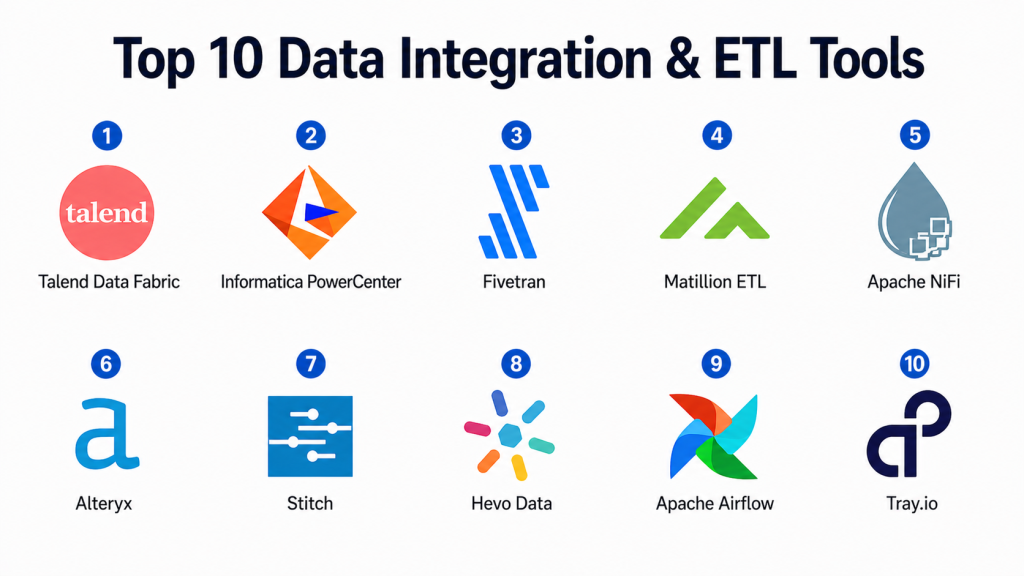
Top 10 Data Integration & ETL Tools
#1 — Talend Data Fabric
Short description:
Talend provides a comprehensive platform for data integration, quality, and governance. It supports both batch and real-time ETL and is suitable for enterprises managing complex multi-cloud environments.
Key Features
- Broad connector library for databases, APIs, and SaaS
- Real-time data streaming
- Data quality and cleansing tools
- Cloud and on-premises deployment
- AI-driven transformation recommendations
- Workflow orchestration
Pros
- Unified platform for integration and governance
- Strong cloud and multi-source support
- Scalable for enterprise needs
Cons
- Complexity in setup for smaller teams
- Licensing costs can be high
Platforms / Deployment
- Web / Windows / Linux
- Cloud / Hybrid
Security & Compliance
- Encryption, RBAC, audit logs
- SOC 2, ISO 27001, GDPR
Integrations & Ecosystem
Supports BI tools, cloud storage, data warehouses, Python/R scripts, API-based integrations
Support & Community
Vendor support, active developer community, extensive documentation
#2 — Informatica PowerCenter
Short description:
Informatica PowerCenter is a robust enterprise ETL tool supporting complex data integration workflows and large-scale data processing.
Key Features
- Enterprise-grade ETL orchestration
- High-performance data transformation
- Real-time and batch processing
- Integration with cloud, on-prem, and hybrid environments
- Metadata management
Pros
- Proven enterprise reliability
- Scales for large workloads
- Extensive connector library
Cons
- Expensive licensing
- Steeper learning curve
Platforms / Deployment
- Web / Windows / Linux
- Cloud / Self-hosted / Hybrid
Security & Compliance
- Encryption, RBAC, audit logs
- SOC 2, ISO 27001
Integrations & Ecosystem
Connects with BI tools, cloud platforms, ETL pipelines, APIs
Support & Community
Vendor enterprise support, strong professional services, documentation
#3 — Fivetran
Short description:
Fivetran specializes in automated, fully managed ETL pipelines. It is ideal for organizations seeking rapid deployment and cloud-based integration.
Key Features
- Automated connectors for SaaS, databases, and cloud storage
- Schema drift handling
- Near real-time replication
- Cloud-native deployment
- Minimal maintenance
Pros
- Fast setup with automated pipelines
- Cloud-focused, low operational overhead
- Reliable data replication
Cons
- Limited on-premises support
- Pricing scales with volume
Platforms / Deployment
- Web
- Cloud
Security & Compliance
- Encryption, audit logs
- SOC 2, ISO 27001, GDPR
Integrations & Ecosystem
Supports data warehouses, BI tools, APIs, and ETL orchestration platforms
Support & Community
Vendor support, documentation, and online community
#4 — Matillion ETL
Short description:
Matillion provides cloud-native ETL designed for modern data warehouses. It simplifies transformation workflows and supports a broad range of cloud platforms.
Key Features
- Cloud-first architecture
- Visual workflow designer
- Job orchestration
- Multi-cloud deployment
- Integration with AI/ML pipelines
Pros
- Easy to use with drag-and-drop interface
- Optimized for cloud data warehouses
- Scalable and flexible
Cons
- Limited on-prem capabilities
- Learning curve for advanced transformations
Platforms / Deployment
- Web
- Cloud (AWS, Azure, GCP)
Security & Compliance
- Encryption, RBAC, audit logs
- SOC 2, GDPR
Integrations & Ecosystem
Connectors for BI tools, cloud data warehouses, APIs, Python/R SDKs
Support & Community
Vendor support, tutorials, active user forums
#5 — Apache NiFi
Short description:
Apache NiFi is an open-source ETL and data integration tool that supports complex data flows with real-time streaming and batch processing.
Key Features
- Flow-based data routing
- Real-time and batch support
- Visual interface for workflows
- Extensible processors and connectors
- Data provenance tracking
Pros
- Open-source and highly flexible
- Strong streaming capabilities
- Supports complex workflows
Cons
- Requires technical expertise
- Community support only for some issues
Platforms / Deployment
- Web / Linux / Windows
- Self-hosted / Cloud
Security & Compliance
- Not publicly stated
Integrations & Ecosystem
Integrates with databases, messaging systems, cloud storage, APIs
Support & Community
Active open-source community, extensive documentation
#6 — Alteryx
Short description:
Alteryx combines ETL and analytics in a single platform, empowering business users and analysts to prepare data for reporting and AI workflows.
Key Features
- Visual workflow builder
- Data blending and cleansing
- Predictive analytics support
- Cloud and on-prem deployment
- API and connector library
Pros
- User-friendly for non-technical users
- Strong analytics integration
- Supports multiple data sources
Cons
- Higher pricing for enterprise tiers
- Limited real-time streaming
Platforms / Deployment
- Web / Windows
- Cloud / Self-hosted
Security & Compliance
- Encryption, RBAC
- SOC 2, GDPR
Integrations & Ecosystem
Connects to BI tools, cloud storage, SQL databases, APIs
Support & Community
Vendor support, extensive training materials, community forums
#7 — Stitch
Short description:
Stitch provides simple, automated ETL for cloud data integration with a focus on SaaS applications.
Key Features
- Automated connectors
- Cloud-native and serverless
- Real-time replication
- Schema management
- Integration with data warehouses
Pros
- Quick to deploy
- Minimal operational maintenance
- Wide range of SaaS connectors
Cons
- Limited advanced transformation features
- Cloud-only
Platforms / Deployment
- Web
- Cloud
Security & Compliance
- Encryption, audit logs
- SOC 2
Integrations & Ecosystem
BI tools, data warehouses, APIs, ETL orchestration
Support & Community
Vendor support, documentation, online user community
#8 — Hevo Data
Short description:
Hevo is a no-code, cloud ETL platform designed for rapid data replication and integration from multiple sources to warehouses or lakehouses.
Key Features
- Pre-built connectors
- No-code transformations
- Real-time data replication
- Multi-cloud deployment
- Data quality monitoring
Pros
- Easy for non-technical users
- Near real-time updates
- Managed infrastructure
Cons
- Limited on-premises support
- Pricing grows with volume
Platforms / Deployment
- Web
- Cloud
Security & Compliance
- Encryption, RBAC
- SOC 2, GDPR
Integrations & Ecosystem
Supports BI tools, warehouses, APIs, Python/R integration
Support & Community
Vendor support, documentation, training materials
#9 — Apache Airflow
Short description:
Apache Airflow is an open-source workflow orchestration tool that can manage ETL pipelines, data transformations, and analytics workflows.
Key Features
- DAG-based orchestration
- Scheduling and dependency management
- Extensible with plugins
- Monitoring dashboards
- Multi-cloud compatibility
Pros
- Open-source and flexible
- Handles complex workflows
- Strong community support
Cons
- Requires technical knowledge
- No native data connectors
Platforms / Deployment
- Web / Linux / Windows
- Cloud / Self-hosted
Security & Compliance
- Not publicly stated
Integrations & Ecosystem
Connects with databases, BI tools, cloud storage, APIs
Support & Community
Active community, plugins, documentation
#10 — Tray.io
Short description:
Tray.io is a cloud-based low-code automation platform that supports ETL, integration, and workflow automation across multiple cloud applications.
Key Features
- Visual workflow builder
- API-based integrations
- Multi-step ETL pipelines
- Real-time triggers
- Multi-cloud support
Pros
- Low-code, easy to automate
- Fast deployment
- Broad SaaS integrations
Cons
- Limited advanced transformations
- Cloud-only
Platforms / Deployment
- Web
- Cloud
Security & Compliance
- Encryption, audit logs, RBAC
- SOC 2, GDPR
Integrations & Ecosystem
SaaS apps, cloud storage, BI tools, APIs
Support & Community
Vendor support, documentation, community forums
Comparison Table (Top 10)
| Tool Name | Best For | Platform(s) Supported | Deployment | Standout Feature | Public Rating |
|---|---|---|---|---|---|
| Talend Data Fabric | Enterprise integration | Web/Windows/Linux | Cloud/Hybrid | Data governance & real-time ETL | N/A |
| Informatica PowerCenter | Large enterprises | Web/Windows/Linux | Cloud/Hybrid | High-performance ETL | N/A |
| Fivetran | SaaS integration | Web | Cloud | Automated pipelines | N/A |
| Matillion ETL | Cloud warehouses | Web | Cloud | Drag-and-drop transformations | N/A |
| Apache NiFi | Open-source streaming | Web/Linux/Windows | Cloud/Self-hosted | Flow-based ETL | N/A |
| Alteryx | Analytics workflows | Web/Windows | Cloud/Self-hosted | Predictive analytics | N/A |
| Stitch | SaaS-focused ETL | Web | Cloud | Simple cloud replication | N/A |
| Hevo Data | No-code ETL | Web | Cloud | Real-time replication | N/A |
| Apache Airflow | Workflow orchestration | Web/Linux/Windows | Cloud/Self-hosted | DAG-based pipeline | N/A |
| Tray.io | Automation & ETL | Web | Cloud | Low-code integrations | N/A |
Evaluation & Scoring of Data Integration & ETL Tools
| Tool Name | Core (25%) | Ease (15%) | Integrations (15%) | Security (10%) | Performance (10%) | Support (10%) | Value (15%) | Weighted Total |
|---|---|---|---|---|---|---|---|---|
| Talend | 9 | 8 | 9 | 8 | 9 | 8 | 8 | 8.5 |
| Informatica | 9 | 7 | 9 | 8 | 9 | 8 | 7 | 8.3 |
| Fivetran | 8 | 9 | 8 | 8 | 8 | 8 | 8 | 8.2 |
| Matillion | 8 | 8 | 8 | 7 | 8 | 7 | 8 | 7.9 |
| Apache NiFi | 8 | 7 | 8 | 7 | 8 | 7 | 7 | 7.6 |
| Alteryx | 8 | 9 | 7 | 7 | 8 | 7 | 7 | 7.8 |
| Stitch | 7 | 9 | 7 | 7 | 7 | 7 | 7 | 7.5 |
| Hevo Data | 7 | 8 | 7 | 7 | 8 | 7 | 7 | 7.6 |
| Apache Airflow | 8 | 7 | 8 | 7 | 8 | 7 | 7 | 7.6 |
| Tray.io | 7 | 8 | 7 | 7 | 7 | 7 | 7 | 7.4 |
The table highlights strengths in core ETL features, ease-of-use, integration capabilities, security, and performance. Scores are comparative, illustrating relative advantages for each platform.
Which Data Integration & ETL Tools Tool Is Right for You?
Solo / Freelancer
Use open-source or low-code tools like Apache NiFi, Airflow, or Tray.io to manage data from multiple SaaS apps efficiently.
SMB
Fivetran, Matillion, and Hevo Data offer cloud-native ETL with low operational overhead, ideal for growing teams.
Mid-Market
Talend, Alteryx, and Stitch provide a balance of automation, data quality, and analytics support for mid-sized companies.
Enterprise
Informatica PowerCenter, Talend Data Fabric, and Alteryx scale to handle complex, multi-cloud integrations with robust governance.
Budget vs Premium
Open-source options are cost-effective but require technical expertise. Cloud-managed solutions provide ease-of-use with higher costs.
Feature Depth vs Ease of Use
Talend and Informatica excel in feature depth; Fivetran and Hevo Data provide rapid deployment and ease of use.
Integrations & Scalability
Platforms like Talend, Informatica, and Matillion support large-scale, multi-cloud environments with extensive connector libraries.
Security & Compliance Needs
Enterprises handling sensitive data should prioritize SOC 2, ISO 27001, GDPR-compliant platforms with encryption, RBAC, and audit capabilities.
Frequently Asked Questions (FAQs)
1. What is a data integration tool?
A data integration tool connects multiple data sources, extracts data, transforms it, and loads it into a central system for analytics or operational use.
2. How does ETL differ from ELT?
ETL transforms data before loading it into a warehouse, while ELT loads raw data first and transforms it inside the warehouse for faster analytics.
3. Which industries benefit most?
Finance, healthcare, retail, and SaaS companies benefit due to complex, multi-source data environments and analytics needs.
4. Are ETL tools cloud-only?
Many modern ETL tools are cloud-native, though several offer hybrid or on-prem deployment options.
5. How is data security handled?
ETL platforms provide encryption, RBAC, audit logs, and compliance with SOC 2, ISO 27001, and GDPR standards.
6. What is the cost structure?
Pricing varies by usage, data volume, and deployment type, including subscription, consumption-based, and enterprise licensing.
7. Can ETL tools handle real-time data?
Yes, leading tools like Fivetran, Talend, and Hevo Data support near real-time streaming and event-driven ETL.
8. How do ETL tools integrate with BI?
They offer connectors and APIs for Tableau, Power BI, Looker, and Python/R environments to provide analytics-ready data.
9. Is technical expertise required?
Low-code and managed ETL platforms reduce technical overhead, while open-source tools may require technical skills.
10. How do ETL tools support AI/ML workflows?
They prepare, clean, and transform large datasets for AI/ML pipelines and integrate with Python, R, and cloud ML services.
Conclusion
Data integration and ETL tools are essential for organizations seeking to unify multi-source data, enable analytics, and power AI workflows. Selecting the right platform depends on company size, technical expertise, deployment preferences, and data volume. Organizations should shortlist platforms, test pilots, and verify integrations and security compliance before choosing a solution. The right ETL tool can significantly improve data reliability, reduce operational overhead, and accelerate analytics and AI initiatives.

Find Trusted Cardiac Hospitals
Compare heart hospitals by city and services — all in one place.
Explore Hospitals
A few invalid rows should not always cause a large pipeline to fail completely. Teams should be able to separate failed records, log the reason, and retry them after fixing the issue. This can keep data processing running while still making errors easier to manage.