Introduction
Lakehouse Platforms combine the scalability and flexibility of data lakes with the structure and performance of data warehouses. They allow organizations to store all types of data—structured, semi-structured, and unstructured—while supporting high-performance analytics, AI, and machine learning workloads. By unifying storage and analytics, lakehouse platforms simplify data pipelines, reduce duplication, and improve time-to-insight.In businesses increasingly rely on lakehouse platforms to manage complex, multi-cloud data environments, support real-time decision-making, and integrate with AI and analytics workloads. Organizations can analyze streaming data, combine operational and historical data, and build predictive models without moving data between systems.
Use cases include:
- Real-time analytics for IoT sensor data in manufacturing.
- Combining structured sales data with unstructured customer feedback for insights.
- AI/ML model training on large, diverse datasets.
- Fraud detection and risk analytics in finance.
- Data-driven product personalization for e-commerce.
Evaluation criteria buyers should consider: scalability, multi-cloud deployment, real-time analytics, integration capabilities, performance under large workloads, security and compliance, AI/ML support, ease of use, pricing, and vendor support.
Best for: Data engineering teams, analytics teams, AI/ML teams, and enterprises managing high-volume, multi-format data. Not ideal for: Small businesses with limited data, simple reporting needs, or teams that do not require AI-driven insights.
Key Trends in Lakehouse Platforms
- Adoption of cloud-native, serverless architectures for cost-efficient scalability.
- AI-driven query optimization and predictive analytics support.
- Integration with real-time streaming and IoT data sources.
- Multi-cloud and hybrid deployment flexibility for modern enterprise ecosystems.
- Converged platforms supporting both storage and analytics in a unified architecture.
- Advanced security and compliance features including encryption, RBAC, audit logs, and GDPR/HIPAA compliance.
- Dynamic pricing models, often consumption-based rather than fixed licenses.
- Automated data governance, cataloging, and lineage tracking.
- Increasing support for machine learning pipelines and data science workflows.
How We Selected These Tools (Methodology)
- Evaluated market adoption and brand recognition in the lakehouse sector.
- Assessed feature completeness for analytics, storage, AI, and ML workloads.
- Measured performance and reliability with benchmarks on query speed and large datasets.
- Verified security and compliance posture, including SOC 2, ISO 27001, GDPR.
- Reviewed integration and extensibility with ETL, BI, and analytics tools.
- Considered customer fit across SMB, mid-market, and enterprise segments.
- Evaluated support and community strength for training, onboarding, and problem-solving.
- Checked AI and ML readiness for predictive and real-time analytics.
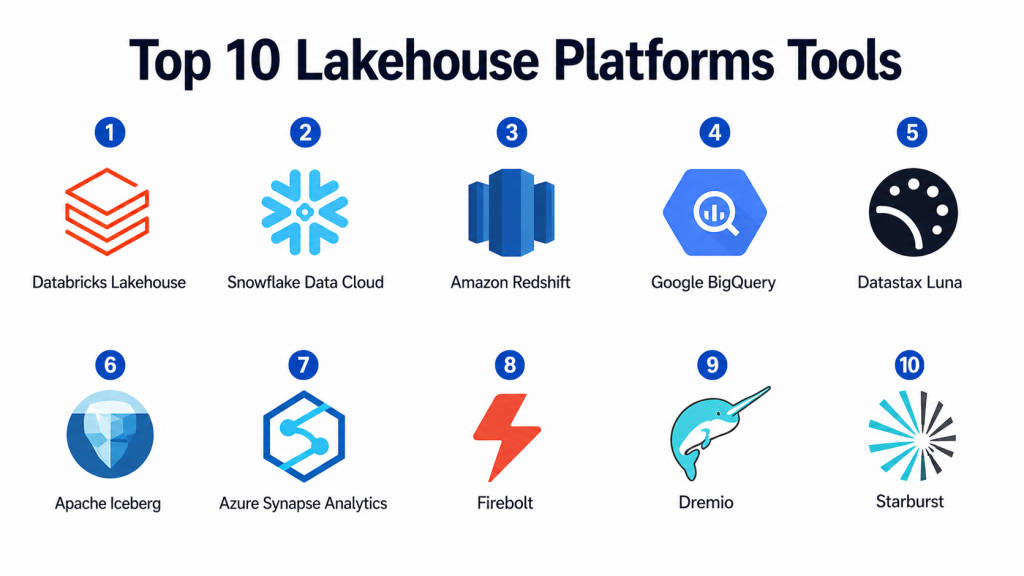
Top 10 Lakehouse Platforms Tools
#1 — Databricks Lakehouse
Short description:
Databricks Lakehouse unifies data warehouses and data lakes into a single platform. It supports structured and unstructured data, enabling AI, ML, and analytics workloads across large datasets. Ideal for enterprises with heavy data science needs.
Key Features
- Delta Lake technology for ACID transactions
- Unified batch and streaming processing
- Built-in ML and AI support
- Multi-cloud deployment
- High scalability and concurrency
- SQL analytics support
Pros
- Powerful AI/ML capabilities
- High performance on large-scale data
- Extensive ecosystem and integrations
Cons
- Can be expensive for smaller teams
- Steep learning curve
Platforms / Deployment
- Web / Windows / Linux / macOS
- Cloud (AWS, Azure, GCP)
Security & Compliance
- RBAC, encryption, audit logging
- SOC 2, ISO 27001, GDPR
Integrations & Ecosystem
Supports BI tools like Tableau, Power BI, Looker, ETL pipelines, ML frameworks, and APIs for custom workflows
Support & Community
Strong documentation, active community, enterprise support tiers
#2 — Snowflake Data Cloud
Short description:
Snowflake Data Cloud delivers lakehouse functionality with scalable cloud data warehousing. It allows combining structured and semi-structured data for analytics and supports AI workloads.
Key Features
- Multi-cloud support (AWS, Azure, GCP)
- Data sharing and marketplace features
- Automatic scaling and concurrency
- SQL-based analytics
- Native semi-structured data support
Pros
- Easy to use and maintain
- Flexible scaling
- Robust performance
Cons
- Cloud-only deployment
- Pricing can increase with high storage
Platforms / Deployment
- Web
- Cloud
Security & Compliance
- Encryption, RBAC, audit logs
- SOC 2, ISO 27001, GDPR
Integrations & Ecosystem
Connectors for BI tools, ETL pipelines, Python/R APIs, partner ecosystem
Support & Community
Vendor support tiers, strong documentation and community forums
#3 — Amazon Redshift
Short description:
Redshift is AWS’s cloud data warehouse with lakehouse capabilities. It enables large-scale analytics with columnar storage and supports semi-structured data and machine learning integration.
Key Features
- Columnar storage and MPP architecture
- Redshift Spectrum for querying S3 data
- Automated backups
- Query optimization and workload management
- Integration with AWS ML services
Pros
- Deep AWS ecosystem integration
- High performance
- Flexible scaling
Cons
- Requires AWS expertise
- Cost grows with storage and compute usage
Platforms / Deployment
- Web
- Cloud (AWS)
Security & Compliance
- Encryption, IAM policies
- SOC 2, ISO 27001, HIPAA
Integrations & Ecosystem
Integrates with AWS Glue, EMR, QuickSight, Python/R SDKs
Support & Community
AWS support tiers, active developer community
#4 — Google BigQuery
Short description:
BigQuery is a fully-managed, serverless platform by Google for large-scale analytics. It provides high-speed querying, AI/ML integration, and supports multi-format data analytics.
Key Features
- Serverless architecture
- BigQuery ML for AI/ML integration
- Standard SQL support
- Streaming and batch processing
- Auto-scaling and high concurrency
Pros
- No infrastructure management
- Cost-efficient on-demand pricing
- Seamless GCP integration
Cons
- Limited to GCP ecosystem
- Query costs can grow with usage
Platforms / Deployment
- Web
- Cloud (GCP)
Security & Compliance
- IAM, encryption at rest/in transit
- SOC 2, ISO 27001, GDPR
Integrations & Ecosystem
Connectors for Looker, Dataflow, AI Platform, REST APIs
Support & Community
Google Cloud support tiers, strong developer community
#5 — Datastax Luna
Short description:
DataStax Luna provides a cloud-native, multi-cloud lakehouse with real-time analytics, AI support, and graph processing capabilities.
Key Features
- Apache Cassandra-based scalable storage
- Multi-cloud deployment
- Graph and search analytics
- Real-time processing
- AI/ML integration
Pros
- Strong multi-cloud support
- Real-time analytics and graph processing
- High availability
Cons
- Complexity in setup
- Requires experienced teams
Platforms / Deployment
- Web / Linux
- Cloud / Hybrid
Security & Compliance
- Encryption, RBAC
- SOC 2, ISO 27001
Integrations & Ecosystem
Connects with BI tools, APIs, Kafka, Spark
Support & Community
Vendor support, active open-source community
#6 — Apache Iceberg
Short description:
Apache Iceberg is an open-source table format for cloud data lakes providing ACID transactions and analytics at scale.
Key Features
- ACID transactions on data lakes
- Time travel queries
- Schema evolution support
- Integration with Spark, Hive, Flink
- High-performance analytics
Pros
- Open-source and flexible
- Strong integration with existing data pipelines
- Supports large-scale datasets
Cons
- Requires expertise to deploy
- Community-based support
Platforms / Deployment
- Linux
- Self-hosted / Cloud
Security & Compliance
- Not publicly stated
Integrations & Ecosystem
Spark, Hive, Flink, BI connectors, APIs
Support & Community
Open-source community support, documentation
#7 — Azure Synapse Analytics
Short description:
Azure Synapse unifies data integration, big data, and data warehousing. It allows real-time analytics and AI-ready workloads.
Key Features
- SQL and Spark analytics
- Serverless and dedicated options
- Data integration pipelines
- Real-time analytics support
- Built-in ML integration
Pros
- Deep Azure ecosystem
- Flexible deployment options
- Scalable performance
Cons
- Azure-only
- Complexity for beginners
Platforms / Deployment
- Web
- Cloud (Azure)
Security & Compliance
- Encryption, RBAC
- SOC 2, ISO 27001, HIPAA
Integrations & Ecosystem
Power BI, Azure Data Factory, ML APIs, Python/R SDKs
Support & Community
Microsoft support plans, active community forums
#8 — Firebolt
Short description:
Firebolt is a cloud-native analytics platform designed for high-speed queries on structured and semi-structured data with lakehouse capabilities.
Key Features
- Columnar storage
- High-performance query engine
- Serverless architecture
- Integration with data pipelines and BI tools
- Scalability for large datasets
Pros
- Extremely fast query performance
- Optimized for analytics workloads
- Easy to scale
Cons
- Cloud-only
- Less mature ecosystem
Platforms / Deployment
- Web
- Cloud
Security & Compliance
- Encryption, audit logs
- SOC 2
Integrations & Ecosystem
BI connectors, ETL integrations, APIs
Support & Community
Vendor support, documentation
#9 — Dremio
Short description:
Dremio is a cloud lakehouse platform enabling high-speed SQL analytics directly on data lakes and structured data sources.
Key Features
- Query acceleration
- Data virtualization
- ML and AI integrations
- Multi-cloud support
- Open-source flexibility
Pros
- Query directly on raw data
- Supports BI and AI workflows
- Flexible deployment
Cons
- Requires technical expertise
- Open-source support may be limited
Platforms / Deployment
- Web / Linux
- Cloud / Self-hosted
Security & Compliance
- Not publicly stated
Integrations & Ecosystem
Spark, BI tools, Python APIs, ETL pipelines
Support & Community
Open-source community, enterprise support tiers
#10 — Starburst
Short description:
Starburst provides a high-performance distributed SQL engine for lakehouse analytics across multiple cloud and on-prem data sources.
Key Features
- Distributed query engine
- Multi-cloud and hybrid support
- ANSI SQL compliance
- Integration with BI and analytics
- High concurrency and scalability
Pros
- Fast query performance
- Multi-cloud flexibility
- Easy integration with existing lakes
Cons
- Cloud cost management required
- Limited native storage
Platforms / Deployment
- Web / Linux
- Cloud / Hybrid
Security & Compliance
- Encryption, RBAC
- SOC 2, GDPR
Integrations & Ecosystem
BI tools, Spark, Hadoop, Python APIs
Support & Community
Vendor support, documentation, active enterprise community
Comparison Table (Top 10)
| Tool Name | Best For | Platform(s) Supported | Deployment | Standout Feature | Public Rating |
|---|---|---|---|---|---|
| Databricks Lakehouse | AI/ML and analytics | Web/Windows/Linux/macOS | Cloud | Delta Lake ACID | N/A |
| Snowflake | Enterprise analytics | Web | Cloud | Multi-cloud scalability | N/A |
| Amazon Redshift | AWS-centric analytics | Web | Cloud | Redshift Spectrum | N/A |
| Google BigQuery | Cloud-native analytics | Web | Cloud | Serverless SQL | N/A |
| Datastax Luna | Multi-cloud & real-time | Web/Linux | Cloud/Hybrid | Graph analytics | N/A |
| Apache Iceberg | Open-source lakehouse | Linux | Cloud/Self-hosted | ACID transactions | N/A |
| Azure Synapse Analytics | Azure-native workloads | Web | Cloud | Unified analytics | N/A |
| Firebolt | High-speed analytics | Web | Cloud | Query performance | N/A |
| Dremio | Data virtualization | Web/Linux | Cloud/Self-hosted | SQL on raw data | N/A |
| Starburst | Distributed SQL engine | Web/Linux | Cloud/Hybrid | Multi-cloud query | N/A |
Evaluation & Scoring of Lakehouse Platforms
| Tool Name | Core (25%) | Ease (15%) | Integrations (15%) | Security (10%) | Performance (10%) | Support (10%) | Value (15%) | Weighted Total |
|---|---|---|---|---|---|---|---|---|
| Databricks Lakehouse | 9 | 8 | 9 | 8 | 9 | 8 | 8 | 8.7 |
| Snowflake | 8 | 9 | 8 | 8 | 8 | 8 | 8 | 8.2 |
| Amazon Redshift | 8 | 7 | 8 | 8 | 8 | 7 | 8 | 7.9 |
| Google BigQuery | 9 | 9 | 8 | 8 | 8 | 8 | 8 | 8.3 |
| Datastax Luna | 8 | 7 | 8 | 8 | 8 | 7 | 7 | 7.6 |
| Apache Iceberg | 7 | 6 | 7 | 7 | 7 | 6 | 7 | 6.8 |
| Azure Synapse Analytics | 8 | 8 | 8 | 8 | 8 | 8 | 8 | 8.0 |
| Firebolt | 8 | 8 | 7 | 7 | 9 | 7 | 8 | 7.9 |
| Dremio | 7 | 7 | 7 | 7 | 7 | 7 | 7 | 7.0 |
| Starburst | 8 | 7 | 8 | 7 | 8 | 7 | 8 | 7.7 |
The table demonstrates relative strengths across critical categories. Scores are comparative, highlighting areas such as performance, integrations, and security where each platform excels.
Which Lakehouse Platforms Tool Is Right for You?
Solo / Freelancer
Use open-source options like Apache Iceberg or Dremio for cost-effective access and learning.
SMB
Platforms like Snowflake or Firebolt provide scalable analytics without heavy infrastructure overhead.
Mid-Market
Databricks Lakehouse and Azure Synapse offer strong AI/ML and analytics capabilities with moderate complexity.
Enterprise
BigQuery, Databricks, and Starburst scale for massive data and multi-cloud operations with advanced analytics.
Budget vs Premium
Open-source tools are budget-friendly but require expertise. Cloud-native lakehouses offer premium features with higher cost.
Feature Depth vs Ease of Use
Platforms like Snowflake and BigQuery balance ease-of-use with advanced features; Databricks offers depth but higher complexity.
Integrations & Scalability
Multi-cloud platforms like Databricks, BigQuery, and Starburst excel at handling diverse data sources and large datasets.
Security & Compliance Needs
Enterprises handling sensitive data should prioritize platforms with SOC 2, GDPR, ISO 27001, and robust RBAC and encryption features.
Frequently Asked Questions (FAQs)
1. What is a lakehouse platform?
A lakehouse platform combines the benefits of data lakes and data warehouses, providing unified storage and analytics capabilities across structured, semi-structured, and unstructured data.
2. How does a lakehouse differ from a traditional data warehouse?
Unlike traditional warehouses, lakehouses handle multiple data formats, support real-time ingestion, and integrate AI/ML pipelines directly on the stored data.
3. Which industries benefit most from lakehouse platforms?
Finance, healthcare, retail, and manufacturing benefit most, especially for analytics-heavy operations and AI-driven insights.
4. Are lakehouse platforms cloud-only?
Most leading lakehouses are cloud-native, but some, like Apache Iceberg and Starburst, offer hybrid or on-premises deployment.
5. How is data security handled?
Platforms implement encryption, role-based access control (RBAC), audit logging, and often comply with SOC 2, ISO 27001, and GDPR standards.
6. What is the cost structure?
Costs vary from open-source free models to consumption-based pricing in cloud-native platforms, which scales with storage and compute usage.
7. Can lakehouse platforms handle real-time data?
Yes, modern lakehouses support streaming ingestion, real-time analytics, and event-driven processing.
8. How do lakehouses integrate with BI and analytics tools?
They provide connectors, APIs, and native integrations for tools like Tableau, Power BI, Looker, and Python/R frameworks.
9. Is technical expertise required?
Open-source options require more technical expertise, whereas managed platforms like Snowflake or BigQuery offer simplified usage.
10. How does a lakehouse support AI and ML?
Lakehouses store large datasets suitable for ML models, offer built-in ML support, and integrate with AI frameworks for training and inference.
Conclusion
Lakehouse platforms are the modern solution for enterprises and analytics-driven organizations seeking the flexibility of data lakes with the structured analytics of warehouses. The right platform depends on business size, data volume, deployment preferences, and AI/ML needs. Organizations should shortlist platforms, run pilots, and validate integrations and security compliance before committing to a specific vendor.

Find Trusted Cardiac Hospitals
Compare heart hospitals by city and services — all in one place.
Explore Hospitals
Keeping every dataset forever can increase storage costs and make it harder to find useful information. Teams should define when data should be archived, retained, or removed based on business needs. This can keep the lakehouse easier to manage while controlling long-term costs.