Introduction
Data catalog and metadata management tools enable organizations to discover, manage, and govern their data assets efficiently. These platforms provide a centralized view of enterprise data, allowing data professionals to understand the lineage, quality, and context of datasets. By cataloging metadata, organizations can improve data governance, accelerate analytics, and ensure compliance with regulatory requirements.
Real-world use cases include creating a searchable data repository for analysts, tracking data lineage for audits, maintaining data quality metrics, managing data ownership, and integrating metadata across multiple systems to enable a single source of truth.
Key evaluation criteria include metadata discovery and management, data lineage tracking, collaboration features, automation and AI-assisted metadata classification, scalability, integration capabilities, compliance support, ease of use, governance workflows, and pricing.
Best for: Data governance teams, data engineers, analysts, and large enterprises with complex data landscapes. Not ideal for: Small teams with simple datasets or organizations without a formal governance framework.
Key Trends in Data Catalog & Metadata Management Tools
- AI-driven metadata classification and enrichment
- Automated data lineage mapping across pipelines
- Real-time collaboration and knowledge-sharing features
- Cloud-native and multi-cloud deployment models
- Integration with data quality, ETL, and analytics platforms
- Compliance and audit-ready reporting for GDPR, HIPAA, and SOC 2
- Consumption-based and subscription pricing models
- Embedded data governance workflows for stewardship
- Low-code/no-code interfaces for broader adoption
- Focus on hybrid environments with on-prem and cloud interoperability
How We Selected These Tools (Methodology)
- Market adoption and vendor mindshare
- Feature completeness across metadata management, cataloging, and governance
- Reliability and performance signals in enterprise environments
- Security posture, including audit logging and encryption
- Integration ecosystem with data warehouses, BI, and ETL tools
- Flexibility and customer fit across enterprise and SMB segments
- Ease of use and automation capabilities
- Community and vendor support quality
- Scalability for large datasets and multi-source environments
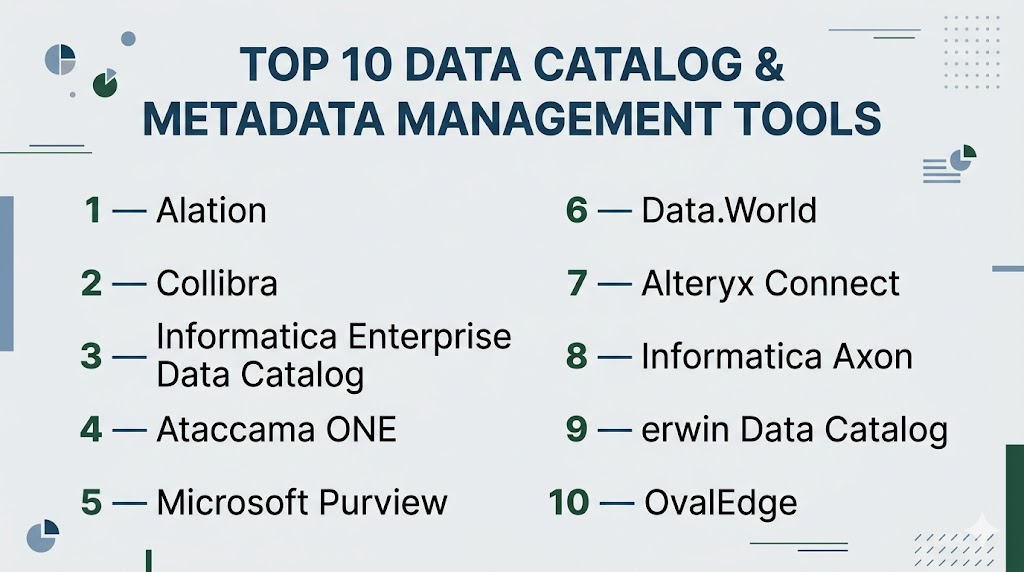
Top 10 Data Catalog & Metadata Management Tools
#1 — Alation
Short description:
Alation provides a comprehensive data catalog with strong governance capabilities. It is ideal for enterprises seeking to improve data discoverability, stewardship, and analytics productivity.
Key Features
- Centralized data catalog
- Automated metadata ingestion and classification
- Data lineage visualization
- Policy and stewardship workflows
- Search and collaboration features
- Integration with BI and ETL tools
Pros
- User-friendly interface with search and collaboration
- Strong governance and compliance support
- Scales for large enterprises
Cons
- Premium pricing
- May require configuration for complex pipelines
Platforms / Deployment
- Web
- Cloud / Hybrid
Security & Compliance
- SOC 2, ISO 27001, GDPR
Integrations & Ecosystem
Connects to Snowflake, Redshift, Tableau, Power BI, ETL platforms, APIs
Support & Community
Vendor support with knowledge base, training resources, and active community
#2 — Collibra
Short description:
Collibra offers a robust data governance and catalog platform, helping organizations centralize metadata management and improve compliance workflows.
Key Features
- Metadata discovery and cataloging
- Data lineage and impact analysis
- Stewardship and governance workflows
- Policy enforcement and compliance tracking
- Collaboration and self-service data discovery
Pros
- Strong governance and audit capabilities
- Highly configurable for enterprise workflows
- Integrates with major analytics and ETL platforms
Cons
- Complex initial setup
- Higher learning curve for small teams
Platforms / Deployment
- Web
- Cloud / On-premises / Hybrid
Security & Compliance
- SOC 2, ISO 27001, GDPR, RBAC
Integrations & Ecosystem
Supports Salesforce, Snowflake, Tableau, Power BI, APIs
Support & Community
Vendor support, training, and global user community
#3 — Informatica Enterprise Data Catalog
Short description:
Informatica EDC delivers AI-powered metadata management with automated data discovery, classification, and lineage for enterprise-scale datasets.
Key Features
- AI-driven metadata discovery
- Data lineage mapping
- Profiling and impact analysis
- Integration with ETL and BI tools
- Business glossary and collaboration
Pros
- Automated and scalable
- Strong enterprise integrations
- Supports governance and compliance
Cons
- Complexity for smaller teams
- Requires Informatica ecosystem familiarity
Platforms / Deployment
- Web / Windows / Linux
- Cloud / On-premises / Hybrid
Security & Compliance
- SOC 2, ISO 27001, GDPR, audit logging
Integrations & Ecosystem
Supports Informatica platform, Snowflake, Redshift, Tableau, APIs
Support & Community
Enterprise support and documentation, active community forums
#4 — Ataccama ONE
Short description:
Ataccama ONE combines data catalog, quality, and governance capabilities in a single platform with AI-assisted automation.
Key Features
- AI-based metadata classification
- Data lineage and profiling
- Automated stewardship workflows
- Policy enforcement and reporting
- Collaboration and search
Pros
- AI-driven automation
- Comprehensive governance capabilities
- Scalable for large datasets
Cons
- Setup and onboarding required
- Pricing for small organizations
Platforms / Deployment
- Web / Windows / Linux
- Cloud / Hybrid
Security & Compliance
- SOC 2, ISO 27001, GDPR
Integrations & Ecosystem
Supports Snowflake, Redshift, Tableau, Power BI, APIs
Support & Community
Vendor support with active knowledge base and community
#5 — Microsoft Purview
Short description:
Microsoft Purview is a unified data governance solution that provides metadata management, discovery, and lineage for enterprise data in cloud and on-prem environments.
Key Features
- Automated metadata discovery
- Data lineage visualization
- Policy enforcement and compliance
- Business glossary and collaboration
- Integration with Microsoft ecosystem and BI tools
Pros
- Seamless Microsoft integration
- Scales across cloud and on-prem data
- Built-in governance and compliance
Cons
- Limited non-Microsoft integrations
- Requires Azure familiarity
Platforms / Deployment
- Web
- Cloud / Hybrid
Security & Compliance
- SOC 2, ISO 27001, GDPR, Azure security features
Integrations & Ecosystem
Integrates with Azure Data Lake, Power BI, Synapse, APIs
Support & Community
Microsoft support, community forums, and tutorials
#6 — Data.World
Short description:
Data.World provides a collaborative data catalog platform with social features, suitable for analytics teams seeking community-driven data governance.
Key Features
- Metadata discovery and cataloging
- Collaboration and data documentation
- Lineage and impact analysis
- Data governance workflow support
- APIs and integration connectors
Pros
- Strong collaboration features
- Easy to use for analysts
- Cloud-native and scalable
Cons
- Limited enterprise governance features
- Less suited for highly regulated environments
Platforms / Deployment
- Web
- Cloud
Security & Compliance
- SOC 2, encryption
Integrations & Ecosystem
Connects with Snowflake, Redshift, Tableau, APIs
Support & Community
Documentation, tutorials, and community forums
#7 — Alteryx Connect
Short description:
Alteryx Connect enables metadata management, cataloging, and data lineage for analytics-driven organizations, tightly integrated with the Alteryx ecosystem.
Key Features
- Metadata discovery and catalog
- Data lineage visualization
- Collaboration and data documentation
- Integration with Alteryx Designer and Server
- Automated classification
Pros
- Seamless integration with Alteryx tools
- Strong collaboration and search
- Scalable for enterprise analytics
Cons
- Best suited for Alteryx users
- Pricing can be high
Platforms / Deployment
- Web
- Cloud / On-premises
Security & Compliance
- SOC 2, encryption, RBAC
Integrations & Ecosystem
Alteryx Designer, Tableau, Power BI, Snowflake
Support & Community
Vendor support and user community
#8 — Informatica Axon
Short description:
Informatica Axon complements the EDC platform by providing data governance, cataloging, and stewardship capabilities for large organizations.
Key Features
- Centralized data catalog
- Data lineage tracking
- Stewardship workflows
- Compliance and policy enforcement
- Collaboration features
Pros
- Enterprise-grade governance
- Integrates with EDC and other Informatica tools
- Strong reporting and audit capabilities
Cons
- Complexity for smaller teams
- Cost-intensive
Platforms / Deployment
- Web / Windows / Linux
- Cloud / On-premises / Hybrid
Security & Compliance
- SOC 2, ISO 27001, GDPR
Integrations & Ecosystem
Integrates with Informatica suite, Snowflake, Tableau, APIs
Support & Community
Enterprise support and documentation
#9 — erwin Data Catalog
Short description:
erwin Data Catalog provides metadata management, lineage, and governance for enterprises, focusing on compliance and operational efficiency.
Key Features
- Metadata discovery and cataloging
- Data lineage and impact analysis
- Policy enforcement and stewardship
- Collaboration and search
- Integration with ETL and analytics tools
Pros
- Strong compliance and governance
- Enterprise scalability
- Detailed lineage visualization
Cons
- Higher learning curve
- Premium pricing
Platforms / Deployment
- Web
- Cloud / On-premises / Hybrid
Security & Compliance
- SOC 2, ISO 27001, GDPR, RBAC
Integrations & Ecosystem
Snowflake, Redshift, Tableau, Power BI, APIs
Support & Community
Vendor support and active enterprise community
#10 — OvalEdge
Short description:
OvalEdge offers data cataloging and metadata management with automated discovery, collaboration, and governance features.
Key Features
- Automated metadata discovery
- Data lineage visualization
- Stewardship and governance workflows
- Collaboration tools and search
- Policy enforcement and reporting
Pros
- AI-driven discovery
- User-friendly and collaborative
- Suitable for mid-market to enterprise
Cons
- May require training for full adoption
- Cloud-focused
Platforms / Deployment
- Web
- Cloud / Hybrid
Security & Compliance
- SOC 2, GDPR, RBAC
Integrations & Ecosystem
Connects with Snowflake, Redshift, Tableau, Power BI, APIs
Support & Community
Vendor support, tutorials, and community forums
Comparison Table (Top 10)
| Tool Name | Best For | Platform(s) Supported | Deployment | Standout Feature | Public Rating |
|---|---|---|---|---|---|
| Alation | Enterprise catalog & governance | Web | Cloud / Hybrid | AI-assisted discovery | N/A |
| Collibra | Governance & compliance | Web | Cloud / On-prem / Hybrid | Workflow automation | N/A |
| Informatica EDC | Metadata discovery | Web / Windows / Linux | Cloud / On-prem / Hybrid | AI-driven cataloging | N/A |
| Ataccama ONE | AI-driven data management | Web / Windows / Linux | Cloud / Hybrid | AI-based classification | N/A |
| Microsoft Purview | Azure ecosystem | Web | Cloud / Hybrid | Unified governance | N/A |
| Data.World | Analytics teams | Web | Cloud | Collaboration & social catalog | N/A |
| Alteryx Connect | Alteryx ecosystem | Web | Cloud / On-prem | Integration with Alteryx | N/A |
| Informatica Axon | Enterprise governance | Web / Windows / Linux | Cloud / On-prem / Hybrid | Stewardship & compliance | N/A |
| erwin Data Catalog | Compliance & lineage | Web | Cloud / On-prem / Hybrid | Enterprise lineage visualization | N/A |
| OvalEdge | Mid-market & enterprise | Web | Cloud / Hybrid | AI-assisted discovery | N/A |
Evaluation & Scoring of Data Catalog & Metadata Management Tools
| Tool Name | Core | Ease | Integrations | Security | Performance | Support | Value | Weighted Total |
|---|---|---|---|---|---|---|---|---|
| Alation | 9 | 8 | 8 | 8 | 8 | 8 | 7 | 8.1 |
| Collibra | 9 | 7 | 8 | 8 | 8 | 7 | 7 | 7.9 |
| Informatica EDC | 9 | 7 | 8 | 8 | 8 | 7 | 7 | 7.9 |
| Ataccama ONE | 8 | 7 | 8 | 8 | 8 | 7 | 7 | 7.6 |
| Microsoft Purview | 8 | 8 | 7 | 8 | 8 | 7 | 7 | 7.6 |
| Data.World | 7 | 8 | 7 | 7 | 7 | 7 | 7 | 7.1 |
| Alteryx Connect | 7 | 8 | 7 | 7 | 7 | 7 | 7 | 7.1 |
| Informatica Axon | 8 | 7 | 8 | 8 | 8 | 7 | 7 | 7.6 |
| erwin Data Catalog | 8 | 7 | 8 | 8 | 8 | 7 | 7 | 7.6 |
| OvalEdge | 8 | 8 | 7 | 7 | 7 | 7 | 7 | 7.3 |
Scores are comparative; higher totals indicate broader capability, ease of use, integrations, and governance. Selection should consider organizational size, compliance requirements, and integration needs.
Which Data Catalog & Metadata Management Tools Tool Is Right for You?
Solo / Freelancer
Open-source or lightweight tools like Data.World can help small teams manage metadata without heavy investment.
SMB
Mid-market solutions like OvalEdge or Microsoft Purview offer ease of use, collaboration, and integration.
Mid-Market
Ataccama ONE and Alation provide governance, automation, and AI-assisted classification suitable for mid-sized enterprises.
Enterprise
Collibra, Informatica EDC, and erwin Data Catalog deliver enterprise-grade governance, compliance, and scalability.
Budget vs Premium
Open-source or mid-market tools reduce cost; enterprise-grade platforms provide advanced capabilities at higher pricing.
Feature Depth vs Ease of Use
Enterprise tools offer comprehensive features; mid-market tools focus on usability and collaboration.
Integrations & Scalability
Enterprise tools integrate broadly with BI, ETL, and analytics platforms, scaling for large data environments.
Security & Compliance Needs
SOC 2, ISO 27001, GDPR, and RBAC are essential for regulated industries.
Frequently Asked Questions (FAQs)
1. What are data catalog and metadata management tools?
They are platforms for discovering, organizing, and governing metadata across enterprise data assets.
2. Why are they important?
They ensure consistent, accurate, and compliant data for analytics, reporting, and operations.
3. How do these tools work?
They profile, classify, and catalog metadata, provide lineage, and enforce governance policies.
4. Who benefits most from them?
Data engineers, analysts, governance teams, and enterprise operations teams.
5. Can they handle real-time data?
Many provide real-time or near-real-time metadata updates and lineage tracking.
6. Are they cloud-only?
Many are cloud-native, with hybrid and on-prem options for enterprise deployments.
7. Do they integrate with analytics platforms?
Yes, most connect with Snowflake, Redshift, Tableau, Power BI, and ETL pipelines.
8. Are AI features available?
Some platforms offer AI-assisted classification, anomaly detection, and metadata enrichment.
9. Do they support compliance?
Enterprise tools support SOC 2, ISO 27001, GDPR, RBAC, and audit logging.
10. Can small businesses benefit?
Yes, lightweight tools like Data.World and OvalEdge provide metadata management for smaller datasets.
Conclusion
Data catalog and metadata management tools are critical for maintaining data governance, ensuring compliance, and enabling data-driven decision-making. Selecting the right platform depends on organizational size, data complexity, and integration needs. Organizations should shortlist tools, pilot in their environment, and validate security, integrations, and governance capabilities before full adoption. Proper implementation ensures data trust, discoverability, and operational efficiency.

Find Trusted Cardiac Hospitals
Compare heart hospitals by city and services — all in one place.
Explore Hospitals
Data sources can change, but the catalog may still show an old owner, description, or classification. Teams should review important metadata after major system changes and clearly flag information that may be outdated. This can help users trust the catalog when they are searching for data.