Introduction
AutoML platforms are revolutionizing the way businesses harness the power of machine learning. Instead of requiring teams of specialized data scientists, AutoML platforms automate critical tasks like data preprocessing, feature engineering, algorithm selection, and hyperparameter tuning. This allows organizations to accelerate AI adoption, reduce errors, and deliver predictive insights faster. In , as AI becomes central to business competitiveness, AutoML platforms are essential for teams that want to deploy models efficiently while maintaining control and governance.
Real-world applications of AutoML platforms are diverse and impactful: predicting customer churn for telecom operators, optimizing supply chain demand forecasts, building recommendation engines for e-commerce, detecting fraudulent financial transactions, and classifying medical images for healthcare diagnostics. When evaluating AutoML platforms, buyers should look at:
- End-to-end pipeline automation
- Range of supported ML algorithms and tasks
- Hyperparameter optimization and feature engineering
- Scalability for large datasets and distributed compute
- Deployment flexibility across cloud, on-prem, and edge
- Model interpretability and explainability
- Experiment tracking and reproducibility
- Ease of use and learning curve
- Integration with cloud services, data warehouses, and analytics tools
- Security, compliance, and governance capabilities
Best for: Data scientists, ML engineers, business analysts, and enterprises of all sizes aiming to accelerate AI projects without heavy manual intervention.
Not ideal for: Teams only running simple predictive tasks, companies with highly custom ML pipelines, or those that prefer full manual control over model development.
Key Trends in AutoML Platforms
- AI-first approach with deep learning and transformer support baked into AutoML pipelines
- Low-code and no-code interfaces empowering business analysts and citizen data scientists
- Cloud-native and hybrid deployments to support enterprise-scale workloads
- Automated feature engineering and hyperparameter optimization for faster insights
- Built-in model interpretability, fairness, and explainability features
- Seamless MLOps pipelines for deployment, monitoring, and retraining
- Integration with data lakes, warehouses, and orchestration tools
- Subscription and pay-as-you-go pricing models for flexible scaling
- Real-time collaboration tools for distributed teams
- Focus on reproducibility, experiment tracking, and audit logs for compliance
How We Selected These Tools (Methodology)
- Evaluated global adoption, enterprise mindshare, and brand trust
- Assessed feature completeness for end-to-end ML automation
- Measured reliability, performance, and scalability across datasets and compute resources
- Analyzed security posture, compliance certifications, and governance features
- Examined integrations with popular ML frameworks, cloud platforms, and orchestration pipelines
- Reviewed customer fit for solo users, SMBs, mid-market, and large enterprises
- Considered collaboration, reproducibility, and experiment tracking capabilities
- Evaluated vendor support, community activity, and active development
- Balanced open-source flexibility against enterprise-grade features
- Tested practical usability, dashboard intuitiveness, and learning curve
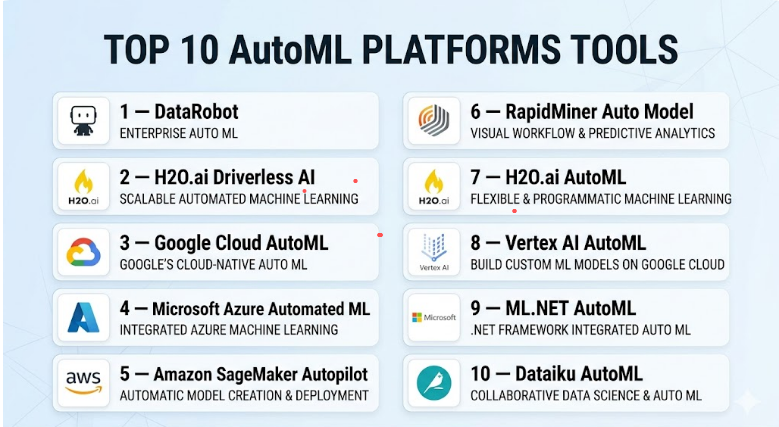
Top 10 AutoML Platforms Tools
#1 — DataRobot
Short description : DataRobot is a powerhouse enterprise AutoML platform that automates the full lifecycle of model building, deployment, and monitoring. It’s perfect for teams that need speed without sacrificing governance or predictive accuracy.
Key Features
- Automated algorithm selection and hyperparameter tuning
- Intelligent feature engineering
- Model interpretability with visual explanations
- Deployment-ready pipelines with monitoring
- Python and R integration
- MLOps-ready infrastructure
- Collaboration features for teams
Pros
- Accelerates model development across enterprise teams
- Strong compliance and governance capabilities
- Handles large-scale datasets efficiently
Cons
- Premium pricing may be high for smaller teams
- Cloud-first approach may limit some on-prem deployments
- Complexity for non-technical users
Platforms / Deployment
- Web
- Cloud / Hybrid
Security & Compliance
- SOC 2, ISO 27001, GDPR
- Encryption, RBAC
Integrations & Ecosystem
- AWS, Azure, GCP
- Python/R SDKs
- REST APIs for production deployment
- MLOps pipeline integration
Support & Community
Enterprise support available; extensive tutorials and community forums.
#2 — H2O.ai Driverless AI
Short description : Driverless AI by H2O.ai brings speed and intelligence to AutoML. It automates feature engineering, model selection, and evaluation, allowing teams to focus on solving real business problems.
Key Features
- Automated feature engineering and preprocessing
- Hyperparameter tuning for optimal model performance
- Explainable AI and interpretability
- GPU acceleration for rapid training
- Deployment-ready API endpoints
- Python integration
Pros
- Rapid experimentation and deployment
- High-quality predictions
- Intuitive visualizations for insights
Cons
- Requires enterprise subscription for full features
- High hardware demands for very large datasets
- Less flexibility for highly customized workflows
Platforms / Deployment
- Windows / macOS / Linux
- Cloud / Self-hosted
Security & Compliance
- Not publicly stated
Integrations & Ecosystem
- Spark and Hadoop integration
- Python API
- REST endpoints for deployment
Support & Community
Active enterprise support and strong open-source community presence.
#3 — Google Cloud AutoML
Short description : Google Cloud AutoML empowers enterprises to build models without deep ML expertise. It supports vision, language, and tabular data tasks, scaling seamlessly on Google Cloud infrastructure.
Key Features
- AutoML for text, vision, and tabular data
- Integration with Vertex AI pipelines
- Hyperparameter tuning and model evaluation
- Pre-trained model transfer learning
- Python SDK and REST API
- Cloud-native scalability
Pros
- Minimal coding required
- Scalable for enterprise workloads
- Pre-trained models accelerate deployment
Cons
- Cloud-only platform
- Costs increase with usage
- Limited offline capabilities
Platforms / Deployment
- Web
- Cloud
Security & Compliance
- SOC 2, ISO 27001, GDPR, HIPAA
- Encryption, access control
Integrations & Ecosystem
- BigQuery, Cloud Storage
- TensorFlow, PyTorch
- REST APIs and SDKs
Support & Community
Google Cloud support; tutorials and enterprise documentation.
#4 — Microsoft Azure Automated ML
Short description : Azure Automated ML enables fast, automated model creation for enterprise teams, integrating seamlessly with the Microsoft ecosystem.
Key Features
- Feature engineering and preprocessing automation
- Hyperparameter optimization
- Model deployment pipelines
- Python and R support
- Built-in interpretability and monitoring
- Integration with Azure ML pipelines
Pros
- Enterprise-grade MLOps
- Easy deployment in Azure
- Scalable and secure infrastructure
Cons
- Tied to Azure ecosystem
- Learning curve for advanced pipelines
- Cost varies by compute usage
Platforms / Deployment
- Web
- Cloud
Security & Compliance
- SOC 2, ISO 27001, GDPR, HIPAA
- Encryption, RBAC
Integrations & Ecosystem
- Azure Data Lake, SQL Database
- TensorFlow, PyTorch
- REST APIs for automation
Support & Community
Microsoft support; comprehensive documentation and forums.
#5 — Amazon SageMaker Autopilot
Short description : SageMaker Autopilot automates ML model building, tuning, and deployment on AWS, making it ideal for enterprises seeking scalable, cloud-native AutoML.
Key Features
- AutoML for preprocessing, training, and deployment
- Hyperparameter optimization
- Model monitoring and drift detection
- Integration with AWS data services
- Python SDK and REST API
Pros
- Deep integration with AWS
- End-to-end automated workflows
- Scalable and cloud-native
Cons
- AWS subscription required
- Cost scales with compute
- Cloud-only deployment
Platforms / Deployment
- Web
- Cloud
Security & Compliance
- SOC 2, ISO 27001, HIPAA, GDPR
- Encryption, SSO
Integrations & Ecosystem
- S3, Redshift, Lambda
- TensorFlow, PyTorch
- REST APIs and SDK
Support & Community
AWS enterprise support and active forums.
#6 — RapidMiner Auto Model
Short description : RapidMiner Auto Model is a low-code AutoML platform ideal for business analysts and SMB teams, offering drag-and-drop workflows for rapid model deployment.
Key Features
- Drag-and-drop workflow design
- Automated feature engineering
- Model evaluation and interpretability
- Deployment-ready models
- Python/R integration
- Collaboration for teams
Pros
- Minimal coding required
- Fast prototyping
- Easy to learn
Cons
- Limited advanced customization
- Licensing cost for enterprise features
- Cloud deployment optional
Platforms / Deployment
- Windows / macOS / Linux / Web
- Cloud / Self-hosted / Hybrid
Security & Compliance
- Not publicly stated
Integrations & Ecosystem
- Python/R APIs
- Database connectors
- Pre-built model templates
Support & Community
Documentation, enterprise support, and community forums.
#7 — H2O.ai AutoML
Short description : H2O.ai AutoML automates model selection, hyperparameter tuning, and leaderboard-based evaluation, ideal for data scientists and analysts across industries.
Key Features
- Automated model selection and tuning
- Feature engineering
- Leaderboard comparison of models
- Deployment pipelines
- Python/R SDK
- Cloud and on-prem support
Pros
- Open-source flexibility
- Scalable for large datasets
- Quick experimentation
Cons
- GUI less polished
- Cloud integration requires setup
- Learning curve for deployment
Platforms / Deployment
- Windows / macOS / Linux
- Cloud / Self-hosted / Hybrid
Security & Compliance
- Not publicly stated
Integrations & Ecosystem
- Python/R APIs
- Spark integration
- REST APIs
Support & Community
Open-source community; enterprise support optional.
#8 — Vertex AI AutoML
Short description : Vertex AI AutoML offers fully managed AutoML pipelines for Google Cloud, supporting vision, tabular, and NLP tasks with scalable compute.
Key Features
- AutoML for multiple data types
- Hyperparameter tuning
- Cloud-scale GPU/TPU compute
- Model monitoring
- Python SDK and REST API
Pros
- Scalable and cloud-native
- Easy integration with Google Cloud
- Multi-task support
Cons
- Cloud-only
- Pricing scales with usage
- Limited offline support
Platforms / Deployment
- Web
- Cloud
Security & Compliance
- SOC 2, ISO 27001, GDPR, HIPAA
- Encryption, access controls
Integrations & Ecosystem
- BigQuery, Cloud Storage
- TensorFlow/PyTorch
- REST APIs
Support & Community
Google Cloud enterprise support; tutorials available.
#9 — ML.NET AutoML
Short description : ML.NET AutoML simplifies model creation for .NET developers, providing automated workflows and deployment for Windows-centric teams.
Key Features
- AutoML for classification, regression, and time series
- Visual Studio integration
- Preprocessing automation
- Python and .NET support
- Deployment-ready models
Pros
- Seamless .NET integration
- Minimal coding required
- Supports on-prem and cloud deployment
Cons
- Limited language support
- Smaller adoption outside .NET
- Fewer pre-trained models
Platforms / Deployment
- Windows
- Cloud / Self-hosted / Hybrid
Security & Compliance
- Not publicly stated
Integrations & Ecosystem
- Visual Studio and .NET libraries
- REST API deployment
Support & Community
Microsoft documentation and enterprise support.
#10 — Dataiku AutoML
Short description : Dataiku AutoML combines automation with collaboration, making it suitable for enterprise teams who need transparency and governance in model building.
Key Features
- Automated feature engineering
- Model selection and tuning
- Collaboration and workflow management
- Deployment pipelines
- Integration with Python, R, and SQL
- Explainable AI features
Pros
- Balances automation with interpretability
- Supports team collaboration
- Enterprise-ready scalability
Cons
- Premium pricing
- Learning curve for advanced workflows
- Full cloud deployment required
Platforms / Deployment
- Web
- Cloud / Self-hosted / Hybrid
Security & Compliance
- Not publicly stated
Integrations & Ecosystem
- Python, R, SQL connectors
- Cloud storage integration
- REST APIs
Support & Community
Enterprise support tiers; active tutorials and community.
Comparison Table (Top 10)
| Tool Name | Best For | Platform(s) Supported | Deployment | Standout Feature | Public Rating |
|---|---|---|---|---|---|
| DataRobot | Enterprise AutoML | Web | Cloud / Hybrid | Governance and pipeline automation | N/A |
| H2O.ai Driverless AI | Feature engineering | Windows/macOS/Linux | Cloud / Self-hosted | Automated feature engineering | N/A |
| Google Cloud AutoML | Cloud AI workflows | Web | Cloud | Pre-trained models and scaling | N/A |
| Azure Automated ML | Microsoft ecosystem | Web | Cloud | End-to-end Azure integration | N/A |
| SageMaker Autopilot | AWS users | Web | Cloud | Managed training and deployment | N/A |
| RapidMiner Auto Model | Analysts / SMB | Windows/macOS/Linux/Web | Cloud / Hybrid | Drag-and-drop AutoML | N/A |
| H2O.ai AutoML | Open-source experimentation | Windows/macOS/Linux | Cloud / Hybrid | Leaderboard for model selection | N/A |
| Vertex AI AutoML | Google Cloud enterprises | Web | Cloud | Multi-task AutoML | N/A |
| ML.NET AutoML | .NET developers | Windows | Cloud / Hybrid | AutoML for .NET applications | N/A |
| Dataiku AutoML | Enterprise collaboration | Web | Cloud / Hybrid | Team collaboration and automation | N/A |
Evaluation & Scoring of AutoML Platforms
| Tool Name | Core (25%) | Ease (15%) | Integrations (15%) | Security (10%) | Performance (10%) | Support (10%) | Value (15%) | Weighted Total (0–10) |
|---|---|---|---|---|---|---|---|---|
| DataRobot | 9 | 7 | 9 | 8 | 9 | 8 | 7 | 8.3 |
| H2O.ai Driverless AI | 8 | 7 | 8 | 6 | 8 | 7 | 7 | 7.6 |
| Google Cloud AutoML | 8 | 7 | 8 | 8 | 8 | 7 | 7 | 7.8 |
| Azure Automated ML | 8 | 7 | 7 | 8 | 8 | 7 | 7 | 7.7 |
| SageMaker Autopilot | 8 | 7 | 8 | 8 | 8 | 7 | 7 | 7.8 |
| RapidMiner Auto Model | 7 | 8 | 7 | 6 | 7 | 7 | 7 | 7.3 |
| H2O.ai AutoML | 8 | 7 | 7 | 6 | 8 | 7 | 7 | 7.3 |
| Vertex AI AutoML | 8 | 7 | 7 | 8 | 8 | 7 | 7 | 7.5 |
| ML.NET AutoML | 7 | 7 | 6 | 6 | 7 | 6 | 7 | 6.8 |
| Dataiku AutoML | 8 | 7 | 7 | 7 | 8 | 7 | 7 | 7.5 |
Weighted scoring allows teams to compare platforms based on functionality, usability, integrations, performance, and enterprise value.
Which AutoML Platforms Tool Is Right for You?
Solo / Freelancer
RapidMiner, H2O.ai AutoML, or ML.NET offer low-cost, accessible solutions for individual experimentation and learning.
SMB
DataRobot, H2O.ai Driverless AI, and Dataiku combine automation and collaboration for small to medium teams with growing AI needs.
Mid-Market
Google Cloud AutoML, Vertex AI AutoML, and SageMaker Autopilot provide cloud-scale compute and multi-task support for mid-sized businesses.
Enterprise
DataRobot, Azure Automated ML, Vertex AI AutoML, and Dataiku deliver enterprise-grade governance, compliance, and distributed workload management.
Budget vs Premium
Open-source H2O.ai is cost-effective; premium platforms provide automation, scalability, and enterprise-grade support.
Feature Depth vs Ease of Use
DataRobot, SageMaker, and Vertex AI offer deep capabilities; RapidMiner and ML.NET focus on usability and quick results.
Integrations & Scalability
Cloud-native platforms integrate with data lakes, warehouses, and MLOps pipelines for enterprise-scale deployment.
Security & Compliance Needs
Enterprise platforms provide encryption, RBAC, and audit logging; open-source alternatives require manual configuration.
Frequently Asked Questions (FAQs)
1. What are typical pricing models for AutoML platforms?
Open-source frameworks are free; cloud-hosted or enterprise support tiers may require subscriptions or pay-as-you-go.
2. How easy is onboarding?
Low-code platforms like RapidMiner and Dataiku are beginner-friendly; DataRobot and cloud AutoML platforms require initial training.
3. Can multiple users collaborate?
Yes. DataRobot, Dataiku, and Vertex AI support team-based workflows with role-based access and shared experiments.
4. Are these platforms secure for sensitive data?
Enterprise AutoML solutions offer SOC 2, ISO 27001, GDPR, and HIPAA compliance; open-source platforms need custom security setup.
5. Which ML tasks are supported?
Classification, regression, time series forecasting, NLP, and image recognition are supported, depending on the platform.
6. Can models be deployed to production easily?
Yes, platforms provide APIs, cloud deployment, and integration with MLOps pipelines.
7. How scalable are these platforms?
Cloud-native AutoML platforms support distributed GPU/TPU compute for large datasets.
8. Are the outputs explainable?
Yes, many platforms include model interpretability and visualization tools to explain predictions.
9. Can I switch platforms easily?
ONNX or standard formats allow portability, but some platform-specific features may require adaptation.
10. Are there alternatives?
Yes, notebook environments, AutoML libraries, and manual ML pipelines are viable for smaller or simpler projects.
Conclusion
AutoML platforms have transformed the AI landscape by democratizing model creation and deployment. Organizations can accelerate predictive insights, reduce development time, and scale AI across business units. Open-source tools like H2O.ai provide flexibility and low cost, while enterprise platforms such as DataRobot, Google Cloud AutoML, Vertex AI, and Azure Automated ML deliver governance, scalability, and MLOps readiness. Selecting the right platform depends on team size, cloud strategy, compliance needs, and the complexity of use cases. Pilots or trial deployments are highly recommended to validate fit and performance before full-scale adoption

Find Trusted Cardiac Hospitals
Compare heart hospitals by city and services — all in one place.
Explore Hospitals
The highest accuracy score does not always mean the model is the most useful in real situations. Teams should also look at business impact, false positives, false negatives, and how the model performs with real users. This helps make sure automation leads to better decisions, not just better test results.