Introduction
Synthetic Data Generation Tools create artificial data that mimics the statistical properties of real-world datasets. These tools enable organizations to develop, test, and train AI and machine learning models without exposing sensitive or regulated data. As AI adoption accelerates in synthetic data is critical for maintaining privacy, complying with regulations, and ensuring model robustness across industries.
Real-world use cases include generating healthcare datasets for research without patient data exposure, creating realistic financial transaction records for fraud detection, producing manufacturing sensor data to test predictive maintenance models, generating training data for autonomous vehicles, and simulating customer behavior for e-commerce recommendation systems. Key evaluation criteria for buyers include:
- Quality and realism of synthetic data
- Support for structured, unstructured, and time-series data
- Integration with ML pipelines and MLOps platforms
- Privacy guarantees and compliance features
- Ease of use and automation
- Scalability and performance
- Support for multi-modal data (images, text, audio, video)
- Data versioning and lineage
- Deployment flexibility (cloud, on-prem, hybrid)
- Cost and licensing models
Best for: Data scientists, AI/ML teams, and enterprises handling sensitive datasets requiring privacy, testing, or simulation.
Not ideal for: Teams with low data sensitivity or small-scale projects where real data can be safely used without compliance risks.
Key Trends in Synthetic Data Generation Tools
- Increased use of generative AI for realistic data simulation
- Emphasis on privacy-preserving synthetic data to comply with GDPR and HIPAA
- Multi-modal data generation (text, images, video, audio, tabular)
- Integration with MLOps pipelines for automated data generation
- Cloud-native SaaS platforms with APIs for scalability
- Data versioning, lineage, and reproducibility for experiments
- Real-time synthetic data generation for streaming pipelines
- Open-source frameworks gaining traction alongside enterprise solutions
- Cost-effective subscription and pay-per-use pricing models
- Cross-industry adoption including healthcare, finance, autonomous systems, and e-commerce
How We Selected These Tools (Methodology)
- Evaluated market adoption and credibility of the vendor
- Assessed feature completeness across data types and privacy guarantees
- Reviewed performance, scalability, and real-time data capabilities
- Examined security, compliance, and governance features
- Checked integration with ML frameworks, pipelines, and data lakes
- Evaluated fit for small teams, mid-market, and enterprise-scale operations
- Considered reproducibility, versioning, and lineage features
- Reviewed ease of adoption, onboarding, and automation support
- Prioritized active development, customer support, and documentation
- Balanced open-source flexibility with enterprise-grade capabilities
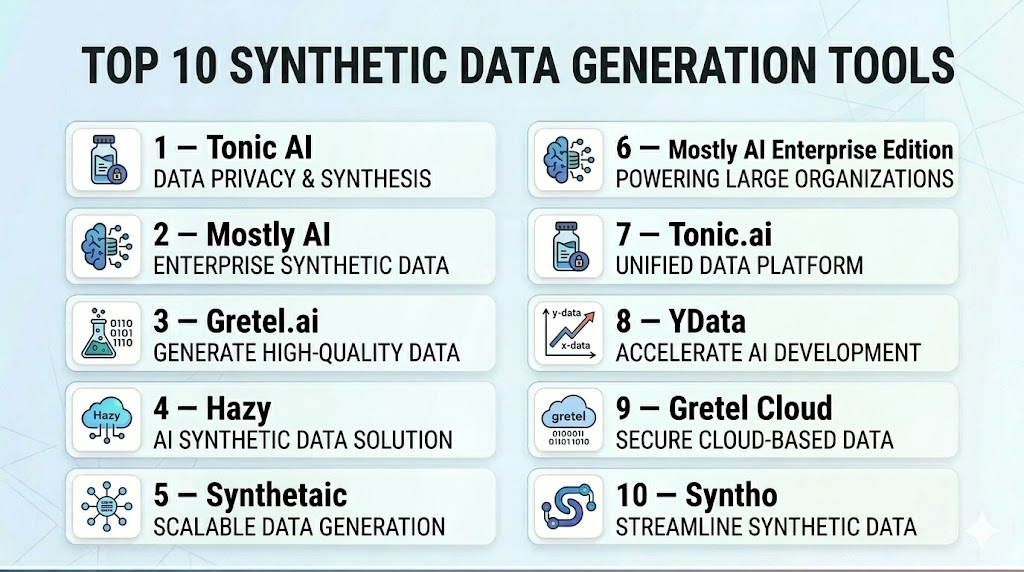
Top 10 Synthetic Data Generation Tools
#1 — Tonic AI
Short description : Tonic AI generates realistic, privacy-compliant synthetic data for testing and training ML models. It is designed for enterprises requiring high fidelity and regulatory compliance.
Key Features
- High-fidelity synthetic data generation
- Supports structured, semi-structured, and relational data
- Privacy-preserving transformations
- API for automation and integration
- Versioning and lineage tracking
- Multi-database support
Pros
- Strong privacy guarantees
- Enterprise-ready for production pipelines
- Scalable for large datasets
Cons
- Premium pricing
- Setup can be complex
- Cloud-focused deployment
Platforms / Deployment
- Web
- Cloud
Security & Compliance
- GDPR, SOC 2, HIPAA
- Encryption and RBAC
Integrations & Ecosystem
- SQL databases, Python SDK, REST APIs
- Integration with ML pipelines and BI tools
Support & Community
Enterprise support, onboarding, and extensive documentation.
#2 — Mostly AI
Short description : Mostly AI provides AI-generated synthetic datasets with a focus on tabular and time-series data. Ideal for regulated industries requiring privacy compliance.
Key Features
- Synthetic tabular and time-series data
- Differential privacy features
- Automatic feature correlation preservation
- API for pipeline integration
- Data versioning
- GDPR and HIPAA compliance
Pros
- Strong data privacy and compliance
- Accurate statistical representation of real data
- Suitable for financial and healthcare applications
Cons
- Cloud-only deployment
- Subscription cost may be high
- Limited unstructured data support
Platforms / Deployment
- Web
- Cloud
Security & Compliance
- SOC 2, GDPR, HIPAA
- Encryption and audit logging
Integrations & Ecosystem
- Python SDK, REST APIs, SQL connectors
- Integrates with ML training pipelines
Support & Community
Professional support, tutorials, and onboarding guides.
#3 — Gretel.ai
Short description : Gretel.ai focuses on privacy-preserving synthetic data for structured and tabular datasets. It is suitable for enterprises looking to anonymize sensitive data while retaining utility.
Key Features
- Tabular synthetic data generation
- Differential privacy and anonymization
- API for batch and real-time pipelines
- Data lineage and audit tracking
- Integration with Python and cloud storage
Pros
- Strong privacy focus
- Flexible API-based integration
- Supports both batch and real-time generation
Cons
- Limited unstructured data capabilities
- Cloud subscription required
- Advanced analytics require technical setup
Platforms / Deployment
- Web
- Cloud
Security & Compliance
- GDPR, SOC 2
- Encryption and RBAC
Integrations & Ecosystem
- Python SDK, REST APIs
- Integration with cloud storage and ML pipelines
Support & Community
Enterprise support and active documentation.
#4 — Hazy
Short description : Hazy specializes in synthetic tabular data generation for financial and healthcare industries, emphasizing privacy and regulatory compliance.
Key Features
- Tabular data generation
- Privacy-preserving transformations
- Feature correlation preservation
- Cloud API and integration
- Data lineage and versioning
Pros
- High fidelity and privacy
- Regulatory compliance focus
- Enterprise-ready for large datasets
Cons
- Limited multi-modal support
- Cloud-only deployment
- Premium pricing
Platforms / Deployment
- Web
- Cloud
Security & Compliance
- GDPR, HIPAA, SOC 2
- Encryption, RBAC, audit logging
Integrations & Ecosystem
- Python SDK, REST API
- Database and ML pipeline connectors
Support & Community
Professional support and documentation.
#5 — Synthetaic
Short description : Synthetaic offers synthetic image and video generation, ideal for training computer vision and autonomous systems models.
Key Features
- Synthetic images and video datasets
- Scene and object variability generation
- API and SDK for automation
- High-resolution output
- Integration with ML pipelines
Pros
- Ideal for computer vision applications
- Supports diverse scenarios and environments
- Enterprise-grade quality
Cons
- Focused on visual data only
- Premium subscription required
- Limited tabular or text data support
Platforms / Deployment
- Web
- Cloud
Security & Compliance
- Not publicly stated
Integrations & Ecosystem
- Python SDK, REST API
- Integration with CV pipelines
Support & Community
Enterprise support, onboarding, and tutorials.
#6 — Mostly AI Enterprise Edition
Short description : Enterprise-focused version of Mostly AI with additional compliance features, real-time generation, and multi-team collaboration.
Key Features
- Real-time synthetic data generation
- Team collaboration and access control
- Audit trails and lineage
- Integration with cloud ML pipelines
- Multi-format support
Pros
- Enterprise-ready
- Supports real-time applications
- Governance and compliance
Cons
- Higher subscription cost
- Learning curve for setup
- Cloud-only
Platforms / Deployment
- Web
- Cloud
Security & Compliance
- GDPR, HIPAA, SOC 2
- RBAC, encryption
Integrations & Ecosystem
- Python SDK, SQL connectors, REST APIs
Support & Community
Enterprise support and onboarding.
#7 — Tonic.ai
Short description : Tonic.ai is a synthetic data platform for tabular datasets with privacy and compliance features suitable for testing and ML training.
Key Features
- Tabular data generation
- Privacy-preserving transformations
- Integration with testing and ML pipelines
- API and SDK
- Versioning and lineage
Pros
- Accurate statistical representation
- Privacy and compliance-focused
- Scalable
Cons
- Limited unstructured data
- Cloud-only
- Premium pricing
Platforms / Deployment
- Web
- Cloud
Security & Compliance
- SOC 2, GDPR, HIPAA
- Encryption and audit logs
Integrations & Ecosystem
- Python SDK, REST API, SQL connectors
Support & Community
Professional support and documentation.
#8 — YData
Short description : YData provides multi-modal synthetic data generation for tabular, text, and image data, with privacy guarantees for regulated industries.
Key Features
- Multi-modal synthetic data
- Privacy-preserving transformations
- API for pipeline integration
- Data lineage and versioning
- Visualization and analytics tools
Pros
- Supports tabular, text, and image data
- Privacy and compliance-friendly
- Scalable for enterprise use
Cons
- Cloud subscription required
- Premium pricing
- Complex setup for advanced features
Platforms / Deployment
- Web
- Cloud
Security & Compliance
- GDPR, SOC 2
- Encryption and access control
Integrations & Ecosystem
- Python SDK, REST API
- ML pipeline integration
Support & Community
Enterprise support; documentation and tutorials.
#9 — Gretel Cloud
Short description : Gretel Cloud offers privacy-preserving synthetic data generation for tabular and structured datasets, ideal for compliance-driven applications.
Key Features
- Tabular and structured data generation
- Differential privacy
- API and SDK integration
- Data versioning
- Audit and lineage tracking
Pros
- Privacy-first platform
- Easy integration with pipelines
- Scalable for enterprise datasets
Cons
- Cloud-only
- Limited unstructured support
- Subscription-based
Platforms / Deployment
- Web
- Cloud
Security & Compliance
- GDPR, SOC 2
- Encryption, RBAC
Integrations & Ecosystem
- Python SDK, REST APIs
- ML pipelines and databases
Support & Community
Professional support and documentation.
#10 — Syntho
Short description : Syntho focuses on tabular synthetic data for banking, healthcare, and insurance, emphasizing privacy and compliance with enterprise features.
Key Features
- Tabular data generation
- GDPR and HIPAA compliance
- Data lineage and versioning
- API and SDK
- Realistic synthetic datasets
Pros
- Enterprise compliance
- Scalable datasets
- Easy integration with ML pipelines
Cons
- Limited multi-modal support
- Cloud-only
- Premium pricing
Platforms / Deployment
- Web
- Cloud
Security & Compliance
- GDPR, HIPAA, SOC 2
- Encryption and RBAC
Integrations & Ecosystem
- Python SDK, REST APIs
- Database and ML pipeline connectors
Support & Community
Enterprise support and onboarding.
Comparison Table (Top 10)
| Tool Name | Best For | Platform(s) Supported | Deployment | Standout Feature | Public Rating |
|---|---|---|---|---|---|
| Tonic AI | Enterprise tabular data | Web | Cloud | High-fidelity & privacy | N/A |
| Mostly AI | Regulated industries | Web | Cloud | Differential privacy | N/A |
| Gretel.ai | Privacy-preserving tabular | Web | Cloud | API-based generation | N/A |
| Hazy | Financial & healthcare data | Web | Cloud | Feature correlation preservation | N/A |
| Synthetaic | Synthetic images & video | Web | Cloud | Multi-environment CV datasets | N/A |
| Mostly AI Enterprise | Enterprise real-time datasets | Web | Cloud | Team collaboration | N/A |
| Tonic.ai | Testing & ML training | Web | Cloud | Statistical representation | N/A |
| YData | Multi-modal synthetic data | Web | Cloud | Tabular, text, and image data | N/A |
| Gretel Cloud | Compliance-driven synthetic data | Web | Cloud | Differential privacy | N/A |
| Syntho | Banking & healthcare | Web | Cloud | GDPR/HIPAA compliance | N/A |
Evaluation & Scoring of Synthetic Data Generation Tools
| Tool Name | Core (25%) | Ease (15%) | Integrations (15%) | Security (10%) | Performance (10%) | Support (10%) | Value (15%) | Weighted Total (0–10) |
|---|---|---|---|---|---|---|---|---|
| Tonic AI | 9 | 7 | 8 | 8 | 9 | 8 | 7 | 8.1 |
| Mostly AI | 8 | 7 | 7 | 8 | 8 | 7 | 7 | 7.6 |
| Gretel.ai | 8 | 7 | 7 | 8 | 8 | 7 | 7 | 7.6 |
| Hazy | 8 | 7 | 7 | 8 | 8 | 7 | 7 | 7.6 |
| Synthetaic | 8 | 7 | 7 | 6 | 8 | 7 | 7 | 7.3 |
| Mostly AI Enterprise | 9 | 7 | 8 | 8 | 9 | 8 | 7 | 8.1 |
| Tonic.ai | 8 | 7 | 7 | 8 | 8 | 7 | 7 | 7.6 |
| YData | 8 | 7 | 7 | 8 | 8 | 7 | 7 | 7.6 |
| Gretel Cloud | 8 | 7 | 7 | 8 | 8 | 7 | 7 | 7.6 |
| Syntho | 8 | 7 | 7 | 8 | 8 | 7 | 7 | 7.6 |
Which Synthetic Data Generation Tools Tool Is Right for You?
Solo / Freelancer
Open-source or cloud trial options like Gretel.ai or Tonic AI free tier for experimentation.
SMB
Mostly AI, Gretel Cloud, or YData for small teams requiring privacy and compliance.
Mid-Market
Tonic AI, Hazy, and Mostly AI Enterprise for scalable production datasets and team collaboration.
Enterprise
Syntho, Synthetaic, and Tonic Enterprise for high compliance, multi-modal data generation, and integration with MLOps pipelines.
Budget vs Premium
Open-source and trial versions are cost-effective; premium SaaS tools provide collaboration, compliance, and enterprise-grade features.
Feature Depth vs Ease of Use
Enterprise platforms like Tonic and Syntho offer full lifecycle features; Gretel and YData prioritize ease of use and rapid adoption.
Integrations & Scalability
Cloud-native solutions integrate with ML pipelines, databases, and storage for large-scale generation.
Security & Compliance Needs
Enterprise tools provide encryption, RBAC, audit logging, and compliance with GDPR, HIPAA, and SOC 2.
Frequently Asked Questions (FAQs)
1. What pricing models are common?
Open-source tools are free; SaaS platforms use subscriptions scaled by usage or team size.
2. How fast is onboarding?
SaaS tools have guided onboarding; open-source requires setup and integration knowledge.
3. Can multiple users collaborate?
Yes, enterprise solutions support role-based access, shared repositories, and team workflows.
4. Are these tools secure for sensitive data?
Enterprise tools offer encryption, compliance, and audit logs; open-source may require additional configuration.
5. Do these tools support multi-modal data?
Some platforms (YData, Synthetaic) support text, images, video, and tabular data; others are tabular-focused.
6. Can synthetic data replace real data in training?
Yes, for testing, ML training, and validation, especially when privacy or availability is a concern.
7. How scalable are these platforms?
Cloud-native tools handle large datasets and multiple pipelines efficiently; on-prem setups may require scaling infrastructure.
8. Do they integrate with MLOps pipelines?
Yes, APIs and SDKs allow integration with model training, validation, and deployment workflows.
9. Are open-source tools production-ready?
Many are, but enterprise tools provide enhanced support, compliance, and multi-team features.
10. Can we migrate synthetic data between platforms?
Yes, but export/import features and API compatibility should be verified.
Conclusion
Synthetic Data Generation Tools have become essential for AI/ML teams managing sensitive datasets. They provide privacy, regulatory compliance, and high-fidelity data for testing, validation, and training ML models. Open-source tools like Gretel.ai provide flexibility and cost-efficiency, while enterprise solutions like Tonic, Mostly AI, and Syntho deliver advanced features, multi-modal data support, and seamless integration with MLOps pipelines. Selecting the right tool depends on team size, compliance requirements, data types, and workflow complexity. Conducting pilot trials and testing integration into existing pipelines ensures optimal adoption and ROI.

Find Trusted Cardiac Hospitals
Compare heart hospitals by city and services — all in one place.
Explore Hospitals
Data may look realistic in reports but still produce different results when used for testing or model training. Teams should compare important outputs between synthetic and real data and check for unexpected differences. This helps make sure the synthetic data is useful for the actual business purpose, not just realistic on paper.