Introduction
Speech Recognition Platforms convert spoken language into text and provide real-time or batch voice analysis for business and AI applications. They are critical in as organizations increasingly rely on voice interfaces, call center automation, accessibility solutions, and voice-driven analytics. These platforms help streamline operations, improve customer engagement, and enable voice-driven AI insights across industries.
Real-world use cases include automatic transcription for meetings and webinars, voice command systems in smart devices, call center analytics for sentiment detection, accessibility tools for the visually impaired, and speech-to-text pipelines for legal and medical documentation. Key evaluation criteria for buyers include:
- Accuracy and recognition speed
- Support for multiple languages and accents
- Real-time versus batch processing
- Integration with AI/ML and analytics platforms
- Privacy and regulatory compliance
- Deployment flexibility (cloud, on-prem, hybrid)
- Customization for domain-specific vocabulary
- API availability and developer support
- Cost and pricing structure
Best for: Enterprises, developers, and organizations leveraging voice interfaces or needing automated transcription and voice analytics.
Not ideal for: Teams with limited voice data requirements or projects that do not require high-accuracy speech recognition.
Key Trends in Speech Recognition Platforms
- AI-driven continuous learning for improved accuracy
- Real-time transcription and voice command integration
- Support for multi-lingual and regional accents
- Cloud-native solutions for scalability and integration
- On-prem and hybrid deployments for privacy-sensitive data
- Voice biometrics and authentication
- Low-latency streaming for real-time applications
- Integration with analytics and business intelligence tools
- Subscription and pay-per-use pricing models
- Industry-specific models for healthcare, legal, and finance
How We Selected These Tools (Methodology)
- Market adoption and vendor credibility
- Accuracy and feature completeness for speech recognition
- Reliability and real-time processing capabilities
- Security posture and regulatory compliance
- Integration with ML pipelines and analytics platforms
- Customer fit across SMB, mid-market, and enterprise segments
- Multi-language and accent support
- Ease of deployment and developer-friendly APIs
- Documentation, onboarding, and support
- Value for cost and subscription flexibility
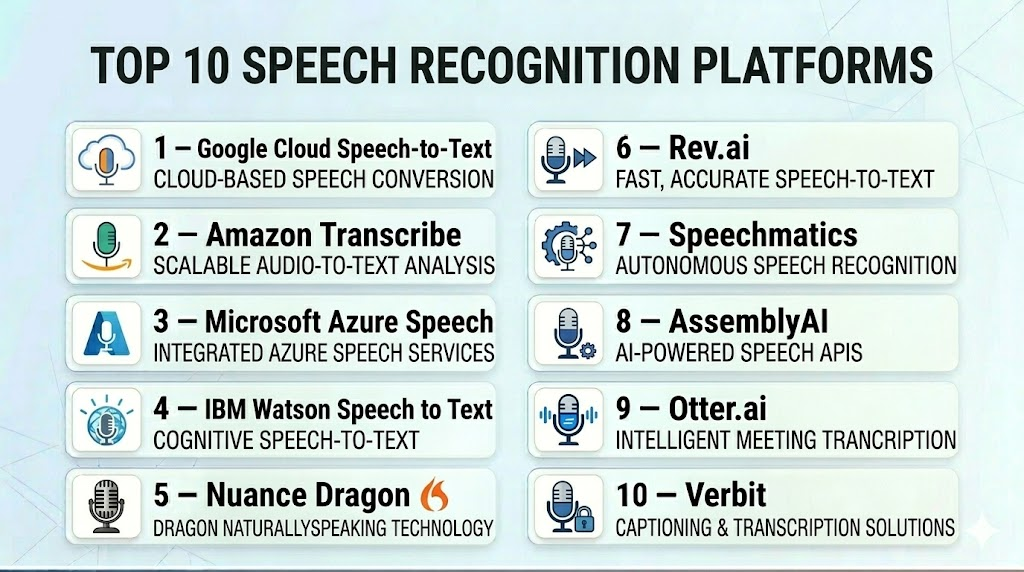
Top 10 Speech Recognition Platforms
#1 — Google Cloud Speech-to-Text
Short description : Google Cloud Speech-to-Text converts audio into text using advanced deep learning models. Suitable for enterprises needing scalable, cloud-based transcription.
Key Features
- Real-time and batch transcription
- Multi-language and dialect support
- Speaker diarization and punctuation
- Noise robustness and streaming API
- Custom model training
- Integration with Google Cloud AI services
Pros
- Highly accurate and scalable
- Cloud-native and flexible
- Supports complex audio scenarios
Cons
- Cloud-only deployment
- Costs scale with usage
- Requires Google Cloud familiarity
Platforms / Deployment
- Web
- Cloud
Security & Compliance
- GDPR, SOC 2
- Encryption and access control
Integrations & Ecosystem
- Google Cloud APIs
- ML pipeline integration
- REST and Python SDK
Support & Community
Enterprise support, documentation, and tutorials.
#2 — Amazon Transcribe
Short description : Amazon Transcribe provides real-time and batch speech recognition for audio and video files. Ideal for call centers, transcription, and voice analytics.
Key Features
- Real-time and batch transcription
- Custom vocabulary and domain adaptation
- Speaker identification
- Medical transcription capabilities
- API integration with AWS ecosystem
Pros
- High accuracy with AWS scalability
- Pre-built models for medical and call center use
- Easy API-based integration
Cons
- Cloud-only deployment
- Pricing may be high for large volumes
- Customization requires expertise
Platforms / Deployment
- Web
- Cloud
Security & Compliance
- HIPAA, SOC 2
- Encryption and IAM
Integrations & Ecosystem
- AWS services (S3, Lambda, Comprehend)
- Python SDK, REST API
- Integration with analytics and ML pipelines
Support & Community
AWS enterprise support and tutorials.
#3 — Microsoft Azure Speech
Short description : Azure Speech provides transcription, translation, and speaker recognition services. Suited for businesses leveraging Microsoft’s ecosystem.
Key Features
- Real-time and batch transcription
- Custom speech models
- Speaker identification and diarization
- Multi-language support
- API for integration with Power Platform
Pros
- Enterprise-grade cloud platform
- High customization and multi-language support
- Integration with Microsoft ecosystem
Cons
- Cloud-dependent
- Subscription pricing
- Advanced features require Azure experience
Platforms / Deployment
- Web
- Cloud
Security & Compliance
- GDPR, HIPAA, SOC 2
- Encryption and RBAC
Integrations & Ecosystem
- Python SDK, REST API
- Azure ML and Power Platform
- Edge device support
Support & Community
Enterprise support, onboarding guides, and tutorials.
#4 — IBM Watson Speech to Text
Short description : IBM Watson Speech to Text provides AI-driven transcription for audio and video files. Suitable for enterprises with regulatory compliance requirements.
Key Features
- Real-time and batch transcription
- Custom language models
- Speaker diarization
- Multi-domain support (call centers, healthcare)
- API integration
Pros
- Enterprise-grade accuracy
- Privacy and compliance features
- Integration with IBM Cloud
Cons
- Cloud-focused
- Subscription pricing
- Learning curve for new users
Platforms / Deployment
- Web
- Cloud / Hybrid
Security & Compliance
- HIPAA, SOC 2
- Encryption and audit logs
Integrations & Ecosystem
- IBM Cloud APIs
- Python SDK, REST API
- ML pipeline connectors
Support & Community
Enterprise support, documentation, and community forums.
#5 — Nuance Dragon
Short description : Nuance Dragon specializes in accurate speech recognition for healthcare, legal, and professional documentation.
Key Features
- Domain-specific vocabularies
- Real-time dictation
- Speaker-independent recognition
- Integration with EMR systems
- API for automation
Pros
- Highly accurate for professional domains
- Mature product with strong enterprise adoption
- Custom vocabularies
Cons
- Expensive licensing
- Limited cloud deployment options
- Setup complexity
Platforms / Deployment
- Windows / macOS
- On-prem / Hybrid
Security & Compliance
- HIPAA, SOC 2
- Encryption and RBAC
Integrations & Ecosystem
- EMR systems
- APIs and SDKs for workflow automation
Support & Community
Enterprise support, knowledge base, and training.
#6 — Rev.ai
Short description : Rev.ai provides speech-to-text services for call centers, video, and transcription applications. Supports real-time and batch processing.
Key Features
- High-accuracy transcription
- Real-time streaming
- Speaker diarization
- API and SDK
- Multi-language support
Pros
- Fast and accurate transcription
- Easy API integration
- Scalable for high-volume workflows
Cons
- Cloud-only
- Subscription-based
- Limited customization
Platforms / Deployment
- Web
- Cloud
Security & Compliance
- SOC 2
- Encryption and access control
Integrations & Ecosystem
- REST API, Python SDK
- Integration with CRM and analytics tools
Support & Community
Professional support and documentation.
#7 — Speechmatics
Short description : Speechmatics offers transcription and language recognition services with support for multiple languages and accents.
Key Features
- Real-time and batch transcription
- Over 30 languages
- Accent recognition
- API for integration
- Custom vocabulary
Pros
- High multi-language accuracy
- Scalable and reliable
- Flexible API
Cons
- Cloud subscription required
- Limited offline support
- Complex custom models
Platforms / Deployment
- Web / Linux / Windows
- Cloud / Hybrid
Security & Compliance
- SOC 2, GDPR
- Encryption and access control
Integrations & Ecosystem
- Python SDK, REST API
- Integration with ML and analytics pipelines
Support & Community
Documentation, professional support, and tutorials.
#8 — AssemblyAI
Short description : AssemblyAI provides AI-powered speech-to-text and audio intelligence for transcription and analysis applications.
Key Features
- Real-time transcription
- Speaker identification
- Sentiment and entity extraction
- API-based integration
- Multi-language support
Pros
- Fast transcription with additional audio insights
- API-first design
- Easy integration with applications
Cons
- Cloud-only
- Pricing scales with volume
- Limited on-prem deployment
Platforms / Deployment
- Web
- Cloud
Security & Compliance
- SOC 2, GDPR
- Encryption and RBAC
Integrations & Ecosystem
- REST API, Python SDK
- Integration with analytics and ML pipelines
Support & Community
Documentation, support, and tutorials.
#9 — Otter.ai
Short description : Otter.ai offers AI-powered transcription for meetings, interviews, and lectures with real-time notes.
Key Features
- Real-time transcription
- Speaker identification
- Collaborative note-taking
- Multi-device support
- API access
Pros
- User-friendly and collaborative
- Fast transcription for meetings
- Multi-device synchronization
Cons
- Limited enterprise-level customizations
- Cloud subscription required
- Focused on meeting transcription
Platforms / Deployment
- Web / iOS / Android
- Cloud
Security & Compliance
- SOC 2, GDPR
- Encryption
Integrations & Ecosystem
- APIs for integration with conferencing tools
- Cloud storage integration
Support & Community
Documentation, tutorials, and support.
#10 — Verbit
Short description : Verbit provides AI-assisted transcription and captioning solutions for education, media, and enterprise communications.
Key Features
- Real-time transcription
- Automated captioning
- Speaker diarization
- API and SDK integration
- Multi-language support
Pros
- High accuracy with human review option
- Enterprise-ready for media and education
- Scalable and fast
Cons
- Cloud-only
- Pricing scales with usage
- Customization requires setup
Platforms / Deployment
- Web
- Cloud
Security & Compliance
- SOC 2, GDPR, HIPAA
- Encryption and RBAC
Integrations & Ecosystem
- Python SDK, REST API
- LMS and video platform integration
Support & Community
Enterprise support, onboarding, and documentation.
Comparison Table (Top 10)
| Tool Name | Best For | Platform(s) Supported | Deployment | Standout Feature | Public Rating |
|---|---|---|---|---|---|
| Google Cloud Speech-to-Text | Scalable cloud transcription | Web | Cloud | Pre-trained & custom models | N/A |
| Amazon Transcribe | Call centers and real-time | Web | Cloud | Streaming and batch transcription | N/A |
| Azure Speech | Microsoft ecosystem | Web | Cloud | Custom speech models | N/A |
| IBM Watson Speech | Enterprise compliance | Web | Cloud / Hybrid | Multi-domain recognition | N/A |
| Nuance Dragon | Healthcare and legal | Windows/macOS | On-prem / Hybrid | Domain-specific vocabularies | N/A |
| Rev.ai | Transcription & analytics | Web | Cloud | Real-time streaming | N/A |
| Speechmatics | Multi-language transcription | Web/Windows/Linux | Cloud / Hybrid | Accent recognition | N/A |
| AssemblyAI | Audio intelligence | Web | Cloud | Sentiment & entity extraction | N/A |
| Otter.ai | Meetings and lectures | Web/iOS/Android | Cloud | Collaborative transcription | N/A |
| Verbit | Education & media | Web | Cloud | AI-assisted transcription | N/A |
Evaluation & Scoring of Speech Recognition Platforms
| Tool Name | Core (25%) | Ease (15%) | Integrations (15%) | Security (10%) | Performance (10%) | Support (10%) | Value (15%) | Weighted Total |
|---|---|---|---|---|---|---|---|---|
| Google Cloud Speech-to-Text | 9 | 8 | 8 | 7 | 9 | 8 | 7 | 8.1 |
| Amazon Transcribe | 9 | 8 | 8 | 7 | 9 | 8 | 7 | 8.1 |
| Azure Speech | 9 | 8 | 8 | 7 | 8 | 8 | 7 | 8.0 |
| IBM Watson Speech | 8 | 7 | 7 | 7 | 8 | 7 | 7 | 7.5 |
| Nuance Dragon | 8 | 7 | 7 | 7 | 8 | 7 | 7 | 7.5 |
| Rev.ai | 8 | 7 | 7 | 7 | 8 | 7 | 7 | 7.5 |
| Speechmatics | 8 | 7 | 7 | 7 | 8 | 7 | 7 | 7.5 |
| AssemblyAI | 8 | 7 | 7 | 7 | 8 | 7 | 7 | 7.5 |
| Otter.ai | 7 | 8 | 7 | 7 | 7 | 7 | 7 | 7.3 |
| Verbit | 8 | 7 | 7 | 7 | 8 | 7 | 7 | 7.5 |
Which Speech Recognition Platforms Tool Is Right for You?
Solo / Freelancer
Otter.ai or Rev.ai for lightweight transcription and rapid adoption.
SMB
Google Cloud Speech-to-Text or AssemblyAI for scalable, cloud-native voice analytics.
Mid-Market
Amazon Transcribe, Azure Speech, or Speechmatics for multi-language support and integration with business pipelines.
Enterprise
Nuance Dragon, IBM Watson Speech, or Verbit for domain-specific, compliance-focused transcription solutions.
Budget vs Premium
Open-source or low-cost tools provide basic transcription; enterprise SaaS tools offer advanced features, accuracy, and integrations.
Feature Depth vs Ease of Use
Enterprise tools like Nuance Dragon provide extensive customization; Otter.ai offers simplicity for meeting transcripts.
Integrations & Scalability
Cloud-native platforms integrate with ML pipelines, conferencing, and storage solutions for scalable operations.
Security & Compliance Needs
Enterprise solutions provide encryption, audit logs, RBAC, and compliance with HIPAA, GDPR, and SOC 2.
Frequently Asked Questions (FAQs)
1. What pricing models are common?
SaaS platforms often use subscription-based or pay-per-minute pricing, while some open-source options are free.
2. How fast can teams onboard?
SaaS platforms offer guided onboarding; open-source tools require technical setup and configuration.
3. Can multiple users collaborate on transcriptions?
Yes, enterprise platforms offer role-based access, shared workspaces, and version control.
4. Are these platforms secure for sensitive audio data?
Enterprise solutions provide encryption, RBAC, audit logging, and compliance certifications; open-source requires configuration.
5. Do these tools support multiple languages?
Many support multiple languages and regional accents, critical for global operations.
6. Can they process real-time audio streams?
Yes, cloud-native platforms handle streaming data for live transcription and analytics.
7. Are pre-trained models included?
Yes, platforms include models for general speech, medical, legal, and domain-specific applications.
8. Can these platforms integrate with ML pipelines?
APIs and SDKs allow seamless integration with data pipelines, analytics tools, and MLOps workflows.
9. Do these tools support offline processing?
Some enterprise solutions support on-prem or hybrid deployments for offline use.
10. Can transcribed data be exported and reused?
Yes, APIs and export options allow integration with BI, CRM, or storage systems.
Conclusion
Speech Recognition Platforms are critical for enterprises seeking to leverage voice data for AI, analytics, and automation. Platforms like Google Cloud Speech-to-Text, Amazon Transcribe, and Azure Speech provide scalable, cloud-based solutions with robust APIs and multi-language support. Enterprise-focused tools such as Nuance Dragon and Verbit offer domain-specific accuracy and compliance features. Choosing the right platform depends on team size, data sensitivity, deployment needs, and integration with business workflows. Running pilot projects and testing API integration ensures maximum efficiency and ROI

Find Trusted Cardiac Hospitals
Compare heart hospitals by city and services — all in one place.
Explore Hospitals
Even a small speech-to-text error can change the meaning of a medical note, customer request, or business record. Teams should flag low-confidence results and allow users to quickly correct them before the data moves to another system. This can make speech recognition safer and more reliable in real-world use.